T1 – Atomic Structure and the Periodic Table (CIE)
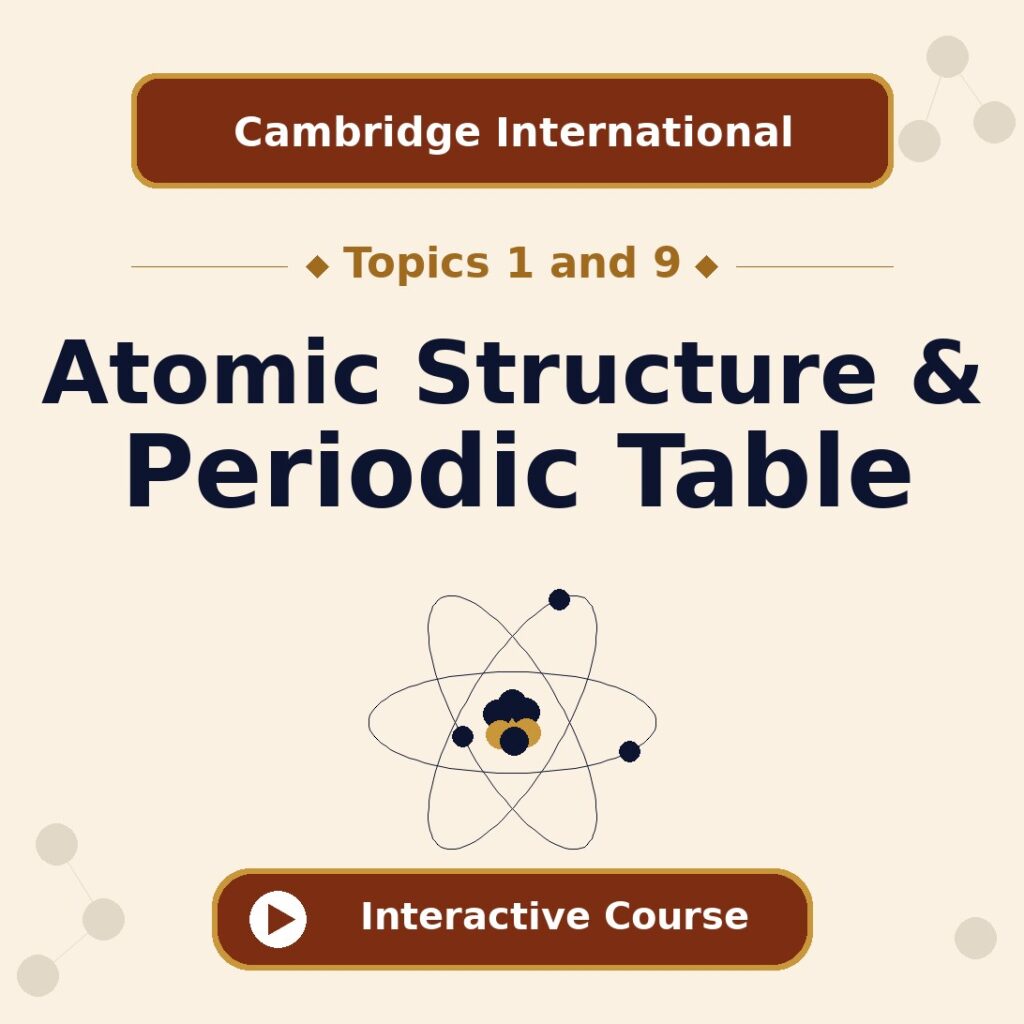
This course covers the particles in the atom and their behaviour in electric fields, isotopes and mass spectrometry, electron configuration up to krypton, ionisation energies and their trends, and the physical periodicity of Period 3 including atomic and ionic radii, aligned with Cambridge International AS Level Chemistry 9701 Topic 1 Atomic structure and Topic 9.1 […]
T3 – Ionic and Metallic Bonding (CIE)
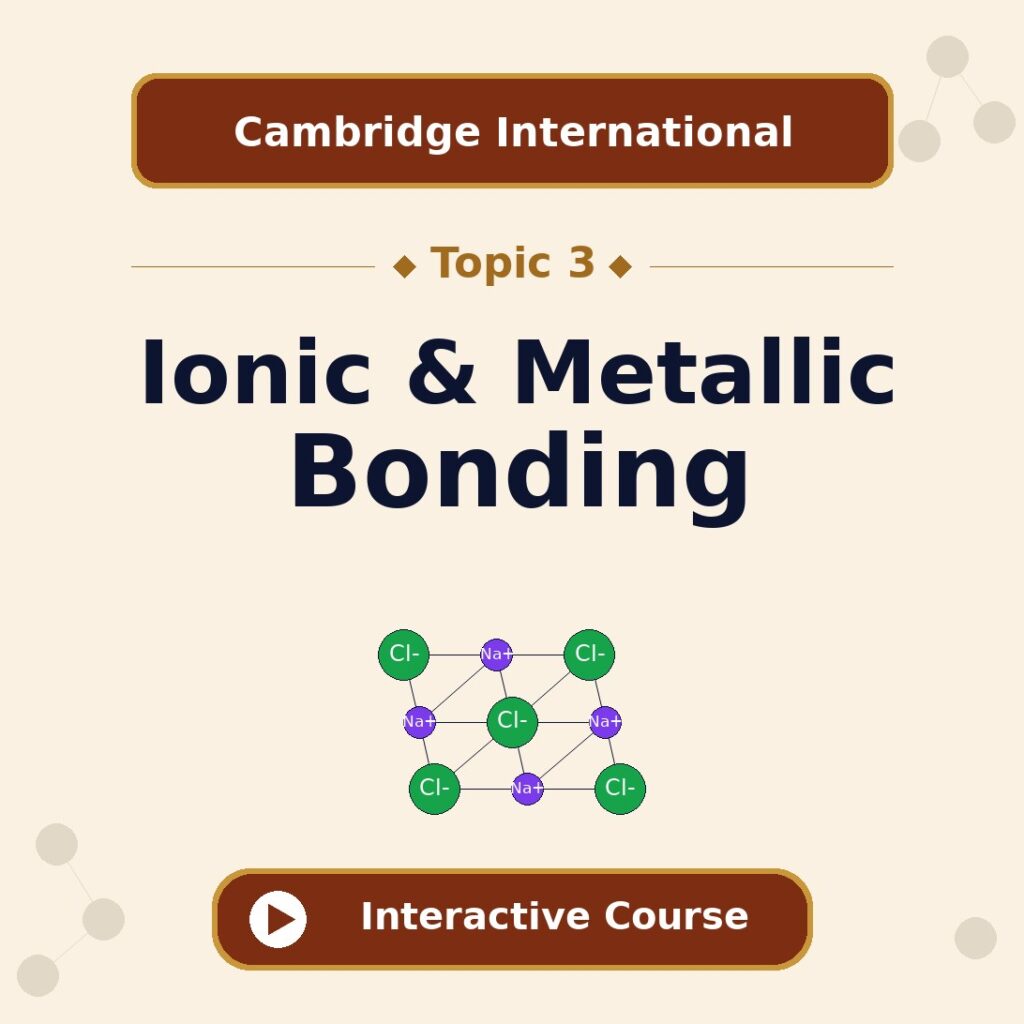
This course covers ionic bonding in sodium chloride, magnesium oxide and calcium fluoride, giant ionic lattices, polarisation and the properties of ionic compounds, metallic bonding, and the giant ionic, giant metallic, giant molecular and simple molecular lattices of Topic 4.2 with their properties, aligned with Cambridge International AS Level Chemistry 9701 Topics 3.2, 3.3, 3.7.1 […]
T3 – Covalent Bonding and Shapes (CIE)
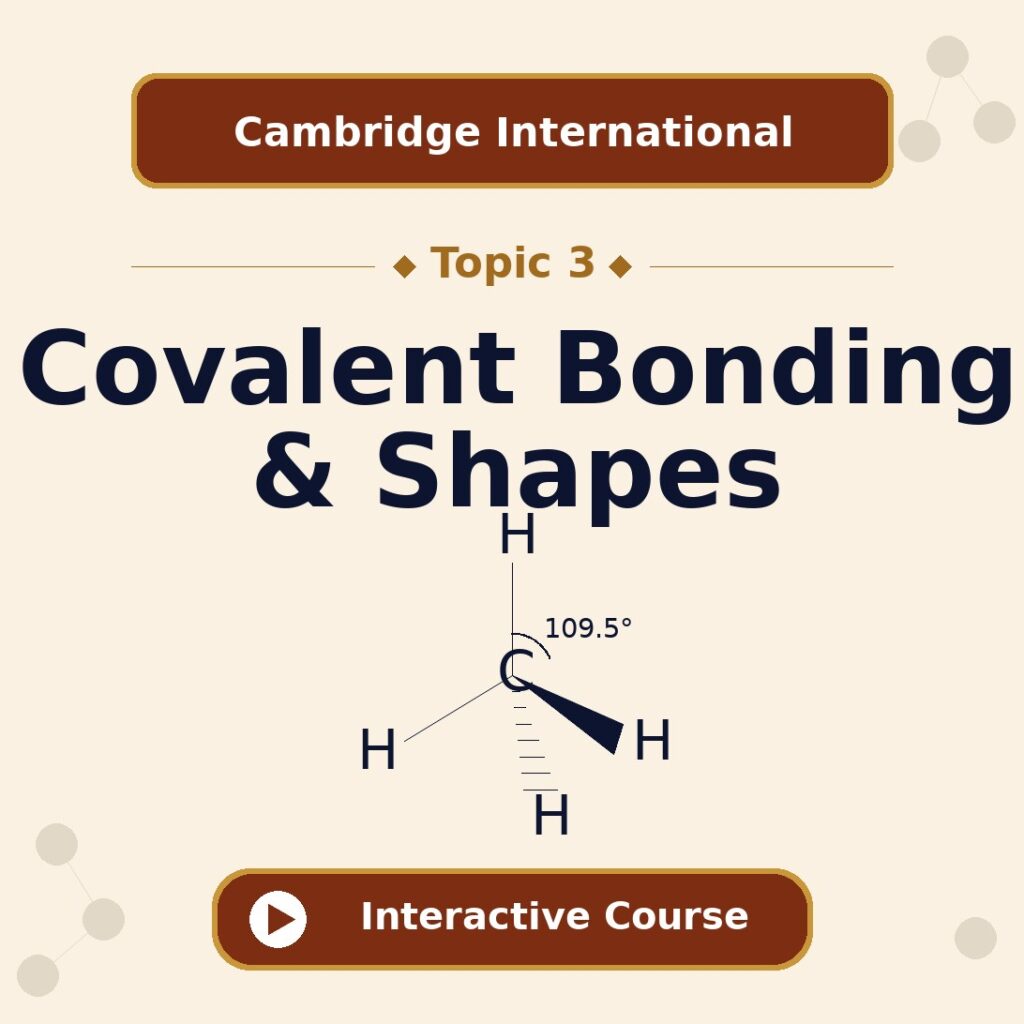
This course covers electronegativity, covalent bonding with sigma and pi bonds, dative bonding, giant covalent structures, the shapes and bond angles of molecules by VSEPR theory, and polar molecules, aligned with the covalent-bonding, shapes and electronegativity outcomes of Cambridge International AS Level Chemistry 9701 Topic 3 and 4.2.
T13-14.1 – Intro to Organic and Alkanes (CIE)
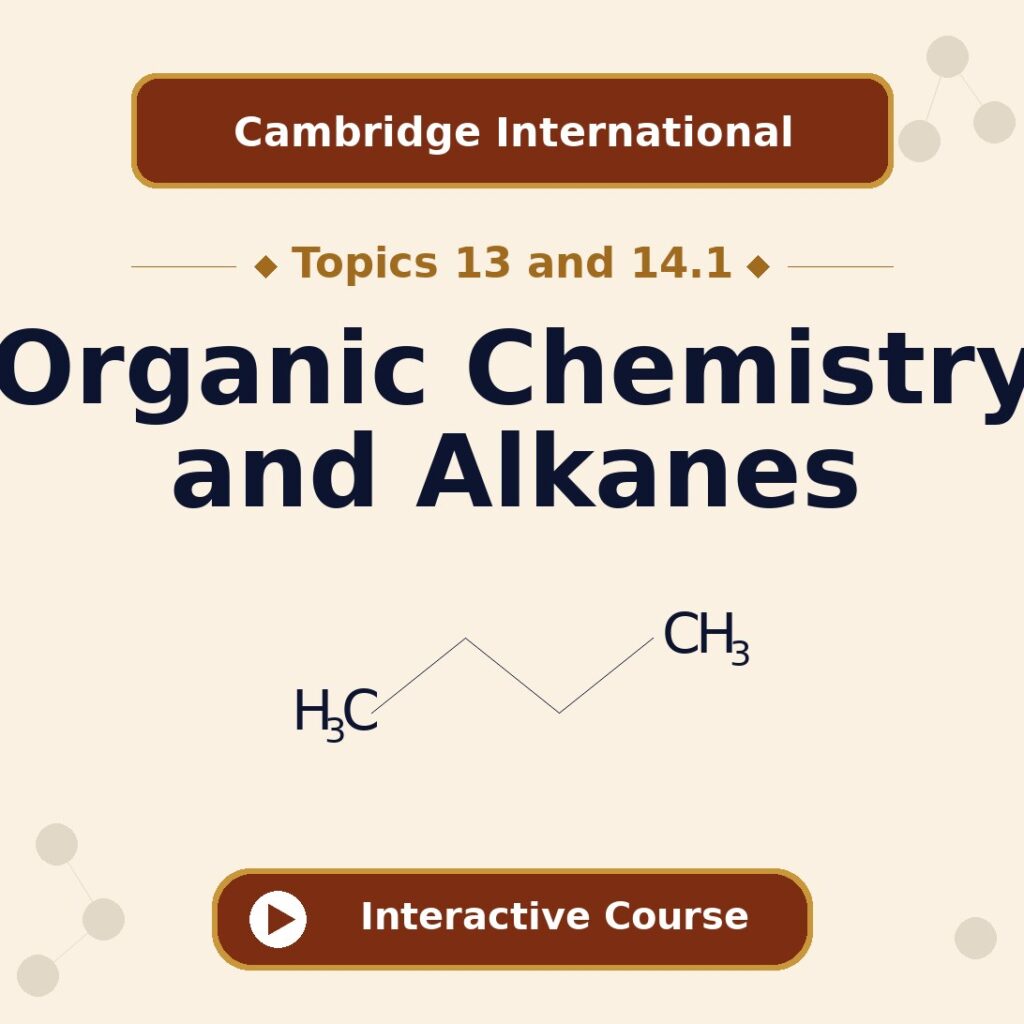
This course covers the introduction to AS Level organic chemistry and the chemistry of alkanes: formulae, functional groups and nomenclature, the terminology of reactions and mechanisms, shapes of organic molecules, structural and stereoisomerism, and the production, combustion and free-radical substitution of alkanes, aligned with Cambridge International AS Level Chemistry 9701 Topic 13 and Topic 14.1.
T14.2 – Alkenes (CIE)
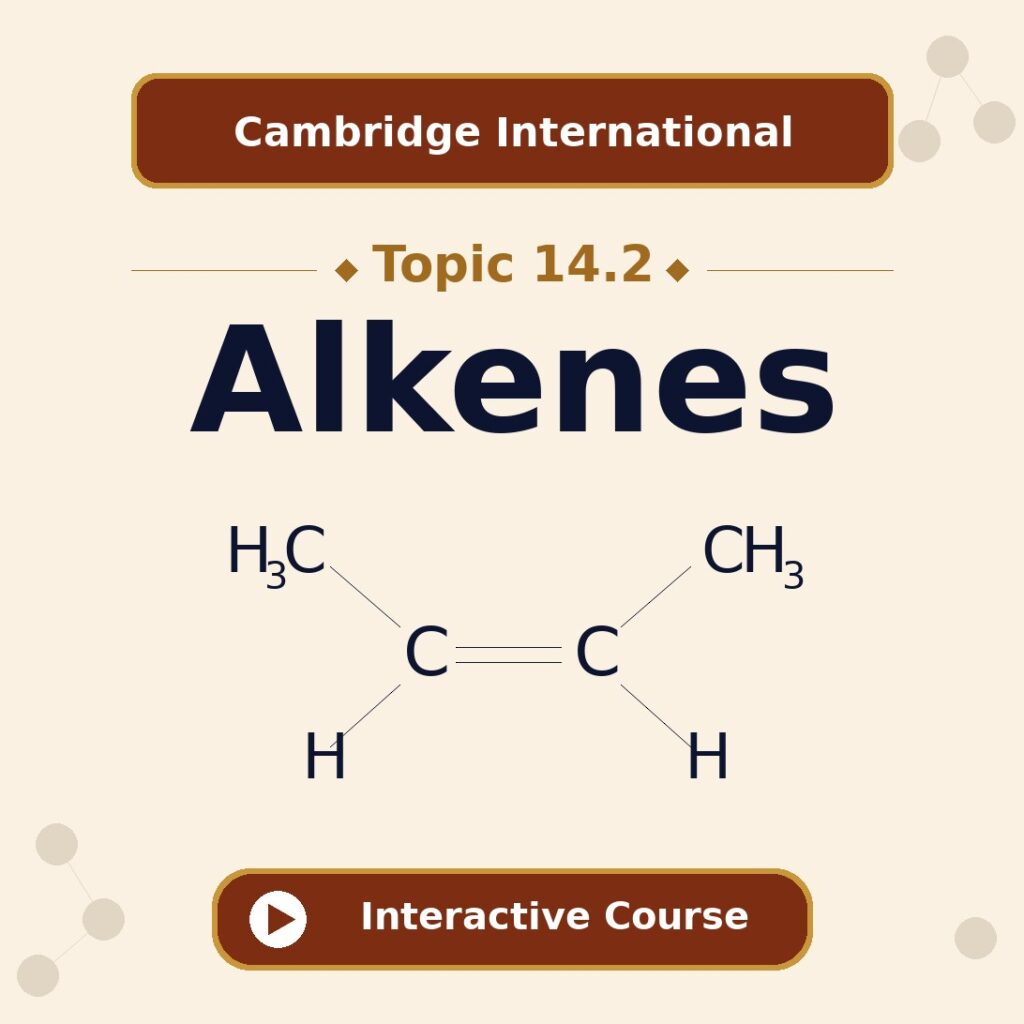
This course covers the production, bonding and reactivity of alkenes, including cis/trans isomerism, electrophilic addition and Markovnikov addition, oxidation by potassium manganate(VII), addition polymerisation and polymer waste, aligned with Cambridge International AS Level Chemistry 9701 Topic 14.2 Alkenes together with the related learning outcomes in Topics 13 and 20.