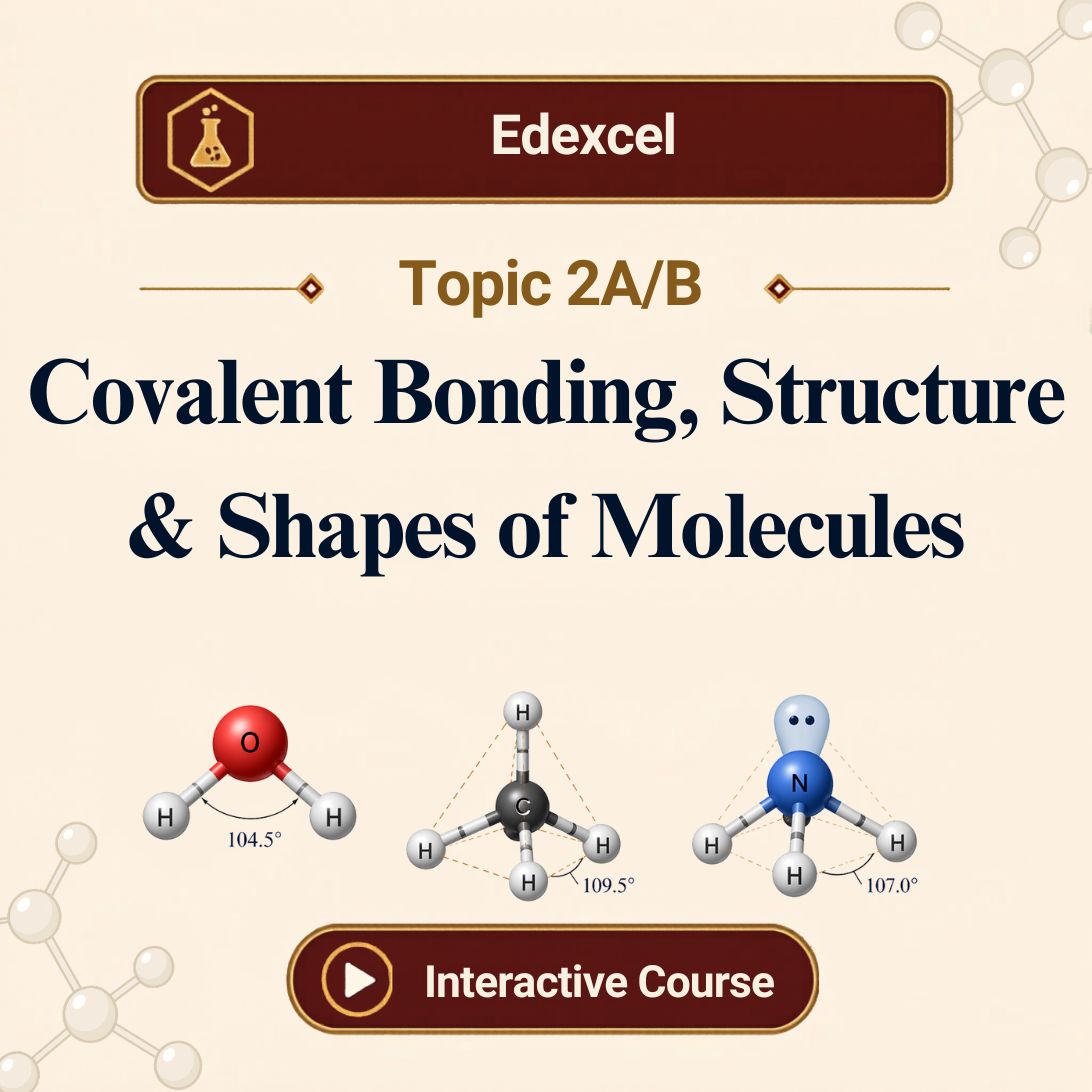
Covalent Bonding, Structure and Shapes of Molecules – Topic 2A/B

£10.20

Taught in full. 281 minutes of video.

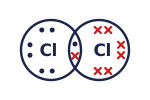
  1. A dot-and-cross diagram of Cl₂: three lone pairs on each atom and the shared pair, one dot and one cross, in the overlap
    Covalent Bonding78 min
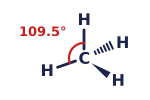
  2. Methane drawn as a tetrahedron with a wedge and a hashed bond, the bond angle 109.5° marked in red
    Shapes of Molecules121 min
  3. An exam page with a bent water molecule, two lone pairs on oxygen, a red tick and a pencil
    Exam Practice82 min
A laptop playing a lesson
  1. Watch
  2. Pause and try the exam question
  3. Check the worked answer

Watch a minute of the lessons.

Short clips cut from the course itself.

  1. Dot-and-cross diagrams from the group number

  2. What a dative bond needs

  3. One lone pair squeezes the bonds

  4. Is sulfur dioxide polar?

  • 14hoursguided learning
  • 281minof video lessons
  • 94MCQ marks
  • 180SAQ marks
Full details of the lessons and hours

Covalent Bonding, Structure and Shapes of Molecules Topic 2A/2B

The Topic 2A/2B course on Edexcel A Level Chemistry provides approximately 14 hours of guided learning. Students work through three recorded video lessons, 94 marks of auto-marked MCQ practice, 180 marks of teacher-marked written questions, and a personalised spec-point progress report.

Guided Learning
14 Hours
total study time
Video Lessons
281 mins
3 recorded lessons
MCQ Assessments
94 Marks
5 quizzes
SAQ Assessments
180 Marks
6 quizzes

How the 14 guided learning hours are worked out

Guided learning hours are calculated from the actual contents of the course, not estimated.

Video time is counted at its true running length, MCQs at 1.5 minutes per question, written answers at 1.5 minutes per mark, and time is allowed for reading the feedback returned on every quiz.

ComponentTime
Virtual lesson video281 min
MCQ practice (94 questions × 1.5 min)141 min
MCQ feedback review (5 quizzes × 10 min)50 min
SAQ practice (180 marks × 1.5 min)270 min
SAQ feedback review (6 quizzes × 15 min)90 min
Total832 min ≈ 14 hours

The three recorded lessons

The virtual lesson is delivered as three recorded lessons totalling 281 minutes. Students pause during exam-practice sections, attempt questions independently, then review the worked explanations and the mark-scheme approach.

LessonRunning time
1. Covalent Bonding78 min
2. Shapes of Molecules121 min
3. Exam Practice82 min
Total video281 min
At a glance

What you get in this course

281 minutes of guided video

Three recorded lessons covering Topic 2A and Topic 2A in full, with worked exam questions and mark-scheme strategy built into the teaching.

94 marks of MCQ practice

5 auto-marked quizzes of 17–21 questions each, with diagnostic feedback on every option. One attempt per quiz, so your scores track real progress.

180 marks of written practice

6 written-answer quizzes (78 questions) marked by a specialist chemistry teacher, assisted by KASP, with per-mark feedback returned the following Monday.

Spec-point coverage

36 Edexcel A level spec points are assessed in this course, every one of them in both question styles.

Exam-technique baked in

The lessons teach the chemistry and the exam wording. You learn what Edexcel actually rewards, not just the content.

Personalised progress report

A one-click PDF report shows your level on every spec point in colour-coded form.

See exactly where your marks are lost.

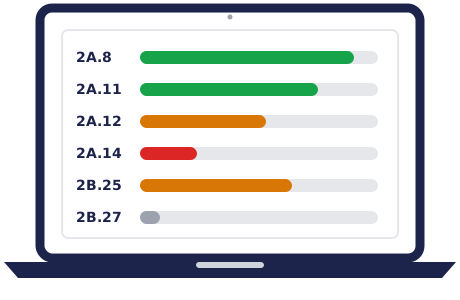
An example KASP report: six of this course's spec points, each with a coloured score bar
One-click progress report
  • Secure 70%+
  • Developing 40–69%
  • Weak below 40%
  • Not yet assessed
  • Every question tagged to a spec point
  • Updates after every quiz
  • 36 of 69 spec points covered

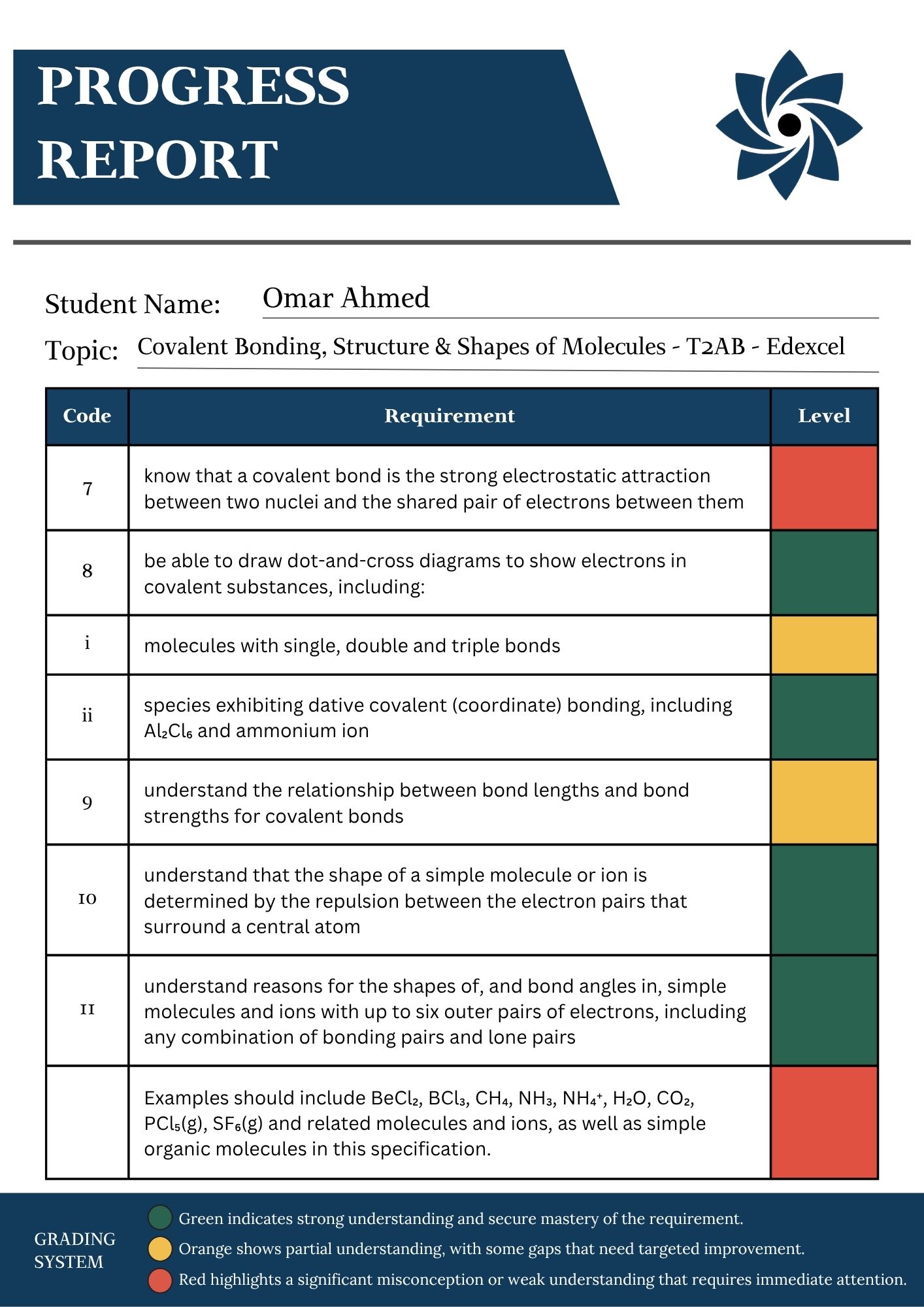
Your report, spec point by spec point.

An example of the colour-coded report for this topic.

A Level Chemistry progress report for Covalent Bonding, Structure and Shapes of Molecules showing student performance across specification points with colour coded levels for understanding
Full details of KASP Analytics

What is KASP Analytics?

KASP (Knowledge Analytics & Spec-point Platform) tracks your progress at the level of individual specification points, not just whole quizzes.

Every question on this course is mapped to the Edexcel A level spec point it assesses, so you always know exactly which parts of the specification you have mastered and which need another look.

Spec points tracked
36
Specification area
Topic 2A/2B: Bonding and Structure
Questions tagged
172
36 spec points assessed in this course

Shared with the Ionic & Metallic course (13 more points). Intermolecular forces (2A.16–2A.21) have their own course; 2B.24 and 2B.26-a are not yet assessed.

Across the 94 MCQ and 78 SAQ questions here, most of those spec points are assessed several times over, in both question styles.

Your topic dashboard

Every topic you have worked through is summarised here. At a glance you see how many questions you have attempted, what is still waiting to be marked, your total marks scored, and an overall score percentage.

The dashboard below is an example, filled with the real topic structure of this course.

Hello, Sara – here is how you are doing

Edexcel A level Chemistry
TopicQuestions attemptedPendingMarks (scored / available)Score
Topic 2A: Covalent Bonding22 / 28436.00 / 50.0072%
Topic 2A: Shapes of Molecules19 / 26527.50 / 46.0060%

Spec-point breakdown for a topic

Click into any topic and you see the full spec-point breakdown. Each row is a single Edexcel A level spec point with its official wording, how many questions the bank holds against it, your score, and a colour that tells you immediately where to focus.

The spec points and question counts below are the real ones from this course; the scores are an example.

Spec tagDescriptionAttemptedIn bankMarksScore
2A.8iibe able to draw dot-and-cross diagrams to show electrons in covalent substances, including: species exhibiting dative covalent (coordinate) bonding, including Al2Cl6 and ammonium ion4 / 4118.00 / 8.00100.0%
2A.10-aunderstand that the shape of a simple molecule is determined by repulsion between electron pairs around a central atom5 / 5109.00 / 11.0081.8%
2A.11-dunderstand reasons for the shape of, and bond angles in, NH33 / 3125.00 / 6.0083.3%
2A.11-eunderstand reasons for the shape of, and bond angles in, NH4+4 / 4106.00 / 9.0066.7%
2A.11-funderstand reasons for the shape of, and bond angles in, H2O5 / 5137.00 / 12.0058.3%
2A.15-bbe able to predict whether or not a given molecule is likely to be polar3 / 4234.00 / 8.0050.0%
2B.25-bknow the structure of diamond2 / 352.00 / 7.0028.6%
2B.25-cknow the structure of graphene0 / 35–Not yet attempted
■ Green 70–100%: secure mastery■ Orange 40–69%: some gaps■ Red 0–39%: needs attention■ Grey: not yet assessed

Printable progress report

One click and you can download a clean, branded Progress Report PDF for the topic. Useful for your own revision folder, for parents to see at a glance, or for tutors to plan focused sessions.

Every spec point in the topic appears with its code and full requirement text, and the level column is colour-coded green through red.

A Level Chemistry progress report for Covalent Bonding, Structure and Shapes of Molecules showing student performance across specification points with colour coded levels for understanding
At a glance

What you get with KASP Analytics

Spec-point level tracking

Every question is tagged to the exact Edexcel A level spec point it assesses, so your scores roll up cleanly to the specification.

Updates automatically

Submit a quiz and your dashboard updates right away. Short-answer questions appear as pending until they have been marked.

Built for Edexcel A level

Wording, codes and topic structure follow the Edexcel A Level Chemistry specification exactly, so your scores line up with the document you will be examined on.

Printable report

One-click PDF Progress Report per topic, in the same colour system, ready for your folder or for a tutor session.

Both question styles counted

MCQ and written answers feed the same spec point. With 94 MCQ and 78 SAQ questions tagged, a weak area shows up whether you miss it under multiple choice or in writing.

Progress over time

A simple line chart shows how your overall score has trended across the days you have been studying.

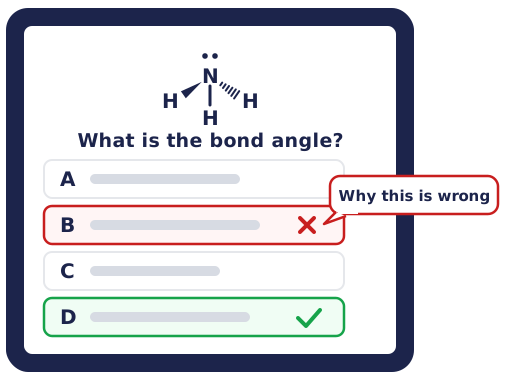
94 exam questions. Feedback on every option.

A multiple-choice question asking for the bond angle in ammonia, drawn with its lone pair, a wedge and a hashed bond, with the wrong option B showing why it is wrong and the right option D ticked
Feeds your KASP report
  • 5quizzes
  • 17–21questions each
  • 1attempt per quiz

A real question. Marked, as you see it.

Question 20 of MCQ (A), answered: why the wrong answer is wrong, and the right one ticked.

Question 20Wrong · 0/1

Solid phosphorus(V) chloride contains the PCl₄⁺ ion.

The shape of this ion is

  • A

    tetrahedral

    Correct answer
  • B

    trigonal bipyramidal

    Your answer
  • C

    square planar

  • D

    trigonal pyramidal

About your answer

Incorrect. That is the shape of the neutral PCl₅ molecule, which has five bonding pairs. Removing a chloride and the associated electron leaves PCl₄⁺ with only four pairs.

The correct answer is: tetrahedral

Explanation

For an ion, adjust the central atom’s electron count for the charge before counting pairs.

  • Phosphorus has five outer electrons; the + charge removes one, leaving four, each shared with a chlorine. That is four bonding pairs and no lone pairs – tetrahedral, 109.5°, the same as NH₄⁺.

  • Trigonal bipyramidal belongs to neutral PCl₅, with five bonding pairs.

  • Square planar needs six pairs with two lone pairs.

  • Trigonal pyramidal needs a lone pair, which the positive charge has removed.

Therefore the correct answer is tetrahedral.

MCQ (A) is free: take it on the website, marked straight away.

Full details of the MCQ Bank

What is the MCQ Bank?

The MCQ Bank for Topic 2A/2B is an auto-marked, instant-feedback practice engine of original questions written at real Edexcel A level exam difficulty. It runs to 5 quizzes, 94 questions and 94 marks.

Every question is tagged to a specific Edexcel A level spec point, every option carries diagnostic feedback explaining the chemistry, and every quiz attempt feeds directly into your KASP Analytics dashboard.

Quizzes
5
Questions
94
Marks
94
Attempts
1 per quiz

Try a Topic 2A/2B MCQ from the bank

This is an original question from the bank, shown exactly as it appears in the course. Click any option to reveal the diagnostic feedback for that choice, then expand the panel at the bottom for the full walkthrough.

Evidence that a molecule with polar bonds is non-polar

2A.15-b (Edexcel A level)1 mark

A molecule AB₃ has a central atom A bonded to three B atoms. Each A−B bond is polar.

Which extra piece of information shows that AB₃ is not a polar molecule?

Click an option to see feedback

AAll three B−A−B bond angles are 120°.
Correct

Correct. 120° angles mean the molecule is flat, with the three bonds pointing to the corners of a triangle and no lone pair on A. Three identical dipoles at 120° to each other cancel, so the molecule is non-polar, like BCl₃.

BAll three B−A−B bond angles are 107°.
Incorrect

Incorrect. 107° angles mean a pyramidal molecule with a lone pair on A, like NH₃. The three dipoles all tilt the same way and do not cancel, so the molecule is polar.

CA is more electronegative than B.
Incorrect

Incorrect. This only tells us the direction of each bond dipole. Whether the dipoles cancel depends on the shape, not on which atom is more electronegative.

DAll three A−B bonds are the same length.
Incorrect

Incorrect. Equal bonds are needed for cancelling, but they are not enough on their own. A pyramidal molecule such as NH₃ also has three equal bonds and is polar.

Show correct answer & full explanation →
General feedback

A molecule with polar bonds is non-polar only if its shape makes the bond dipoles cancel.

  • Trigonal planar (120°): three equal dipoles cancel, non-polar.
  • Pyramidal (107°): a lone pair, dipoles do not cancel, polar.

The correct answer is all three B−A−B bond angles are 120°.

5 quizzes, 94 marks of MCQ practice

The MCQ Bank is split across the two halves of the topic. Quizzes hold 17–21 questions worth one mark each, and each quiz is a single auto-marked attempt.

Because every spec point is tested across several quizzes, your KASP scores reveal real improvement as you work through them.

Topic 2A: Covalent Bonding

3 quizzes · 52 marks
MCQ A
18
questions & marks
MCQ B
17
questions & marks
MCQ C
17
questions & marks

Topic 2A: Shapes of Molecules

2 quizzes · 42 marks
MCQ A
21
questions & marks
MCQ B
21
questions & marks
94 total marks94 questions in totalOne attempt per quizAuto-marked on submit
At a glance

What you get with the MCQ Bank

94 marks across 5 quizzes

3 quizzes on Covalent Bonding and 2 on Shapes of Molecules, 17–21 questions each, giving balanced coverage across the whole topic.

Instant auto-marking

Submit and the result is back in your hands inside a second. No waiting, no manual checking.

Diagnostic feedback per option

Every wrong option carries a tailored explanation of the misconception, not just a generic ‘incorrect’, plus a full walkthrough on every question.

Spec-point tagged

Each question is mapped to the Edexcel A level spec point it assesses, so your score flows straight into KASP Analytics.

Track improvement across quizzes

One attempt per quiz, but the same spec points appear across the set. Your scores from quiz to quiz show real progress, not repeat-attempt inflation.

Original questions

Every MCQ is an original question written at real exam difficulty, with the chemistry checked.

Marked by a teacher. Assisted by KASP.

KASP drafts the marks
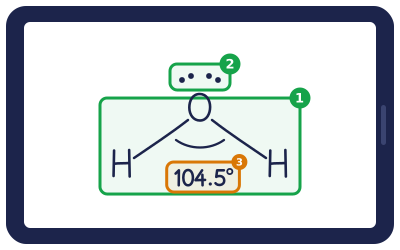
A student's handwritten water molecule on a tablet: the bent shape boxed green, the two lone pairs on oxygen boxed green, and the bond angle 104.5° boxed in orange
Teacher decides every mark
  1. MonSubmit
  2. TueSubmit
  3. WedSubmit
  4. ThuSubmit
  5. FriSubmit
  6. Sat–SunTeacher + KASP mark
  7. MonFeedback back

Every SAQ is marked by a specialist chemistry teacher, assisted by KASP. One SAQ quiz is marked each week.

What you get back. Every mark explained.

A marked answer from this course, exactly as a student sees it.

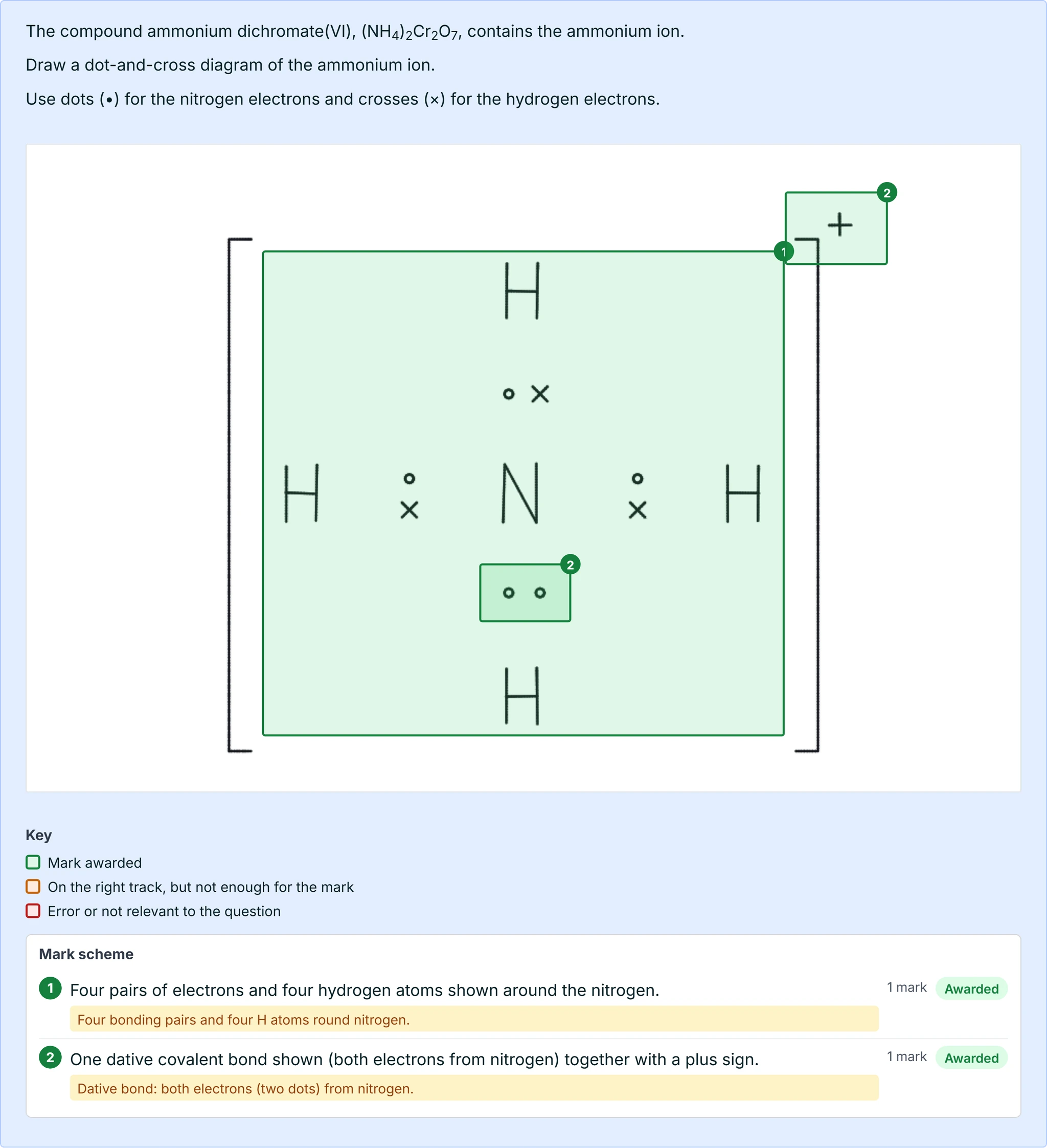
  1. SAQ (C) Topic 2A Covalent, Question 2: NH₄⁺Each marking point boxed on the student's own answer, with the worked answer and the teacher's comment.
    A marked drawing question, SAQ (C) Topic 2A Covalent Question 2: the student's dot-and-cross diagram of NH₄⁺ with the dative bond, each marking point boxed green, 2 out of 2, and the mark scheme
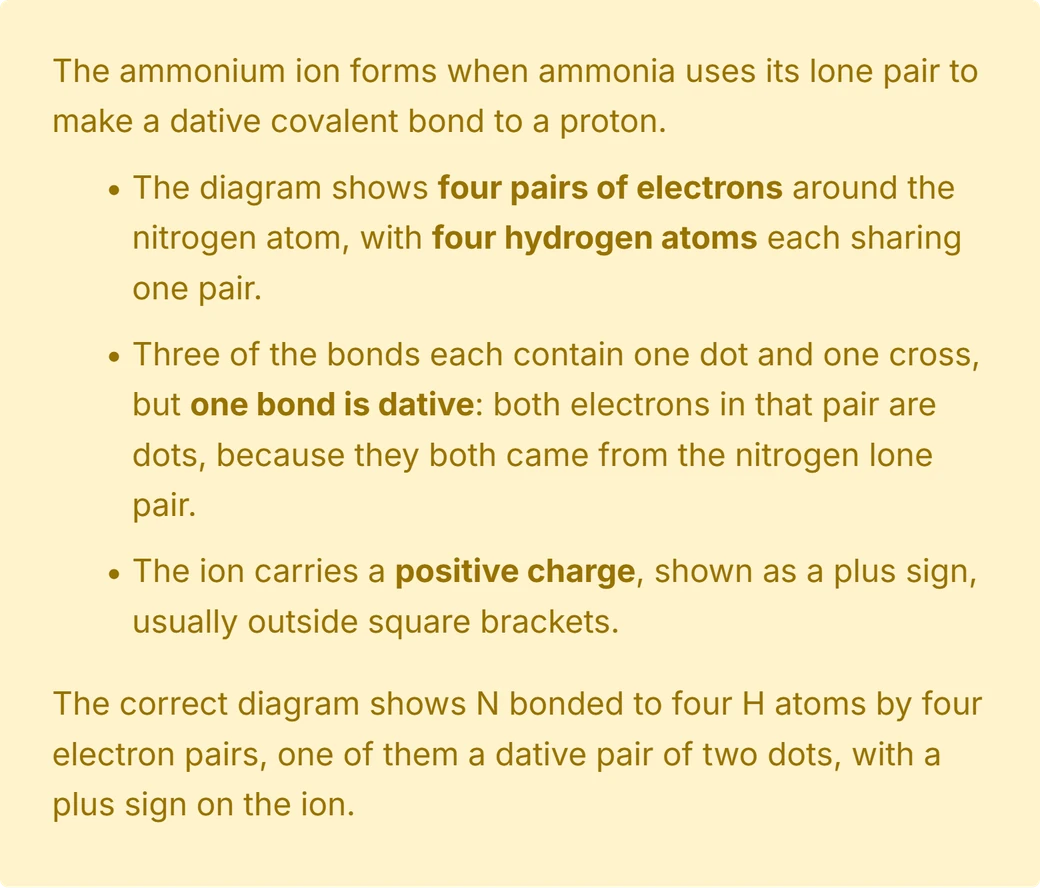
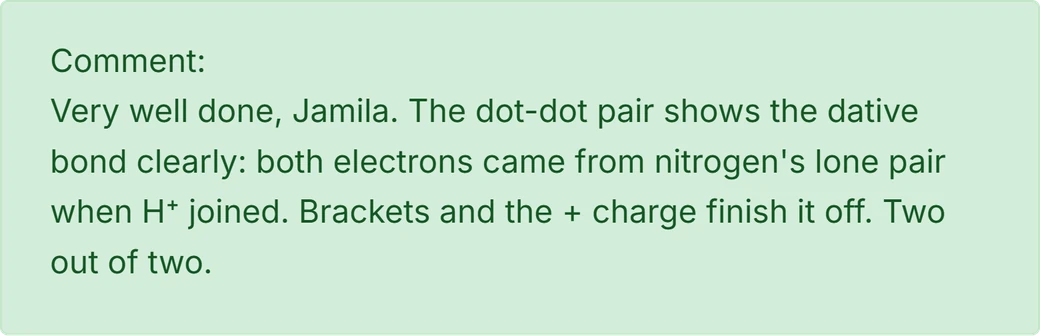
    The worked answer shown after markingThe teacher's comment to the student
  • 6quizzes
  • 78questions
  • 180marks
  • 1quiz marked each week

Not all writing. You draw and calculate too.

How the 78 questions split.

Written
57
Drawing
21
Full details of the SAQ Bank

What is the SAQ Bank?

The SAQ Bank for Topic 2A/2B is a written-answer practice engine marked by a specialist chemistry teacher, assisted by KASP. It runs to 6 quizzes, 78 questions and 180 marks.

You attempt one quiz per week, submit your full written response, and your teacher returns mark-by-mark feedback the following Monday. Every comment is targeted at the exam wording you need to use.

Quizzes
6
Questions
78
Marks
180
Marks per quiz
30

A submitted SAQ and the feedback it gets

This is an original question from the bank with its full mark scheme. The submitted answer below is an example of a typical response at this standard. Expand the panel to see how it was marked.

Bond angles and shapes of water and the oxonium ion

2A.11-f (Edexcel A level)4 marks

Oxonium salts contain the oxonium ion, H₃O+. This ion is formed when water forms a dative covalent bond with a proton.

Explain, using electron-pair repulsion theory, how the water molecule and the oxonium ion have different bond angles and shapes.

Submitted answer

In water the oxygen atom has two bonding pairs and two lone pairs, which makes the molecule bent with a bond angle of 104.5°.

In the oxonium ion the oxygen has three bonding pairs and one lone pair, so it is trigonal pyramidal with a bond angle of 107°.

View returned feedback →
Returned by your chemistry specialist3 / 4 · 75%
Mark scheme
Criterion
✓Bond angles: 104.5 degrees in water and 107 degrees in the oxonium ion.
Awarded – both angles quoted correctly, and to the precision the mark scheme expects.
✓Shapes: bent / V-shaped for water and (trigonal) pyramidal for the oxonium ion.
Awarded – both shapes named correctly.
✓Water has two bonded pairs (of electrons) plus two lone pairs and the oxonium ion has three bonded pairs plus one lone pair.
Awarded – the electron-pair counts are right for both species.
✗Lone pairs repel more (than bonded pairs, and water has more lone pairs, so the bond angle is smaller in water / the shape changes).
Not awarded. You gave the shapes and the angles but never said why they differ. The mark needs the repulsion argument: lone pairs repel more strongly than bonding pairs, and water has two lone pairs to the oxonium ion's one, so the bond angle in water is squeezed further.
Teacher comment

Three marks banked cleanly, Sara – the shapes, the angles and the electron-pair counts are all correct, which is more than most students manage on this question.

The mark you have missed is the one the question is really testing: it says ‘using electron-pair repulsion theory’, so the examiner wants the comparison, not just the description.

Add one sentence – lone pairs repel more than bonding pairs, and water has an extra lone pair, so its angle is smaller – and this is a full-mark answer.

A predictable weekly rhythm over 6 weeks

One quiz per week across the 6 quizzes, so the SAQ Bank runs as a 6-week programme. Submit anywhere from Monday to Friday, marking happens over the weekend, and you receive your feedback by the following Monday.

The rhythm is the same every week so you always know when to expect a return.

Mon
Submit
Tue
Submit
Wed
Submit
Thu
Submit
Fri
Submit
Sat
Marking
Sun
Marking
Mon
Returned

One attempt per quiz, one quiz submitted per week. Because the same spec points reappear across the 6 quizzes, your scores over the programme show real improvement – not repeat-attempt inflation.

The weekly cap also keeps the marking load manageable so your feedback stays thorough and detailed.

6 quizzes, 180 marks of written practice

The SAQ Bank holds 78 questions and 180 marks between its 6 quizzes.

Every quiz is worth 30 marks, and runs to between 11 and 16 questions depending on how the marks fall, with the parts of each multi-part question kept together in the same quiz.

Every question is original, written at real Edexcel A level exam difficulty, across the whole topic pair.

Topic 2A: Covalent Bonding

3 quizzes · 90 marks
SAQ A
30
marks · 14 questions
SAQ B
30
marks · 14 questions
SAQ C
30
marks · 16 questions

Topic 2A: Shapes of Molecules

3 quizzes · 90 marks
SAQ A
30
marks · 12 questions
SAQ B
30
marks · 11 questions
SAQ C
30
marks · 11 questions
180 total marks78 questions1 quiz per week, over 6 weeksReturned the following Monday

What the written questions ask you to do

The bank is not all prose. Alongside written explanations you are asked to draw structures and mechanisms and to work through calculations, all marked by a specialist chemistry teacher, assisted by KASP, against the same mark scheme.

Question styleQuestionsWhat it asks for
Written answer57Explanations, descriptions, equations and definitions, marked against the exam mark scheme point by point.
Drawing21Structural and displayed formulae, skeletal structures and mechanism steps, drawn on screen and marked by your teacher, assisted by KASP.
Total78
At a glance

What you get with the SAQ Bank

180 marks across 6 quizzes

3 quizzes on Covalent Bonding and 3 on Shapes of Molecules, holding 78 questions between them at 30 marks per quiz.

Marked by a teacher, assisted by KASP

KASP drafts the marking; your teacher reads your answer end to end, decides every mark and writes the comments.

Per-mark feedback

Every mark in the scheme is checked off explicitly. You see exactly which marks you earned and what wording the missed ones needed.

Predictable weekly turnaround

Submit by Friday, marked over the weekend, feedback returned by Monday. One quiz per week; one attempt per quiz; 6 weeks end to end.

Exam-board wording focus

Feedback teaches the precise language the Edexcel mark scheme rewards, so the next time the topic appears you write to score.

Feeds your KASP dashboard

Every SAQ is spec-point tagged. Once marked, your scores flow into KASP Analytics alongside your MCQ results.

36 of 69 spec points. Assessed.

Edexcel A Level Chemistry, Topic 2: Bonding and Structure (covalent bonding, shapes of molecules and structure).

13 more are assessed in the Ionic and Metallic Bonding and Structure course.

Not yet assessed: intermolecular forces (2A.16 to 2A.21, a separate course), 2B.24 and 2B.26-a.

2A Bonding

  • 2A.6Evidence for ions
  • 2A.7Covalent bonding
  • 2A.8Dot-and-cross diagrams
  • 2A.9Bond length and strength
  • 2A.10Electron-pair repulsion
  • 2A.11Shapes of molecules
  • 2A.12Predicting shapes
  • 2A.13Electronegativity
  • 2A.14Bonding continuum
  • 2A.15Polar bonds and molecules

2B Structure

  • 2B.23Giant lattices
  • 2B.25Graphite, diamond and graphene
  • 2B.26Predicting structure and bonding
  • 2B.27Predicting physical properties

Covalent Bonding, Structure and Shapes, for £10.20.

281 minutes of video, 94 MCQs, 180 SAQ marks marked by a teacher, assisted by KASP.

Add to basket
Every spec point, in full
Exam Board Alignment

Covalent Bonding, Structure & Shapes of Molecules Topic 2A/B Edexcel A Level Chemistry

This course covers the following Edexcel A Level Chemistry specification points. These are limited to covalent bonding, covalent structure, VSEPR theory and molecular shapes.

7
know that a covalent bond is the strong electrostatic attraction between two nuclei and the shared pair of electrons between them
8
be able to draw dot-and-cross diagrams to show electrons in covalent substances, including:
i
molecules with single, double and triple bonds
ii
species exhibiting dative covalent (coordinate) bonding, including Al₂Cl₆ and ammonium ion
9
understand the relationship between bond lengths and bond strengths for covalent bonds
10
understand that the shape of a simple molecule or ion is determined by the repulsion between the electron pairs that surround a central atom
11
understand reasons for the shapes of, and bond angles in, simple molecules and ions with up to six outer pairs of electrons, including any combination of bonding pairs and lone pairs
Examples should include BeCl₂, BCl₃, CH₄, NH₃, NH₄+, H₂O, CO₂, PCl₅(g), SF₆(g) and related molecules and ions, as well as simple organic molecules in this specification.
12
be able to predict the shapes of, and bond angles in, simple molecules and ions analogous to those specified above using electron-pair repulsion theory
13
know that electronegativity is the ability of an atom to attract the bonding electrons in a covalent bond
14
know that ionic and covalent bonding are the extremes of a continuum of bonding type and that electronegativity differences lead to bond polarity in bonds and molecules
15
understand that molecules with polar bonds may not be polar molecules and be able to predict whether or not a given molecule is likely to be polar
23
know that giant lattices are present in:
ii
covalently bonded solids, such as diamond, graphite and silicon(IV) oxide (giant covalent lattices)
24
know that the structure of covalently bonded substances such as iodine, I₂, and ice, H₂O, is simple molecular
25
know the different structures formed by carbon atoms, including graphite, diamond and graphene
26
be able to predict the type of structure and bonding present in a substance from numerical data and/or other information
27
be able to predict the physical properties of a substance, including melting and boiling temperature, electrical conductivity and solubility in water, in terms of:
i
the types of particle present, including atoms and molecules where relevant
ii
the structure of the substance
iii
the type of bonding and the presence of intermolecular forces, where relevant
Specification Coverage

Students will be assessed on their ability to:

The following specification points are limited to covalent bonding, covalent structure, VSEPR theory and molecular shapes.

7
know that a covalent bond is the strong electrostatic attraction between two nuclei and the shared pair of electrons between them
8
be able to draw dot-and-cross diagrams to show electrons in covalent substances, including:
i
molecules with single, double and triple bonds
ii
species exhibiting dative covalent (coordinate) bonding, including Al₂Cl₆ and ammonium ion
9
understand the relationship between bond lengths and bond strengths for covalent bonds
10
understand that the shape of a simple molecule or ion is determined by the repulsion between the electron pairs that surround a central atom
11
understand reasons for the shapes of, and bond angles in, simple molecules and ions with up to six outer pairs of electrons, including any combination of bonding pairs and lone pairs
Examples should include BeCl₂, BCl₃, CH₄, NH₃, NH₄+, H₂O, CO₂, PCl₅(g), SF₆(g) and related molecules and ions, as well as simple organic molecules in this specification.
12
be able to predict the shapes of, and bond angles in, simple molecules and ions analogous to those specified above using electron-pair repulsion theory
13
know that electronegativity is the ability of an atom to attract the bonding electrons in a covalent bond
14
know that ionic and covalent bonding are the extremes of a continuum of bonding type and that electronegativity differences lead to bond polarity in bonds and molecules
15
understand that molecules with polar bonds may not be polar molecules and be able to predict whether or not a given molecule is likely to be polar
23
know that giant lattices are present in:
ii
covalently bonded solids, such as diamond, graphite and silicon(IV) oxide (giant covalent lattices)
24
know that the structure of covalently bonded substances such as iodine, I₂, and ice, H₂O, is simple molecular
25
know the different structures formed by carbon atoms, including graphite, diamond and graphene
26
be able to predict the type of structure and bonding present in a substance from numerical data and/or other information
27
be able to predict the physical properties of a substance, including melting and boiling temperature, electrical conductivity and solubility in water, in terms of:
i
the types of particle present, including atoms and molecules where relevant
ii
the structure of the substance
iii
the type of bonding and the presence of intermolecular forces, where relevant
Complete Topic Package

Learn the content, practise exam questions, and identify exactly where marks are being lost.

This course combines guided video teaching, diagnostic MCQs, teacher-marked written assessment, and detailed specification reporting for Edexcel A Level Chemistry.

Exam-focused learning with clear performance feedback