Reactions of Alkenes
Alkenes react because the carbon-carbon double bond contains an electron-rich pi bond. These pages separate the key addition reactions and chemical tests so students can revise reagents, conditions, products and observations clearly.
Revision Notes
5 revision notes, in the order the specification teaches them.
Halogens
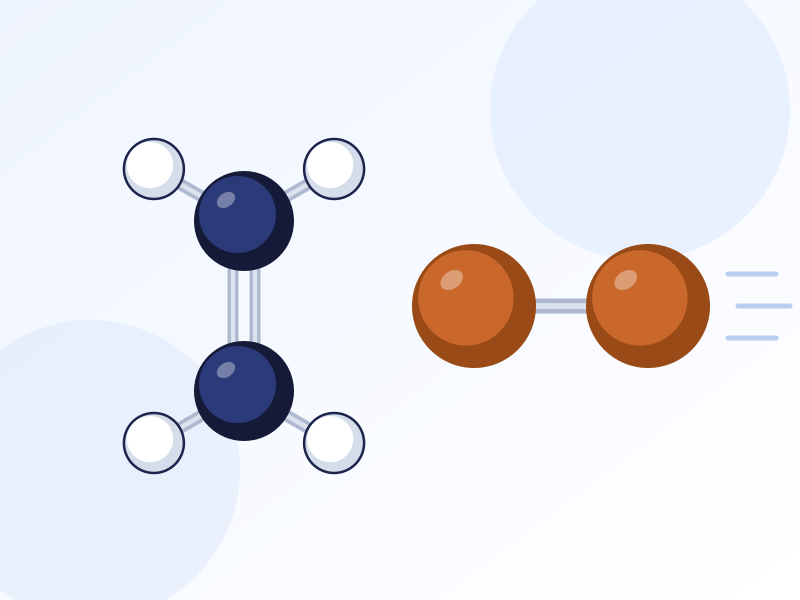
Revise the addition reactions of alkenes with halogens, including how the C=C bond reacts with Br₂ and Cl₂.
Start revising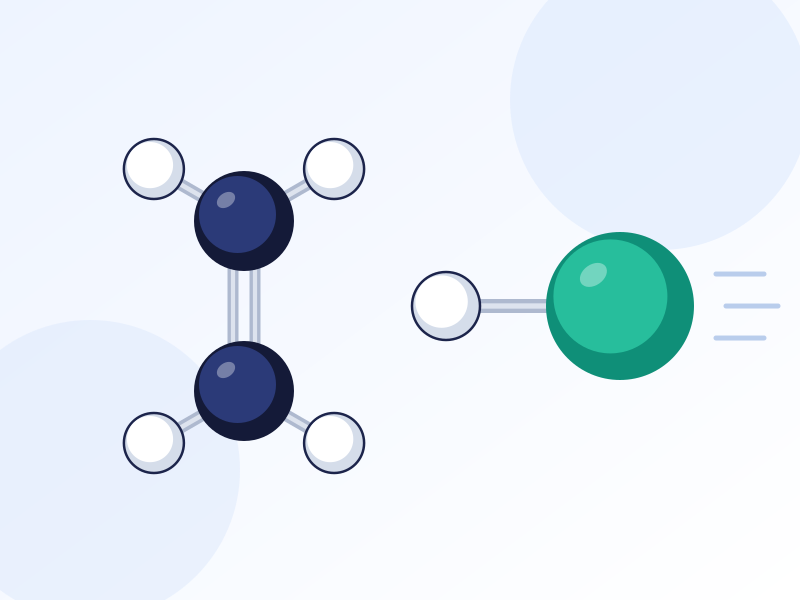
Hydrogen Halide
Learn how hydrogen halides add across the C=C bond and how major products can form with unsymmetrical alkenes.
Start revising
Bromine Water
Review the bromine water test for unsaturation, including the colour change from orange to colourless.
Start revising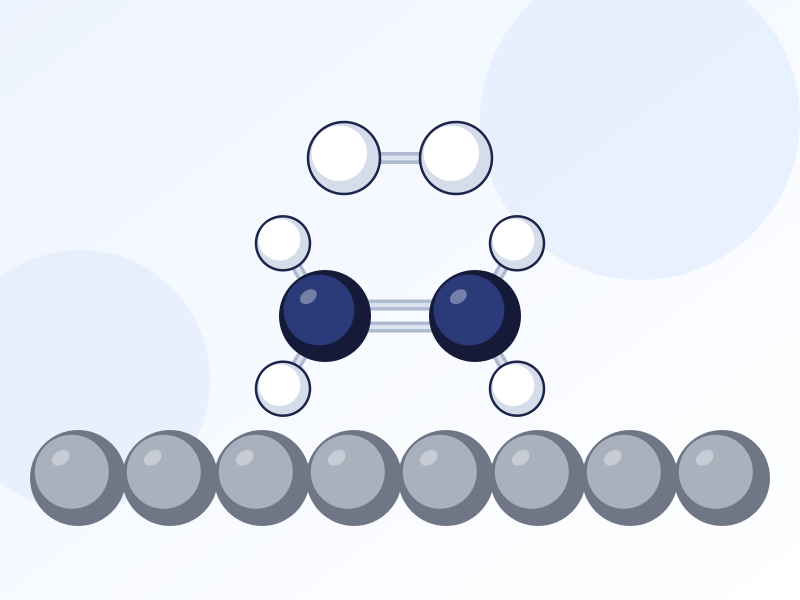
Hydrogen
Revise hydrogenation of alkenes, including conversion to alkanes using a nickel catalyst.
Start revising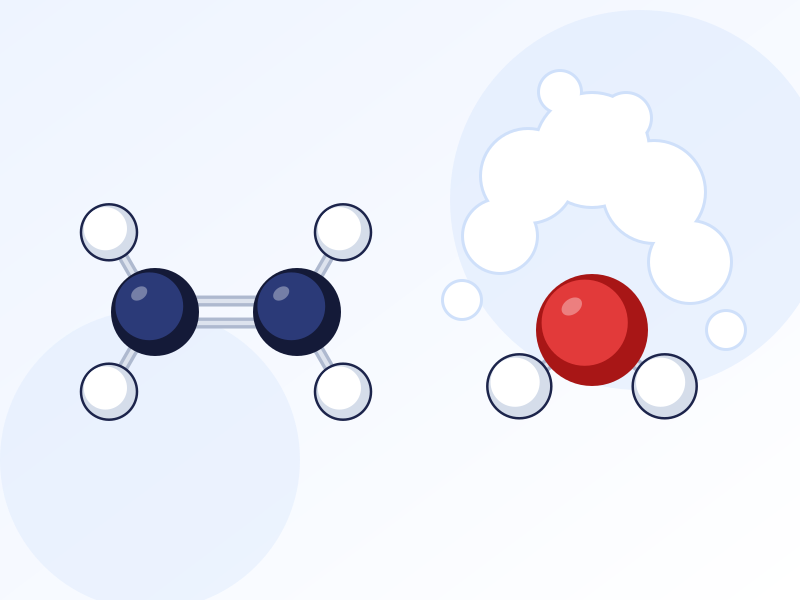
Steam
Learn how steam adds to alkenes in hydration reactions to produce alcohols under suitable conditions.
Start revisingSummary Map
Download, print and revise the reactions of this topic at a glance.
Summary map
Download, print and revise the reactions of this topic at a glance.

Alkenes Map
OCR A Level Chemistry A · 4.1.3 Alkenes
Every reaction on one A4 page: reagents, conditions and reaction type for each arrow, colour coded, with the key tests.
© 2026 Online Learning System. For personal study: printing is allowed; editing, copying and redistribution are not.
Virtual Lessons
Recorded video lessons that teach the topic step by step.
The Virtual Lessons for 4.1.3 Alkenes are being recorded.
MCQ Bank
Multiple-choice papers on this topic, marked the moment you submit.
The MCQ papers for 4.1.3 Alkenes are being written.
SAQ Bank
Written, drawn and worked exam practice on this topic.
The exam practice papers for 4.1.3 Alkenes are being written.
Revision Game
Match reagents to products, free, with your board's reagents and conditions.

Study Cards
Pick a deck, then turn each card to check what you remember.
Specification
Every specification point in this topic, in the exam board's own words. Rate how confident you are with each one.
Self-assessment · 27 points
Sign in to rate how confident you feel about each point. Your ratings are saved to your account, follow you to any device, and appear beside your KASP analytics, kept apart from your marks.
4.1.3
- a i
alkenes as unsaturated hydrocarbons containing a C=C bond comprising a π-bond (sideways overlap of adjacent p-orbitals above and below the bonding C atoms) and a σ-bond (overlap of orbitals directly between the bonding atoms) (see also 4.1.2 a)
Revise - b i
explanation of the trigonal planar shape around each carbon in the C=C of alkenes in terms of electron pair repulsion (see also 2.2.2 g–h, 4.1.2 b)
Revise - b ii
explanation of the bond angle around each carbon in the C=C of alkenes in terms of electron pair repulsion (see also 2.2.2 g–h, 4.1.2 b)
Revise - c (i) a
explanation of the term stereoisomers (compounds with the same structural formula but with a different arrangement in space)
Revise - c (i) b
explanation of the term E/Z isomerism (an example of stereoisomerism, in terms of restricted rotation about a double bond and the requirement for two different groups to be attached to each carbon atom of the C=C group)
Revise - c (i) c
explanation of the term cis–trans isomerism (a special case of E/Z isomerism in which two of the substituent groups attached to each carbon atom of the C=C group are the same)
Revise - d i
determination of possible E/Z stereoisomers of an organic molecule, given its structural formula
Revise - d ii
determination of possible cis–trans stereoisomers of an organic molecule, given its structural formula
Revise - f (i)
addition reactions of alkenes with hydrogen in the presence of a suitable catalyst, e.g. Ni, to form alkanes
Revise - f (ii) b
the use of bromine to detect the presence of a double C=C bond as a test for unsaturation in a carbon chain
Revise - f (iv)
addition reactions of alkenes with steam in the presence of an acid catalyst, e.g. H3PO4, to form alcohols
Revise - h
the mechanism of electrophilic addition in alkenes by heterolytic fission (see also 4.1.1 h–i)
Revise - i i
use of Markownikoff's rule to predict formation of a major organic product in addition reactions of H–X to unsymmetrical alkenes, e.g. H–Br to propene
Revise - i ii
the relative stabilities of carbocation intermediates in the mechanism of addition of H–X to unsymmetrical alkenes
Revise - j (i)
addition polymerisation of alkenes and substituted alkenes, including the repeat unit of an addition polymer deduced from a given monomer
Revise - j (ii)
addition polymerisation of alkenes and substituted alkenes, including identification of the monomer that would produce a given section of an addition polymer
Revise - k (i)
the benefits for sustainability of processing waste polymers by combustion for energy production
Revise - k (ii)
the benefits for sustainability of processing waste polymers by use as an organic feedstock for the production of plastics and other organic chemicals
Revise - k (iii)
the benefits for sustainability of processing waste polymers by removal of toxic waste products, e.g. removal of HCl formed during disposal by combustion of halogenated plastics (e.g. PVC)
Revise
Keep this note — free
Save your progress across every OCR topic. A free account remembers which topics you have covered, saves your question scores, and syncs across your phone and laptop.
- Track every topic you have finished
- Keep your practice-question scores
- No payment, no card, free forever
Already registered? Log in