Fuel Cells
A concise revision guide to fuel cells: how the reaction of a fuel with oxygen generates a voltage, the electrode reactions in an alkaline hydrogen–oxygen fuel cell.
- 3.1.11.2iii-c
- 3.1.11.2iv
- 3.1.11.2v
- 3.1.11.2vi
- 3.1.11.2ix
What these spec points say
- 3.1.11.2iii-c know that cells can be fuel cells
- 3.1.11.2iv know that fuel cells generate an electric current and do not need to be electrically recharged
- 3.1.11.2v know the electrode reactions in an alkaline hydrogen-oxygen fuel cell
- 3.1.11.2vi evaluate the benefits and risks to society associated with using electrochemical cells
- 3.1.11.2ix explain how electrode reactions can be used to generate an electric current
The alkaline hydrogen–oxygen fuel cell
A cutaway fuel cell: hydrogen and oxygen are supplied continuously, the two electrode reactions push electrons round the external circuit, and water is the only product.
© Dr. Mohammed Al-Fatah – onlinelearningsystem.net
Before You Start
This page uses the ideas from Electrochemical Cells, Cell Diagrams and Cell Potentials and The Electrochemical Series and Feasibility of Reactions, and follows Commercial Cells.
What you need to remember
- Hydrogen burns in oxygen to form water, and the reaction is exothermic: 2H₂ + O₂ → 2H₂O.
- Burning a fuel is a redox reaction: the fuel is oxidised and oxygen is reduced.
- In a cell, oxidation happens at the negative electrode and reduction at the positive electrode.
- EMF: EMF = E⦵(positive electrode) − E⦵(negative electrode).
GCSE Recap: Redox, Combustion and Simple Cells
Three quick questions on the GCSE ideas this page builds on.
What a Fuel Cell Is
A fuel cell uses the energy from the reaction of a fuel with oxygen to generate a voltage. The fuel is not burned: it is oxidised at one electrode while oxygen is reduced at the other.
- The fuel and the oxygen (usually from air) are supplied continuously from outside the cell.
- The cell gives a steady voltage for as long as both are supplied.
- It does not run down, so it does not need to be electrically recharged.
- The concentrations of the reactants at the electrodes stay constant, so the voltage does not fall as it does in an ordinary cell.
- The electrodes are porous and coated with a platinum catalyst. Gases pass through the pores and react on the large surface.
- An electrolyte between the electrodes lets ions move and completes the circuit.
| Fuel cell | Storage cell | |
|---|---|---|
| Reactants | supplied continuously from outside | sealed inside the cell |
| When reactants are used up | does not happen while the supply lasts | voltage falls; the cell is recharged or replaced |
| Energy change | chemical energy to electrical energy | chemical energy to electrical energy |
Key idea: A fuel cell turns the energy of the reaction between a fuel and oxygen directly into electrical energy. The reactants flow in continuously, so it never needs recharging.
Quick Check: A Fuel Cell at Work
A delivery drone runs on a hydrogen fuel cell. Pick the one accurate statement in each set.
The Alkaline Hydrogen–Oxygen Fuel Cell
The fuel is hydrogen gas and the electrolyte is aqueous potassium hydroxide, KOH(aq). Hydroxide ions carry the charge through the electrolyte.
| Electrode | Reaction | Type | E⦵ / V |
|---|---|---|---|
| negative | H₂(g) + 2OH⁻(aq) → 2H₂O(l) + 2e⁻ | oxidation of hydrogen | −0.83 |
| positive | O₂(g) + 2H₂O(l) + 4e⁻ → 4OH⁻(aq) | reduction of oxygen | +0.40 |
The overall equation
Step 1. Multiply the hydrogen half-equation by 2 to give four electrons: 2H₂ + 4OH⁻ → 4H₂O + 4e⁻.
Step 2. Add the oxygen half-equation: 2H₂ + 4OH⁻ + O₂ + 2H₂O + 4e⁻ → 4H₂O + 4e⁻ + 4OH⁻.
Step 3. Cancel 4e⁻, 4OH⁻ and 2H₂O from both sides.
2H₂(g) + O₂(g) → 2H₂O(l)
EMF = (+0.40) − (−0.83) = 1.23 V
The conventional cell diagram is Pt | H₂(g) | OH⁻(aq), H₂O(l) ‖ O₂(g) | H₂O(l), OH⁻(aq) | Pt.
What moves where
- Electrons released at the negative electrode flow through the external circuit to the positive electrode.
- Hydroxide ions made at the positive electrode move through the electrolyte to the negative electrode, where they are used up.
- The hydroxide ions cancel in the overall equation, so the potassium hydroxide is not consumed.
- Water is the only product. It leaves the cell as liquid or steam.
- The E⦵ values belong to the half-equations written as reductions: 2H₂O + 2e⁻ ⇌ H₂ + 2OH⁻ has E⦵ = −0.83 V.
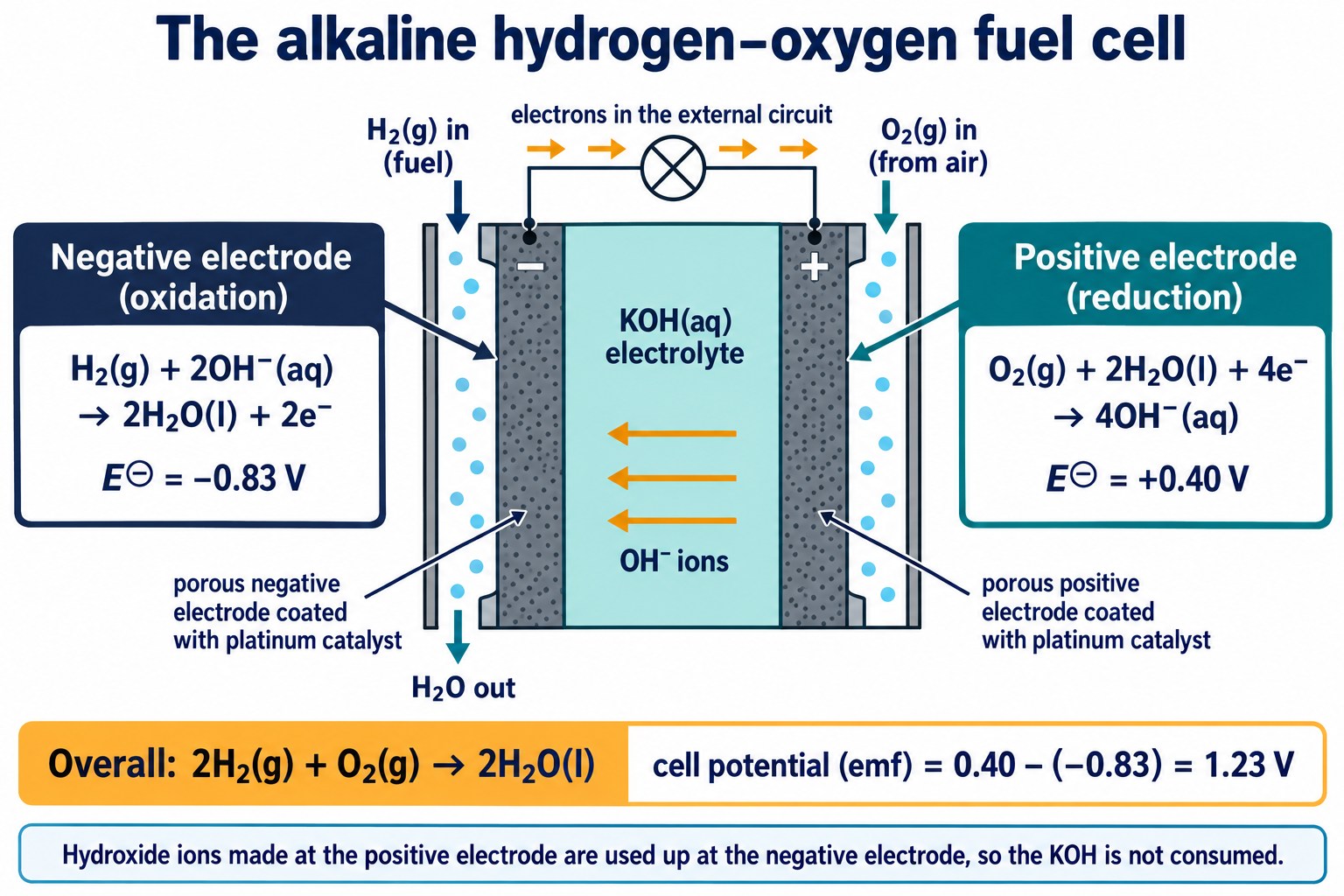
The alkaline hydrogen–oxygen fuel cell. Hydrogen is oxidised at the negative electrode, oxygen is reduced at the positive electrode, and hydroxide ions cross the electrolyte.
Check: How a Hydrogen–Oxygen Fuel Cell Works
Decide what is oxidised and reduced, which way the electrons and the ions move, and how many electrons are transferred in an alkaline hydrogen–oxygen fuel cell.
Advantages and Disadvantages of Fuel Cells
| Advantages | Disadvantages |
|---|---|
| water is the only product of a hydrogen–oxygen cell: no carbon dioxide where it is used | most hydrogen is made from fossil fuels, or by electrolysis that needs electricity |
| more efficient than burning the fuel in an engine, where much of the energy is lost as heat | hydrogen is a flammable gas that is difficult to store and transport |
| no electrical recharging: it runs for as long as fuel is supplied | platinum catalysts make the electrodes expensive |
| quiet, with few moving parts | there are few hydrogen filling stations |
- A fuel cell vehicle is only as clean as the method used to make its hydrogen.
- Hydrogen can be stored as a compressed gas, as a liquid at very low temperature, or held in a solid material.
- A fuel cell has a limited lifetime, and toxic materials are used to make it, so replacement and disposal add to the cost.
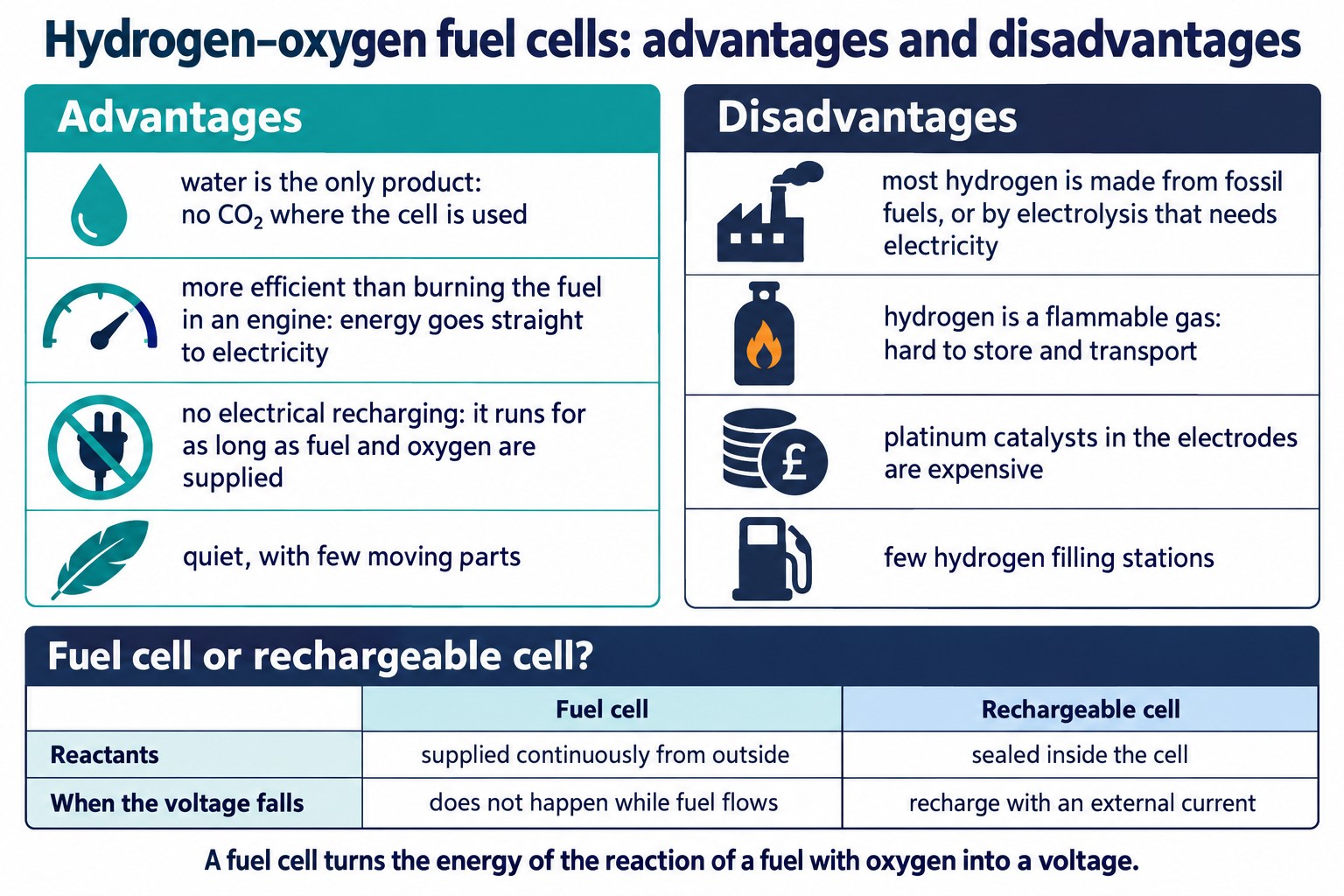
Advantages and disadvantages of hydrogen–oxygen fuel cells, with a comparison between a fuel cell and a rechargeable cell.
Quick Check: Evaluate a Different Fuel
Work out each step on paper, then flip the card to compare.
Common Exam Points
Say
- “A fuel cell uses the energy from the reaction of a fuel with oxygen to generate a voltage.”
- “The fuel and oxygen are supplied continuously, so the cell does not need recharging.”
- “Hydrogen is oxidised at the negative electrode and oxygen is reduced at the positive electrode.”
Do not say
- “Hydrogen is burned in the fuel cell” (there is no combustion and no flame).
- “Fuel cells cause no pollution” (making the hydrogen usually releases carbon dioxide).
- “Electrons move through the electrolyte” (ions move through the electrolyte; electrons use the external circuit).
Watch for
- Electrons must balance before the half-equations are added: four electrons for each O₂ molecule.
- State symbols: H₂(g), O₂(g), OH⁻(aq) and H₂O(l).
- The alkaline cell half-equations contain OH⁻, never H⁺.
- The voltage does not change when a half-equation is multiplied.
Check: Fuel Cells in Use
Compare fuel cells with other cells, weigh advantages against disadvantages and apply electrode potential ideas to a fuel cell.
FAQs
Use these quick answers to check fuel cells and the electrode reactions of the hydrogen-oxygen fuel cell.
How is a fuel cell different from an ordinary cell?
The fuel and the oxygen are supplied continuously from outside, so the cell gives a constant voltage for as long as they flow. It does not need recharging, because the reactants are not stored inside the cell.
What are the electrode reactions in an alkaline hydrogen-oxygen fuel cell?
Negative electrode: H₂ + 2OH⁻ → 2H₂O + 2e⁻. Positive electrode: O₂ + 2H₂O + 4e⁻ → 4OH⁻. Doubling the first and adding gives the overall equation, 2H₂ + O₂ → 2H₂O. Water is the only product.
What voltage does a hydrogen-oxygen fuel cell give?
In alkali the oxygen half-cell is +0.40 V and the hydrogen half-cell is −0.83 V, so the cell gives +0.40 − (−0.83) = 1.23 V.
Why are the electrodes porous and coated with platinum?
A porous electrode gives a large surface area where the gas, the electrolyte and the electrode meet. The platinum acts as a catalyst for the electrode reactions, and the electrode conducts electrons to and from the external circuit.
What are the drawbacks of hydrogen fuel cells?
Hydrogen is a flammable gas that is difficult to store and transport. Most hydrogen is made from fossil fuels or by electrolysis, which needs energy. The platinum catalysts in the electrodes are also expensive.

Copyright notice: This OLS revision content, including the explanations, layout, diagrams, tables and embedded learning structure, is authored for Online Learning System by Dr. Mohammed Al-Fatah. It may not be copied, reproduced, redistributed or adapted without written permission.
Keep this note — free
Save your progress across every AQA topic. A free account remembers which topics you have covered, saves your question scores, and syncs across your phone and laptop.
- Track every topic you have finished
- Keep your practice-question scores
- No payment, no card, free forever
Already registered? Log in