Commercial Cells: Non-Rechargeable, Rechargeable and Lithium Ion
A concise revision guide to commercial electrochemical cells: non-rechargeable and rechargeable cells, the lithium ion cell and its electrode reactions, with the benefits and risks to society.
- 3.1.11.2i
- 3.1.11.2ii-a
- 3.1.11.2ii-b
- 3.1.11.2iii-a
- 3.1.11.2iii-b
- 3.1.11.2vi
- 3.1.11.2vii
- 3.1.11.2viii
What these spec points say
- 3.1.11.2i know that electrochemical cells can be used as a commercial source of electrical energy
- 3.1.11.2ii-a know the simplified positive electrode reaction in a lithium cell: Li+ + CoO2 + e- -> Li+[CoO2]-
- 3.1.11.2ii-b know the simplified negative electrode reaction in a lithium cell: Li -> Li+ + e-
- 3.1.11.2iii-a know that cells can be non-rechargeable (irreversible)
- 3.1.11.2iii-b know that cells can be rechargeable
- 3.1.11.2vi evaluate the benefits and risks to society associated with using electrochemical cells
- 3.1.11.2vii use given electrode data to deduce the reactions occurring in non-rechargeable and rechargeable cells
- 3.1.11.2viii deduce the EMF of a cell
Before You Start
This page applies Electrochemical Cells, Cell Diagrams and Cell Potentials and The Electrochemical Series and Feasibility of Reactions to the cells sold as batteries. A battery is two or more cells joined in series.
What you need to remember
- A cell is two half-cells joined so that electrons flow through an external circuit.
- The half-cell with the more negative E⦵ is the negative electrode, where oxidation happens.
- The half-cell with the more positive E⦵ is the positive electrode, where reduction happens.
- EMF: EMF = E⦵(positive electrode) − E⦵(negative electrode).
GCSE Recap: Metals, Electrons and Voltage
Three quick questions on the GCSE ideas this page builds on.
Cells as a Source of Electrical Energy
An electrochemical cell turns the energy of a redox reaction into electrical energy. Commercial cells are built to be compact, sealed and safe to carry.
| Type of cell | What happens | Examples |
|---|---|---|
| non-rechargeable | the cell reaction cannot be reversed; the cell is discarded when a reactant runs out | zinc–carbon, alkaline |
| rechargeable | the cell reaction is reversed by an external current, which regenerates the reactants | lead–acid, nickel–cadmium, lithium ion |
| fuel cell | fuel and oxygen are supplied continuously, so no recharging is needed | hydrogen–oxygen |
- Rechargeable cells are also called storage cells: they store electrical energy as chemical energy.
- Most commercial cells use pastes or solids instead of 1.00 mol dm⁻³ solutions, so the real voltage is close to, but not exactly, the value from E⦵ data.
- Fuel cells have their own page: Fuel Cells.
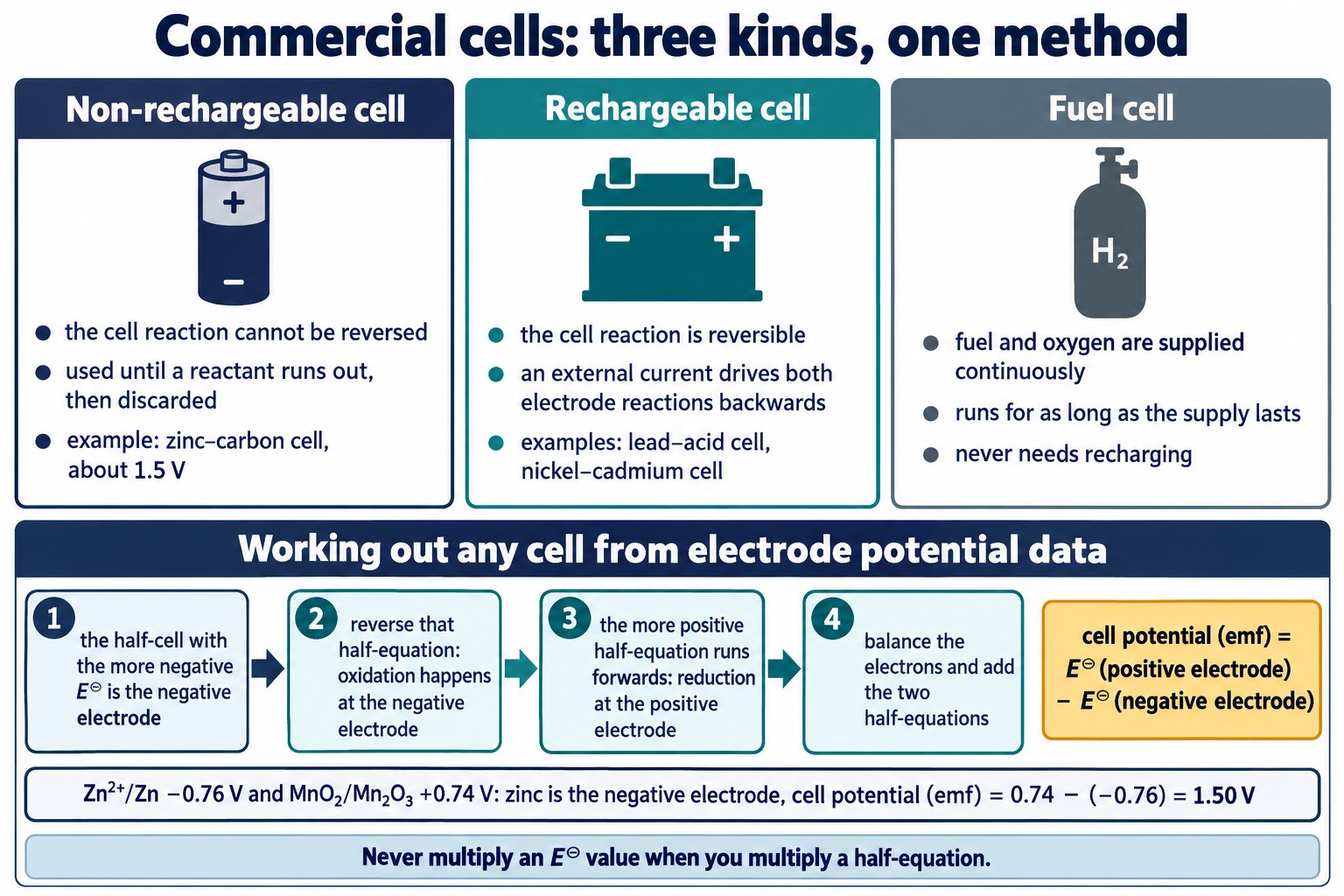
The three kinds of commercial cell, and the four-step method for working out the electrode reactions and the voltage of any cell from electrode potential data.
Working Out a Cell From Electrode Potential Data
The electrode reactions of a commercial cell do not need to be learned, apart from the lithium ion cell. The data are given, and the cell is worked out in the same way every time.
- Compare the two E⦵ values. The more negative half-cell is the negative electrode.
- Reverse that half-equation: it runs as an oxidation and releases electrons.
- The more positive half-equation runs forwards as a reduction at the positive electrode.
- Multiply the half-equations so that the electrons match. Do not multiply the E⦵ values.
- Add the half-equations and cancel the electrons and anything that appears on both sides.
- Calculate EMF = E⦵(positive electrode) − E⦵(negative electrode).
Key idea: More negative E⦵: negative electrode, oxidation, electrons leave. More positive E⦵: positive electrode, reduction, electrons arrive. The voltage of a working cell is always positive.
Non-Rechargeable Cells
In a non-rechargeable cell the reaction is not reversible. Once a reactant is used up, the voltage falls and the cell is thrown away or recycled.
Worked example: the zinc–carbon cell
A zinc case surrounds a paste of ammonium chloride and manganese(IV) oxide, with a carbon rod as the positive terminal. Deduce the overall equation and the voltage.
| Half-equation | E⦵ / V |
|---|---|
| Zn²⁺ + 2e⁻ ⇌ Zn | −0.76 |
| 2MnO₂ + 2NH₄⁺ + 2e⁻ ⇌ Mn₂O₃ + 2NH₃ + H₂O | +0.74 |
Step 2. Reduction at the positive electrode: 2MnO₂ + 2NH₄⁺ + 2e⁻ → Mn₂O₃ + 2NH₃ + H₂O.
Answer. EMF = (+0.74) − (−0.76) = 1.50 V
Why it cannot be recharged
- The zinc case is itself the reactant: it is used up and becomes thin, so the cell may leak.
- The products do not stay in place at the electrodes, so a reverse current cannot turn them back into the reactants.
- An alkaline cell uses the same zinc and manganese(IV) oxide chemistry with a potassium hydroxide paste, and lasts longer.
Check: Deducing Cell Reactions From Data
Use electrode potential data for cells not used on this page to identify the negative electrode, write both electrode reactions and calculate the cell voltage.
Rechargeable Cells
In a rechargeable cell the products stay on the electrodes. An external supply with a larger voltage forces electrons the opposite way, and both electrode reactions run backwards.
The lead–acid cell
Car batteries use plates of lead and lead(IV) oxide in sulfuric acid.
| Half-equation | E⦵ / V |
|---|---|
| PbSO₄ + 2e⁻ ⇌ Pb + SO₄²⁻ | −0.36 |
| PbO₂ + 4H⁺ + SO₄²⁻ + 2e⁻ ⇌ PbSO₄ + 2H₂O | +1.69 |
- Negative electrode (oxidation): Pb + SO₄²⁻ → PbSO₄ + 2e⁻
- Positive electrode (reduction): PbO₂ + 4H⁺ + SO₄²⁻ + 2e⁻ → PbSO₄ + 2H₂O
- Overall on discharge: Pb + PbO₂ + 4H⁺ + 2SO₄²⁻ → 2PbSO₄ + 2H₂O
- EMF = (+1.69) − (−0.36) = 2.05 V. Six cells in series give about 12 V.
- On recharging: 2PbSO₄ + 2H₂O → Pb + PbO₂ + 4H⁺ + 2SO₄²⁻
Insoluble lead(II) sulfate coats both plates during discharge. It stays where it forms, which is why the reaction can be reversed.
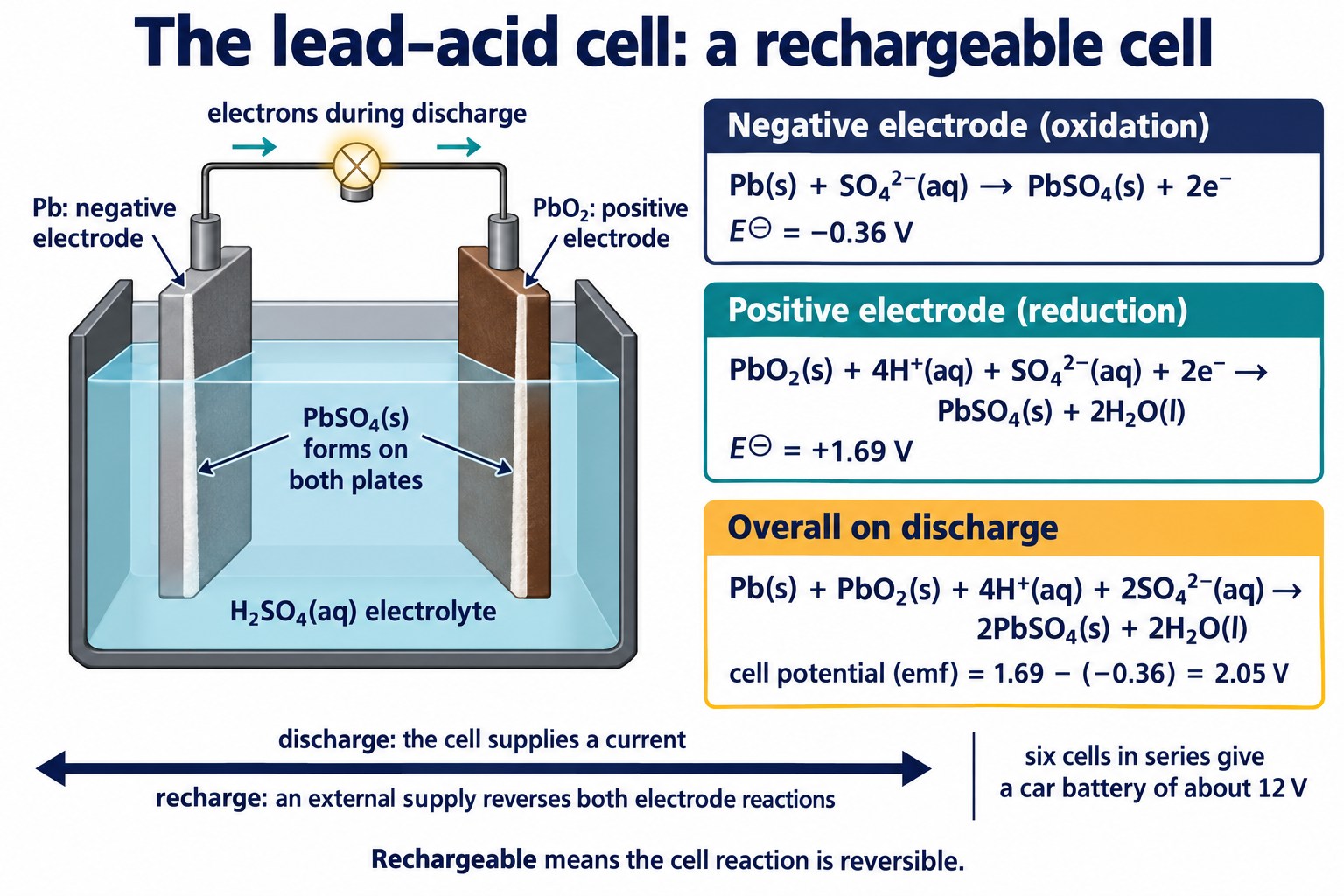
The lead–acid cell: the two electrode reactions, the overall equation on discharge and the cell voltage. Recharging drives both electrode reactions backwards.
Worked example: the nickel–cadmium cell
Deduce the overall equation on discharge and the voltage of a nickel–cadmium cell.
| Half-equation | E⦵ / V |
|---|---|
| Cd(OH)₂ + 2e⁻ ⇌ Cd + 2OH⁻ | −0.88 |
| NiO(OH) + H₂O + e⁻ ⇌ Ni(OH)₂ + OH⁻ | +0.52 |
Step 2. Multiply the nickel half-equation by 2 to match the electrons: 2NiO(OH) + 2H₂O + 2e⁻ → 2Ni(OH)₂ + 2OH⁻.
Step 3. Add and cancel 2e⁻ and 2OH⁻: Cd + 2NiO(OH) + 2H₂O → Cd(OH)₂ + 2Ni(OH)₂.
The Lithium Ion Cell
Lithium ion cells power phones, laptops and electric cars. Lithium has a very negative electrode potential and a low density, so the cell gives a high voltage for a small mass.
| Electrode | Reaction on discharge | Change |
|---|---|---|
| negative | Li → Li⁺ + e⁻ | oxidation of lithium, 0 to +1 |
| positive | Li⁺ + CoO₂ + e⁻ → Li⁺[CoO₂]⁻ | reduction of cobalt, +4 to +3 |
Overall on discharge: Li + CoO₂ → Li⁺[CoO₂]⁻
Cell representation: Li | Li⁺ ‖ Li⁺, CoO₂ | LiCoO₂ | Pt
How the cell is built
- The negative electrode is lithium held in a graphite support, which conducts electrons.
- The positive electrode is lithium cobalt oxide, LiCoO₂.
- The electrolyte is a lithium salt in an organic solvent or a polymer. Li⁺ ions move through it from the negative to the positive electrode.
- Water must not be used as the solvent: lithium reacts with water.
Worked example
Calculate the EMF of a lithium ion cell. E⦵ values: Li⁺ + e⁻ ⇌ Li, −3.04 V; Li⁺ + CoO₂ + e⁻ ⇌ Li⁺[CoO₂]⁻, +0.56 V.
Answer. EMF = (+0.56) − (−3.04) = 3.60 V
Recharging
- An external supply reverses both electrode reactions.
- At the cobalt oxide electrode: Li⁺[CoO₂]⁻ → Li⁺ + CoO₂ + e⁻
- At the graphite electrode: Li⁺ + e⁻ → Li
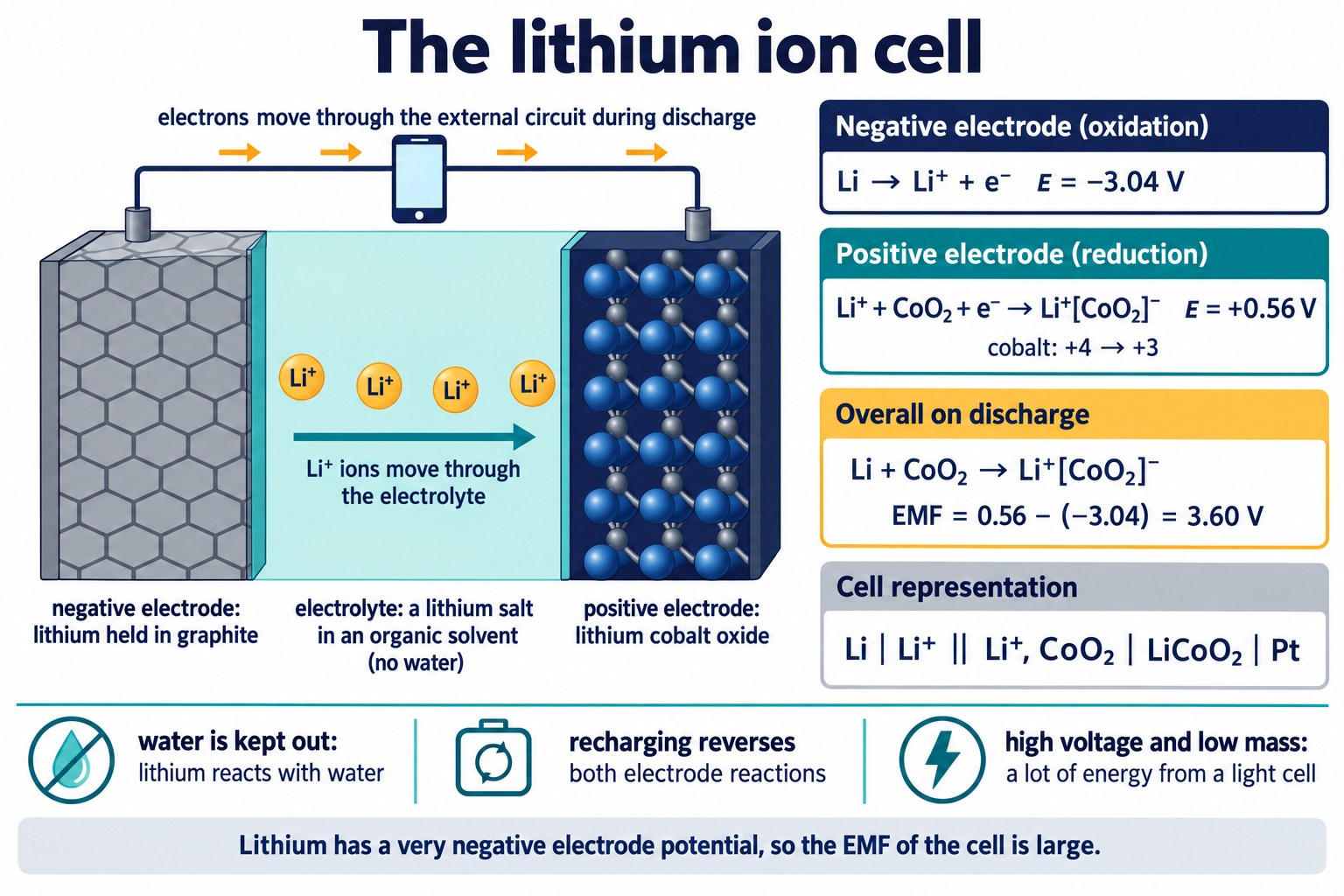
The lithium ion cell on discharge. Lithium ions cross the electrolyte while electrons travel through the external circuit to the cobalt oxide electrode.
Exam focus: Learn both simplified electrode equations and the overall equation. Lithium is oxidised at the negative electrode; cobalt, not lithium, is reduced at the positive electrode.
Applying the Method to an Unfamiliar Cell
Exam questions often give data for a cell that is new to you. The method does not change.
Worked example: a silver oxide button cell
A watch cell uses zinc and silver(I) oxide in an alkaline paste. Identify the negative electrode, write the overall equation and calculate the voltage.
| Half-equation | E⦵ / V |
|---|---|
| ZnO + H₂O + 2e⁻ ⇌ Zn + 2OH⁻ | −1.26 |
| Ag₂O + H₂O + 2e⁻ ⇌ 2Ag + 2OH⁻ | +0.34 |
Step 2. Reduction at the positive electrode: Ag₂O + H₂O + 2e⁻ → 2Ag + 2OH⁻.
Step 3. Add the two, then cancel 2e⁻, 2OH⁻ and H₂O: Zn + Ag₂O → ZnO + 2Ag.
Answer. EMF = (+0.34) − (−1.26) = 1.60 V
- The hydroxide ions cancel, so the electrolyte is not used up and the voltage stays steady as the cell runs.
- Zinc changes from 0 to +2 and silver from +1 to 0: check the oxidation states to confirm which species is oxidised.
Quick Check: A Cell You Have Not Met
Work out each step on paper, then flip the card to compare.
Benefits and Risks to Society
Questions may ask for a balanced judgement on the use of commercial cells. Give points on both sides.
| Benefits | Risks |
|---|---|
| portable electrical energy for phones, laptops and medical devices | toxic metals such as lead, cadmium and nickel |
| storage of electricity from wind and solar sources | cells in landfill can leak metal compounds into soil and water |
| rechargeable cells are reused many times, which reduces waste | lithium cells can overheat and catch fire if damaged or overcharged |
| electric vehicles give no exhaust gases where they are used | mining lithium and cobalt uses energy and water and damages land |
- Recharging uses electricity, which may itself be generated by burning fossil fuels.
- Recycling recovers the metals, which reduces both mining and landfill.
- Non-rechargeable cells are cheap, but every one becomes waste after a single use.
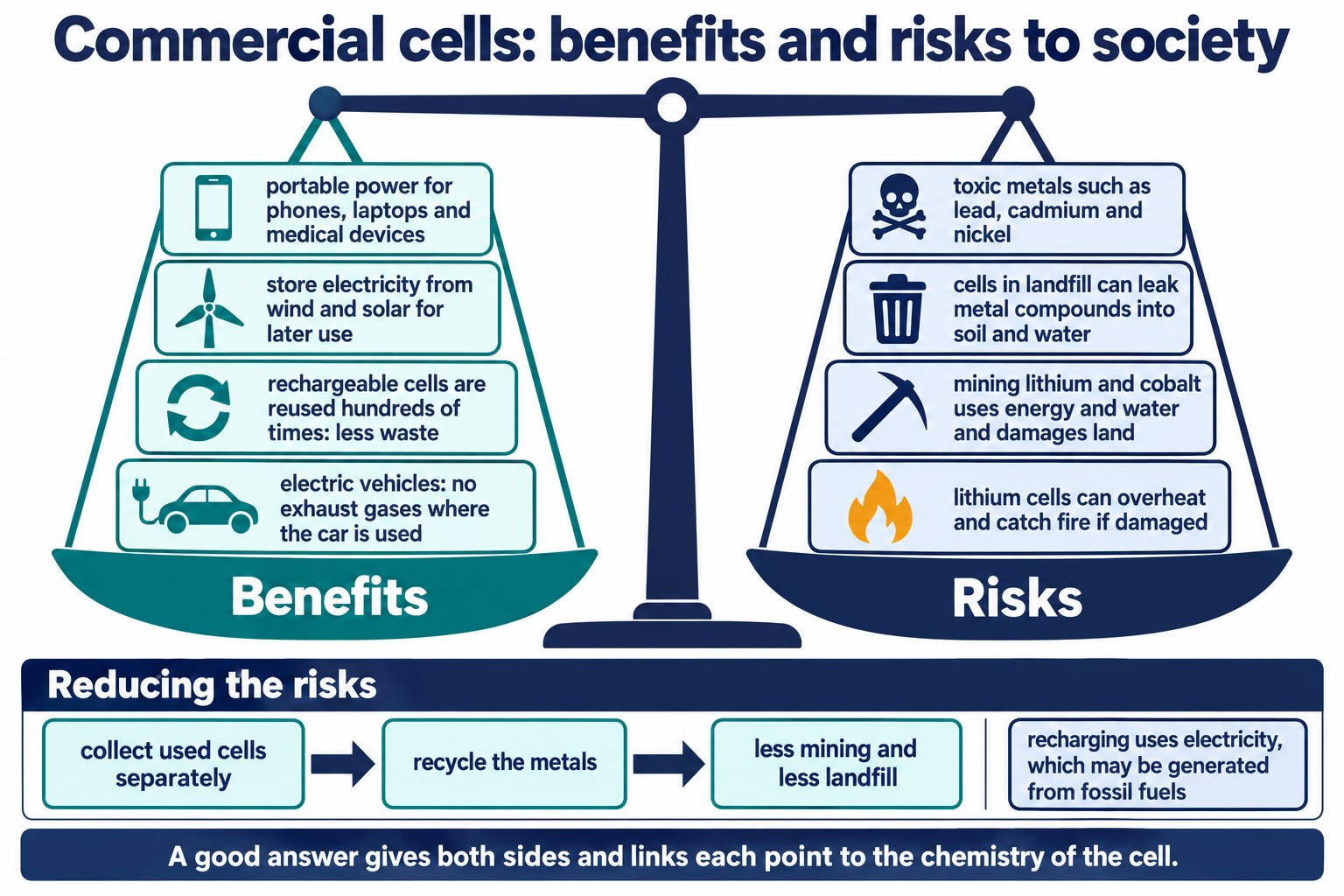
Benefits and risks of commercial cells weighed against each other, with recycling as the way to reduce the risks.
Common Exam Points
Say
- “The more negative half-cell is the negative electrode, where oxidation takes place.”
- “The cell is rechargeable because the cell reaction can be reversed.”
- “Water is not used because lithium reacts with water.”
Do not say
- “The E⦵ value is doubled because the half-equation is doubled” (E⦵ values are never multiplied).
- “A non-rechargeable cell stops because the electrons run out” (a reactant is used up).
- “Lithium ions are reduced at the positive electrode” (cobalt is reduced, from +4 to +3).
Watch for
- Reverse the more negative half-equation before adding, and cancel species that appear on both sides.
- A cell voltage is quoted as a positive number with its unit, V.
- Equations for recharging are the discharge equations written backwards.
- Benefits and risks questions need points on both sides, each linked to the chemistry.
Check: Rechargeable Cells and Storage Cells
Work with data for storage cells not used on this page: write discharge and recharge equations, combine half-equations with different numbers of electrons and calculate cell voltages.
FAQs
Use these quick answers to check non-rechargeable, rechargeable and lithium ion cells.
What is the difference between a non-rechargeable and a rechargeable cell?
In a non-rechargeable cell the reaction cannot be reversed, so the cell is discarded once the reactants are used up. In a rechargeable cell, such as lead-acid or nickel-cadmium, an external current reverses the cell reaction and regenerates the reactants.
How do I work out which electrode is negative from the data?
The half-cell with the more negative E⦵ is the negative electrode, where oxidation happens, so reverse that half-equation. Reduction happens at the more positive half-cell. Then EMF = E⦵(positive electrode) − E⦵(negative electrode).
What voltage does a lead-acid cell give?
The lead electrode is −0.36 V and the lead(IV) oxide electrode is +1.69 V, so each cell gives +1.69 − (−0.36) = 2.05 V. A car battery joins six cells in series to give about 12 V.
What happens when a cell is recharged?
An external supply forces electrons through the cell in the opposite direction, so both electrode reactions are reversed and the original reactants are regenerated. In the lead-acid cell: 2PbSO₄ + 2H₂O → Pb + PbO₂ + 4H⁺ + 2SO₄²⁻.
What are the electrode reactions in a lithium ion cell?
At the negative electrode, Li → Li⁺ + e⁻. At the positive electrode, Li⁺ + CoO₂ + e⁻ → Li⁺[CoO₂]⁻, with cobalt reduced from +4 to +3. Water is not used as the solvent because lithium reacts with water.

Copyright notice: This OLS revision content, including the explanations, layout, diagrams, tables and embedded learning structure, is authored for Online Learning System by Dr. Mohammed Al-Fatah. It may not be copied, reproduced, redistributed or adapted without written permission.
Keep this note — free
Save your progress across every AQA topic. A free account remembers which topics you have covered, saves your question scores, and syncs across your phone and laptop.
- Track every topic you have finished
- Keep your practice-question scores
- No payment, no card, free forever
Already registered? Log in