3.2.5
Transition
Metals
Section 3.2.5 covers the general properties of the transition metals from titanium to copper (3.2.5.1); ligand substitution, bidentate and multidentate ligands, haem and the chelate effect (3.2.5.2); the shapes of complex ions with cis–trans and optical isomerism, cisplatin and the linear [Ag(NH₃)₂]⁺ ion (3.2.5.3); the formation of coloured ions, ΔE = hν = hc/λ and colorimetry (3.2.5.4); variable oxidation states, the reduction of vanadate(V) by zinc, Tollens’ reagent and redox titrations with manganate(VII) (3.2.5.5); and heterogeneous and homogeneous catalysts, including autocatalysis (3.2.5.6).
Revision Notes
9 revision notes, in the order the specification teaches them.

Electron Configurations and Properties of Transition metals
Transition metals: electron configurations of d-block atoms and ions, the definition of a transition metal and variable oxidation states.
Start revising
Ligands, Complex Ions and Their Shapes
Ligands and complex ions: co-ordinate bonds, co-ordination number, bidentate and multidentate ligands and the shapes of complexes.
Start revising
Stereoisomerism in Complex Ions
Stereoisomerism in transition metal complexes: cis–trans and optical isomers, including cis-platin.
Start revising
Colour of Transition metal Ions
The colour of transition metal ions: d-orbital splitting, absorption of visible light and the effect of oxidation state, ligand and co-ordination number.
Start revising
Ligand substitution and the Stability of Complexes
Ligand substitution in copper(II) and cobalt(II) complexes, the chelate effect and entropy.
Start revising
Redox Chemistry of Transition metals
Transition metal redox reactions: vanadium oxidation states and colour changes.
Start revising
Redox Titrations with Transition metal Ions
Redox titrations of Fe²⁺ and C₂O₄²⁻ with MnO₄⁻: equations, ratios and calculations.
Start revising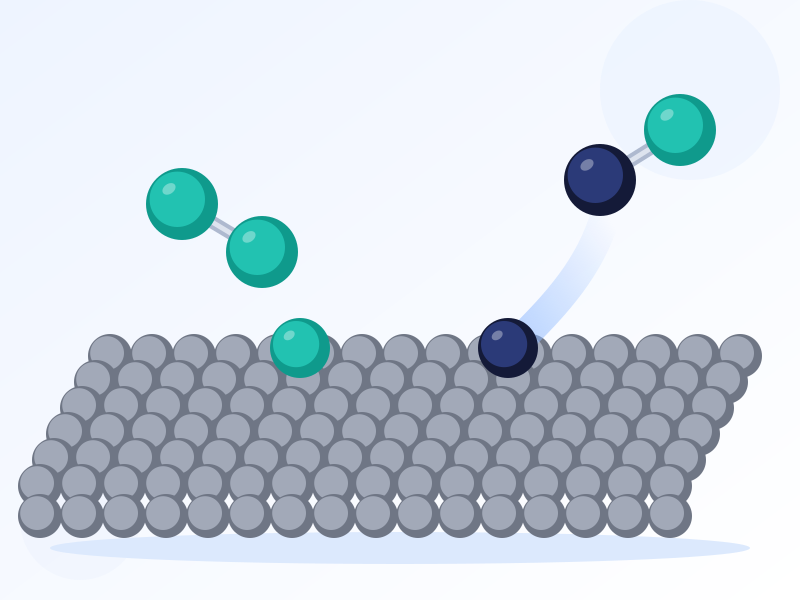
Heterogeneous Catalysis
Transition metals as heterogeneous catalysts: surface adsorption, V₂O₅ in the Contact process.
Start revising
Homogeneous Catalysis and Autocatalysis
Homogeneous catalysis: Fe²⁺ with I⁻ and S₂O₈²⁻, and autocatalysis by Mn²⁺ in the MnO₄⁻ and C₂O₄²⁻ reaction.
Start revisingSummary Map
Download, print and revise the key facts of this topic at a glance.
Summary maps
Download, print and revise the key facts of this topic at a glance.

Complexes and Colour Map
AQA A-level Chemistry · 3.2.5 Complexes and colour
The whole section on one A4 page: transition metals, ligands, multidentate ligands and haem, isomers, colour and colorimetry.
Exchange and Catalysis Map
AQA A-level Chemistry · 3.2.5 Exchange, vanadium and catalysis
The whole section on one A4 page: ligand exchange, the chelate effect, vanadium, Tollens' reagent and heterogeneous and homogeneous catalysts.
Redox Titrations Map
AQA A-level Chemistry · 3.2.5.5 Redox titrations
The whole section on one A4 page: manganate(VII) with iron(II), the titration itself, other reducing agents, the choice of acid, similar redox titrations and the calculation.
© 2026 Online Learning System. For personal study: printing is allowed; editing, copying and redistribution are not.
Virtual Lessons
Recorded video lessons that teach the topic step by step.
The Virtual Lessons for 3.2.5 Transition metals are being recorded.
MCQ Bank
Multiple-choice papers on this topic, marked the moment you submit.
The MCQ papers for 3.2.5 Transition metals are being written.
SAQ Bank
Written, drawn and worked exam practice on this topic.
The exam practice papers for 3.2.5 Transition metals are being written.
Revision Game
Match reagents to products, with your board's reagents and conditions.
The revision game for 3.2.5 Transition metals is being built.
Study Cards
Pick a deck, then turn each card to check what you remember.
Specification
Every specification point in this topic, in the exam board's own words. Rate how confident you are with each one.
Self-assessment · 61 points
Sign in to rate how confident you feel about each point. Your ratings are saved to your account, follow you to any device, and appear beside your KASP analytics, kept apart from your marks.
3.2.5.1
- i
know that transition metal characteristics of elements Ti-Cu arise from an incomplete d sub-level in atoms or ions
Revise - iii
know that a ligand is a molecule or ion that forms a co-ordinate bond with a transition metal by donating a pair of electrons
Revise - v
know that co-ordination number is the number of co-ordinate bonds to the central metal atom or ion
Revise
3.2.5.2
- ii a
know that exchange of NH3 ligands occurs without change of co-ordination number in examples such as Co2+ and Cu2+
Revise - ii b
know that exchange of H2O ligands occurs without change of co-ordination number in examples such as Co2+ and Cu2+
Revise - iv c
know that exchange of H2O by Cl- can involve a change of co-ordination number in examples such as Co2+, Cu2+ and Fe3+
Revise - vii
know that carbon monoxide is toxic because it replaces oxygen co-ordinately bonded to Fe(II) in haemoglobin
Revise - viii
know that bidentate and multidentate ligands replace monodentate ligands from complexes (the chelate effect)
Revise
3.2.5.3
3.2.5.4
- ii
understand that colour arises when some wavelengths of visible light are absorbed and the remaining wavelengths are transmitted or reflected
Revise - iii
know that d electrons move from the ground state to an excited state when light is absorbed
Revise - iv
know that the energy difference between ground and excited states is given by DeltaE = hv = hc/lambda
Revise - vi
know that a simple colorimeter can be used to determine the concentration of coloured ions in solution
Revise
3.2.5.5
- ii a
know that vanadium species in oxidation state IV are formed by reduction of vanadate(V) ions by zinc in acidic solution
Revise - ii b
know that vanadium species in oxidation state III are formed by reduction of vanadate(V) ions by zinc in acidic solution
Revise - ii c
know that vanadium species in oxidation state II are formed by reduction of vanadate(V) ions by zinc in acidic solution
Revise - iii
know that the redox potential for a transition metal ion changing oxidation state is influenced by pH and by the ligand
Revise - iv
know that the reduction of [Ag(NH3)2]+ (Tollens' reagent) to metallic silver is used to distinguish between aldehydes and ketones
Revise - v
perform calculations for the redox titrations of Fe2+ and C2O42- with MnO4- and similar redox reactions
Revise
3.2.5.6
- ii
know that a heterogeneous catalyst is in a different phase from the reactants and the reaction occurs at active sites on the surface
Revise - iii
know the use of a support medium to maximise the surface area of a heterogeneous catalyst and minimise cost
Revise - iv
know that V2O5 acts as a heterogeneous catalyst in the Contact process and explain with equations how it does so
Revise - vi
know that heterogeneous catalysts can become poisoned by impurities that block the active sites
Revise - vii
know that a homogeneous catalyst is in the same phase as the reactants and the reaction proceeds through an intermediate species
Revise
Keep this note — free
Save your progress across every AQA topic. A free account remembers which topics you have covered, saves your question scores, and syncs across your phone and laptop.
- Track every topic you have finished
- Keep your practice-question scores
- No payment, no card, free forever
Already registered? Log in