Redox Chemistry of Transition metals
A concise revision guide to the redox chemistry of the transition metals: the oxidation states and colours of vanadium, Tollens’ reagent, and the half-equations and colour changes.
- 3.2.5.5ii-a
- 3.2.5.5ii-b
- 3.2.5.5ii-c
- 3.2.5.5iii
- 3.2.5.5iv
What these spec points say
- 3.2.5.5ii-a know that vanadium species in oxidation state IV are formed by reduction of vanadate(V) ions by zinc in acidic solution
- 3.2.5.5ii-b know that vanadium species in oxidation state III are formed by reduction of vanadate(V) ions by zinc in acidic solution
- 3.2.5.5ii-c know that vanadium species in oxidation state II are formed by reduction of vanadate(V) ions by zinc in acidic solution
- 3.2.5.5iii know that the redox potential for a transition metal ion changing oxidation state is influenced by pH and by the ligand
- 3.2.5.5iv know that the reduction of [Ag(NH3)2]+ (Tollens' reagent) to metallic silver is used to distinguish between aldehydes and ketones
Before You Start
This page uses the ideas of 3.1.11 Electrode potentials and electrochemical cells and the variable oxidation states introduced on Electron Configurations and Properties of Transition metals.
What you need to remember
- Oxidation is loss of electrons: the oxidation state of the element increases.
- Reduction is gain of electrons: the oxidation state decreases.
- An oxidising agent takes electrons and is itself reduced. A reducing agent gives electrons and is itself oxidised.
- Oxygen is usually −2 and hydrogen +1. The oxidation states in an ion add up to its charge.
- A reaction is feasible when E⦵cell is positive: E⦵cell = E⦵(species reduced) − E⦵(species oxidised).
Oxidation States, Colour and Half-Equations
A transition metal has several stable oxidation states, so its ions take part in many redox reactions. Each oxidation state has a different number of d electrons, so each has its own colour.
Working out an oxidation state
- In Cr₂O₇²⁻: 2Cr + 7 × (−2) = −2, so each chromium is +6.
- In MnO₄⁻: Mn + 4 × (−2) = −1, so manganese is +7.
- In a simple ion such as Fe³⁺, the oxidation state equals the charge: +3.
Building a half-equation in acid
Dichromate(VI) ions are reduced to chromium(III) ions in acidic solution.
- Balance the metal: Cr₂O₇²⁻ → 2Cr³⁺
- Balance oxygen with water: Cr₂O₇²⁻ → 2Cr³⁺ + 7H₂O
- Balance hydrogen with H⁺: Cr₂O₇²⁻ + 14H⁺ → 2Cr³⁺ + 7H₂O
- Balance charge with electrons: the left is 12+ and the right is 6+, so add 6e⁻ to the left.
Cr₂O₇²⁻ + 14H⁺ + 6e⁻ → 2Cr³⁺ + 7H₂O
Check: each chromium falls from +6 to +3, a gain of three electrons, and there are two chromium atoms.
Combining two half-equations
Step 1. Write both half-equations: Cr₂O₇²⁻ + 14H⁺ + 6e⁻ → 2Cr³⁺ + 7H₂O and Fe²⁺ → Fe³⁺ + e⁻.
Step 2. Multiply the iron half-equation by 6 so that the electrons cancel.
Answer. Cr₂O₇²⁻ + 14H⁺ + 6Fe²⁺ → 2Cr³⁺ + 7H₂O + 6Fe³⁺
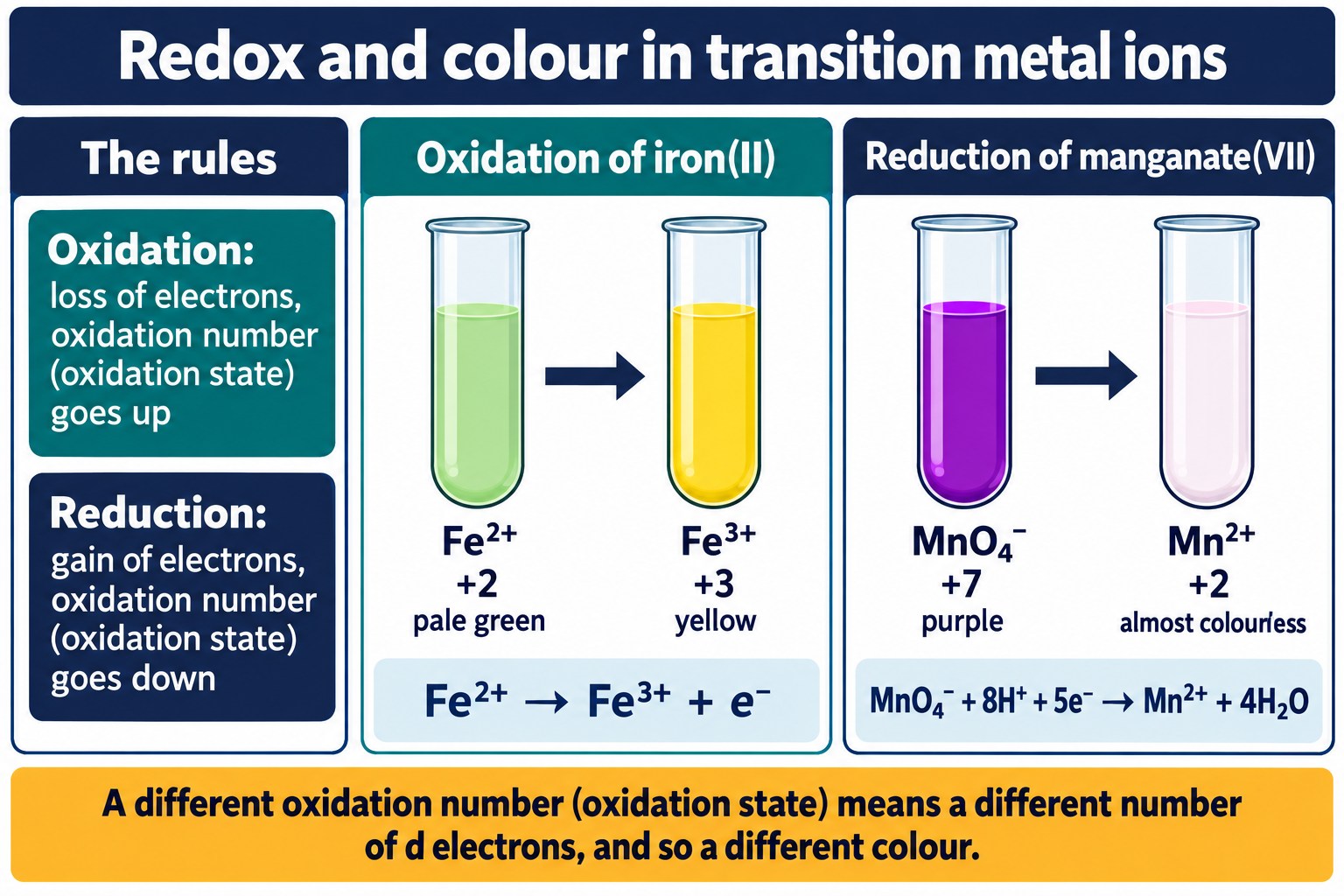
A change of oxidation state changes the colour of a transition metal ion: iron(II) to iron(III), and manganate(VII) to manganese(II).
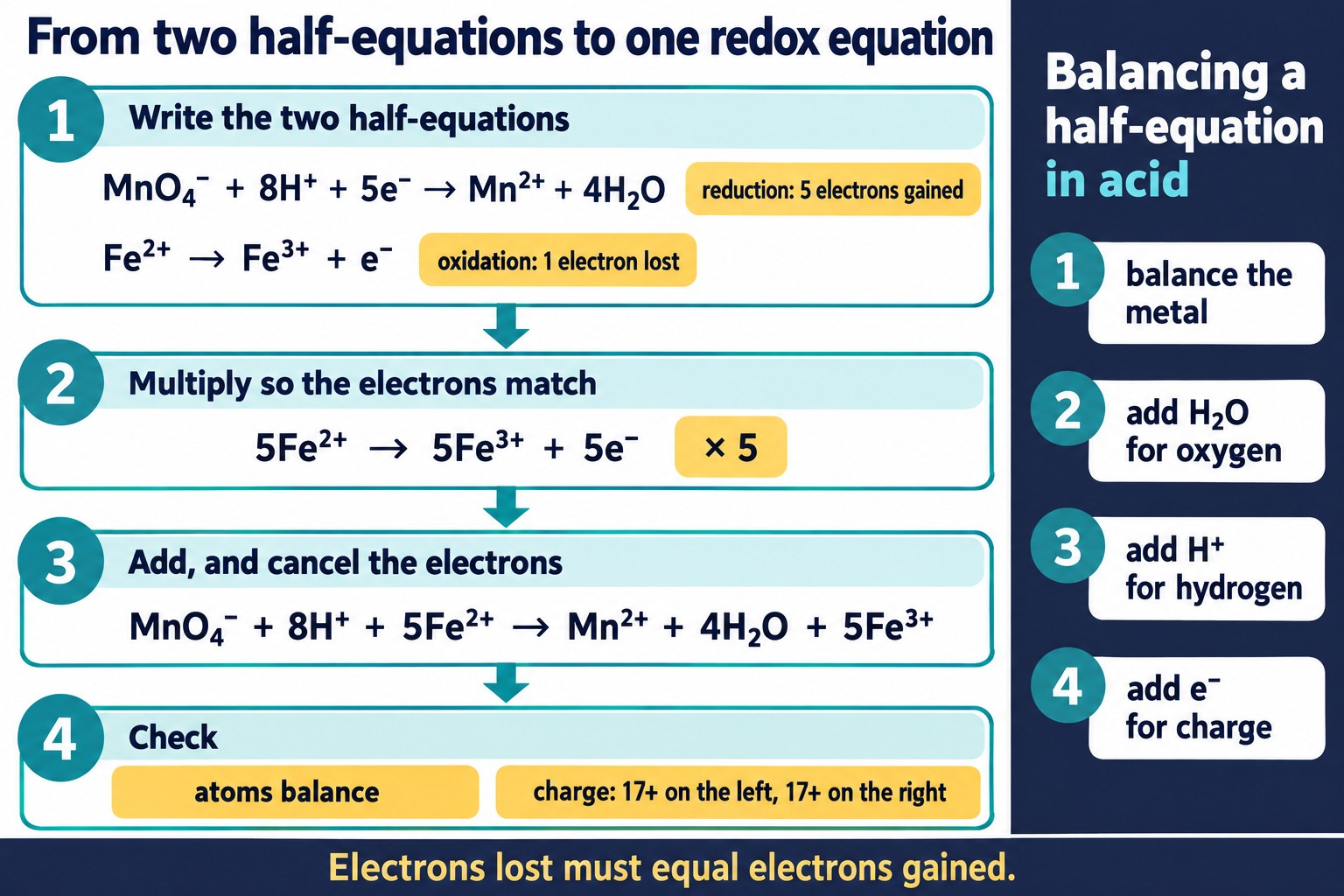
Two half-equations are combined by multiplying them so that the electrons lost equal the electrons gained.
General pattern: Ions with a high oxidation state, such as MnO₄⁻ and Cr₂O₇²⁻, are oxidising agents. Ions with a low oxidation state, such as Fe²⁺, are reducing agents.
Quick Check: Half-Equation for a New Ion
Apply the method to an ion that is new to this card.
The Oxidation States of Vanadium
Vanadium has four common oxidation states, each with its own colour in aqueous solution.
| Oxidation state | Ion | Name | Colour |
|---|---|---|---|
| +5 | VO₂⁺ | dioxovanadium(V) | yellow |
| +4 | VO²⁺ | oxovanadium(IV) | blue |
| +3 | V³⁺ | vanadium(III) | green |
| +2 | V²⁺ | vanadium(II) | violet (purple) |
Reduction by zinc in acid
Ammonium vanadate(V), NH₄VO₃, dissolves in acid to give yellow VO₂⁺ ions. Zinc is added, and the flask is swirled.
- Yellow → green: some VO₂⁺ has become blue VO²⁺, and the mixture of yellow and blue looks green.
- Green → blue: all the vanadium is now VO²⁺, +4.
- Blue → green: V³⁺ forms, +3.
- Green → violet: V²⁺ forms, +2.
Equations
- +5 to +4: 2VO₂⁺ + 4H⁺ + Zn → 2VO²⁺ + 2H₂O + Zn²⁺
- +4 to +3: 2VO²⁺ + 4H⁺ + Zn → 2V³⁺ + 2H₂O + Zn²⁺
- +3 to +2: 2V³⁺ + Zn → 2V²⁺ + Zn²⁺
- Zinc in acid is a powerful reducing agent, so the reduction goes all the way to +2.
- The flask is stoppered with cotton wool: hydrogen escapes, but air is kept out.
- In air, violet V²⁺ is quickly oxidised back to green V³⁺.
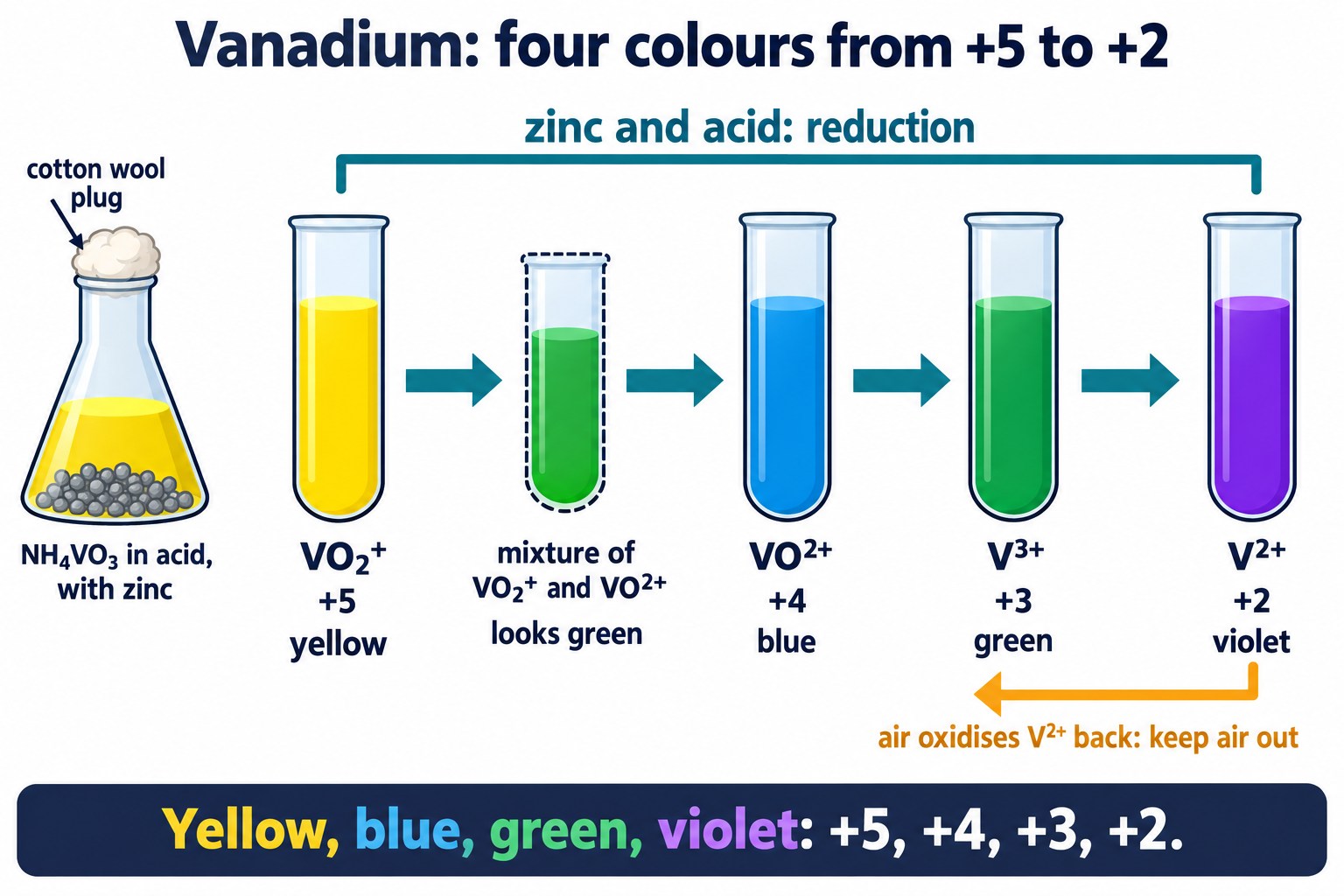
Vanadium is reduced by zinc in acid from +5 to +2. The first green colour is a mixture of yellow and blue ions.
Remember: Yellow, blue, green, violet for +5, +4, +3, +2. Two different greens appear: a mixture of +5 and +4 early on, and V³⁺ later.
Check: Oxidation States and Colour Changes
Assign oxidation states in transition metal species given in the question, and decide what has been oxidised and what has been reduced.
Redox Potentials Depend on pH and Ligand
The redox potential for a transition metal ion changing from a higher to a lower oxidation state is not fixed. It changes with the pH and with the ligands round the ion.
The effect of pH
- Many half-equations contain H⁺ ions, for example MnO₄⁻ + 8H⁺ + 5e⁻ ⇌ Mn²⁺ + 4H₂O.
- More acid moves this equilibrium to the right, so the potential becomes more positive.
- The ion is therefore a stronger oxidising agent in acidic solution.
- In alkaline solution the potential is less positive, so a low oxidation state is easier to oxidise.
| Chromium half-equation | Conditions | E⦵ / V |
|---|---|---|
| Cr₂O₇²⁻ + 14H⁺ + 6e⁻ ⇌ 2Cr³⁺ + 7H₂O | acidic | +1.33 |
| CrO₄²⁻ + 4H₂O + 3e⁻ ⇌ Cr(OH)₃ + 5OH⁻ | alkaline | −0.13 |
Chromium(III) is hard to oxidise in acid but easy to oxidise in alkali. Chromium(VI) is a strong oxidising agent only in acid.
The effect of the ligand
| Cobalt half-equation | E⦵ / V |
|---|---|
| [Co(H₂O)₆]³⁺ + e⁻ ⇌ [Co(H₂O)₆]²⁺ | +1.81 |
| [Co(NH₃)₆]³⁺ + e⁻ ⇌ [Co(NH₃)₆]²⁺ | +0.11 |
Aqua ion. With O₂ + 4H⁺ + 4e⁻ ⇌ 2H₂O (+1.23 V): E⦵cell = (+1.23) − (+1.81) = −0.58 V. Air does not oxidise [Co(H₂O)₆]²⁺.
Ammonia complex. With O₂ + 2H₂O + 4e⁻ ⇌ 4OH⁻ (+0.40 V): E⦵cell = (+0.40) − (+0.11) = +0.29 V. Air oxidises [Co(NH₃)₆]²⁺.
Changing the ligand from water to ammonia makes cobalt(II) much easier to oxidise. These are typical values: data needed in a question are given.
Key idea: Acidic conditions favour reduction of a high oxidation state. Alkaline conditions, or a change of ligand, can make a low oxidation state much easier to oxidise.
Check: Half-Equations and Redox Equations
Combine half-equations given in the question into balanced redox equations, and identify the oxidising agent and the reducing agent.
Tollens’ Reagent
Tollens’ reagent contains the colourless, linear complex ion [Ag(NH₃)₂]⁺. It is a mild oxidising agent.
[Ag(NH₃)₂]⁺(aq) + e⁻ → Ag(s) + 2NH₃(aq)
- An aldehyde reduces the silver(I) complex to metallic silver when warmed gently.
- A silver mirror forms on the inside of the test tube.
- The aldehyde is oxidised to a carboxylic acid (as its salt in the alkaline solution).
- A ketone cannot be oxidised in this way, so no silver mirror forms.
RCHO + 2[Ag(NH₃)₂]⁺ + 3OH⁻ → RCOO⁻ + 2Ag + 4NH₃ + 2H₂O
| Compound | Observation with warm Tollens’ reagent |
|---|---|
| aldehyde | silver mirror |
| ketone | no visible change: the solution stays colourless |
Silver changes from +1 to 0. This reduction is the test that distinguishes aldehydes from ketones.
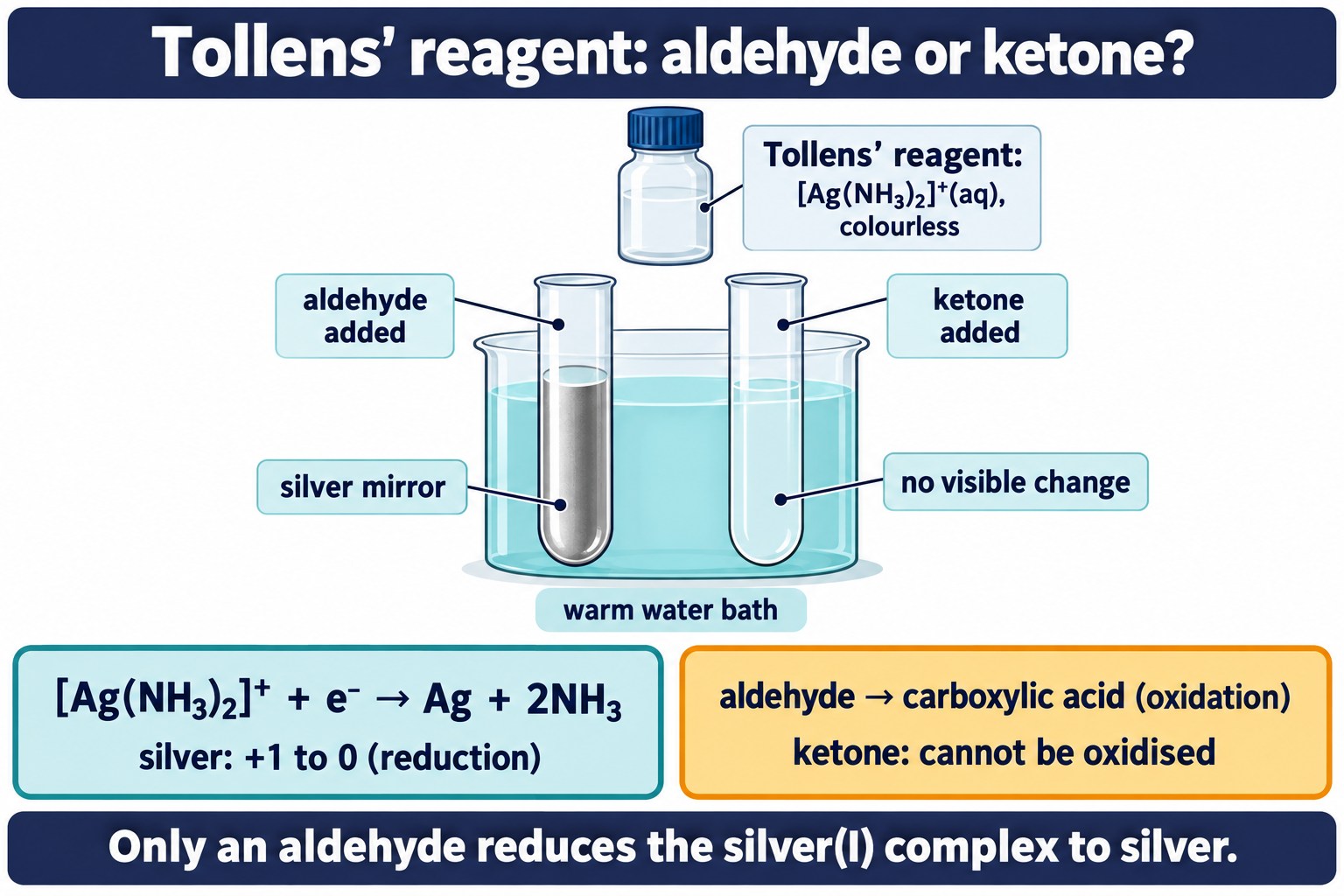
Tollens’ reagent with an aldehyde and with a ketone: only the aldehyde reduces the silver(I) complex to a silver mirror.
Quantitative redox reactions of manganate(VII) ions are covered on Redox Titrations with Transition metal Ions.
Common Exam Points
Say
- “The oxidation state of the metal decreases, so it is reduced.”
- “The first green colour is a mixture of yellow VO₂⁺ and blue VO²⁺.”
- “The aldehyde reduces [Ag(NH₃)₂]⁺ to silver.”
Do not say
- “The colour changes” without naming both colours.
- “VO₂⁺ is vanadium(IV)” (VO₂⁺ is +5; VO²⁺ is +4).
- “The redox potential of an ion is always the same” (it depends on pH and on the ligand).
Watch for
- Balance the electrons before adding two half-equations.
- Balance oxygen with H₂O and hydrogen with H⁺ in acidic solution.
- Check the final equation: the atoms and the total charge must balance.
- Air re-oxidises ions with a low oxidation state, such as V²⁺, so the flask is closed with cotton wool.
Check: Redox Reactions of Transition metals
Interpret redox reactions that are new to you: oxidation states, electrons transferred, balanced equations and the colour changes described.
FAQs
Use these quick answers to check oxidation states, half-equations and the redox chemistry of vanadium, pH and Tollens’ reagent.
How do I work out the oxidation state of chromium in Cr₂O₇²⁻?
Oxygen is −2, so seven oxygen atoms total −14. The ion has a charge of 2−, so the two chromium atoms total +12. Each chromium atom is therefore +6. In the same way, manganese in MnO₄⁻ is +7.
How do I combine the dichromate(VI) and iron(II) half-equations?
Cr₂O₇²⁻ + 14H⁺ + 6e⁻ → 2Cr³⁺ + 7H₂O needs six electrons, and each Fe²⁺ → Fe³⁺ + e⁻ supplies one. Multiply the iron half-equation by 6, then add: Cr₂O₇²⁻ + 14H⁺ + 6Fe²⁺ → 2Cr³⁺ + 7H₂O + 6Fe³⁺.
What are the colours of the vanadium oxidation states?
VO₂⁺ (+5) is yellow, VO²⁺ (+4) is blue, V³⁺ (+3) is green and V²⁺ (+2) is violet. With zinc in acid the solution goes yellow, green, blue, green, then violet. The first green is a mixture of yellow and blue.
How does pH affect a redox potential?
Many half-equations contain H⁺ ions, such as MnO₄⁻ + 8H⁺ + 5e⁻ ⇌ Mn²⁺ + 4H₂O. More acid shifts this equilibrium to the right, so the potential becomes more positive. In alkali, a low oxidation state is easier to oxidise.
Why does Tollens’ reagent give a silver mirror with aldehydes?
The complex ion [Ag(NH₃)₂]⁺ is a mild oxidising agent. It oxidises an aldehyde and is itself reduced: [Ag(NH₃)₂]⁺ + e⁻ → Ag + 2NH₃. Silver coats the tube. Ketones are not oxidised, so they give no mirror.

Copyright notice: This OLS revision content, including the explanations, layout, diagrams, tables and embedded learning structure, is authored for Online Learning System by Dr. Mohammed Al-Fatah. It may not be copied, reproduced, redistributed or adapted without written permission.
Keep this note — free
Save your progress across every AQA topic. A free account remembers which topics you have covered, saves your question scores, and syncs across your phone and laptop.
- Track every topic you have finished
- Keep your practice-question scores
- No payment, no card, free forever
Already registered? Log in