Structure and Bonding in Benzene
A concise revision guide to the structure of benzene: the Kekulé model, the delocalised model with sideways overlap of p orbitals, the planar hexagonal ring with equal bond lengths, how benzene is drawn in equations and mechanisms, and the names of simple aromatic compounds.
Bonding in Benzene
Choose a step to watch the flat ring of carbons form, a p orbital rise on each carbon and the six join into one delocalised ring of electrons.
© Dr. Mohammed Al-Fatah – onlinelearningsystem.net
Recap: Bonding in Alkenes
Five quick questions on what you already know from 3.3.4 Alkenes: the planar shape around a C=C bond, restricted rotation and E–Z isomers, why a C=C bond attracts electrophiles, and the lengths of single and double carbon–carbon bonds.
Benzene: the Simplest Arene
Benzene, C₆H₆, is a planar molecule. Six carbon atoms form a regular hexagonal ring, and one hydrogen atom is bonded to each carbon.
- Each carbon is bonded to two other carbons and one hydrogen by single covalent bonds.
- Every bond angle in the ring is 120°, so all twelve atoms lie in one plane.
- Three of the four outer electrons of each carbon are used in these bonds. One electron is left over.
- Benzene is an arene: a hydrocarbon that contains a benzene ring.
Remember: A hexagon has six corners and six sides, so benzene has six C–C bonds and six C–H bonds in its flat framework. The fourth outer electron of each carbon is dealt with below.
The Kekulé Model (1865)
Kekulé suggested that the ring held alternating single and double bonds: cyclohexa-1,3,5-triene. The double bonds could sit on either set of alternate sides, giving two equivalent structures.
- It gives each carbon four bonds, which fits the formula C₆H₆.
- It predicts two bond lengths: three long C–C bonds of 0.154 nm and three short C=C bonds of 0.134 nm.
- It predicts that benzene should react like an alkene, by addition across the double bonds.
Three problems with the Kekulé model
| Prediction | What is found |
|---|---|
| two different bond lengths | all six C–C bonds are the same length, 0.139 nm |
| about as stable as three C=C bonds | benzene is 152 kJ mol⁻¹ more stable than expected |
| addition reactions like an alkene | benzene resists addition and does not decolourise bromine water |
The evidence behind each line is set out in Evidence for the Structure of Benzene.
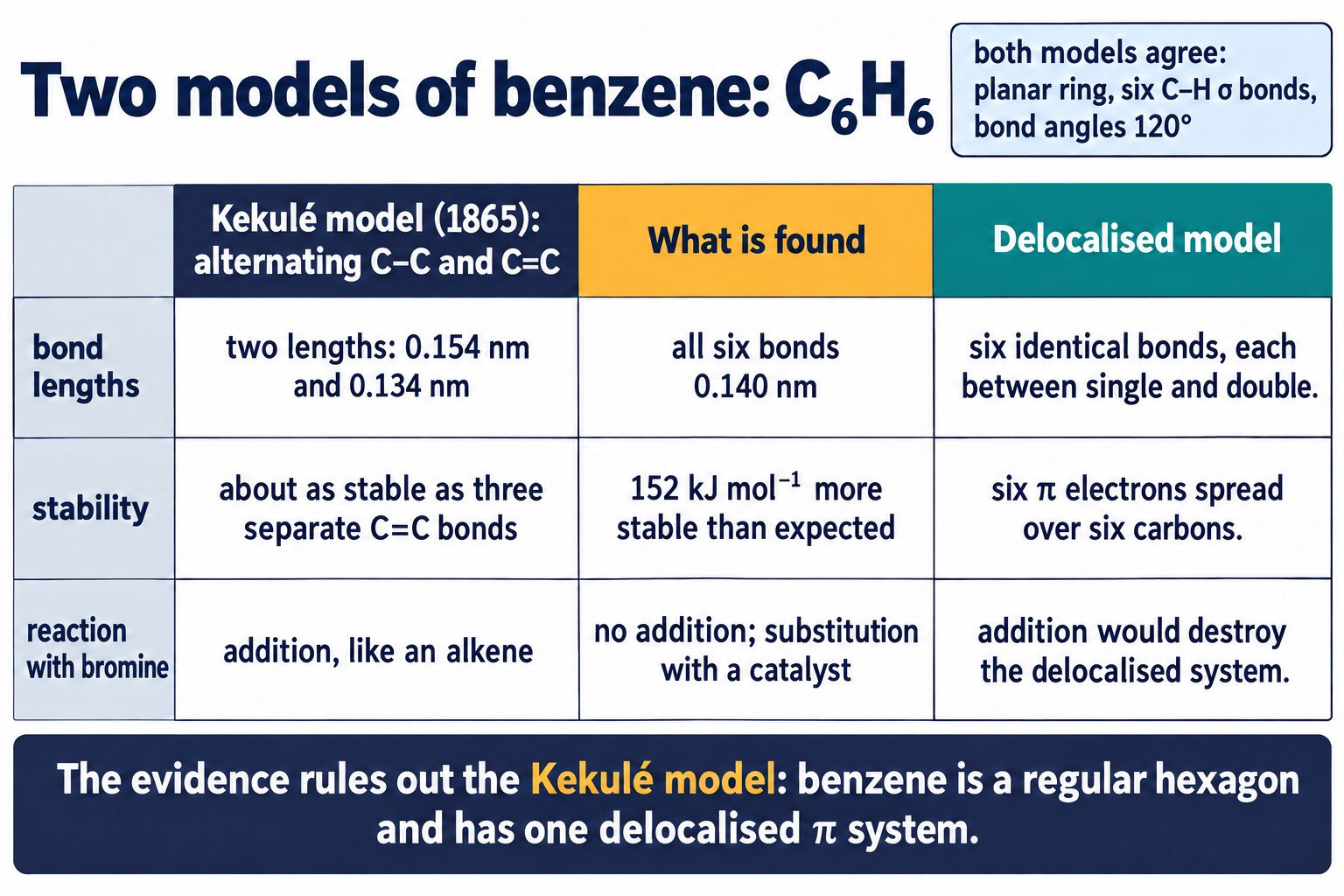
The two models side by side: what the Kekulé model predicts, what is actually observed, and how the delocalised model accounts for it.
Exam focus: Kekulé is not “wrong” in an exam answer: say that it does not fit the evidence of equal bond lengths, extra stability and resistance to addition, and then describe the delocalised model.
The Delocalised Model
In the modern model the fourth outer electron of each carbon sits in a p orbital perpendicular to the plane of the ring. These six p orbitals overlap sideways.
- Each carbon forms three bonds in the plane of the ring and has one electron left in a p orbital.
- The p orbital on each carbon overlaps sideways with the p orbitals on both of its neighbours.
- The overlap forms one continuous delocalised system: a ring of electron density above and a matching ring below the plane.
- The six p electrons are delocalised: they are spread over all six carbons and belong to no single pair of atoms.
| Feature | Kekulé model | Delocalised model |
|---|---|---|
| the six p electrons | held in pairs in three separate C=C double bonds | spread over all six carbons as delocalised p electrons |
| C–C bond lengths | 0.154 nm and 0.134 nm | all 0.139 nm |
| bond order | single and double | between single and double |
| shape | planar hexagon | planar regular hexagon |
Exam focus: A full description needs four points: a p orbital on each carbon, perpendicular to the ring; sideways overlap; a ring of delocalised p electrons above and below the plane; six electrons spread over six carbons.
Why All Six Bonds Are the Same
Every C–C bond in benzene is a single bond plus an equal share of the six delocalised p electrons. The bonds are identical, with a length of 0.139 nm.
| Bond | Length / nm | Found in |
|---|---|---|
| C–C single | 0.154 | ethane, cyclohexane |
| benzene C–C | 0.139 | benzene: all six bonds |
| C=C double | 0.134 | ethene, cyclohexene |
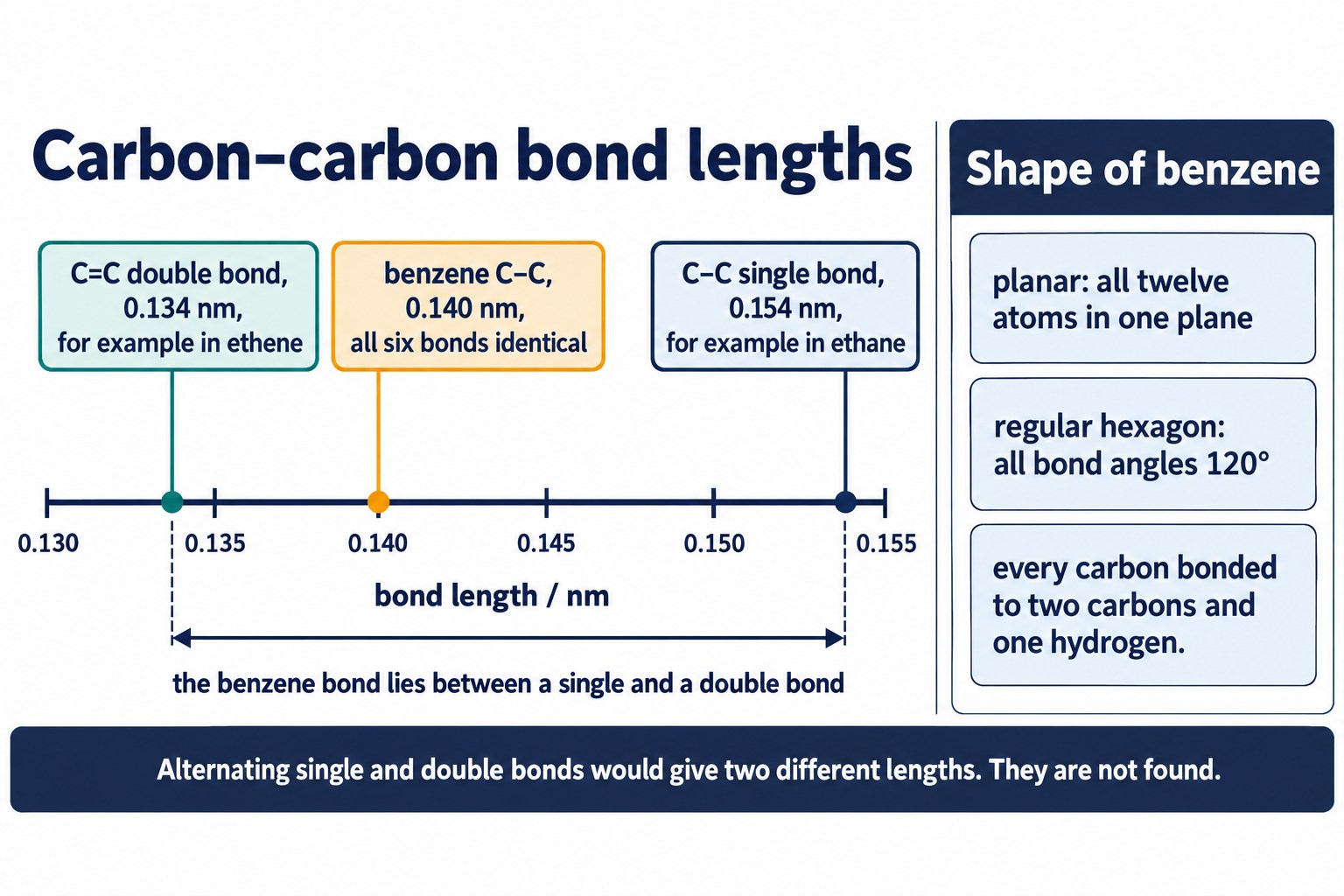
The three bond lengths on one scale. The benzene value sits between a single and a double bond because each bond holds one shared pair plus part of the delocalised p electrons. The poster rounds the benzene bond to 0.140 nm; the accepted value is 0.139 nm.
- Six delocalised p electrons shared over six bonds is one extra electron per bond, so each bond is “one and a half” bonds.
- A regular hexagon with equal sides is exactly what the delocalised model predicts and what is measured.
Remember: The bond length 0.139 nm is intermediate: shorter than a single bond (0.154 nm) and longer than a double bond (0.134 nm).
Extension: beyond the AQA specification
Other specifications describe benzene with σ and π bonds. Each carbon forms three σ bonds in the plane of the ring by end-on overlap: twelve σ bonds in all, six C–C and six C–H. Each ring carbon is sp² hybridised.
The six p orbitals overlap sideways to give a delocalised π system of six π electrons above and below the ring. Each C–C bond is then one σ bond plus a share of the π system.
Check: Bonding in Benzene
Check the bonding, the delocalised p electrons and the bond length in benzene, and why every carbon–carbon bond is the same.
How Benzene Is Represented
Three drawings of benzene are accepted. Each is used for a different purpose.
| Representation | What it shows | When to use it |
|---|---|---|
| skeletal hexagon with a circle | the six delocalised p electrons | reactants and products in equations |
| Kekulé hexagon with three double bonds | three separate C=C double bonds | mechanisms: the first curly arrow can start on a C=C bond or on the circle |
| displayed formula | every C and H written out | showing the formula C₆H₆ in full |
| molecular formula C₆H₆ | atoms only | balanced equations written in a line |
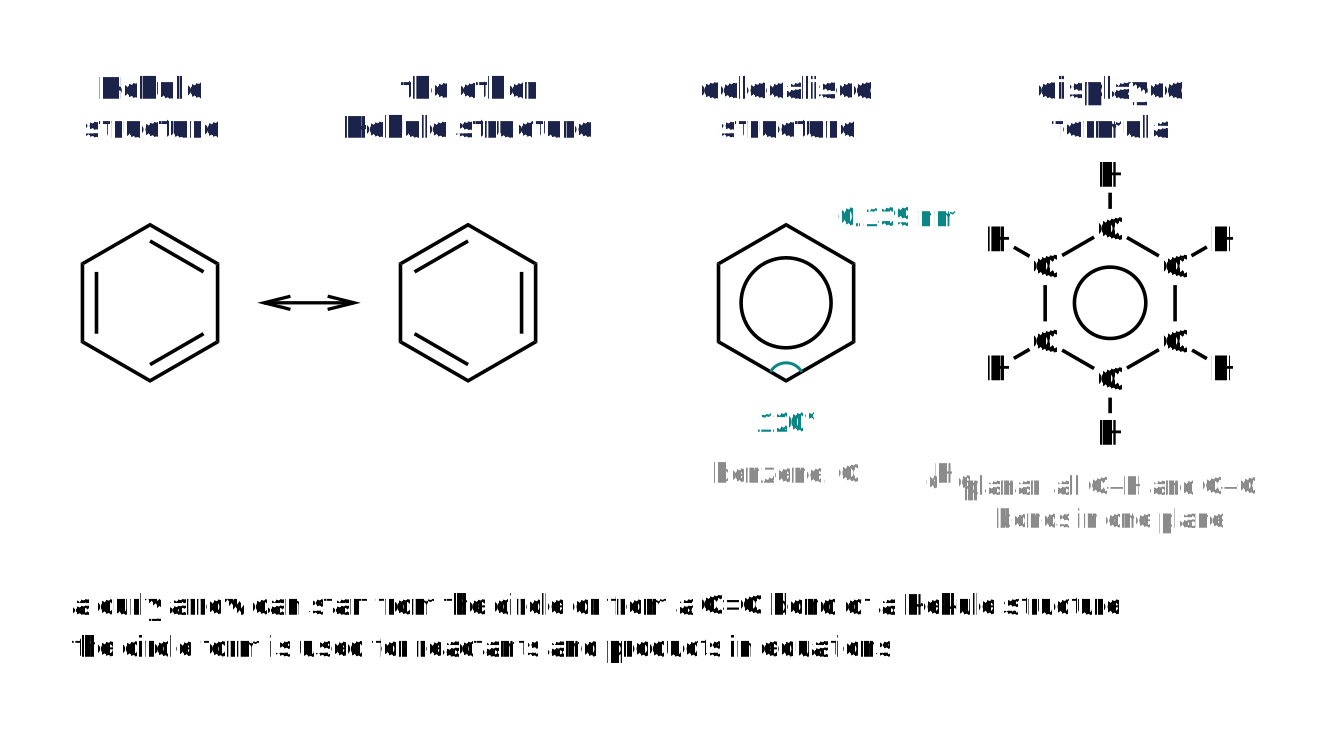
The two Kekulé structures, the circle form with its bond length and angle, and the displayed formula. Either form can be used in mechanisms; the circle form is used in equations.
- In a mechanism, a curly arrow can start from the circle (the delocalised ring) or from a C=C bond of a Kekulé structure.
- In an equation, C₆H₆ or the circle form is accepted, and the hydrogen atoms need not be drawn.
- When a group replaces a hydrogen, draw the group on one corner and leave the other five hydrogens implied.
Exam focus: A circle inside the hexagon stands for six delocalised p electrons. Do not draw a circle and three double bonds together: that counts the six delocalised p electrons twice.
Aromatic Words and the Phenyl Group
Benzene is the parent of a family of aromatic compounds. A benzene ring attached to something else as a substituent is called the phenyl group, C₆H₅–.
| Term | Meaning | Example |
|---|---|---|
| aromatic | containing a benzene ring | nitrobenzene, phenol |
| Arene | an aromatic hydrocarbon | benzene, methylbenzene |
| aliphatic | chains or non-aromatic rings, no benzene ring | hexane, cyclohexene |
| phenyl group, C₆H₅– | a benzene ring as a substituent | phenylethanone, C₆H₅COCH₃ |
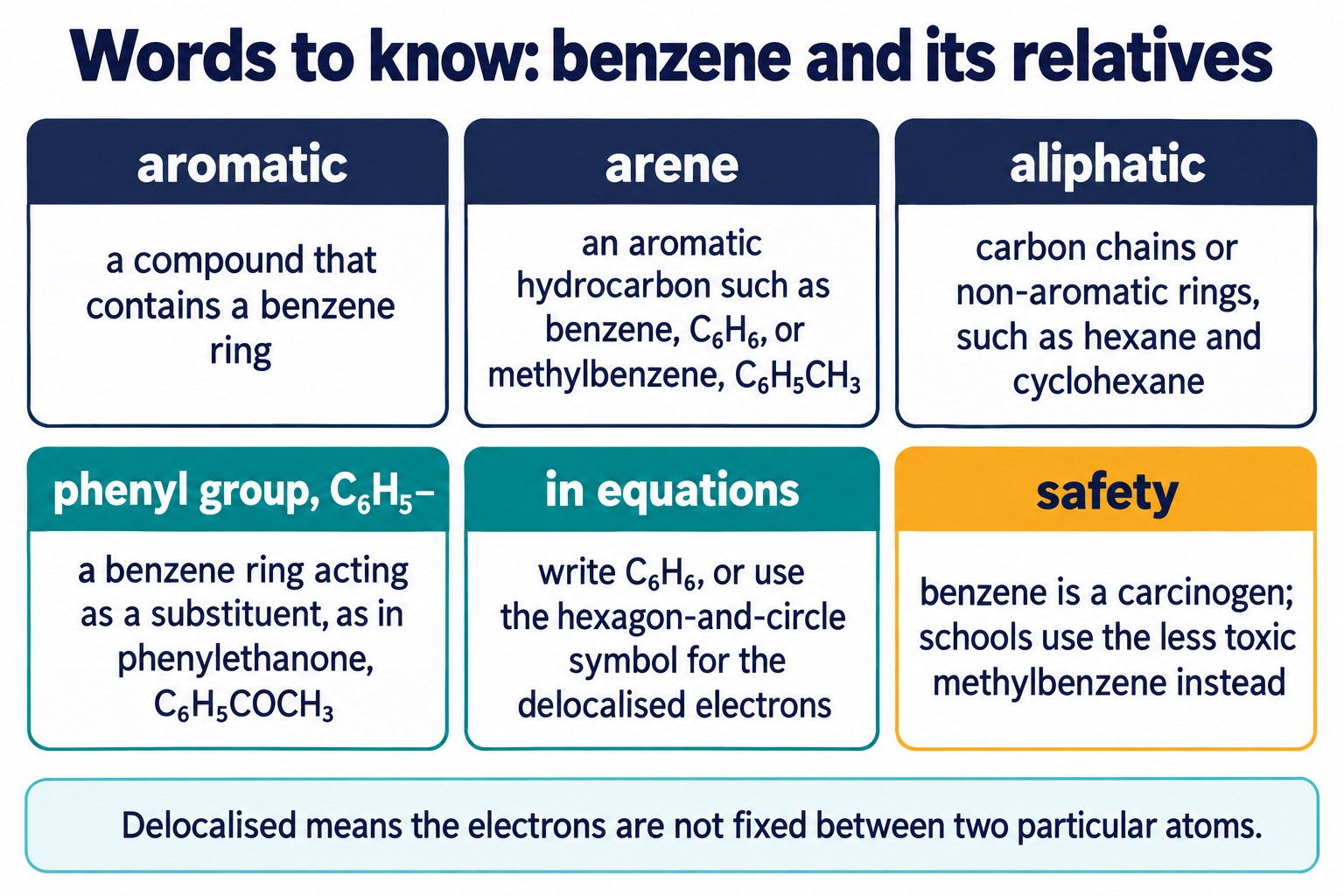
The vocabulary of the topic in one glossary: aromatic, arene, aliphatic, the phenyl group, how to write benzene in equations and a note on toxicity.
- Benzene is a carcinogen, so it is not used in schools. The less toxic methylbenzene is used instead.
- In formulae, C₆H₅– shows a ring with one hydrogen replaced: phenol is C₆H₅OH and bromobenzene is C₆H₅Br.
Naming Simple Aromatic Compounds
Most simple names treat benzene as the parent and the attached group as a prefix. A few compounds have their own parent names.
| Group on the ring | Name | Formula |
|---|---|---|
| –CH₃ | methylbenzene | C₆H₅CH₃ |
| –CH₂CH₃ | ethylbenzene | C₆H₅CH₂CH₃ |
| –Cl | chlorobenzene | C₆H₅Cl |
| –Br | bromobenzene | C₆H₅Br |
| –NO₂ | nitrobenzene | C₆H₅NO₂ |
| –OH | phenol | C₆H₅OH |
| –NH₂ | phenylamine | C₆H₅NH₂ |
Phenyl as the substituent
- When the chain or functional group is the parent, the ring is named phenyl.
- Phenylethanone, C₆H₅COCH₃: a ketone with a phenyl group on the carbonyl carbon.
- Phenylethene, C₆H₅CH=CH₂: an alkene carrying a phenyl group.
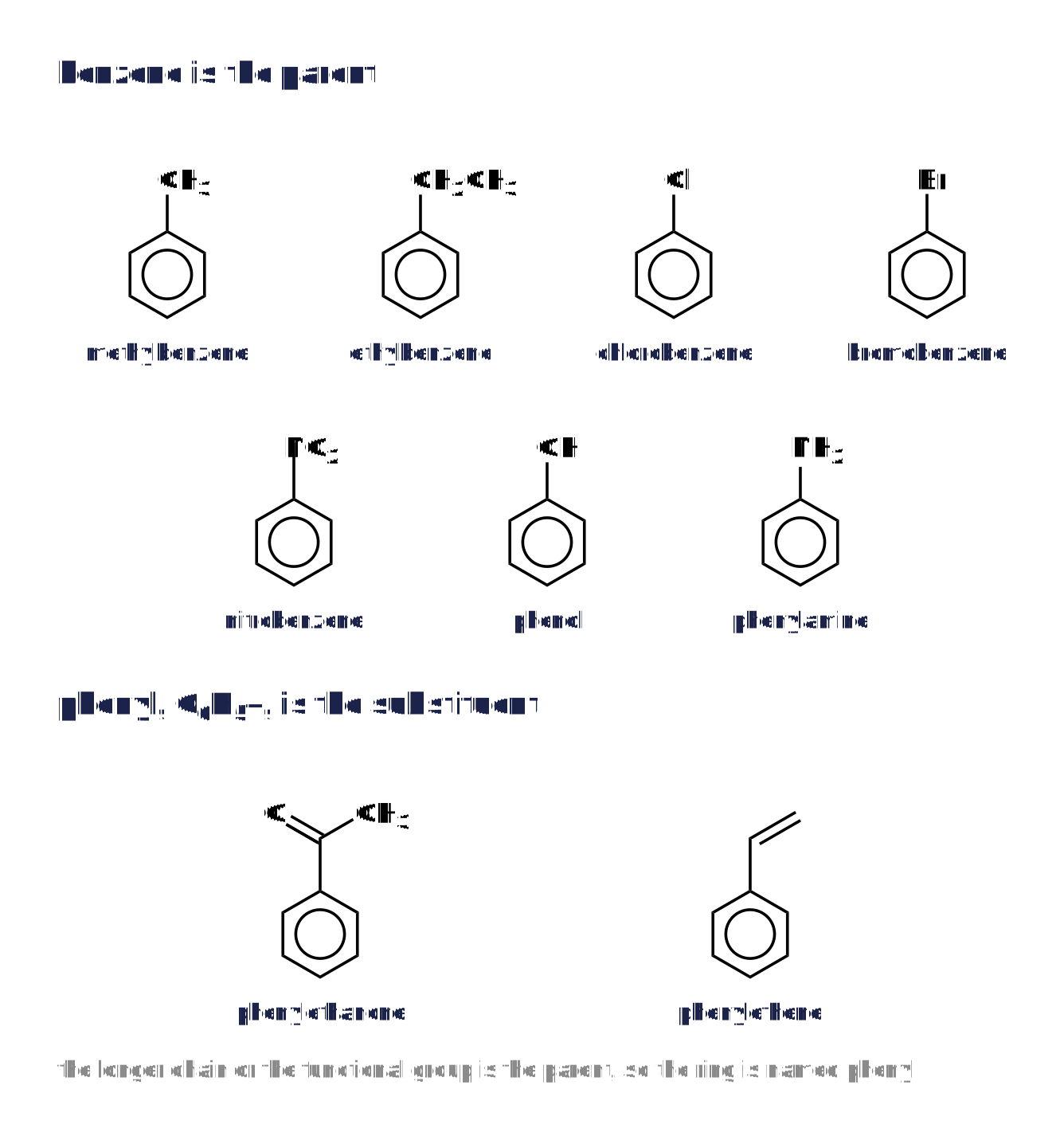
Nine simple aromatic compounds with their names: seven named from benzene and two named with phenyl as the substituent.
Remember: Phenol and phenylamine are parent names in their own right. Hydroxybenzene and aminobenzene are not used.
Check: Representations and Simple Names
Choose the right drawing of benzene for an equation or a mechanism, and match simple aromatic compounds to their names.
Common Exam Points
- Benzene is planar: each carbon forms three bonds at 120°, and one electron per carbon sits in a p orbital perpendicular to the ring.
- The p orbitals overlap sideways with both neighbours to form one ring of delocalised p electrons above and below the plane, holding six electrons.
- All six C–C bonds are 0.139 nm, between a single bond (0.154 nm) and a double bond (0.134 nm).
- The Kekulé model fails on three counts: equal bond lengths, extra stability and resistance to addition.
- In mechanisms, start the arrow from the circle or from a C=C bond of a Kekulé structure; use the circle form in equations.
- Phenyl, C₆H₅–, is a benzene ring acting as a substituent, as in phenylethanone and phenylethene.
FAQs
Use these quick answers to check the Kekulé and delocalised models of benzene, its bond lengths and how arenes are drawn and named.
Why are all the carbon–carbon bonds in benzene the same length?
Each carbon has one electron in a p orbital perpendicular to the ring. The six p orbitals overlap sideways with both neighbours, so the six electrons are delocalised over all six carbons. Every C–C bond is 0.139 nm, between a single and a double bond.
What was wrong with the Kekulé structure?
Kekulé drew alternating single and double bonds, which would need bonds of two lengths, 0.154 nm and 0.134 nm. Real benzene has six equal bonds, is more stable than that structure predicts and does not undergo addition like an alkene.
Which drawing of benzene should I use in equations and mechanisms?
In equations use C₆H₆ or the hexagon with a circle, which shows the six delocalised p electrons. In mechanisms either drawing is accepted: the first curly arrow can start on a C=C bond of the Kekulé hexagon or on the circle, but never on a hydrogen atom.
What is the difference between the phenyl group and benzene?
Benzene is the molecule C₆H₆. The phenyl group, C₆H₅–, is a benzene ring attached to something else as a substituent. Phenylethene and phenylethanone are named this way because the chain, not the ring, is the parent.
Why are the bond angles in benzene 120°?
Each carbon forms three bonds, to two carbons and one hydrogen, all in the plane of the ring. Three bonding pairs repel each other equally and spread out at 120°, so the ring is a regular, planar hexagon.

Copyright notice: This OLS revision content, including the explanations, layout, diagrams, tables and embedded learning structure, is authored for Online Learning System by Dr. Mohammed Al-Fatah. It may not be copied, reproduced, redistributed or adapted without written permission.
Keep this note — free
Save your progress across every AQA topic. A free account remembers which topics you have covered, saves your question scores, and syncs across your phone and laptop.
- Track every topic you have finished
- Keep your practice-question scores
- No payment, no card, free forever
Already registered? Log in