Planning a Synthetic Route
A concise revision guide to multi-step organic synthesis: the reaction map that joins every functional group, how to plan a route of up to 4 steps backwards from the target, worked routes for aliphatic and aromatic targets, and why chemists design routes with fewer steps, a high atom economy, no solvent and safer starting materials.
Before You Start
A synthesis question joins reactions from the whole course. Nothing new is taught here: the skill is choosing and ordering reactions you already know.
- Adding a carbon to a ring: Friedel–Crafts Acylation; to a chain, CN⁻ or HCN (below).
- Nucleophilic substitution of halogenoalkanes by OH⁻, CN⁻ and NH₃: Nucleophilic Substitution Reactions.
- Oxidation of alcohols, reduction of carbonyl compounds, HCN addition: Reduction and Nucleophilic Addition.
- Acyl chlorides with water, alcohols, ammonia and amines: Acyl Chlorides.
- Nitration of benzene, reduction of nitrobenzene and the directing effects of groups on the ring: 3.3.10 Aromatic Chemistry and 3.3.11 Amines.
- Identifying each intermediate by its tests and spectra: Identifying Functional Groups by Chemical Tests and Deducing Formulae from Analytical Data.
The Reaction Map
Every functional group is joined to its neighbours by a reaction with a known reagent. Learn the map as a web of arrows: each arrow is one step, one reagent and one set of conditions.
| From | To | Reagent and conditions |
|---|---|---|
| alkene | halogenoalkane | HBr at room temperature (electrophilic addition) |
| alkene | alcohol | steam, H₃PO₄ catalyst, 300 °C, 60 atm (hydration) |
| halogenoalkane | alcohol | NaOH(aq), heat under reflux (nucleophilic substitution) |
| halogenoalkane | nitrile | KCN in ethanol, heat under reflux (+1 carbon) |
| halogenoalkane | primary amine | excess concentrated NH₃ in ethanol, heated under pressure |
| halogenoalkane | alkene | KOH in ethanol, heat under reflux (elimination) |
| alcohol | halogenoalkane | PCl₅ (chloro-) or NaBr with concentrated H₂SO₄ (bromo-) |
| primary alcohol | aldehyde | K₂Cr₂O₇ / dilute H₂SO₄, distil the aldehyde as it forms |
| primary alcohol | carboxylic acid | K₂Cr₂O₇ / dilute H₂SO₄, heat under reflux |
| secondary alcohol | ketone | K₂Cr₂O₇ / dilute H₂SO₄, heat under reflux |
| aldehyde or ketone | alcohol | NaBH₄ in water or ethanol (reduction) |
| aldehyde or ketone | hydroxynitrile | HCN with KCN (nucleophilic addition, +1 carbon) |
| nitrile | carboxylic acid | dilute HCl, heat under reflux (hydrolysis) (extension: beyond the AQA specification) |
| nitrile | primary amine | LiAlH₄ in dry ether, or H₂ with a nickel catalyst (reduction) |
| carboxylic acid | acyl chloride | PCl₅ (or SOCl₂) at room temperature |
| carboxylic acid | ester | alcohol with concentrated H₂SO₄ catalyst, heat under reflux |
| acyl chloride | ester / amide | alcohol / ammonia or amine, room temperature (addition-elimination) |
| ester | carboxylic acid | dilute acid under reflux, or NaOH(aq) under reflux then acidify |
| benzene | nitrobenzene | concentrated HNO₃ and concentrated H₂SO₄ at about 50 °C, below 60 °C (nitration) |
| nitrobenzene | phenylamine | Sn and concentrated HCl under reflux, then NaOH(aq) |
| benzene | alkyl- or acylbenzene | halogenoalkane or acyl chloride with an AlCl₃ catalyst (Friedel–Crafts) |
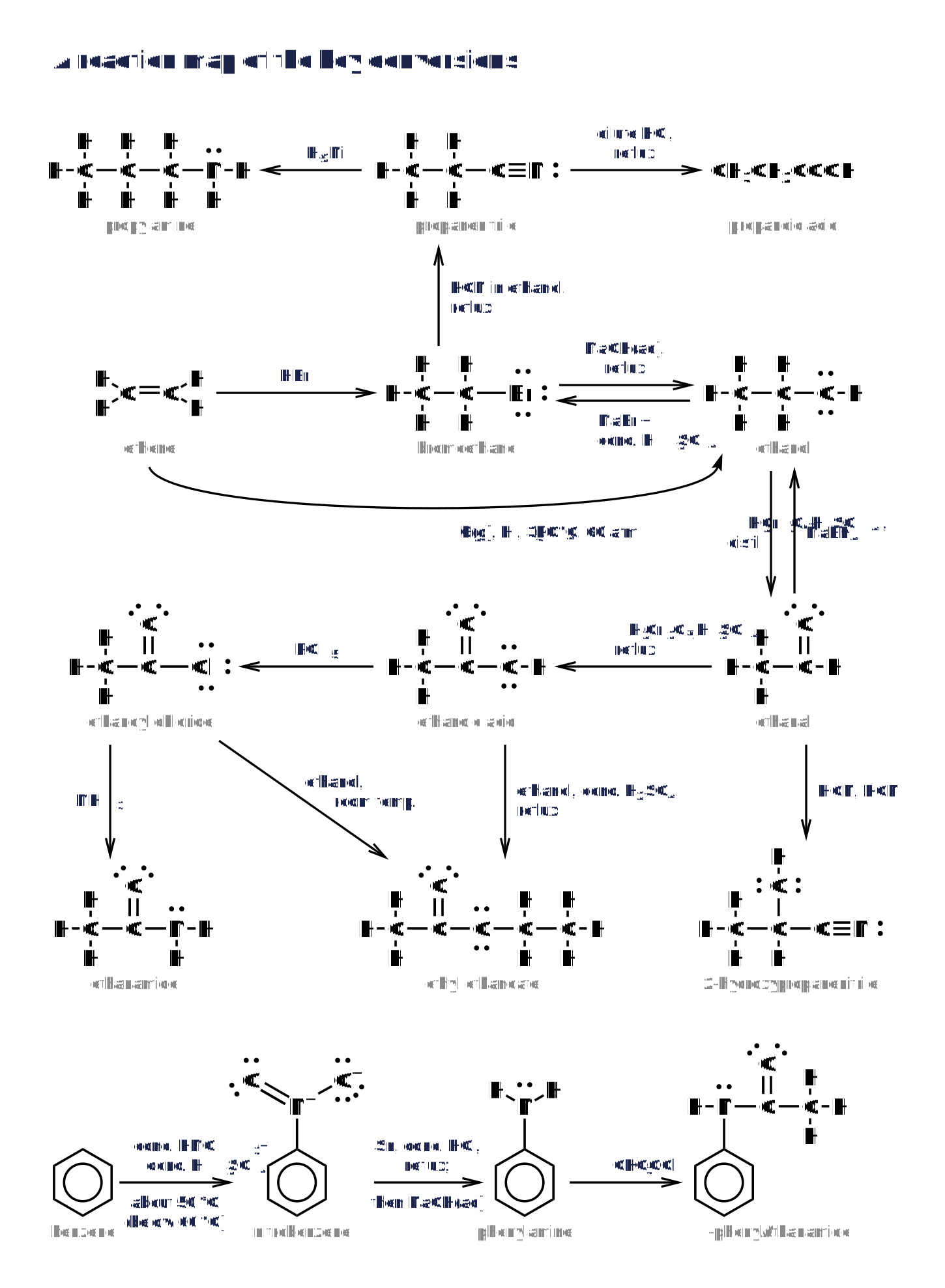
The map drawn as structures: the two-carbon web from ethene, with the nitrile and hydroxynitrile branches, and the benzene row underneath, reagents on every arrow.
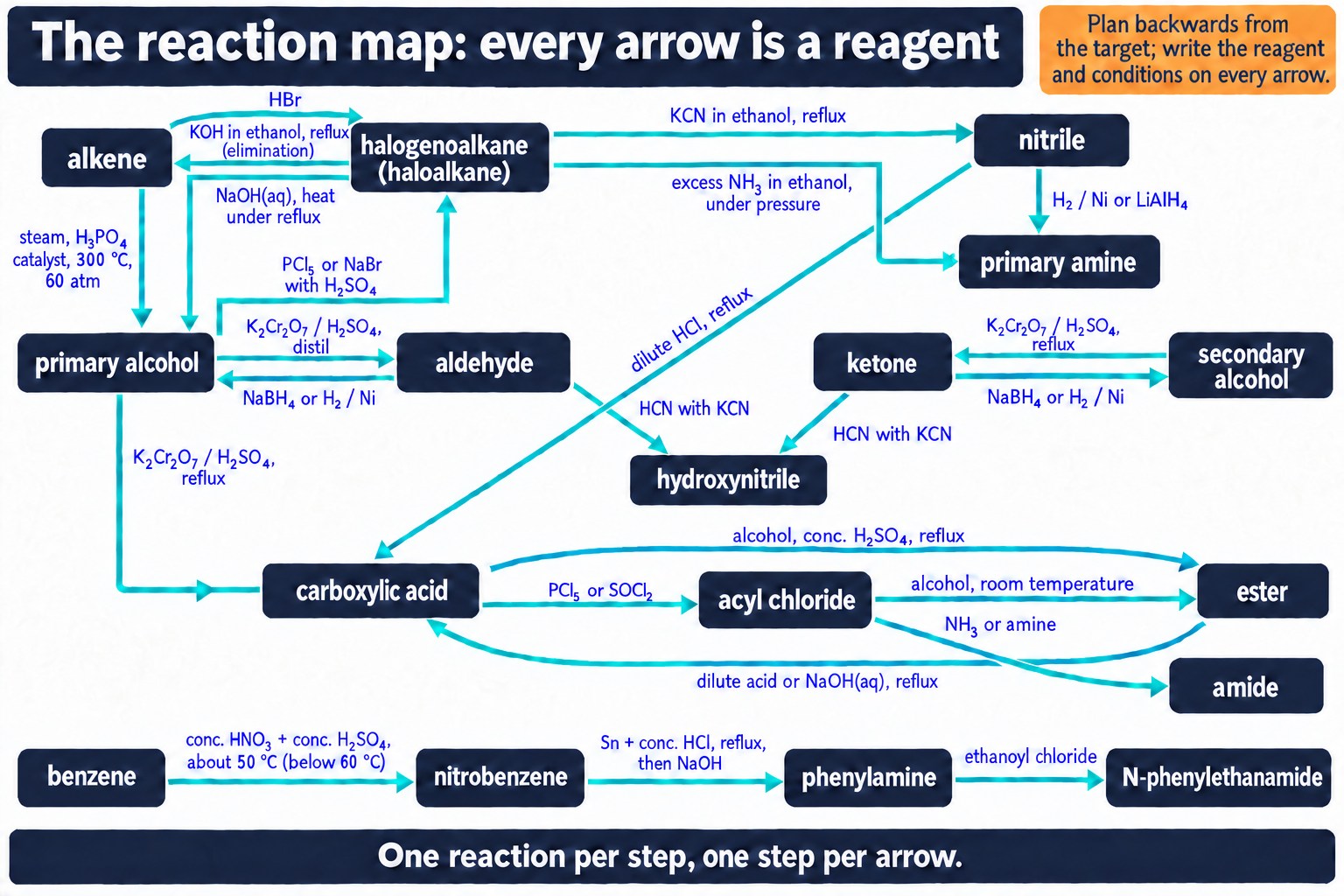
The same map as named boxes: use it to trace any route with your finger before writing it down.
Exam focus: Oxidising agent and conditions are both needed: K₂Cr₂O₇ / H₂SO₄ with distil for an aldehyde and with reflux for the acid. Reflux and distil are different answers.
How to Plan a Route
Work backwards from the target, one step at a time, until the starting material appears. Routes in questions have up to 4 steps.
- Compare the carbon skeletons: same number of carbons, one more, or a ring? One more carbon means a nitrile step somewhere.
- Name the functional group of the start and of the target and find the arrows that join them on the map.
- Ask what the target can be made from in one step; then what that intermediate can be made from; stop at the start.
- Write the reagent and conditions for every step and name the type of reaction.
- Check the route: no step over the limit, every intermediate named, side reactions and excess reagents considered.
Working backwards: ethanoic acid from ethene
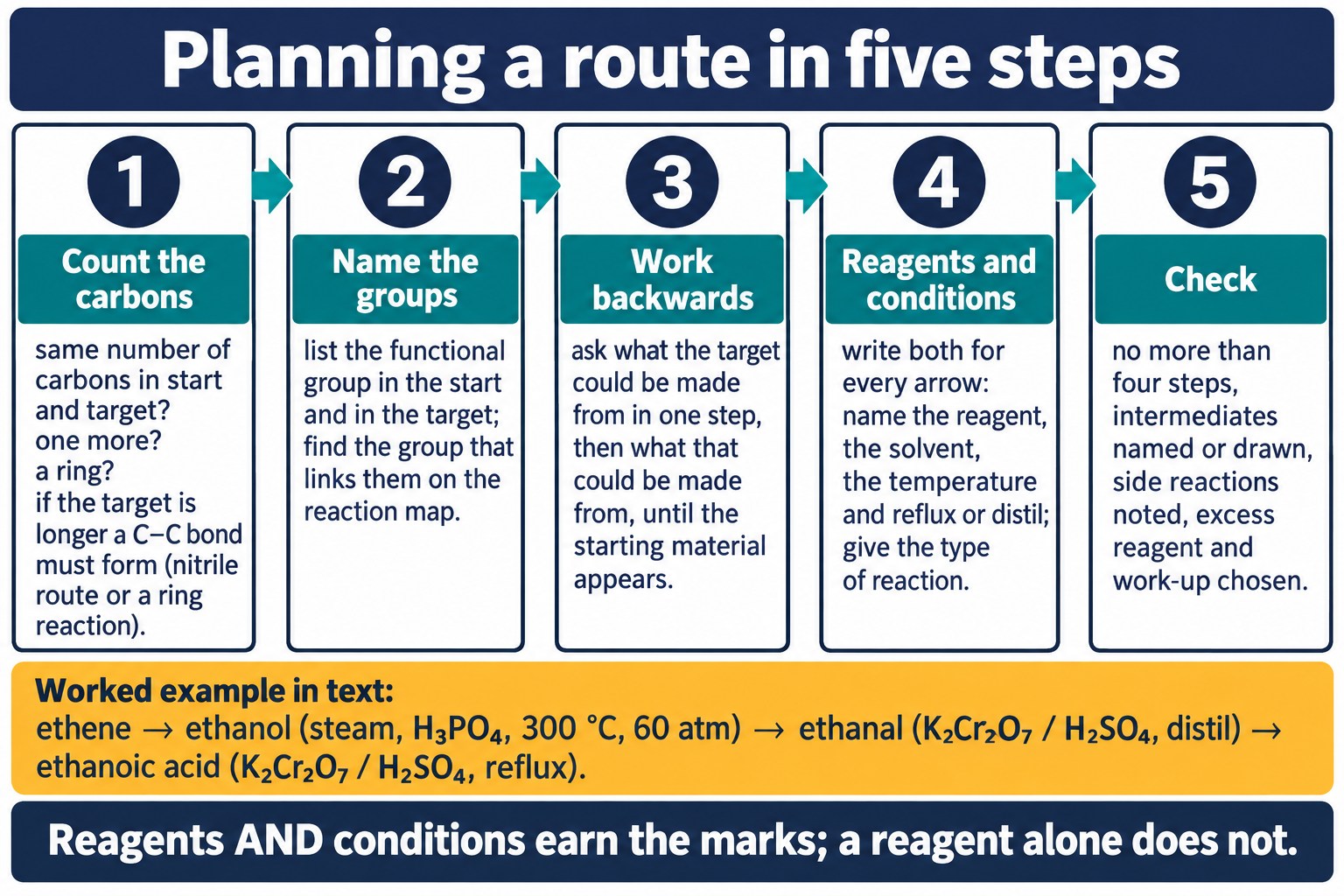
The five planning steps as a checklist, with the ethene to ethanoic acid example worked underneath.
Common mistake: Writing a reagent without conditions, or two changes in one arrow. One arrow is one reaction: an alcohol does not become an ester in a single step from an acyl chloride and an acid at once.
Check: Reading the Reaction Map
Supply the missing reagent and conditions on a route, name the type of each reaction and decide whether the number of carbons changes.
Worked Routes 1: Aliphatic Targets
Three routes of two or three steps, each written as a question would expect it: intermediate, reagent, conditions and type of reaction.
Route (a): ethene to ethanoic acid through ethanal
Step 1. Ethene + steam, H₃PO₄ catalyst, 300 °C and 60 atm → ethanol (hydration, electrophilic addition).
Route (b): 1-bromopropane to butanoic acid or butylamine
Route (c): propan-2-ol to 2-hydroxy-2-methylpropanoic acid
Step 1. Propan-2-ol + K₂Cr₂O₇ / dilute H₂SO₄, heat under reflux → propanone (oxidation of a secondary alcohol to a ketone).
Step 2. Propanone + HCN with KCN → 2-hydroxy-2-methylpropanenitrile, (CH₃)₂C(OH)CN (nucleophilic addition, one carbon added).
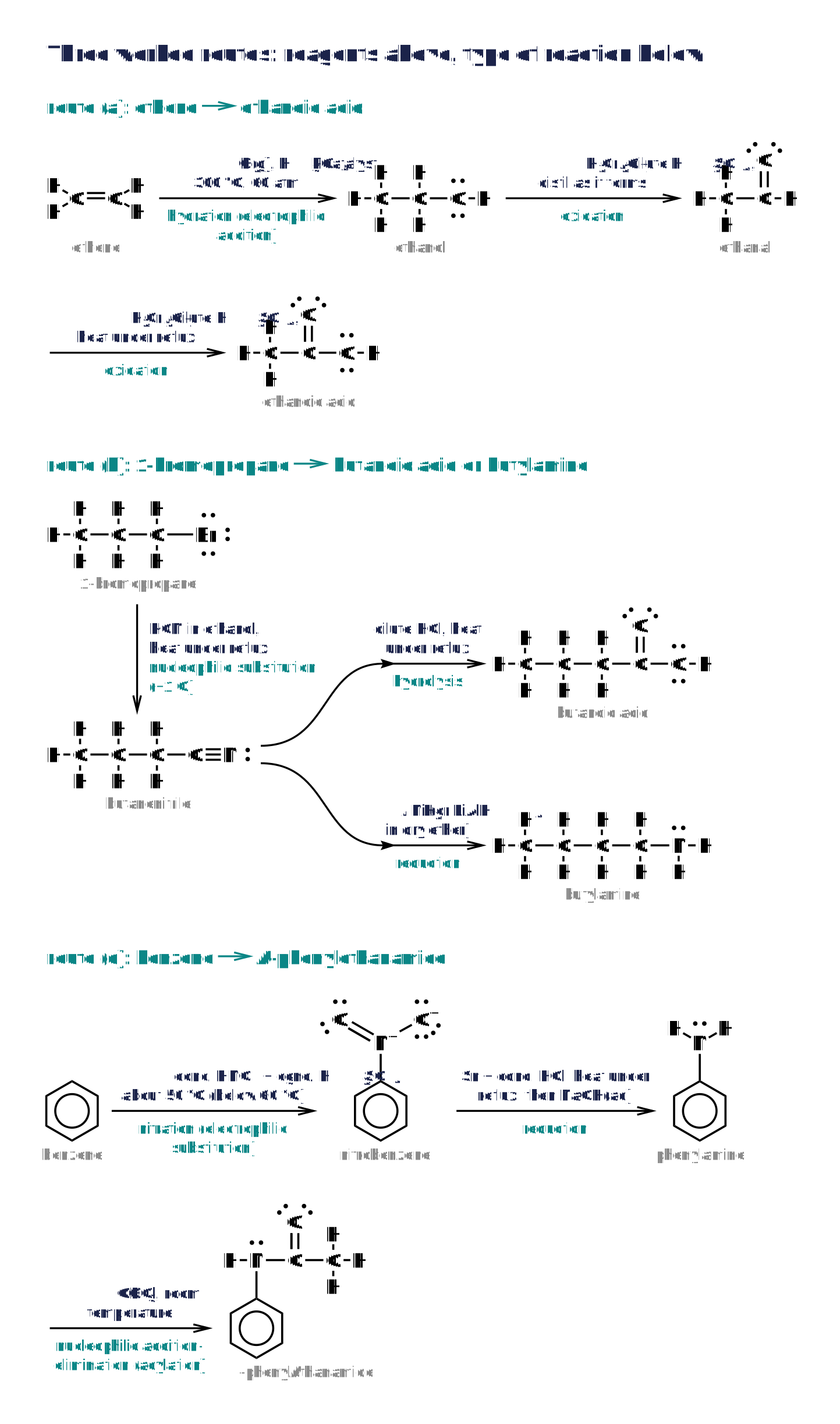
Routes (a), (b) and (d) drawn as structures with the reagent and conditions over every arrow and the reaction type beneath it.
Exam focus: When a route branches, as in (b), the question usually asks for one product: read which, and give only that final step.
Quick Check: Which Proposed Route Works?
Pick the one route in each set that would work.
Worked Routes 2: Aromatic Targets and Choosing the Alcohol
Aromatic routes start from benzene. The ring is kept and its substituent is changed step by step; the order of steps decides where new groups go.
Route (d): benzene to N-phenylethanamide
Step 1. Benzene + concentrated HNO₃ and concentrated H₂SO₄ at about 50 °C (below 60 °C) → nitrobenzene (nitration, electrophilic substitution).
- Nitrate first, then reduce: phenylamine itself is too reactive to nitrate cleanly, and NH₂ directs new groups to the 2 and 4 positions. See 3.3.10 Aromatic Chemistry.
- Protecting the amine as an amide (step 3) is used industrially before further ring substitution: the amide is less activating.
- Keep the nitration at about 50 °C, below 60 °C, to avoid dinitration.
Route (f): but-1-ene to butanone, and which alcohol forms
Remember: Which alcohol an unsymmetrical alkene gives decides the whole route: a secondary alcohol leads to a ketone, a primary alcohol to an aldehyde or acid.
Check: Writing Multi-Step Routes
Plan routes of two to 4 steps from a given start to a given target, name every intermediate and give the reagent, conditions and reaction type for each step.
Unfamiliar Reactions Given in the Question
Questions often supply a reaction you have not met, with its reagents and conditions. Treat it as one more arrow on the map and use it exactly as given.
- Read what the new reagent does to the functional group: which bond breaks, which forms, and whether the carbon count changes.
- Use the reagents and conditions printed in the question, word for word; do not swap in a familiar reagent.
- Apply the reaction to the molecule in the question, not to the example given: the same change on a different skeleton.
- Check the other groups in the molecule: would they react with the same reagent? A question may ask you to protect one.
Exam focus: Marks for an unfamiliar step go to applying the pattern correctly to the new molecule and keeping the reagents and conditions as printed.
Green Chemistry: Designing a Better Route
Chemists design production methods to be safer, cheaper and less wasteful. Four aims appear in questions, and two of them have calculations.
| Aim | Why |
|---|---|
| fewer steps | each step loses product; the overall yield is the product of the step yields, so fewer steps keep more |
| high percentage atom economy | more of the reactant atoms end up in the desired product, so less waste and better use of resources |
| no solvent | less waste to treat, no volatile organic compounds released, lower cost and less energy to recover the solvent |
| non-hazardous starting materials | safer for workers and the environment, less protective equipment and containment, cheaper storage and disposal |
Worked example 1: yield over several steps
Worked example 2: atom economy of two routes to ethanol
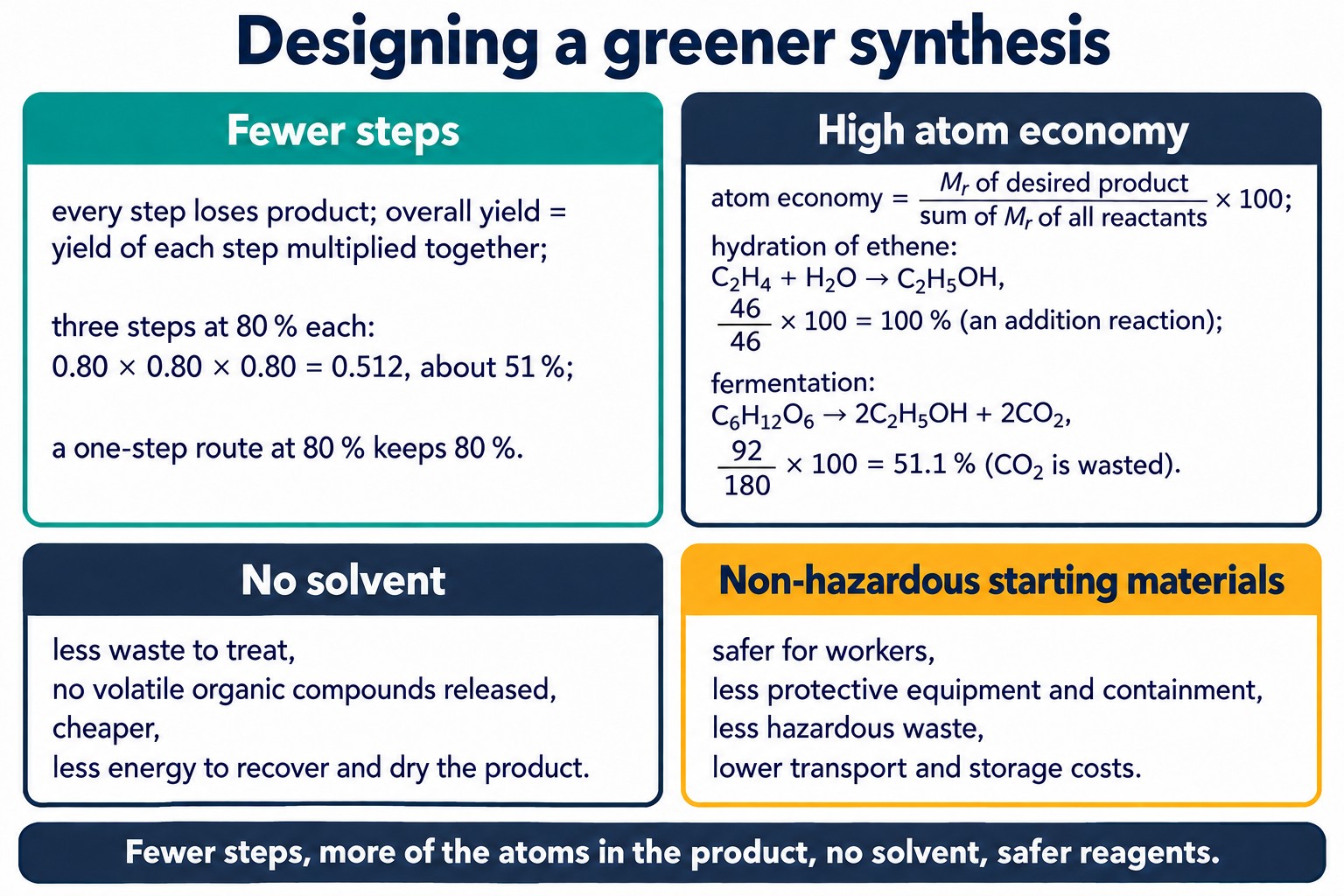
The four aims with the two worked calculations: 0.8³ = 51 % overall yield and 100 % against 51.1 % atom economy.
Remember: Yield and atom economy are different: yield compares what is obtained with the theoretical maximum; atom economy compares the wanted product with everything made by the equation.
Check: Routes, Yields and Unfamiliar Steps
Apply a reaction given in a question to a new molecule, complete a route with an unfamiliar step in it, and compare two routes to the same target.
Common Exam Points
- One arrow is one reaction: give the reagent AND the conditions for every step, and name the type of reaction.
- Count carbons first: one more carbon in the target means a nitrile step; the same count means functional group changes only.
- Oxidation of a primary alcohol: distil for the aldehyde, reflux for the carboxylic acid; a secondary alcohol gives a ketone under reflux.
- Aromatic routes: nitrate benzene at about 50 °C (below 60 °C), reduce nitrobenzene with Sn and concentrated HCl then NaOH, acylate phenylamine with an acyl chloride.
- Routes have up to 4 steps; a shorter correct route is preferred when the question sets a limit.
- Unfamiliar reactions: use the reagents and conditions as printed and apply the same change to the molecule in the question.
- Overall yield = product of the step yields (0.8³ = 51 %); atom economy = (Mr of product) / (total Mr of reactants) × 100.
- Atom economy of ethanol by hydration of ethene 100 %, by fermentation 51.1 %; aim for fewer steps, no solvent and non-hazardous starting materials.
- Show every intermediate by name or structure; a route with a missing intermediate loses the mark for that step.
FAQs
Use these quick answers to check how to plan a route of up to 4 steps from the reaction map, the order of steps in aromatic syntheses, and why fewer steps and a high atom economy matter.
How do I start planning a synthetic route?
Compare the target with the starting material: which functional groups change, and does the carbon skeleton stay the same, gain a carbon or need a ring? Then work backwards step by step, asking which compound could make the target, until you reach the start.
How do I make ethanoic acid from ethene?
Two steps. Hydrate ethene with steam over a phosphoric(V) acid catalyst at about 300 °C and 60 atm to give ethanol. Then heat the ethanol under reflux with excess acidified potassium dichromate(VI), which oxidises it through ethanal to ethanoic acid.
In what order do I carry out the steps from benzene to N-phenylethanamide?
Nitrate first: concentrated nitric and sulfuric acids at about 50 °C give nitrobenzene. Reduce the nitro group with tin and concentrated hydrochloric acid under reflux, then add sodium hydroxide to free phenylamine. Finally react the amine with ethanoyl chloride to give N-phenylethanamide.
What do I do when a question gives me a reaction I have never seen?
Treat it as one step with exactly the reagents and conditions the question states. Work out which functional group changes by comparing the formulae before and after, then fit the step into your route like any other. Examiners test your planning, not the new reaction.
Why do chemists design routes with fewer steps?
Every step loses some product, so the yields multiply: three steps at 80 % each give only 0.8³ = 51 % overall. Fewer steps also mean less solvent, energy and waste. High atom economy, avoiding solvents and safer starting materials are the other green aims.

Copyright notice: This OLS revision content, including the explanations, layout, diagrams, tables and embedded learning structure, is authored for Online Learning System by Dr. Mohammed Al-Fatah. It may not be copied, reproduced, redistributed or adapted without written permission.
Keep this note — free
Save your progress across every AQA topic. A free account remembers which topics you have covered, saves your question scores, and syncs across your phone and laptop.
- Track every topic you have finished
- Keep your practice-question scores
- No payment, no card, free forever
Already registered? Log in