Characteristic Organic Reactions
A concise Cambridge International AS Level Chemistry revision guide to the vocabulary of 13.2: nucleophiles and electrophiles, the reaction types addition, substitution, elimination, hydrolysis and condensation, the [O] and [H] convention for organic redox, the four named mechanisms, and the rules for curly arrows.
- 13.2.1(e)-i
- 13.2.1(e)-ii
- 13.2.1(e)-iii
- 13.2.1(e)-iv
- 13.2.1(f)-i
- 13.2.1(f)-ii
- 13.2.1(f)-iii
- 13.2.1(f)-iv
- 13.2.1(f)-v
- 13.2.1(g)-i
- 13.2.1(g)-ii
- 13.2.2(a)
- 13.2.2(b)
- 13.2.2(c)
- 13.2.2(d)
What these spec points say
- 13.2.1(e)-i interpret and use the term nucleophile
- 13.2.1(e)-ii interpret and use the term electrophile
- 13.2.1(e)-iii interpret and use the term nucleophilic
- 13.2.1(e)-iv interpret and use the term electrophilic
- 13.2.1(f)-i interpret and use the term addition
- 13.2.1(f)-ii interpret and use the term substitution
- 13.2.1(f)-iii interpret and use the term elimination
- 13.2.1(f)-iv interpret and use the term hydrolysis
- 13.2.1(f)-v interpret and use the term condensation
- 13.2.1(g)-i interpret and use the term oxidation (in equations for organic redox reactions, the symbol [O] can be used to represent one atom of oxygen from an oxidising agent)
- 13.2.1(g)-ii interpret and use the term reduction (in equations for organic redox reactions, the symbol [H] can be used to represent one atom of hydrogen from a reducing agent)
- 13.2.2(a) understand and use the terminology free-radical substitution associated with types of organic mechanisms
- 13.2.2(b) understand and use the terminology electrophilic addition associated with types of organic mechanisms
- 13.2.2(c) understand and use the terminology nucleophilic substitution associated with types of organic mechanisms
- 13.2.2(d) understand and use the terminology nucleophilic addition associated with types of organic mechanisms (in organic reaction mechanisms, the use of curly arrows to represent movement of electron pairs is expected; the arrow should begin at a bond or a lone pair of electrons)
Breaking a Covalent Bond: Homolytic and Heterolytic Fission
Choose a step to watch where the two electrons of a bond go when it breaks: one each (free radicals), or both to one atom (ions).
© Dr. Mohammed Al-Fatah – onlinelearningsystem.net
GCSE Recap: Adding Bromine and Making Poly(ethene)
Before you start, check three GCSE ideas that this page turns into named reaction types.
Nucleophiles and Electrophiles
Cambridge 13.2.1(e) asks you to interpret and use the terms nucleophile, electrophile, nucleophilic and electrophilic. Both kinds of reagent are defined by what they do with electron pairs.
| Term | Definition | What it looks for | Examples |
|---|---|---|---|
| Nucleophile | An electron-pair donor: a species with a lone pair (often negatively charged) that forms a new covalent bond by donating the pair | A δ+ atom, usually a carbon bonded to an electronegative atom | OH–, CN–, NH3, H2O |
| Electrophile | An electron-pair acceptor: a species that is short of electrons and forms a new covalent bond by accepting a pair | A region of high electron density, such as a C=C π bond | H+, Brδ+ in polarised Br2, NO2+ |
The adjectives describe the attacking reagent: a nucleophilic reaction is one in which a nucleophile attacks; an electrophilic reaction is one in which an electrophile attacks.
A halogenoalkane undergoes nucleophilic substitution because the nucleophile attacks its δ+ carbon; an alkene undergoes electrophilic addition because an electrophile attacks its π bond.
Exam sentence: A nucleophile is an electron-pair donor that attacks an electron-deficient atom; an electrophile is an electron-pair acceptor that attacks a region of high electron density.
Quick Check: Which Species Are Nucleophiles?
Click every species that can donate a pair of electrons, and leave the acceptors alone.
The Five Reaction Types
Cambridge 13.2.1(f) lists five words that describe what happens to the molecule overall. Learn each with a fresh example, then classify any reaction you meet by asking what has been gained, lost or swapped.
| Reaction type | What happens overall | Example equation |
|---|---|---|
| Addition | Two molecules combine to give one; a multiple bond is used up | CH3CH=CH2 + HCl → CH3CHClCH3 |
| Substitution | One atom or group is replaced by another | CH3CH2Br + CN– → CH3CH2CN + Br– |
| Elimination | A small molecule is removed from one molecule, creating a multiple bond | CH3CH2CH2Br + OH– → CH3CH=CH2 + H2O + Br– (ethanolic KOH, heat) |
| Hydrolysis | A bond is broken by reaction with water (or with OH– or H+ in water) | CH3COOCH3 + H2O → CH3COOH + CH3OH |
| Condensation | Two molecules join with the loss of a small molecule, usually water | CH3CH2COOH + CH3OH → CH3CH2COOCH3 + H2O |
Exam focus: Hydrolysis and condensation are opposites: hydrolysis splits a molecule using water; condensation joins two molecules and releases water. Elimination and addition are also opposites.
Quick Check: Name the Type of Each Reaction
Six reactions, one word each. Ask what has been gained, lost or swapped.
Oxidation and Reduction: [O] and [H]
In organic chemistry the oxidising or reducing agent is often complex, so Cambridge 13.2.1(g) allows a shorthand: [O] represents one atom of oxygen supplied by an oxidising agent, and [H] represents one atom of hydrogen supplied by a reducing agent. The equation must still balance.
- Oxidation: gain of oxygen or loss of hydrogen. Propan-1-ol is oxidised to propanal: CH3CH2CH2OH + [O] → CH3CH2CHO + H2O.
- Reduction: gain of hydrogen or loss of oxygen. Butanone is reduced to butan-2-ol: CH3COCH2CH3 + 2[H] → CH3CH(OH)CH2CH3.
| Change | Classified as | Shorthand | Typical reagent |
|---|---|---|---|
| Alcohol → aldehyde or ketone | Oxidation | + [O], water formed | Acidified potassium dichromate(VI) |
| Aldehyde → carboxylic acid | Oxidation | + [O] | Acidified potassium dichromate(VI), heat under reflux |
| Aldehyde or ketone → alcohol | Reduction | + 2[H] | NaBH4 |
| Nitrile → amine | Reduction | + 4[H] | LiAlH4 or H2 with a nickel catalyst |
Exam sentence: In organic redox equations [O] stands for one oxygen atom from the oxidising agent and [H] for one hydrogen atom from the reducing agent; the equation must balance for every element.
Quick Check: Balancing [O] and [H]
Type the number of oxygen or hydrogen atoms needed to balance each equation.
The Four Named Mechanisms
Cambridge 13.2.2 asks you to understand and use the names of four mechanism types. Each combines a reagent type (radical, electrophile or nucleophile) with an overall reaction type. Knowing the pair tells you which reagent attacks and what the product will be.
| Mechanism | Attacking species | Overall change | Substrate | Met in |
|---|---|---|---|---|
| Free-radical substitution | Radical (Cl•, Br•) | Substitution | Alkanes | Topic 14.1 |
| Electrophilic addition | Electrophile (H+, Brδ+) | Addition | Alkenes | Topic 14.2 |
| Nucleophilic substitution | Nucleophile (OH–, CN–, NH3) | Substitution | Halogenoalkanes | Topic 15 |
| Nucleophilic addition | Nucleophile (CN–, [H] from NaBH4) | Addition | Aldehydes and ketones | Topic 17 |
Key idea: Read the name backwards: nucleophilic addition means an addition reaction started by a nucleophile, so look for a δ+ carbon in a C=O bond and a lone-pair reagent.
Quick Check: More Than One Type
Test the reaction against every definition before you choose.
Curly Arrows: The Cambridge Rules
For every mechanism except free-radical substitution, Cambridge expects curly arrows that represent the movement of a pair of electrons.
The syllabus note for 13.2.2 gives one rule that examiners apply strictly: the arrow should begin at a bond or a lone pair of electrons.
It can end at an atom (forming a bond) or at one atom of a bond that is breaking.
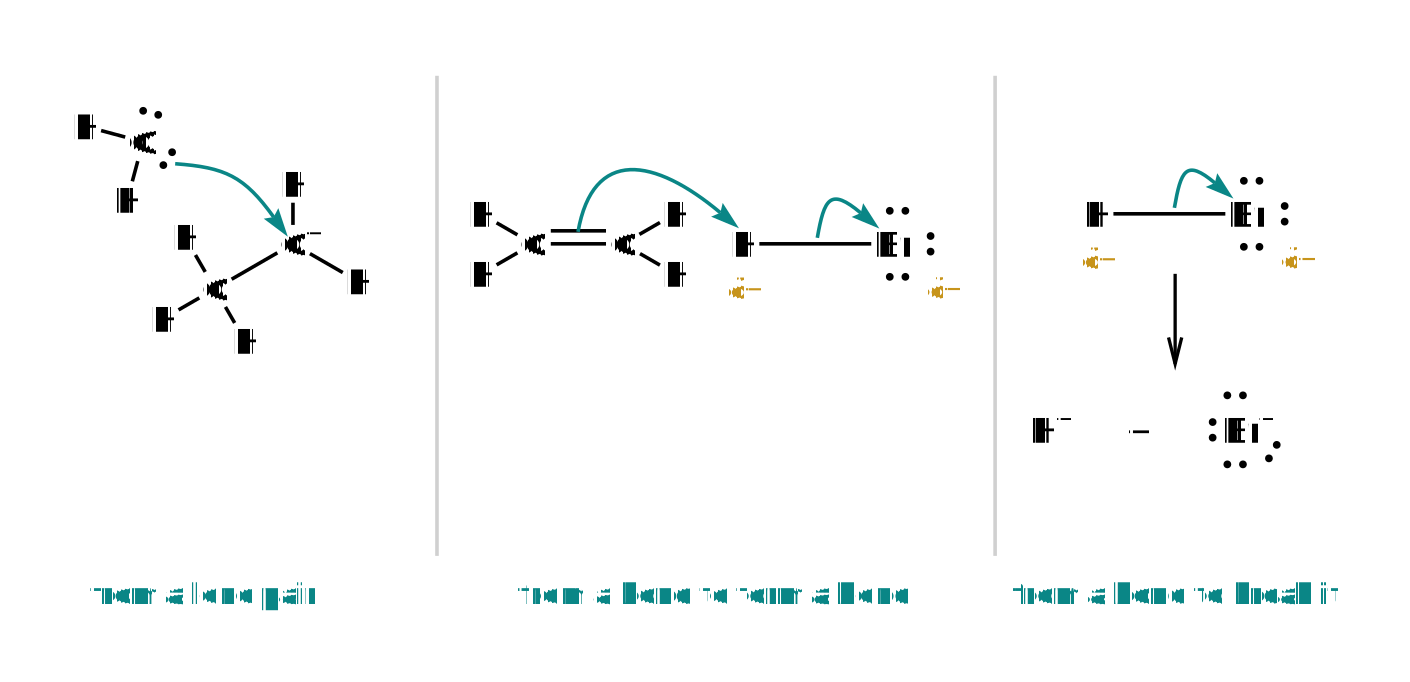
The three places an arrow can start and finish: a lone pair forming a bond, a bond forming another bond, and a bond breaking heterolytically.
- An arrow from a lone pair to an atom forms a new bond: the nucleophile attacking a δ+ carbon.
- An arrow from the middle of a bond to an atom outside it forms a new bond: the π bond of an alkene attacking an electrophile.
- An arrow from the middle of a bond to one of its own atoms breaks the bond heterolytically: the C-Br bond giving Br–.
Exam focus: Radicals are shown with a dot, not with curly arrows. In free-radical substitution write the initiation, propagation and termination equations instead.
Quick Check: Pick the Accurate Statement
In each round, choose the one statement that is accurate.
Common Exam Mistakes
- Calling OH– an electrophile because it is “reactive”. It donates a lone pair, so it is a nucleophile.
- Classifying the reaction of an alkene with bromine as substitution. Nothing is replaced; bromine adds across the double bond.
- Writing [O] without balancing: CH3CH2OH + [O] → CH3CHO needs H2O on the right.
- Starting a curly arrow on an atom or a charge rather than on a bond or lone pair.
- Describing hydrolysis as “adding water”. Hydrolysis breaks a bond; addition of water to an alkene is hydration.
Exam sentence: Classify the overall change (addition, substitution, elimination, hydrolysis or condensation), name the attacking species (radical, electrophile or nucleophile), and the mechanism name follows.
FAQs
These questions cover the classification words students most often mix up.
Is ammonia a nucleophile or an electrophile?
A nucleophile. It has a lone pair on nitrogen that it can donate to a δ+ carbon, even though it carries no charge.
Is the reaction of ethene with steam addition or hydrolysis?
Addition, called hydration. Hydrolysis breaks a bond using water; here water adds across the C=C bond and nothing is split.
What does [O] mean in an equation?
One oxygen atom supplied by the oxidising agent. The equation must still balance, so water usually appears on the right.
Where must a curly arrow start?
At a lone pair or at a bond. It never starts at an atom or at a positive charge.
Why does a halogenoalkane react with nucleophiles but an alkene does not?
The polar C-X bond gives the carbon a δ+ charge that a lone pair can attack. An alkene has an electron-rich π bond, which attracts electrophiles instead.

Copyright notice: This OLS revision content, including the explanations, layout, diagrams, tables and embedded learning structure, is authored for Online Learning System by Dr. Mohammed Al-Fatah. It may not be copied, reproduced, redistributed or adapted without written permission.
Keep this note — free
Save your progress across every Cambridge topic. A free account remembers which topics you have covered, saves your question scores, and syncs across your phone and laptop.
- Track every topic you have finished
- Keep your practice-question scores
- No payment, no card, free forever
Already registered? Log in