Isomerism
Isomers share a molecular formula but differ in structure. Cambridge divides isomerism into structural isomerism (chain, positional and functional group) and stereoisomerism (geometrical and optical). These pages take each type in turn.
Revision Notes
3 revision notes, in the order the specification teaches them.
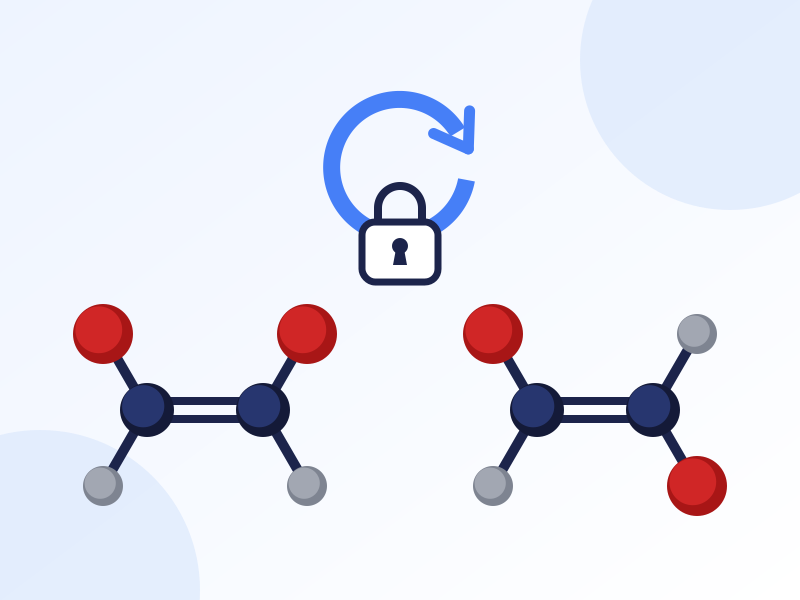
Geometric Isomerism
Restricted rotation about C=C, cis/trans and E/Z isomers, and identifying geometrical isomerism in alkenes and cyclic compounds (13.4.2, 13.4.3, 13.4.5).
Start revising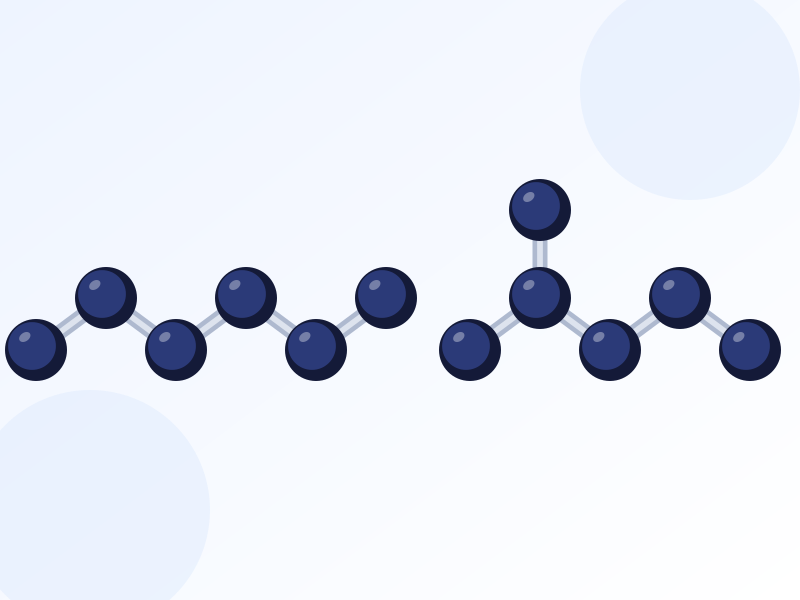
Structural Isomerism
Chain, positional and functional group isomerism, and deducing the possible isomers for a molecular formula (13.4.1, 13.4.6).
Start revising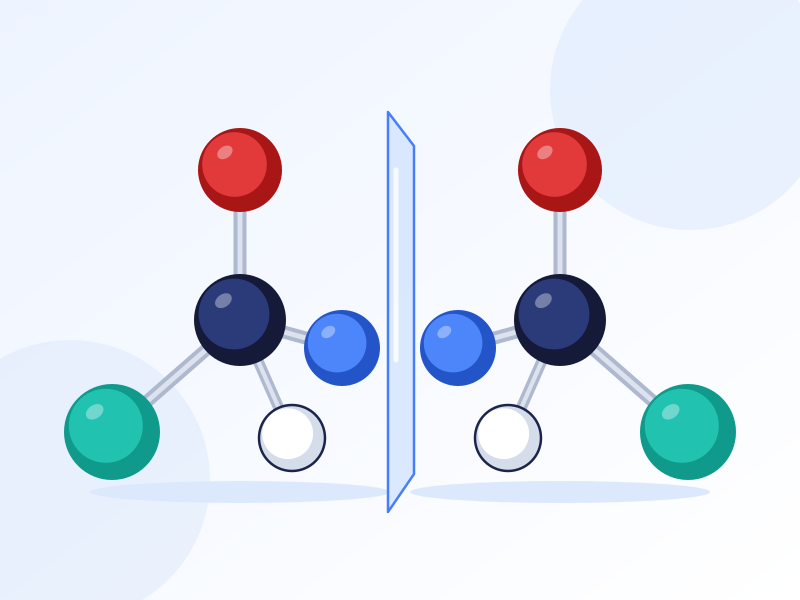
Optical Isomerism
Chiral centres, enantiomers and identifying chiral centres in a given structural formula (13.4.2, 13.4.4, 13.4.5).
Start revisingSummary Map
Download, print and revise the key facts of this topic at a glance.
Summary map
Download, print and revise the key facts of this topic at a glance.

Introduction to Organic Chemistry Map
Cambridge International AS & A Level Chemistry · Topic 13
The whole topic on one A4 page: formulae, homologous series and names, structural isomers and stereoisomers, shapes and hybridisation, bond breaking, reaction types and mechanisms, and the Cambridge AS table of functional groups.
© 2026 Online Learning System. For personal study: printing is allowed; editing, copying and redistribution are not.
Virtual Lessons
Recorded video lessons that teach the topic step by step.
The Virtual Lessons for Topic 13 An Introduction to AS Level Organic Chemistry are being recorded.
MCQ Bank
Multiple-choice papers on this topic, marked the moment you submit.
The MCQ papers for Topic 13 An Introduction to AS Level Organic Chemistry are being written.
SAQ Bank
Written, drawn and worked exam practice on this topic.
The exam practice papers for Topic 13 An Introduction to AS Level Organic Chemistry are being written.
Revision Game
Match reagents to products, with your board's reagents and conditions.
The revision game for Topic 13 An Introduction to AS Level Organic Chemistry is being built.
Study Cards
Pick a deck, then turn each card to check what you remember.
Specification
Every specification point in this topic, in the exam board's own words. Rate how confident you are with each one.
Cambridge no longer issues a data booklet: the data you need are given in each question, and the syllabus has a Data section.
Self-assessment · 58 points
Sign in to rate how confident you feel about each point. Your ratings are saved to your account, follow you to any device, and appear beside your KASP analytics, kept apart from your marks.
13.1.1
13.1.2
13.1.3
- 13.1.3
understand that the compounds in the table on pages 29 and 30 contain a functional group which dictates their physical and chemical properties
Revise
13.1.4
- a
interpret and use the general formulas of the classes of compound stated in the table on pages 29 and 30
Revise - b
interpret and use the structural formulas of the classes of compound stated in the table on pages 29 and 30
Revise - c
interpret and use the displayed formulas of the classes of compound stated in the table on pages 29 and 30
Revise - d
interpret and use the skeletal formulas of the classes of compound stated in the table on pages 29 and 30
Revise
13.1.5
- 13.1.5
understand and use systematic nomenclature of simple aliphatic organic molecules with functional groups detailed in the table on pages 29 and 30, up to six carbon atoms (six plus six for esters, straight chains only for esters and nitriles)
Revise
13.1.6
13.2.1
- g i
interpret and use the term oxidation (in equations for organic redox reactions, the symbol [O] can be used to represent one atom of oxygen from an oxidising agent)
Revise - g ii
interpret and use the term reduction (in equations for organic redox reactions, the symbol [H] can be used to represent one atom of hydrogen from a reducing agent)
Revise
13.2.2
- a
understand and use the terminology free-radical substitution associated with types of organic mechanisms
Revise - b
understand and use the terminology electrophilic addition associated with types of organic mechanisms
Revise - c
understand and use the terminology nucleophilic substitution associated with types of organic mechanisms
Revise - d
understand and use the terminology nucleophilic addition associated with types of organic mechanisms (in organic reaction mechanisms, the use of curly arrows to represent movement of electron pairs is expected; the arrow should begin at a bond or a lone pair of electrons)
Revise
13.3.1
13.3.2
- a
describe and explain the shape of, and bond angles in, molecules containing sp hybridised atoms
Revise - b
describe and explain the shape of, and bond angles in, molecules containing sp2 hybridised atoms
Revise - c
describe and explain the shape of, and bond angles in, molecules containing sp3 hybridised atoms
Revise
13.3.3
13.3.4
- 13.3.4
understand and use the term planar when describing the arrangement of atoms in organic molecules, for example ethene
Revise
13.4.1
13.4.2
- b
describe geometrical (cis/trans) isomerism as a division of stereoisomerism (use of E/Z nomenclature is acceptable but is not required)
Revise
13.4.3
- b
explain the origin of geometrical (cis/trans) isomerism in alkenes in terms of restricted rotation due to the presence of π bonds
Revise
13.4.4
13.4.5
- b
identify geometrical (cis/trans) isomerism in a molecule of given structural formula including cyclic compounds
Revise
13.4.6
Keep this note — free
Save your progress across every Cambridge topic. A free account remembers which topics you have covered, saves your question scores, and syncs across your phone and laptop.
- Track every topic you have finished
- Keep your practice-question scores
- No payment, no card, free forever
Already registered? Log in