Alkynes and Nitriles: sp Carbon
A concise Cambridge International AS Level Chemistry revision guide to sp hybridised carbon (13.3.2 and 13.3.3).
It shows how two sp orbitals and two unhybridised p orbitals give a triple bond of one σ and two π bonds, the linear 180° shape around C≡C and C≡N, and how sp, sp2 and sp3 carbons compare.
- 13.3.2-a
- 13.3.3-a
What these spec points say
- 13.3.2-a describe and explain the shape of, and bond angles in, molecules containing sp hybridised atoms
- 13.3.3-a describe the arrangement of σ and π bonds in molecules containing sp hybridised atoms
Bonding in Ethyne, C₂H₂: sp Hybrids, Sigma and Pi Bonds
Choose a step to watch two sp carbons build the σ framework of ethyne, then two π bonds at right angles that make a cylinder of electron density.
© Dr. Mohammed Al-Fatah – onlinelearningsystem.net
Before You Start
This page builds on sp3 and sp2 hybridisation and on bonding in alkenes.
- Carbon is 1s2 2s2 2p2 and forms four bonds.
- A σ bond forms by head-on overlap; a π bond by sideways overlap of p orbitals.
- A double bond is one σ bond and one π bond.
- Two electron pairs around an atom repel to 180°, giving a linear shape.
GCSE Recap: Shared Pairs in Multiple Bonds
Four quick questions on the GCSE picture of single, double and triple bonds before you look inside one.
Forming sp Hybrid Orbitals
When a carbon atom forms a triple bond, only the 2s orbital and one 2p orbital mix.
This gives two sp hybrid orbitals pointing in opposite directions, 180° apart, and leaves two unhybridised 2p orbitals at right angles to each other and to the sp orbitals.
| Feature | sp carbon | Compare sp2 | Compare sp3 |
|---|---|---|---|
| Orbitals mixed | One 2s + one 2p | One 2s + two 2p | One 2s + three 2p |
| Hybrid orbitals | Two sp | Three sp2 | Four sp3 |
| Unhybridised p orbitals | Two | One | None |
| σ bonds formed | Two | Three | Four |
| π bonds formed | Two | One | None |
| Shape and angle | Linear, 180° | Trigonal planar, 120° | Tetrahedral, 109.5° |
Key idea: Each unhybridised p orbital makes one π bond, so an sp carbon with two p orbitals left over can make two π bonds: the second and third bonds of a triple bond.
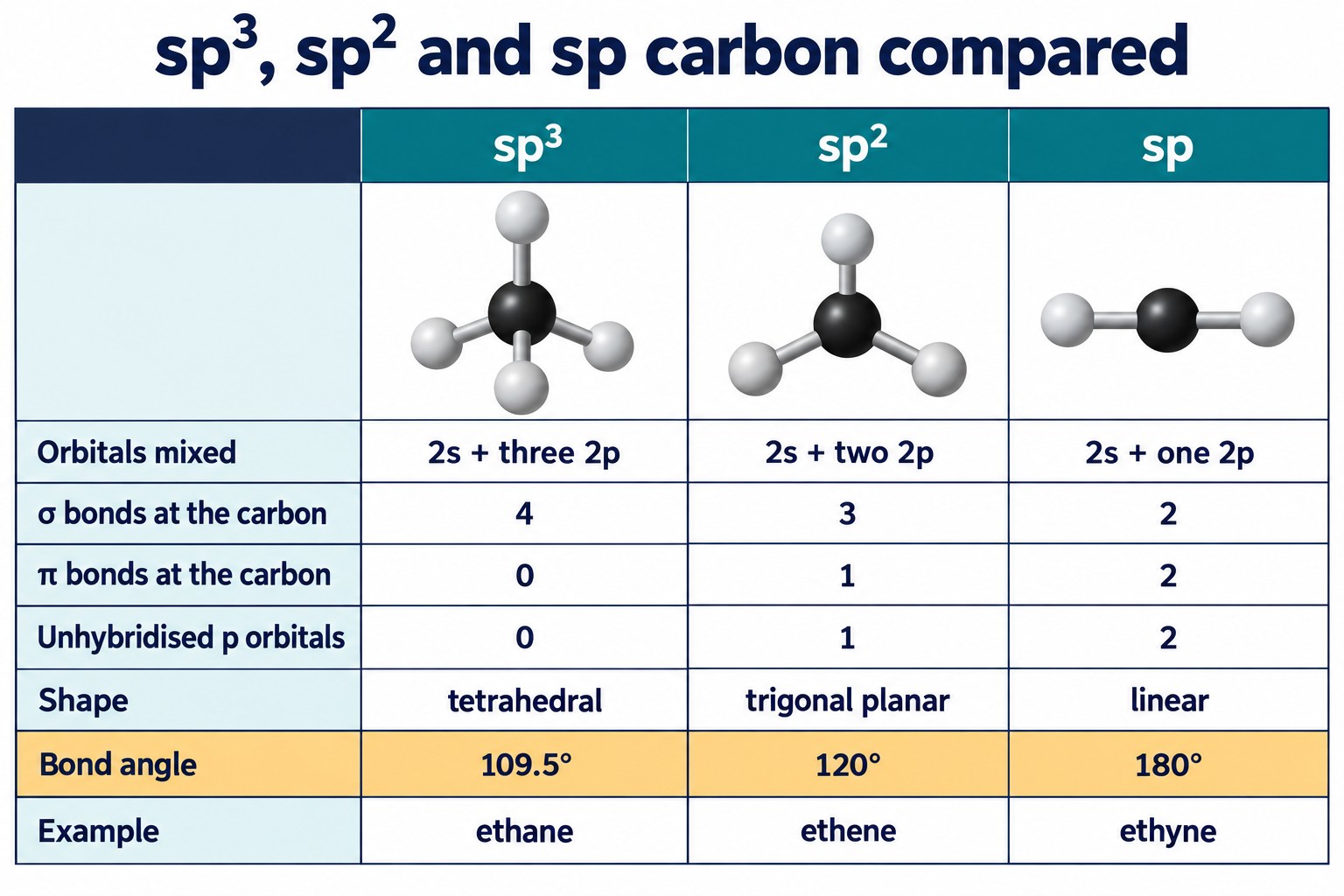
More p orbitals left unhybridised means more π bonds and a wider bond angle: 109.5°, 120°, 180°.
Quick Check: Counting σ and π Bonds
Five quick questions on molecules that do not appear on this page.
The Triple Bond in Ethyne
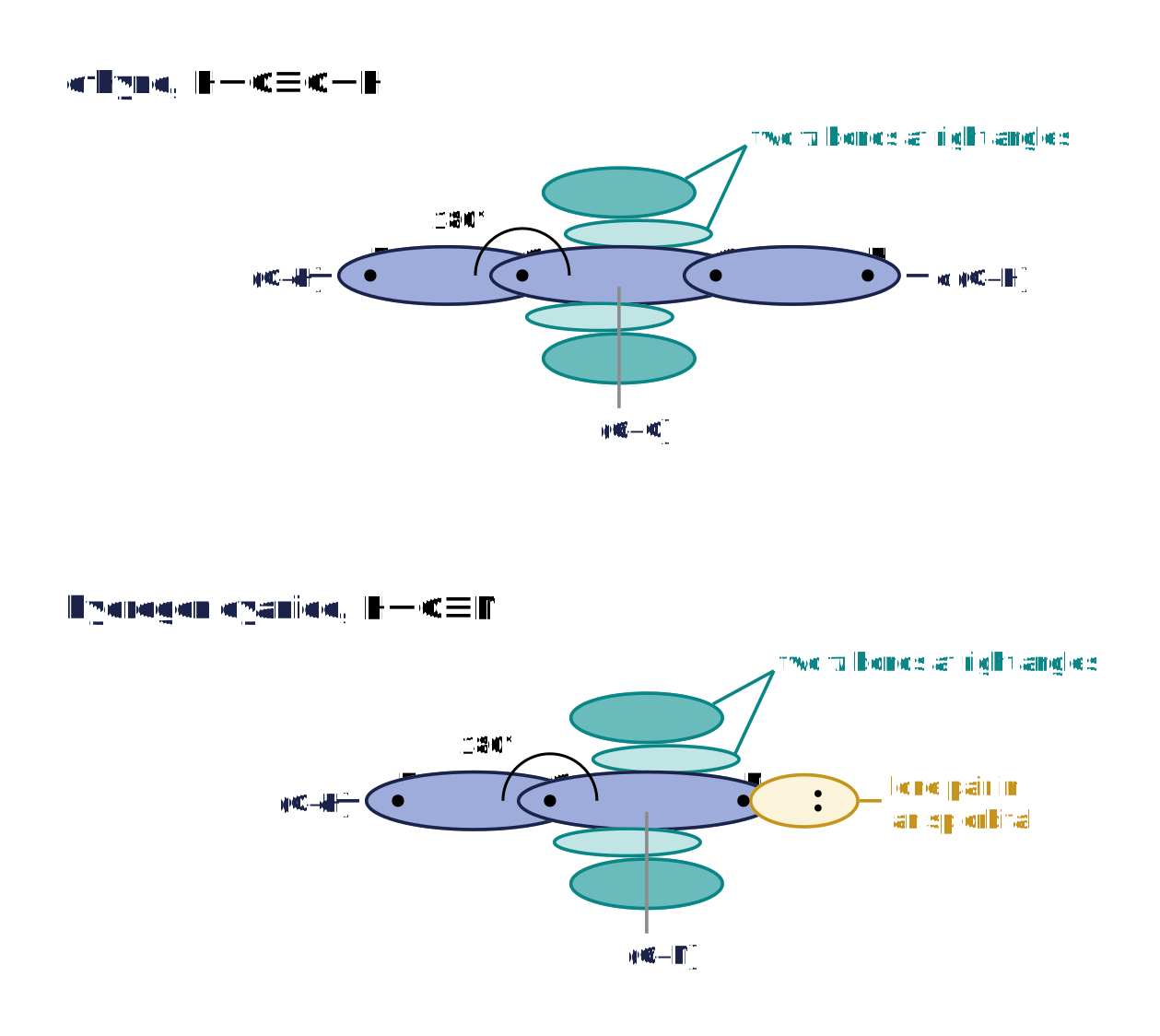
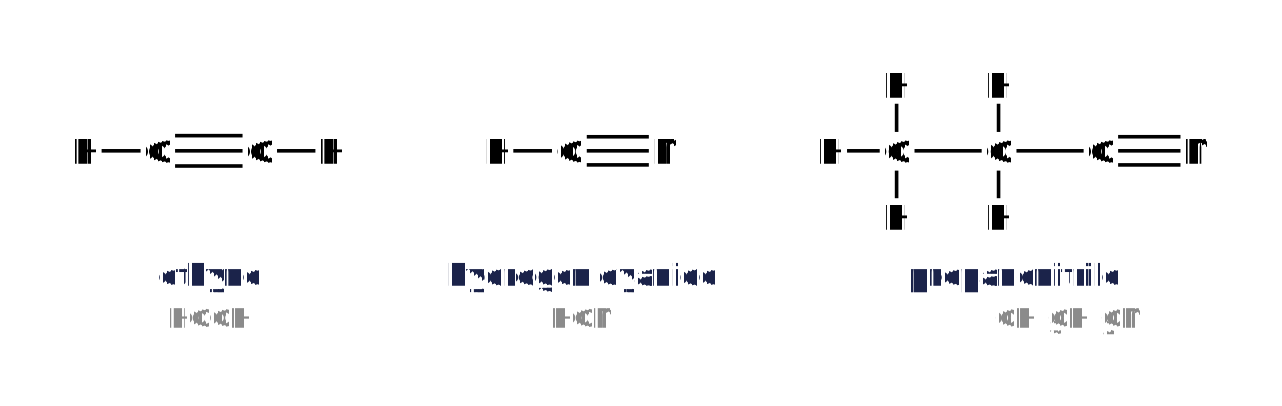
In ethyne, HC≡CH, each carbon is sp hybridised.
One sp orbital overlaps head-on with the other carbon to form the C-C σ bond, and the other sp orbital overlaps with a hydrogen 1s orbital to form the C-H σ bond.
The two remaining p orbitals on each carbon overlap sideways with their partners on the other carbon to form two π bonds, one above and below the molecule and one in front and behind.
The C≡C bond therefore contains one σ bond and two π bonds. Because the two sp orbitals point in opposite directions, the H-C-C bond angle is 180° and ethyne is a linear molecule. The π bonds prevent rotation about the triple bond.
Bonding in Hydrogen Cyanide, HCN: sp Hybrids, Sigma and Pi Bonds
Choose a step to watch HCN build up, from the sp hybrids on carbon and nitrogen, through end-on overlap, to its σ and π molecular orbitals and the lone pair.
© Dr. Mohammed Al-Fatah – onlinelearningsystem.net
Hybridisation of Carbon: sp³, sp² and sp Orbitals
Choose a step to watch carbon’s 2s and 2p orbitals mix into sp³, sp² or sp hybrids, see the angle between them and which 2p orbitals are left for π bonds.
© Dr. Mohammed Al-Fatah – onlinelearningsystem.net
© Dr. Mohammed Al-Fatah – onlinelearningsystem.net
Exam sentence: In ethyne each carbon is sp hybridised: the sp orbitals form two σ bonds at 180°, and the two unhybridised p orbitals on each carbon form two π bonds, so the molecule is linear.
Quick Check: Atoms on a Straight Line
Decide how far along the chain the linear shape of a triple bond reaches.
Quick Check: Cis and Trans in an Alkyne
Decide whether a blocked rotation is enough on its own to give geometrical isomers.
The Nitrile Group
The same bonding occurs in a nitrile, R-C≡N.
The nitrile carbon is sp hybridised: one sp orbital bonds to the alkyl group, the other forms the C-N σ bond, and the two p orbitals form two π bonds with the nitrogen atom.
The nitrogen is also sp hybridised, with its lone pair in the sp orbital pointing away from the carbon.
The C-C≡N unit is linear, with a bond angle of 180° at the nitrile carbon.
In ethanenitrile, CH3CN, the methyl carbon is sp3 and tetrahedral while the nitrile carbon is sp and linear, so one small molecule contains both kinds of carbon.
| Molecule | Carbon atom | Hybridisation | Shape around it | Angle |
|---|---|---|---|---|
| Ethanenitrile, CH3CN | CH3 carbon | sp3 | Tetrahedral | 109.5° |
| Ethanenitrile, CH3CN | CN carbon | sp | Linear | 180° |
| Propyne, CH3C≡CH | Both triple-bond carbons | sp | Linear | 180° |
| Propene, CH3CH=CH2 | Both double-bond carbons | sp2 | Trigonal planar | 120° |
Exam focus: Cambridge asks for the shape and bond angle around a named atom, so identify the hybridisation of that atom only: count its σ bonds and lone pairs (two gives sp, three gives sp2, four gives sp3).
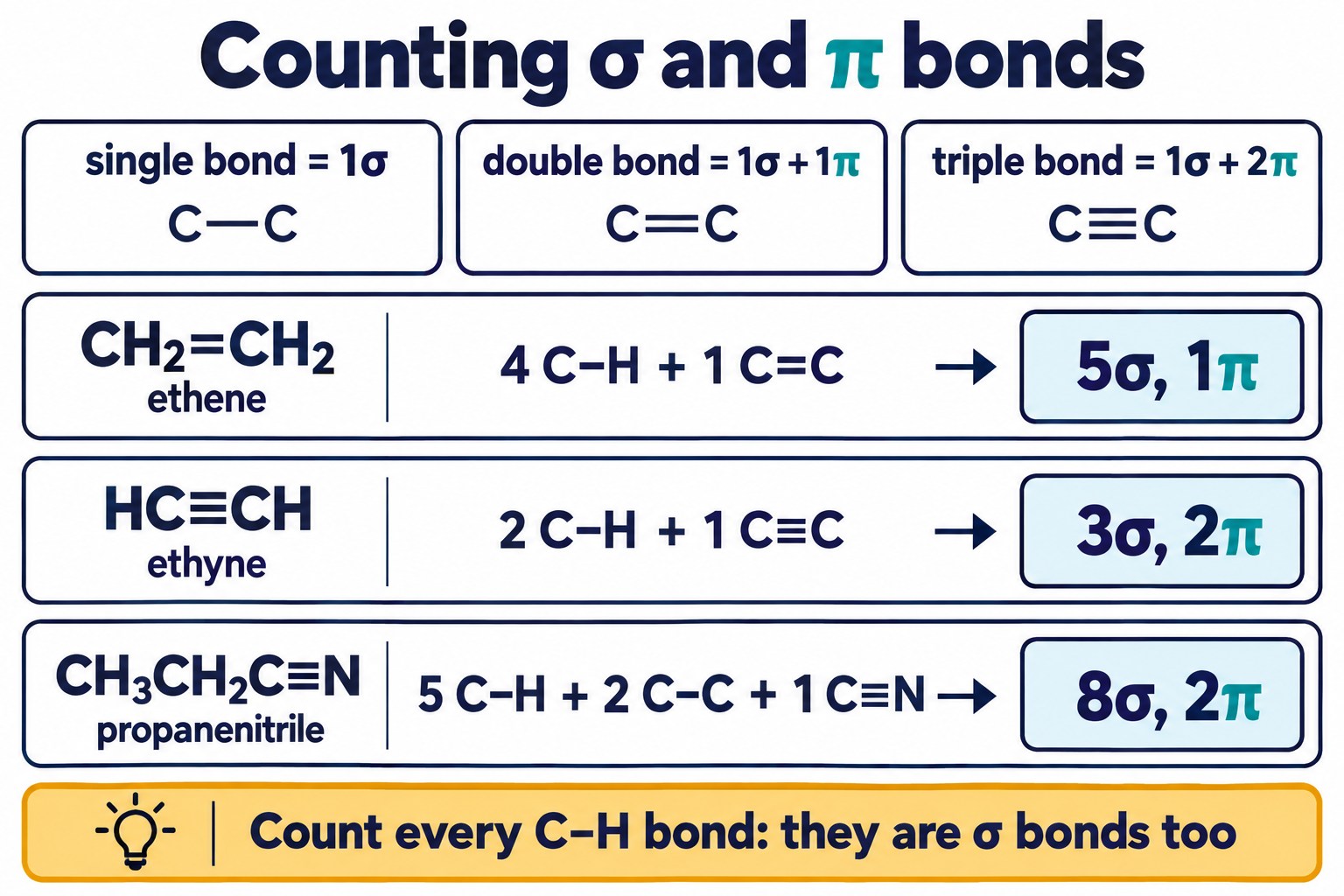
Each multiple bond has one σ bond; the rest are π bonds.
Quick Check: Hybridisation Along a Chain
Work along the formula one carbon atom at a time.
Quick Check: Two Nitrogen Atoms
Drag the words and numbers into place to compare the two nitrogen atoms of one molecule.
Quick Check: The Whole Page in Five Rounds
In each round, choose the one accurate statement about a molecule the page has not used.
Common Exam Mistakes
- Saying a triple bond is three σ bonds or three π bonds. It is one σ bond and two π bonds.
- Quoting 120° for an alkyne carbon. Two σ bonds and no lone pairs give 180°.
- Forgetting that the p orbitals must be at right angles to each other, so the two π bonds are in perpendicular planes.
- Assigning one hybridisation to a whole molecule. Each carbon atom is hybridised according to its own bonds.
Exam sentence: sp carbon: two hybrid orbitals, two σ bonds, two π bonds from two unhybridised p orbitals, linear, 180°.
FAQs
These questions cover the sp carbon points students most often get wrong.
How many σ and π bonds are in a C≡C triple bond?
One σ bond and two π bonds. The σ bond comes from sp orbitals; the two π bonds come from the two unhybridised p orbitals on each carbon.
What is the H-C-C angle in ethyne?
180°. Each carbon has two σ bonds and no lone pairs, so the sp orbitals point in opposite directions and the molecule is linear.
Are the two π bonds in the same plane?
No. The two p orbitals on each carbon are at right angles, so the two π bonds lie in perpendicular planes.
What is the shape around each carbon in ethanenitrile?
Tetrahedral, 109.5°, at the CH3 carbon, which is sp3. Linear, 180°, at the CN carbon, which is sp.
Where is the lone pair in a nitrile?
On the nitrogen, in an sp orbital pointing away from the carbon along the C≡N axis.

Copyright notice: This OLS revision content, including the explanations, layout, diagrams, tables and embedded learning structure, is authored for Online Learning System by Dr. Mohammed Al-Fatah. It may not be copied, reproduced, redistributed or adapted without written permission.
Keep this note — free
Save your progress across every Cambridge topic. A free account remembers which topics you have covered, saves your question scores, and syncs across your phone and laptop.
- Track every topic you have finished
- Keep your practice-question scores
- No payment, no card, free forever
Already registered? Log in