Other Reactions of Benzene
A concise revision guide to the remaining reactions of benzene: combustion with a smoky flame, sulfonation with fuming sulfuric acid, and a reaction map that brings the whole topic together.
Before You Start
This page collects the reactions of benzene that are not electrophilic substitutions, then draws the whole topic together in one reaction map.
- The three-step mechanism and why benzene substitutes rather than adds: Electrophilic Substitution in Benzene.
- Nitration with concentrated HNO₃ and H₂SO₄ at about 50 °C: Nitration of Benzene.
- Bromination and chlorination with a catalyst such as AlCl₃ or FeBr₃: Halogenation of Benzene.
- Friedel–Crafts alkylation and acylation with anhydrous AlCl₃: Friedel–Crafts Alkylation and Acylation.
Combustion of Benzene
Benzene is a liquid hydrocarbon that burns in air. The flame is smoky and yellow and deposits soot, unlike the clean flame of a small alkane.
- The carbon : hydrogen ratio in benzene, C₆H₆, is 1 : 1. In hexane, C₆H₁₄, it is 6 : 14.
- In air there is not enough oxygen to burn all the carbon quickly. Incomplete combustion leaves unburnt carbon, seen as soot.
- Complete combustion in excess oxygen: 2C₆H₆ + 15O₂ → 12CO₂ + 6H₂O.
- The same equation per mole of benzene: C₆H₆ + 7½O₂ → 6CO₂ + 3H₂O.
- A smoky flame is a quick sign of an aromatic or highly unsaturated compound.
Worked example: balancing the combustion equation
Step 1. One C₆H₆ gives 6CO₂ (six carbons) and 3H₂O (six hydrogens).
Answer. Double everything to remove the half: 2C₆H₆ + 15O₂ → 12CO₂ + 6H₂O.
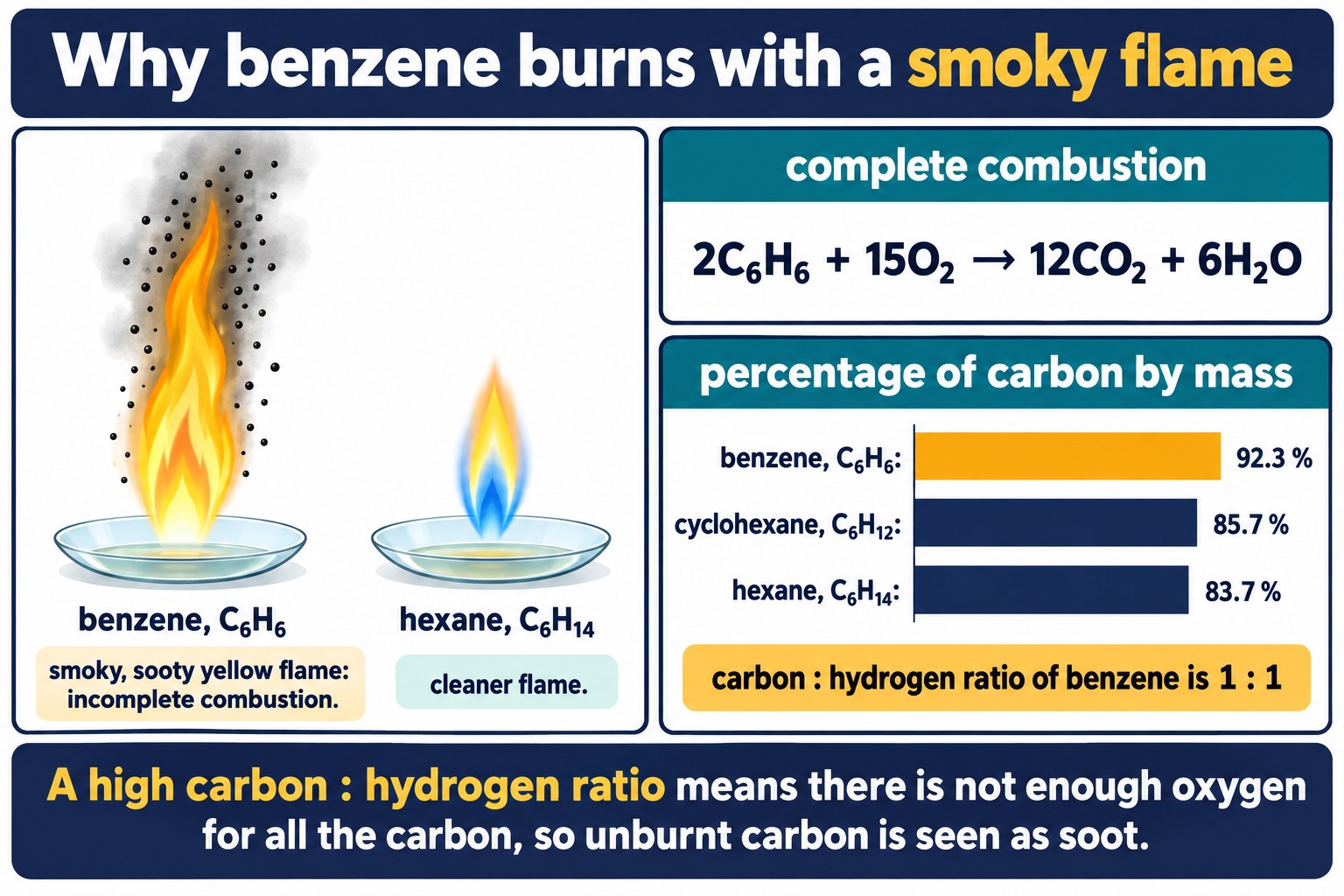
Benzene is 92.3 % carbon by mass, against 85.7 % for cyclohexane and 83.7 % for hexane. The more carbon, the smokier the flame.
Exam focus: Link the smoky flame to the high proportion of carbon: the carbon : hydrogen ratio is high, so combustion in air is incomplete and carbon is released as soot.
Sulfonation with Fuming Sulfuric Acid
Fuming sulfuric acid is concentrated sulfuric acid with dissolved sulfur trioxide, SO₃. It is also called oleum. Benzene warmed with it gives benzenesulfonic acid, C₆H₅SO₃H.
- Overall: C₆H₆ + SO₃ → C₆H₅SO₃H.
- The electrophile is SO₃ itself. Three electronegative oxygen atoms pull electron density away from sulfur, leaving the sulfur electron deficient.
- No charged electrophile and no separate catalyst are needed: the neutral SO₃ molecule is attacked directly by the ring.
- The reaction is an electrophilic substitution with the usual three steps. The H⁺ lost from the ring ends up on an oxygen of the SO₃ group.
- Concentrated sulfuric acid alone also works but needs several hours of reflux: C₆H₆ + H₂SO₄ → C₆H₅SO₃H + H₂O.
- Sulfonic acids are strong acids. Their salts are used in detergents.
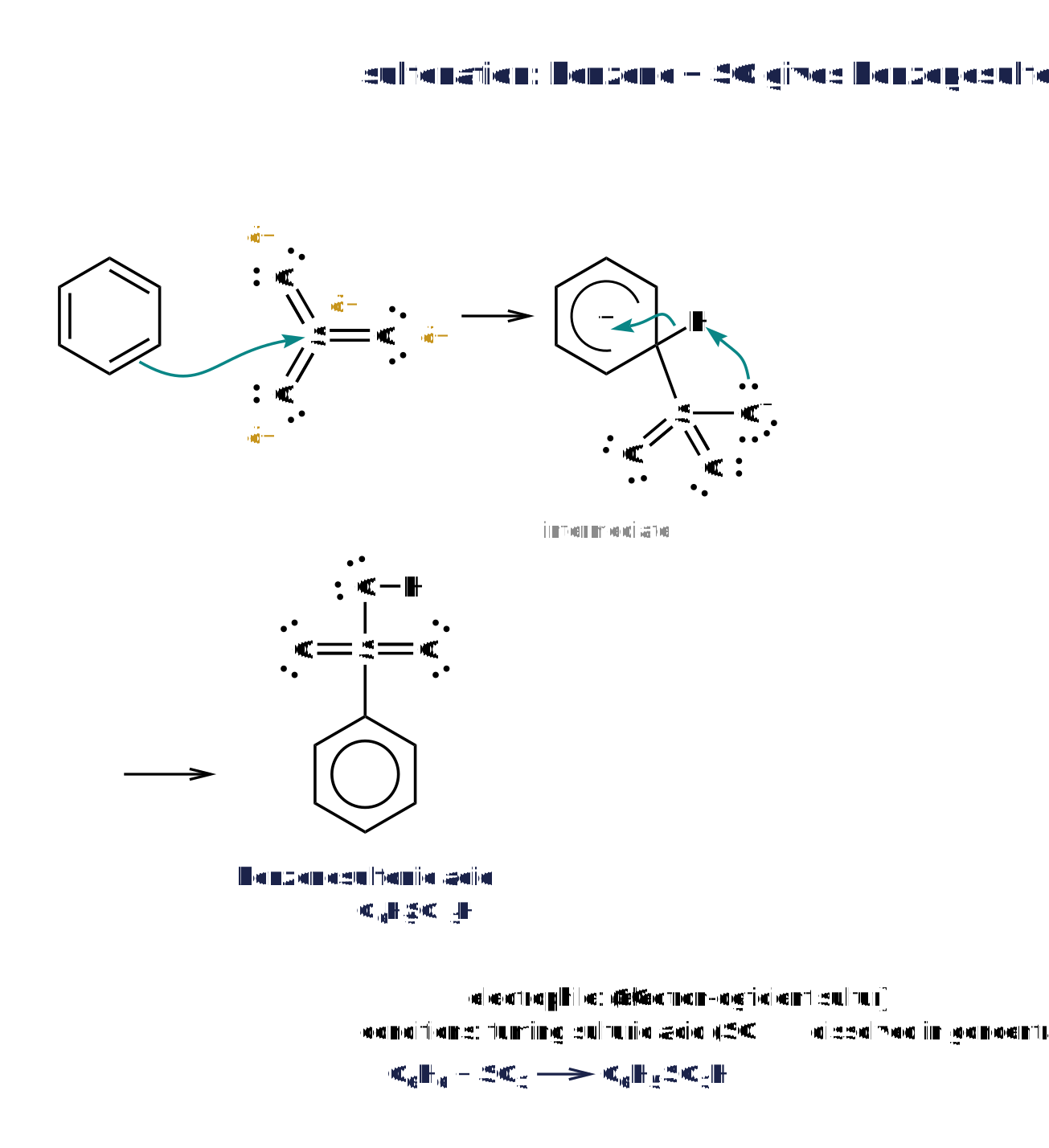
The ring attacks the electron-deficient sulfur of SO₃. The intermediate loses H⁺ to the SO₃⁻ group, giving benzenesulfonic acid.
Remember: Reagent: fuming sulfuric acid (SO₃ dissolved in concentrated H₂SO₄), warmed. Electrophile: SO₃. Product: benzenesulfonic acid, C₆H₅SO₃H. Type: electrophilic substitution.
Check: Substitution or Not?
Decide which reactions of benzene keep the delocalised ring and which destroy it, and account for the atoms in each equation.
Substitution, Addition or Oxidation?
Every reaction of benzene on these pages falls into one of a few classes. Sorting them by class is the quickest way to check that a product makes sense.
| Reaction | Class | Ring kept? |
|---|---|---|
| bromination or chlorination with a catalyst | electrophilic substitution | yes |
| nitration with conc. HNO₃ and H₂SO₄ | electrophilic substitution | yes |
| Friedel–Crafts alkylation with a halogenoalkane | electrophilic substitution | yes |
| Friedel–Crafts acylation with an acyl chloride | electrophilic substitution | yes |
| sulfonation with fuming sulfuric acid | electrophilic substitution | yes |
| combustion in air | oxidation: the molecule is destroyed | no |
- In every electrophilic substitution one hydrogen atom of the ring is replaced and the delocalised system survives.
- The by-product tells you which: HBr or HCl for halogenation and Friedel–Crafts reactions, H₂O for nitration.
- The catalyst is regenerated in the last step: H⁺ + AlCl₄⁻ → AlCl₃ + HCl, or H⁺ + HSO₄⁻ → H₂SO₄.
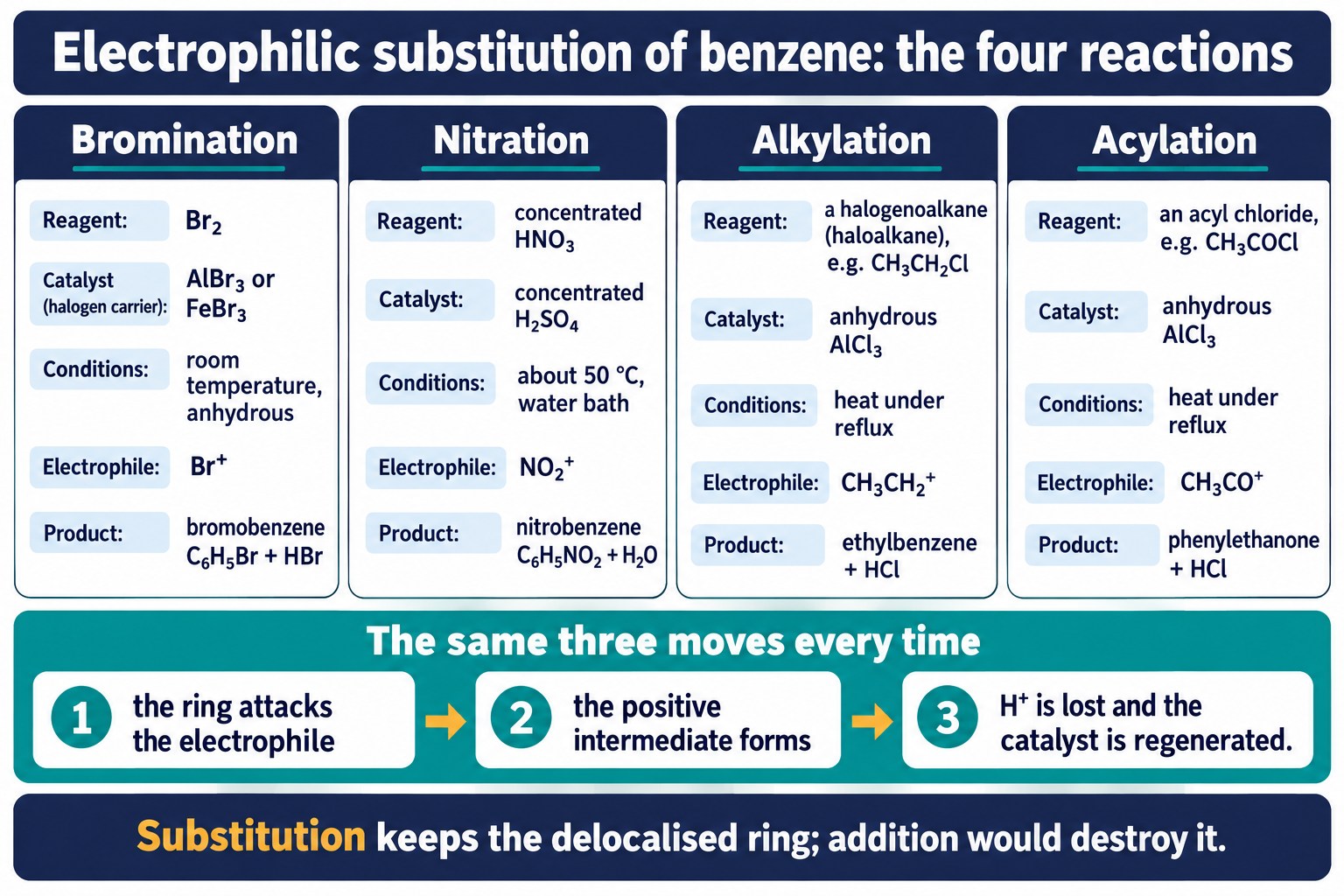
Four reactions, one mechanism. Learn the reagent, the catalyst, the conditions, the electrophile and the product as a set for each.
Quick Check: By-products and Catalysts
Pick the one accurate statement about each new substitution.
Reaction Map
Use the map to revise the whole topic. For each arrow you should be able to give the reagents, the conditions, the type of reaction and a balanced equation.
| Reagents and conditions | Product | Type |
|---|---|---|
| O₂, burn in air | CO₂ + H₂O, smoky flame | combustion |
| Br₂ with catalyst AlBr₃ or FeBr₃, room temperature | bromobenzene C₆H₅Br + HBr | electrophilic substitution |
| conc. HNO₃ + conc. H₂SO₄, about 50 °C | nitrobenzene C₆H₅NO₂ + H₂O | electrophilic substitution |
| fuming sulfuric acid (SO₃ in H₂SO₄), warm | benzenesulfonic acid C₆H₅SO₃H | electrophilic substitution |
| CH₃CH₂Cl, anhydrous AlCl₃, reflux | ethylbenzene C₆H₅CH₂CH₃ + HCl | electrophilic substitution (alkylation) |
| CH₃COCl, anhydrous AlCl₃, reflux | phenylethanone C₆H₅COCH₃ + HCl | electrophilic substitution (acylation) |
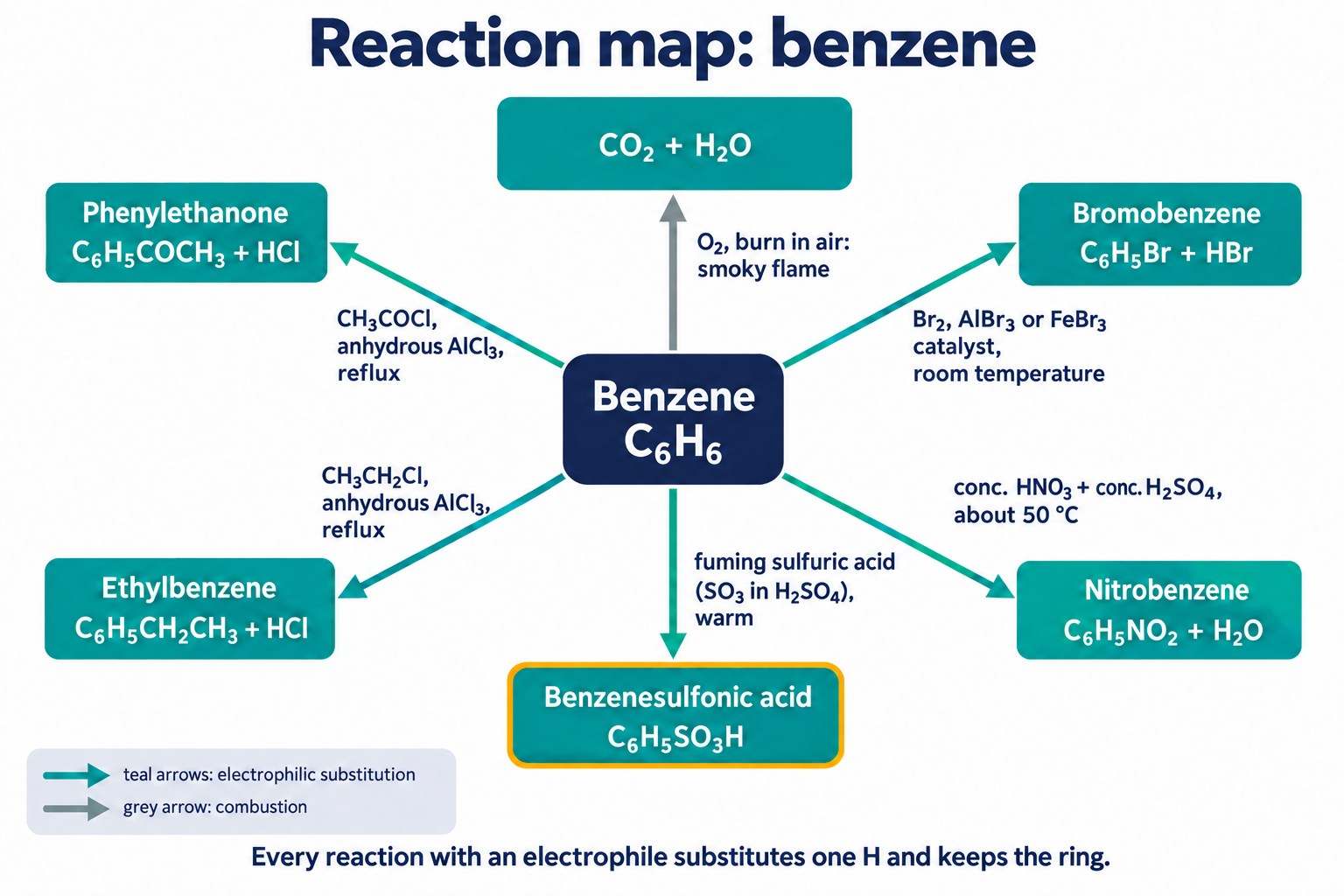
Six arrows from benzene. Five are electrophilic substitutions that keep the ring; combustion destroys it.
Exam focus: A reaction-map question usually asks for reagents and conditions, then the type of reaction, then a mechanism for one arrow. Name the electrophile every time.
Check: The Reaction Map
Match reagents, conditions and products across the reactions of benzene, and classify each one.
Quick Check: New Targets from Benzene
Use the map to plan each new product, then flip the card to compare.
Common Exam Points
- Benzene burns with a smoky flame because of its high carbon : hydrogen ratio; combustion in air is incomplete and gives soot.
- Balanced combustion: 2C₆H₆ + 15O₂ → 12CO₂ + 6H₂O.
- Sulfonation uses fuming sulfuric acid; the electrophile is SO₃ and the product is benzenesulfonic acid, C₆H₅SO₃H.
- Every electrophilic substitution keeps the delocalised ring and replaces one H; the by-product is HBr, HCl or H₂O.
- State the catalyst and how it is regenerated whenever a question asks for conditions.
- When asked for a reaction map, give reagents AND conditions for every arrow; one without the other loses the mark.
FAQs
Use these quick answers to check combustion, sulfonation and the reaction map of benzene.
Why does benzene burn with a smoky flame?
Benzene has a very high carbon to hydrogen ratio, six carbons for six hydrogens. In air there is rarely enough oxygen to oxidise all that carbon, so some is left as soot. The flame is yellow and smoky, a sign of an aromatic compound.
What is the equation for the complete combustion of benzene?
2C₆H₆ + 15O₂ → 12CO₂ + 6H₂O, or C₆H₆ + 7½O₂ → 6CO₂ + 3H₂O for one mole. Balance carbon first, then hydrogen, then count the oxygen atoms. Complete combustion needs a plentiful supply of oxygen.
Why does hexane burn cleanly when benzene is smoky?
Hexane, C₆H₁₄, has fourteen hydrogens for six carbons, so its carbon to hydrogen ratio is much lower and the carbon burns away to carbon dioxide. Benzene, C₆H₆, has far more carbon per hydrogen, so unburnt carbon escapes as sooty smoke.
What is sulfonation?
Benzene is warmed with fuming sulfuric acid, concentrated H₂SO₄ containing dissolved SO₃ (oleum): C₆H₆ + SO₃ → C₆H₅SO₃H, benzenesulfonic acid. The electrophile is SO₃ itself; the H⁺ lost from the ring transfers to the SO₃⁻ group.
Why is SO₃ an electrophile when it carries no positive charge?
Three very electronegative oxygen atoms pull electron density away from the sulfur, leaving it strongly δ+. The electron-deficient sulfur accepts an electron pair from the π system, just as NO₂⁺ or Br⁺ does. Sulfonic acids are strong acids used in detergents.

Copyright notice: This OLS revision content, including the explanations, layout, diagrams, tables and embedded learning structure, is authored for Online Learning System by Dr. Mohammed Al-Fatah. It may not be copied, reproduced, redistributed or adapted without written permission.
Keep this note — free
Save your progress across every Edexcel IAL topic. A free account remembers which topics you have covered, saves your question scores, and syncs across your phone and laptop.
- Track every topic you have finished
- Keep your practice-question scores
- No payment, no card, free forever
Already registered? Log in