Topic 6
Energetics
Energetics is the study of the heat energy transferred when chemicals react. This topic covers exothermic and endothermic reactions, enthalpy level diagrams, the standard enthalpy change definitions, measuring enthalpy changes by calorimetry, Hess’s law and enthalpy cycles, and bond enthalpies, all examined in Unit 2 and assessed practically through Core Practical 2.
Revision Notes
5 revision notes, in the order the specification teaches them.
Enthalpy Changes and Standard Conditions
Exothermic and endothermic reactions, enthalpy level diagrams, activation energy and standard conditions.
Start revising
Standard Enthalpy Changes
The five standard enthalpy change definitions and how to write the equation each one refers to.
Start revising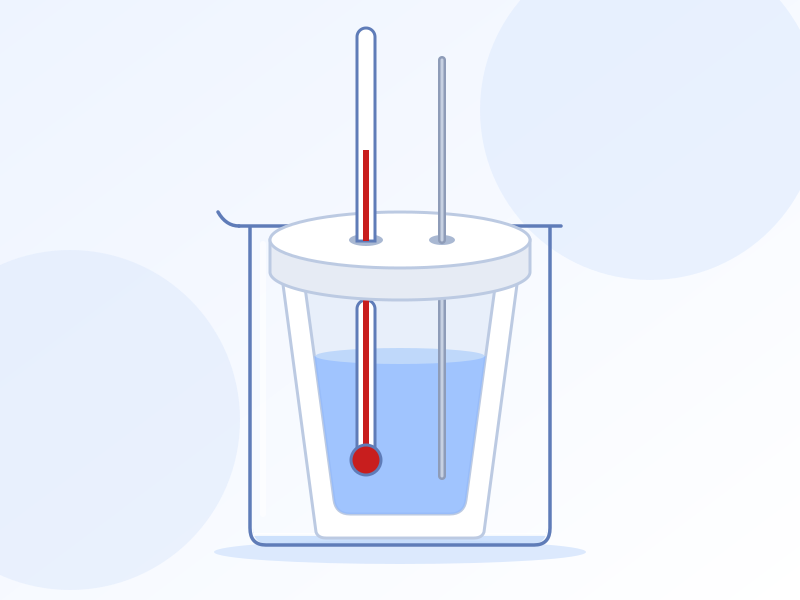
Calorimetry: Measuring Enthalpy Changes
Calculating ΔH from a temperature change, cooling curve corrections, errors and assumptions.
Start revising
Hess’s Law and Enthalpy Cycles
Building enthalpy cycles and calculating ΔH from formation and combustion data.
Start revising
Bond Enthalpies
Mean bond enthalpy, calculating ΔH from bonds broken and made, and why the answers differ from Hess values.
Start revisingSummary Map
Download, print and revise the key facts of this topic at a glance.
Summary maps
Download, print and revise the key facts of this topic at a glance.

Enthalpy Changes Map
Edexcel International A Level Chemistry · Unit 2 · Topic 6A Enthalpy Changes
The whole section on one A4 page: ΔH and its sign, level diagrams, standard conditions and the standard enthalpy changes.
Calorimetry Map
Edexcel International A Level Chemistry · Unit 2 · Topic 6B Calorimetry
The whole section on one A4 page: q = mcΔT, reactions in solution, burning fuels, errors and assumptions, uncertainty and the cooling-curve correction.
Hess's Law Map
Edexcel International A Level Chemistry · Unit 2 · Topic 6C Hess's Law
The whole section on one A4 page: Hess's law, formation and combustion cycles, combining equations, Core Practical 2 and evaluating the result.
Bond Enthalpies Map
Edexcel International A Level Chemistry · Unit 2 · Topic 6D Bond Enthalpies
The whole section on one A4 page: bond enthalpy, mean bond enthalpy, ΔH from bonds broken and made, working back, limitations and which bond breaks first.
© 2026 Online Learning System. For personal study: printing is allowed; editing, copying and redistribution are not.
Virtual Lessons
Recorded video lessons that teach the topic step by step.
The Virtual Lessons for Topic 6 Energetics are being recorded.
MCQ Bank
Multiple-choice papers on this topic, marked the moment you submit.
The MCQ papers for Topic 6 Energetics are being written.
SAQ Bank
Written, drawn and worked exam practice on this topic.
The exam practice papers for Topic 6 Energetics are being written.
Revision Game
Match reagents to products, with your board's reagents and conditions.
The revision game for Topic 6 Energetics is being built.
Study Cards
Pick a deck, then turn each card to check what you remember.
Specification
Every specification point in this topic, in the exam board's own words. Rate how confident you are with each one.
Self-assessment · 33 points
Sign in to rate how confident you feel about each point. Your ratings are saved to your account, follow you to any device, and appear beside your KASP analytics, kept apart from your marks.
6.1
6.2
- 6.2
know that, by convention, exothermic reactions have a negative enthalpy change and endothermic reactions have a positive enthalpy change
Revise
6.3
6.4
6.5
- i
be able to use experimental data to calculate: energy transferred in a reaction recalling and using the expression: energy transferred (J) = mass (g) × specific heat capacity (J g-1 °C-1) × temperature change (°C)
Revise - ii
be able to use experimental data to calculate: enthalpy change of the reaction in kJ mol-1 This will be limited to experiments where substances are mixed in an insulated container and combustion experiments using a suitable calorimeter.
Revise
6.6
- ii b
be able to apply it to: calculating enthalpy changes of reaction using data provided, or data selected from a table or obtained from experiments
Revise
6.7
6.8
6.9
6.10
6.11
- a
understand that bond enthalpy data gives some indication about which bond will break first in a reaction
Revise - b
understand that bond enthalpy data gives some indication about how easy or difficult a bond is to break
Revise - c
understand that bond enthalpy data gives some indication about how rapidly a reaction will take place at room temperature
Revise
Keep this note — free
Save your progress across every Edexcel IAL topic. A free account remembers which topics you have covered, saves your question scores, and syncs across your phone and laptop.
- Track every topic you have finished
- Keep your practice-question scores
- No payment, no card, free forever
Already registered? Log in