High Resolution Mass Spectrometry
A concise revision guide to high resolution mass spectrometry: why accurate relative atomic masses are not whole numbers, calculating an accurate relative molecular mass to four decimal places, and using it to choose between molecular formulae with the same nominal mass.
- 19A.1i
- 19A.1ii
What these spec points say
- 19A.1i be able to use data from mass spectra to: suggest possible structures of a simple organic compound given relative molecular masses, accurate to four decimal places
- 19A.1ii be able to use data from mass spectra to: calculate the accurate relative molecular mass of a compound, given relative atomic masses to four decimal places, and therefore identify a compound
Before You Start
This page builds on the mass spectrometry in Topic 7 Modern Analytical Techniques I: the molecular ion peak, m/z values and fragmentation. Look back at it if those terms feel unfamiliar.
Low Resolution and High Resolution
In a mass spectrum the molecular ion peak, M⁺, is the peak for the whole molecule that has lost one electron. Its m/z value equals the relative molecular mass, Mr.
- It is usually the peak with the highest m/z, apart from a small M+1 peak caused by ¹³C.
- A low resolution spectrometer measures m/z to the nearest whole number.
- A high resolution spectrometer measures m/z very precisely, to four or more decimal places.
The problem with whole numbers
Many different molecular formulae share the same whole-number mass. A low resolution spectrum cannot tell them apart.
| Whole-number Mr | Possible molecular formulae |
|---|---|
| 28 | CO, N₂, C₂H₄ |
| 60 | C₃H₈O, C₂H₄O₂, C₂H₈N₂ |
| 72 | C₄H₈O, C₃H₄O₂, C₃H₈N₂, C₅H₁₂ |
Key idea: High resolution mass spectrometry measures the mass of the molecular ion so precisely that only one molecular formula fits. It gives the molecular formula directly.
Quick Check: Low or High Resolution?
Pick the one accurate statement in each set, using compounds that are new to this page.
Accurate Relative Atomic Masses
Relative masses are measured on a scale where one atom of ¹²C is exactly 12. On this scale no other atom has a whole-number mass.
| Atom | Mass to the nearest whole number | Accurate relative mass |
|---|---|---|
| ¹H | 1 | 1.0078 |
| ¹²C | 12 | 12.0000 |
| ¹⁴N | 14 | 14.0031 |
| ¹⁶O | 16 | 15.9949 |
- These are masses of single isotopes, because each molecular ion contains particular isotopes.
- Do not use the Periodic Table values (such as C = 12.0 or 12.011), which are averages over all the isotopes.
- The accurate values are always given in the question. They do not need to be learned.
Because each element is “off” from a whole number by a different amount, every molecular formula has its own accurate mass.
Remember: Hydrogen is a little heavier than 1 and oxygen a little lighter than 16. A formula rich in hydrogen sits above the whole number; one rich in oxygen sits lower.
Calculating an Accurate Mr
Add the accurate masses of all the atoms in the formula. Keep four decimal places all the way through.
Worked example 1
Calculate the accurate relative molecular mass of C₃H₈O.
Step 2. Add them: 36.0000 + 8.0624 + 15.9949.
Answer. Mr = 60.0573
Three formulae, three accurate masses
| Formula | Working | Accurate Mr |
|---|---|---|
| C₃H₈O | 36.0000 + 8.0624 + 15.9949 | 60.0573 |
| C₂H₄O₂ | 24.0000 + 4.0312 + 31.9898 | 60.0210 |
| C₂H₈N₂ | 24.0000 + 8.0624 + 28.0062 | 60.0686 |
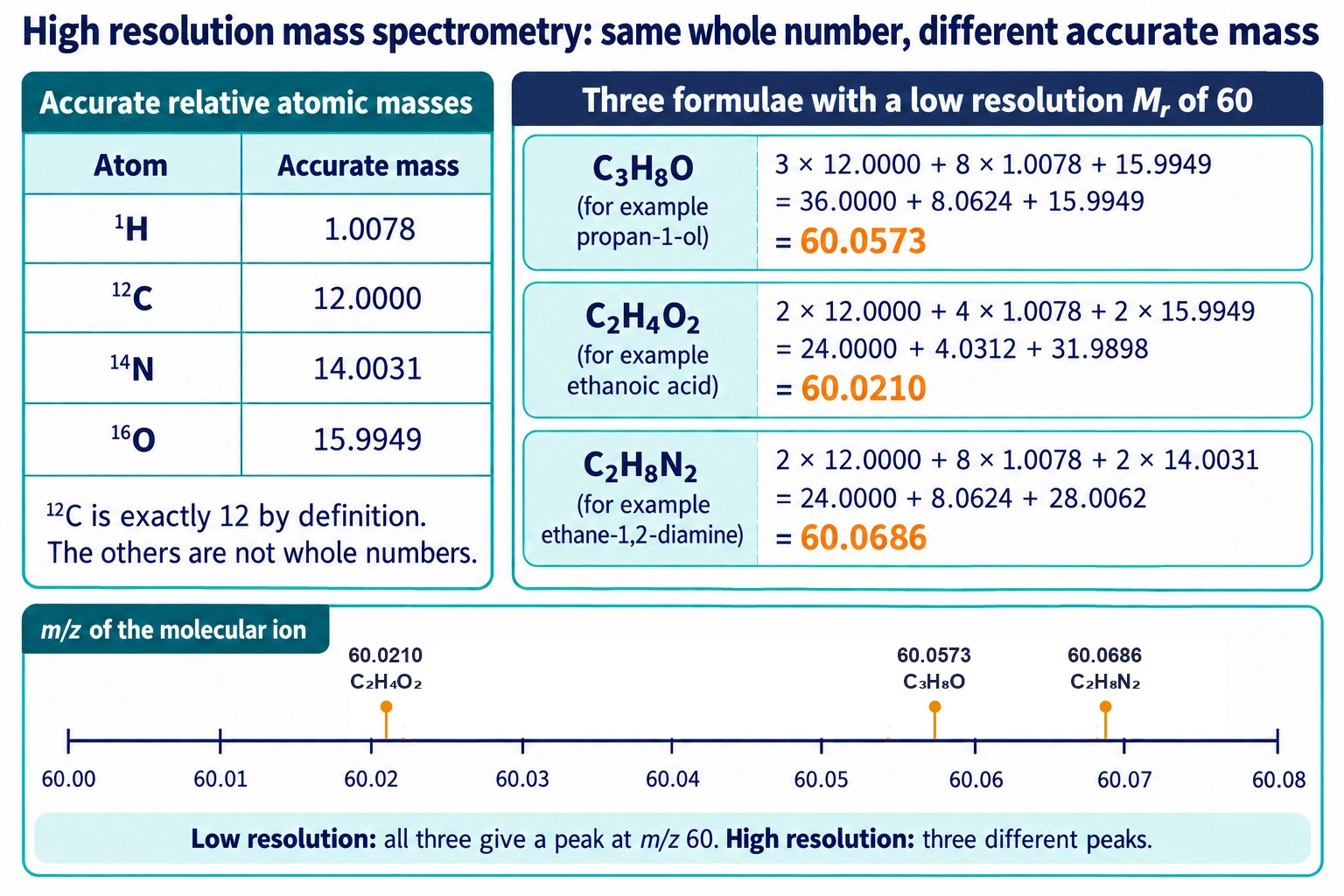
Accurate relative atomic masses and the three formulae with a whole-number mass of 60: C₃H₈O at 60.0573, C₂H₄O₂ at 60.0210 and C₂H₈N₂ at 60.0686.
The same idea separates the three gases with Mr 28.
| Gas | Working | Accurate Mr |
|---|---|---|
| CO | 12.0000 + 15.9949 | 27.9949 |
| N₂ | 2 × 14.0031 | 28.0062 |
| C₂H₄ | 24.0000 + 4 × 1.0078 | 28.0312 |
Exam focus: Show the sum and give the answer to four decimal places. Rounding part way through can make two formulae look the same.
Check: Calculating Accurate Masses
Calculate accurate relative molecular masses to four decimal places and compare formulae with the same whole-number mass, using formulae not used on this page.
Identifying a Molecular Formula
To identify a compound, compare the measured m/z of its molecular ion with the accurate Mr of each possible formula.
Worked example 2
A compound has a molecular ion peak at m/z = 72.0573 in its high resolution mass spectrum. Is its formula C₄H₈O, C₃H₄O₂, C₃H₈N₂ or C₅H₁₂?
Step 1. C₄H₈O = 4 × 12.0000 + 8 × 1.0078 + 15.9949 = 48.0000 + 8.0624 + 15.9949 = 72.0573.
Step 3. C₅H₁₂ = 60.0000 + 12 × 1.0078 = 60.0000 + 12.0936 = 72.0936.
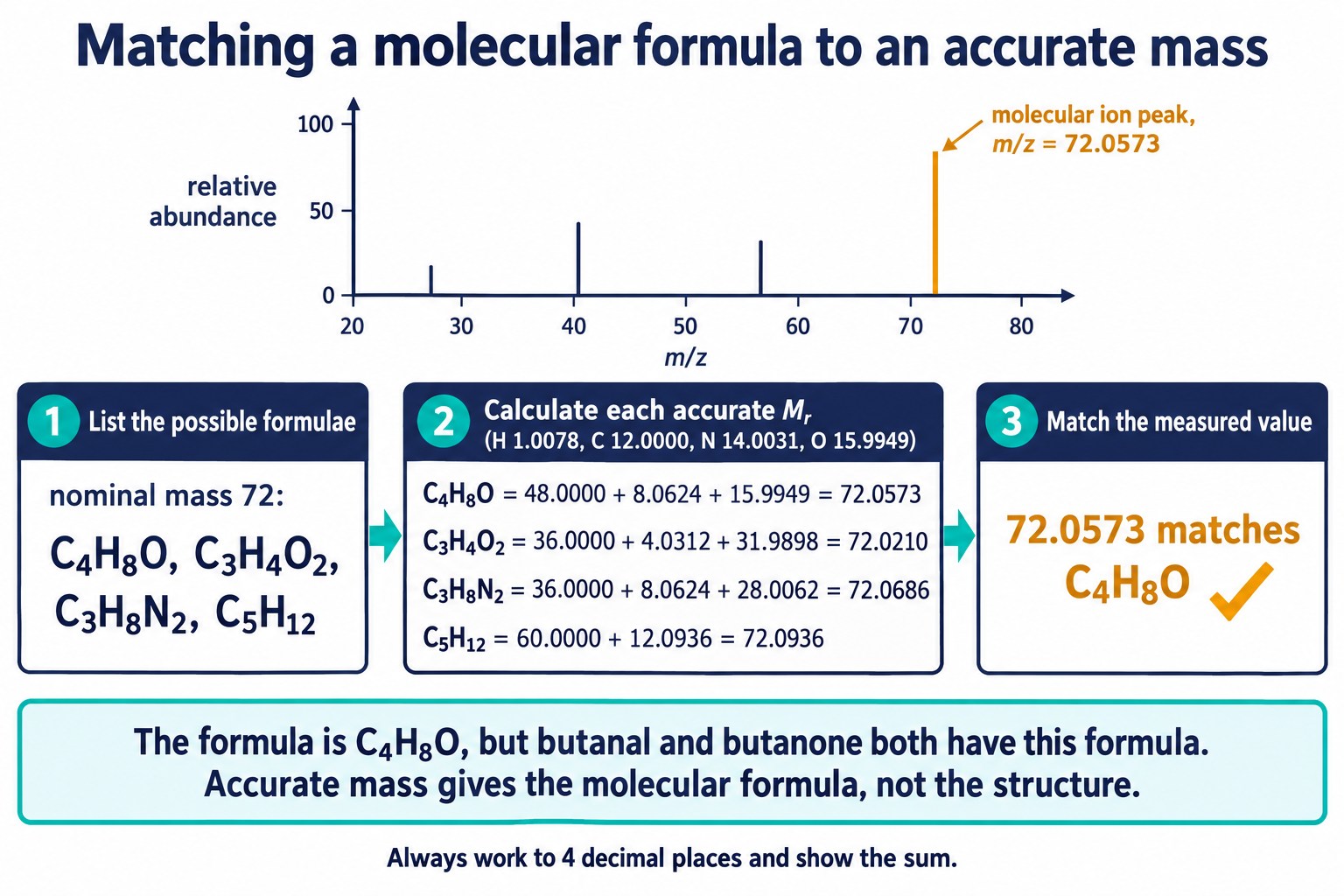
From an accurate molecular ion peak to a molecular formula: list the formulae with a whole-number mass of 72, calculate each to four decimal places and match the measured value of 72.0573.
What accurate mass cannot do
- Isomers have the same molecular formula, so they have exactly the same accurate Mr.
- Butanal and butanone are both C₄H₈O. Both give a molecular ion at 72.0573.
- To choose between isomers, use the fragmentation pattern, infrared spectra or carbon-13 NMR and proton NMR.
Key idea: Accurate mass gives the molecular formula. Other evidence is then needed to find the structure.
Quick Check: Rank the Accurate Masses
All five formulae have the same whole-number mass, so only accurate masses can rank them.
Common Exam Points
Say
- “The molecular ion peak gives the relative molecular mass of the compound.”
- “The compounds have the same Mr to the nearest whole number but different accurate masses.”
- “The measured value matches the calculated Mr of C₄H₈O to four decimal places.”
Do not say
- “High resolution mass spectrometry identifies the structure” (it identifies the molecular formula).
- “Carbon is 12.0000 because it is rounded” (¹²C is exactly 12 by definition).
- “The tallest peak is the molecular ion” (it is the peak at the highest m/z, ignoring M+1).
Watch for
- Using the accurate masses given in the question, not Periodic Table values.
- Formulae with nitrogen: remember 14.0031 for each N atom.
- Questions that ask for a reason: say that each formula has a different accurate mass.
Check: Finding the Molecular Formula
Match a measured molecular ion peak to the correct molecular formula and explain what the result does and does not show, using values not used on this page.
FAQs
Use these quick answers to check high resolution mass spectrometry and accurate masses.
What can high resolution mass spectrometry do that low resolution cannot?
It measures m/z to four decimal places. Molecules with the same Mr to the nearest whole number have slightly different accurate masses, so the molecular formula can be identified from the molecular ion peak alone.
Why do molecules with the same whole-number Mr have different accurate masses?
Only ¹²C has a mass of exactly 12. Other atoms are not whole numbers: H is 1.0078, N is 14.0031 and O is 15.9949. Different combinations of atoms therefore add up to slightly different totals.
How do I calculate an accurate Mr?
Multiply each accurate atomic mass by the number of those atoms and add. For C₃H₈O: (3 × 12.0000) + (8 × 1.0078) + 15.9949 = 60.0573. Keep four decimal places throughout.
How do I use an accurate mass to identify a molecular formula?
Calculate the accurate Mr of each possible formula and match it to the measured value. A molecular ion peak at 60.0210 fits C₂H₄O₂ (60.0210) rather than C₃H₈O (60.0573) or C₂H₈N₂ (60.0686).
Can high resolution mass spectrometry tell isomers apart?
Not from the molecular ion peak. Isomers such as propan-1-ol and propan-2-ol share the formula C₃H₈O, so they have the same accurate mass. Fragmentation patterns, infrared spectra or NMR spectra are needed to distinguish them.

Copyright notice: This OLS revision content, including the explanations, layout, diagrams, tables and embedded learning structure, is authored for Online Learning System by Dr. Mohammed Al-Fatah. It may not be copied, reproduced, redistributed or adapted without written permission.
Keep this note — free
Save your progress across every Edexcel topic. A free account remembers which topics you have covered, saves your question scores, and syncs across your phone and laptop.
- Track every topic you have finished
- Keep your practice-question scores
- No payment, no card, free forever
Already registered? Log in