Electron Configurations and Properties of Transition elements
A concise revision guide to the transition elements: electron configurations of the d-block atoms and ions from scandium to zinc, what makes an element a transition element, and why they show variable oxidation numbers.
- 5.3.1(a)-i
- 5.3.1(a)-ii
- 5.3.1(b)
- 5.3.1(c)(i)
- 5.3.1(c)(ii)
What these spec points say
- 5.3.1(a)-i the electron configuration of atoms of the d-block elements of Period 4 (Sc–Zn), given the atomic number (see also 2.2.1 d)
- 5.3.1(a)-ii the electron configuration of ions of the d-block elements of Period 4 (Sc–Zn), given the atomic number and charge (see also 2.2.1 d)
- 5.3.1(b) the elements Ti–Cu as transition elements i.e. d-block elements that have an ion with an incomplete d-sub-shell
- 5.3.1(c)(i) illustration, using at least two transition elements, of the existence of more than one oxidation state for each element in its compounds (see also 5.3.1 k)
- 5.3.1(c)(ii) illustration, using at least two transition elements, of the formation of coloured ions (see also 5.3.1 h, j–k)
Recap: Electron Configurations
Five quick questions on what you already know: the order in which sub-shells fill, why 4s fills before 3d, and writing configurations for atoms up to krypton.
The d-Block: Scandium to Zinc
The d-block elements of Period 4 run from scandium (Z = 21) to zinc (Z = 30). Across the block, electrons are added to the 3d sub-shell, which holds up to ten electrons in five orbitals.
- The 4s sub-shell fills before the 3d sub-shell.
- [Ar] stands for the argon core, 1s²2s²2p⁶3s²3p⁶.
- Either order of writing is accepted: [Ar]3d⁶4s² or [Ar]4s²3d⁶.
- Your earlier notes, 2.2.1 Electron structure, cover the filling rules.
| Element | Atomic number | Electron configuration | 3d electrons | 4s electrons |
|---|---|---|---|---|
| scandium, Sc | 21 | [Ar]3d¹4s² | 1 | 2 |
| titanium, Ti | 22 | [Ar]3d²4s² | 2 | 2 |
| vanadium, V | 23 | [Ar]3d³4s² | 3 | 2 |
| chromium, Cr | 24 | [Ar]3d⁵4s¹ | 5 | 1 |
| manganese, Mn | 25 | [Ar]3d⁵4s² | 5 | 2 |
| iron, Fe | 26 | [Ar]3d⁶4s² | 6 | 2 |
| cobalt, Co | 27 | [Ar]3d⁷4s² | 7 | 2 |
| nickel, Ni | 28 | [Ar]3d⁸4s² | 8 | 2 |
| copper, Cu | 29 | [Ar]3d¹⁰4s¹ | 10 | 1 |
| zinc, Zn | 30 | [Ar]3d¹⁰4s² | 10 | 2 |
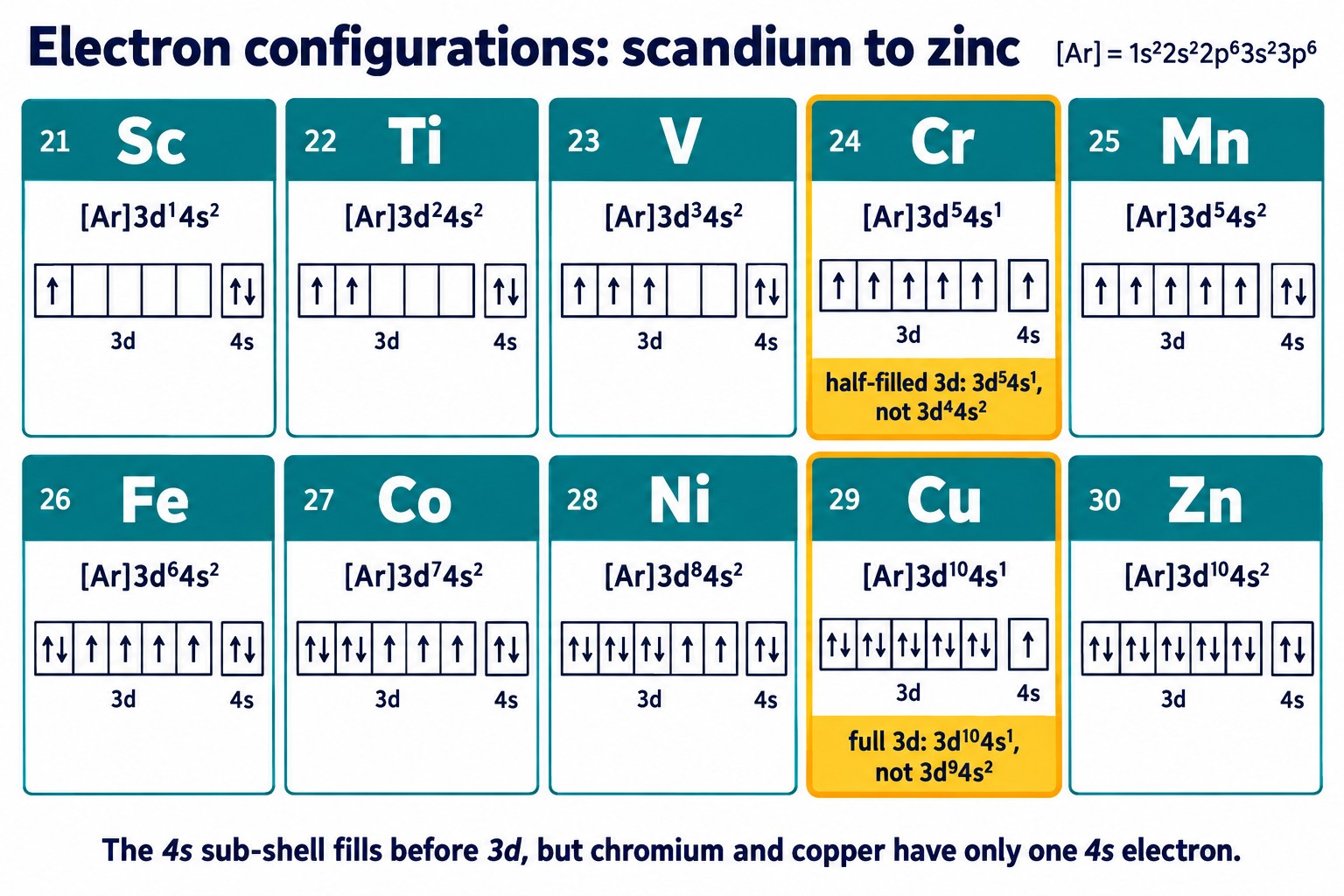
The ten d-block elements of Period 4 with their 3d and 4s electrons shown in boxes. Chromium and copper break the pattern.
Remember: Within the 3d sub-shell, electrons occupy the five orbitals singly before any pairing starts. Manganese, 3d⁵, has five unpaired 3d electrons. Iron, 3d⁶, has one pair and four unpaired electrons.
Chromium and Copper: the Two Exceptions
Chromium and copper each have only one 4s electron. One electron that would be expected in 4s is found in 3d instead.
| Element | Expected (wrong) | Actual | 3d arrangement |
|---|---|---|---|
| chromium | [Ar]3d⁴4s² | [Ar]3d⁵4s¹ | half-filled: five unpaired electrons |
| copper | [Ar]3d⁹4s² | [Ar]3d¹⁰4s¹ | full: five pairs |
- The 3d and 4s sub-shells are very close in energy.
- A half-filled or a full 3d sub-shell is a lower-energy, more stable arrangement.
- In chromium, all six outer electrons are unpaired, so repulsion between paired electrons is avoided.
Exam focus: Write out the configurations of chromium and copper from memory. They are the two most commonly tested atoms in the d-block, and most errors come from writing 3d⁴4s² or 3d⁹4s².
Electron Configurations of Ions
When a d-block atom forms a positive ion, the 4s electrons are lost first, before any 3d electrons. Once the 3d sub-shell holds electrons, 4s is the higher in energy.
- Write the configuration of the atom.
- Remove the 4s electrons first.
- Remove 3d electrons only if more must be lost.
Worked example: Fe²⁺ and Fe³⁺ (Z = 26)
Step 1. The atom is [Ar]3d⁶4s².
Step 2. Fe²⁺ has lost two electrons, both from 4s: [Ar]3d⁶.
Answer. Fe³⁺ has lost one more electron, from 3d: [Ar]3d⁵.
Worked example: Cu²⁺ (Z = 29)
Step 1. The atom is [Ar]3d¹⁰4s¹.
Answer. Remove the one 4s electron, then one 3d electron: Cu²⁺ is [Ar]3d⁹.
Worked example: Cr³⁺ (Z = 24)
Step 1. The atom is [Ar]3d⁵4s¹.
Answer. Remove the one 4s electron, then two 3d electrons: Cr³⁺ is [Ar]3d³.
| Ion | Configuration | Ion | Configuration |
|---|---|---|---|
| Sc³⁺ | [Ar] | Fe³⁺ | [Ar]3d⁵ |
| Ti³⁺ | [Ar]3d¹ | Co²⁺ | [Ar]3d⁷ |
| V³⁺ | [Ar]3d² | Ni²⁺ | [Ar]3d⁸ |
| Cr³⁺ | [Ar]3d³ | Cu⁺ | [Ar]3d¹⁰ |
| Mn²⁺ | [Ar]3d⁵ | Cu²⁺ | [Ar]3d⁹ |
| Fe²⁺ | [Ar]3d⁶ | Zn²⁺ | [Ar]3d¹⁰ |
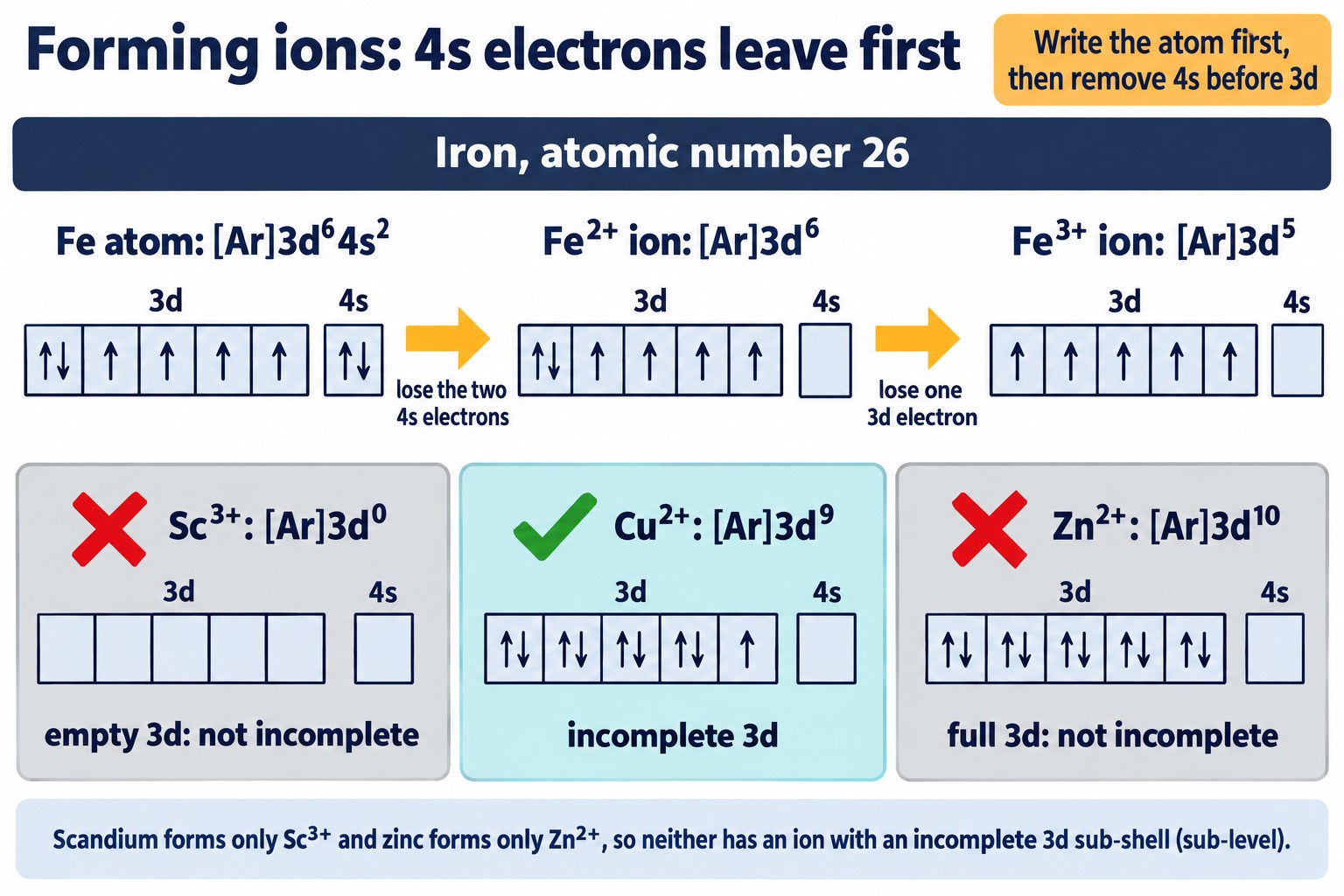
Iron loses its two 4s electrons to form Fe²⁺, then one 3d electron to form Fe³⁺. The ions of scandium and zinc have an empty and a full 3d set.
Common mistake: Fe²⁺ is [Ar]3d⁶, not [Ar]3d⁴4s². No simple ion of a Period 4 d-block element keeps any 4s electrons.
Check: Configurations of Atoms and Ions
Write and recognise the electron configurations of d-block atoms and of ions that were not worked through above.
What Is a Transition element?
Not every d-block element is a transition element. The test is applied to the ions that the element forms.
Definition: A transition element is a d-block element that has an ion with an incomplete d sub-shell. The elements titanium to copper fit this definition.
| Element | Only stable ion | Configuration of the ion | Transition element? |
|---|---|---|---|
| scandium | Sc³⁺ | [Ar], 3d⁰: empty | no |
| zinc | Zn²⁺ | [Ar]3d¹⁰: full | no |
| iron | Fe²⁺ and Fe³⁺ | 3d⁶ and 3d⁵: incomplete | yes |
| copper | Cu⁺ and Cu²⁺ | 3d¹⁰ and 3d⁹: Cu²⁺ is incomplete | yes |
- Scandium forms only Sc³⁺, which has no 3d electrons.
- Zinc forms only Zn²⁺, which has a full 3d sub-shell.
- Copper qualifies through Cu²⁺, even though Cu⁺ is 3d¹⁰. One ion with an incomplete set is enough.
- The transition elements of Period 4 are therefore the eight elements from titanium to copper.
Exam focus: To explain why zinc is not a transition element, name the ion and give its configuration: zinc forms only Zn²⁺, [Ar]3d¹⁰, which has a full 3d sub-shell.
Characteristic Properties
The transition elements share four properties that set them apart from the s-block metals. All four come from the incomplete 3d sub-shell.
| Property | What it means | Notes |
|---|---|---|
| variable oxidation number | each element forms ions and compounds in more than one oxidation number | Redox Chemistry of Transition elements |
| coloured ions | their compounds and solutions are usually coloured | Colour of Transition element Ions |
| complex formation | their ions bond to ligands to form complex ions | Ligands, Complex Ions and Their Shapes |
| catalytic activity | the elements and their compounds speed up many reactions | Transition elements as Catalysts |
Illustrating the properties with iron and copper
| Iron | Copper | |
|---|---|---|
| More than one oxidation number | +2 in FeCl₂, +3 in FeCl₃ | +1 in Cu₂O, +2 in CuO |
| Coloured ions | Fe²⁺(aq) pale green, Fe³⁺(aq) yellow | Cu²⁺(aq) blue |
| Catalyst | iron in the Haber process | copper, deposited on the zinc, in the reaction of zinc with acid |
Remember: Scandium and zinc compounds are white and their solutions are colourless. Each has only one oxidation number in its compounds: +3 for scandium and +2 for zinc.
Quick Check: Which Property Is This?
Each fact shows one characteristic property. Choose it quickly.
Why Transition elements Have Variable Oxidation numbers
The 3d and 4s sub-shells are very close in energy. Different numbers of these electrons can be lost or shared without a large energy cost.
- Successive ionisation energies rise gradually, with no large jump until all the 3d and 4s electrons have gone.
- Calcium: 590, 1145, then 4912 kJ mol⁻¹. The third electron comes from an inner shell, so calcium is only ever +2.
- Vanadium: 651, 1414, 2830, 4507, then 6299 kJ mol⁻¹. The rise is steady, so +2, +3, +4 and +5 are all found.
- The extra energy needed to remove another electron is repaid by the larger lattice energy or hydration energy of the more highly charged ion.
| Element | Common oxidation numbers | Examples |
|---|---|---|
| titanium | +3, +4 | Ti³⁺, TiO₂ |
| vanadium | +2, +3, +4, +5 | V²⁺, V³⁺, VO²⁺, VO₂⁺ |
| chromium | +2, +3, +6 | Cr²⁺, Cr³⁺, Cr₂O₇²⁻ |
| manganese | +2, +4, +6, +7 | Mn²⁺, MnO₂, MnO₄²⁻, MnO₄⁻ |
| iron | +2, +3 | Fe²⁺, Fe³⁺ |
| cobalt | +2, +3 | Co²⁺, Co³⁺ |
| nickel | +2 | Ni²⁺ |
| copper | +1, +2 | Cu⁺, Cu²⁺ |
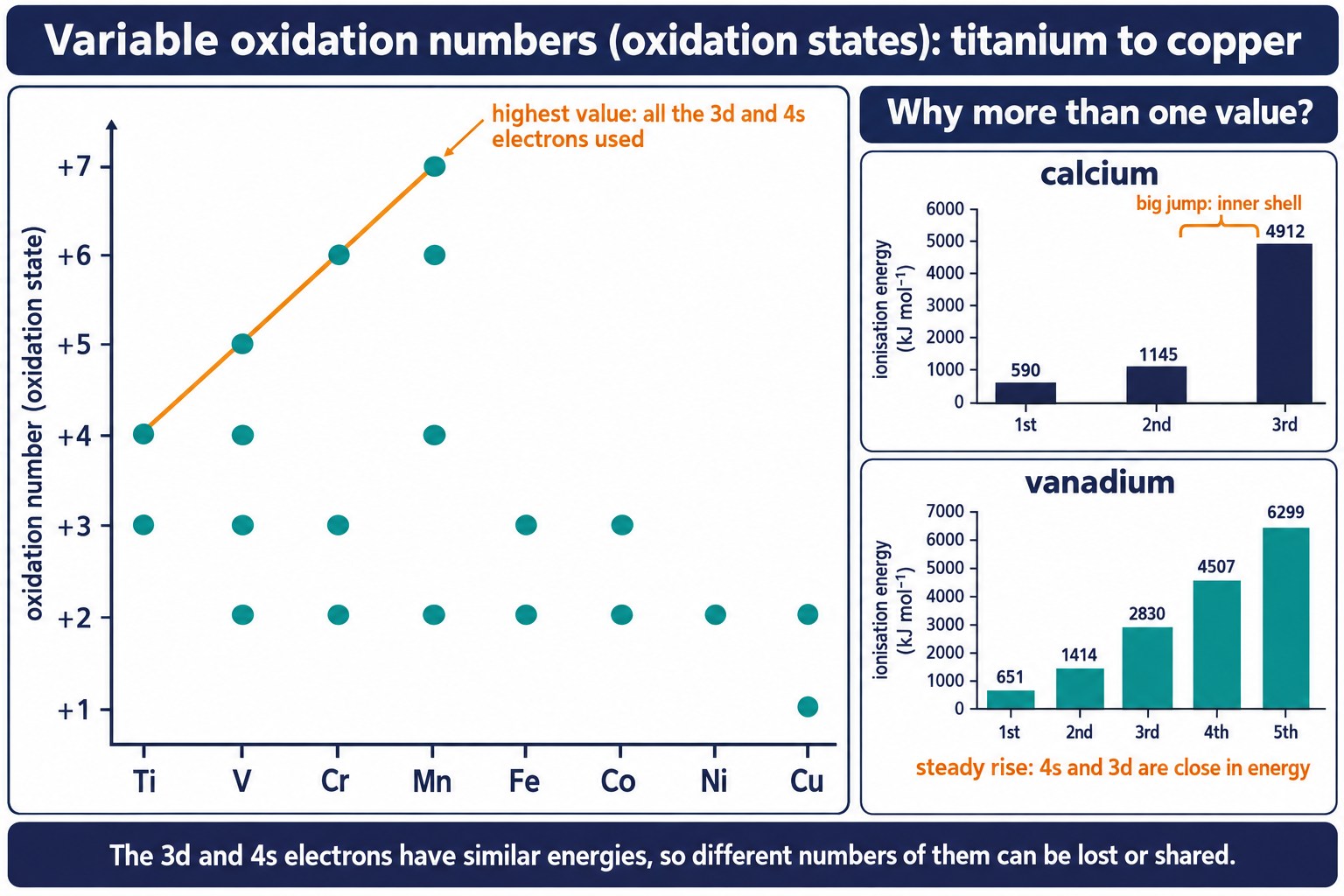
The common values for titanium to copper. The highest value rises to +7 at manganese, where all the 3d and 4s electrons are used.
- Low oxidation numbers, such as +2 and +3, are found in simple ions like Fe²⁺.
- High oxidation numbers are found in ions with oxygen, such as MnO₄⁻, where the metal is covalently bonded.
- The highest value from titanium to manganese equals the total number of 3d and 4s electrons.
Exam focus: The key phrase is that the 3d and 4s electrons have similar energies. Add that successive ionisation energies increase only gradually, so several oxidation numbers are energetically possible.
Check: Transition elements and Their Properties
Apply the definition to ions you have not met on this page, and explain why more than one oxidation number is possible.
Quick Check: Reading Ionisation Energy Data
Use new ionisation energy data to compare a transition metal with a metal that is not one.
Common Exam Points
- Chromium is [Ar]3d⁵4s¹ and copper is [Ar]3d¹⁰4s¹.
- Ions lose 4s electrons before 3d electrons: Fe²⁺ is [Ar]3d⁶ and Cu²⁺ is [Ar]3d⁹.
- Always write the atom first, then remove electrons. Do not work from the element with the same number of electrons.
- Sc³⁺ (3d⁰) and Zn²⁺ (3d¹⁰) do not have an incomplete 3d sub-shell, so scandium and zinc are not transition elements.
- The four characteristic properties are variable oxidation number, coloured ions, complex formation and catalytic activity.
- Variable oxidation numbers arise because the 3d and 4s electrons are close in energy.
- Be ready to illustrate each property with two named transition elements, such as iron and copper.
FAQs
Use these quick answers to check electron configurations, the definition of a transition element and variable oxidation numbers.
Why is chromium 3d⁵4s¹ and not 3d⁴4s²?
The 3d and 4s sub-shells are very close in energy. One electron in each of the five 3d orbitals and one in 4s avoids pairing, which lowers repulsion. Copper is the other exception: [Ar]3d¹⁰4s¹, with a full 3d sub-shell.
Which electrons are lost first when a transition element forms an ion?
The 4s electrons are lost before the 3d electrons, even though 4s fills first. Iron is [Ar]3d⁶4s², so Fe²⁺ is [Ar]3d⁶ and Fe³⁺ is [Ar]3d⁵. Write the configuration of the atom first, then remove electrons from 4s.
Why are scandium and zinc not transition elements?
Scandium forms only Sc³⁺, which is [Ar] with an empty 3d sub-shell. Zinc forms only Zn²⁺, which is [Ar]3d¹⁰ with a full one. Neither has an ion with an incomplete 3d sub-shell, so both are d-block elements but not transition elements.
Why do transition elements have variable oxidation numbers?
The 3d and 4s sub-shells are close in energy, so successive ionisation energies rise only gradually. The extra energy needed to remove another electron is offset by the energy released when the ion forms bonds or is hydrated.
What are the characteristic properties of the transition elements?
They show variable oxidation numbers, form coloured ions, form complex ions with ligands and act as catalysts. All four properties arise from the incomplete 3d sub-shell. Copper qualifies through Cu²⁺, which is [Ar]3d⁹.

Copyright notice: This OLS revision content, including the explanations, layout, diagrams, tables and embedded learning structure, is authored for Online Learning System by Dr. Mohammed Al-Fatah. It may not be copied, reproduced, redistributed or adapted without written permission.
Keep this note — free
Save your progress across every OCR topic. A free account remembers which topics you have covered, saves your question scores, and syncs across your phone and laptop.
- Track every topic you have finished
- Keep your practice-question scores
- No payment, no card, free forever
Already registered? Log in