Qualitative Analysis of Ions: Anions, Ammonium and Transition Element Cations
A concise revision guide to identifying ions in an unknown compound on a test-tube scale: the anion tests for carbonate, sulfate and halide ions in the right order, the ammonium test, and the transition element cations Cu²⁺, Fe²⁺, Fe³⁺, Mn²⁺, Cr³⁺ with sodium hydroxide and ammonia solutions, with every observation, equation and the reasoning that turns results into an identity.
Recap: AS Tests for Ions
Five quick questions on what you already know: the carbonate, sulfate and halide tests (Tests for Ions and Halide Ions: Reducing Agents and Tests) and the colours of the common transition element ions in solution.
Anion Tests in the Right Order
Three anion tests, always in the same order: carbonate, then sulfate, then halide. Each test removes an ion that would give a misleading result in the next.
| Order | Test | Positive result | Why this position |
|---|---|---|---|
| 1: carbonate, CO₃²⁻ | add dilute nitric acid | fizzing; the gas turns limewater cloudy (CO₂) | carbonate would give white BaCO₃ and Ag₂CO₃ precipitates in the later tests |
| 2: sulfate, SO₄²⁻ | add Ba(NO₃)₂(aq), or BaCl₂(aq) acidified with HCl | white precipitate of BaSO₄ | sulfate goes before the halide test because Ag₂SO₄ can precipitate from concentrated solutions |
| 3: halide, Cl⁻, Br⁻, I⁻ | add dilute nitric acid, then AgNO₃(aq) | white, cream or yellow precipitate | last, because carbonate and sulfate both precipitate with silver ions |
- Why nitric acid: hydrochloric acid would add chloride ions and sulfuric acid would add sulfate ions, giving precipitates that did not come from the sample.
- Equations: CO₃²⁻(aq) + 2H⁺(aq) → CO₂(g) + H₂O(l); Ba²⁺(aq) + SO₄²⁻(aq) → BaSO₄(s); Ag⁺(aq) + Cl⁻(aq) → AgCl(s).
- Acidified barium chloride works for sulfate because the acid destroys any carbonate before the barium ions meet it.
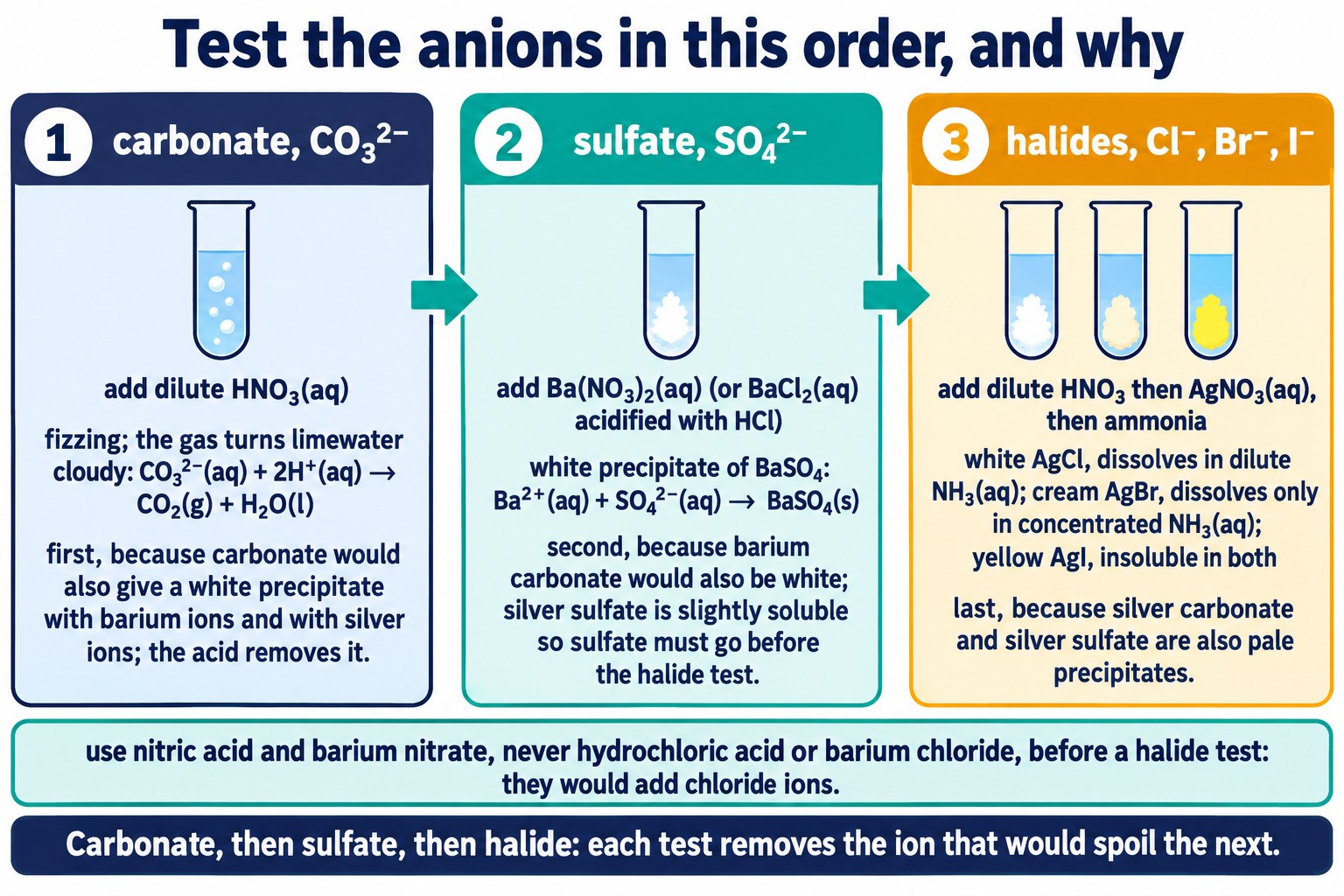
The three anion tests as a flow: carbonate, sulfate, halide, with the reason for the order written beside each step.
Exam focus: A “why this order” question wants the interfering ion named: “carbonate ions would also form a white precipitate with barium ions, so they are removed first”.
The Halide Test and Ammonia
Silver nitrate gives three similar precipitates. Ammonia solution tells them apart, because the three silver halides differ in how readily they dissolve as [Ag(NH₃)₂]⁺.
| Halide | Precipitate with AgNO₃(aq) | Dilute NH₃(aq) | Concentrated NH₃(aq) |
|---|---|---|---|
| chloride, Cl⁻ | white AgCl | dissolves | dissolves |
| bromide, Br⁻ | cream AgBr | insoluble | dissolves |
| iodide, I⁻ | yellow AgI | insoluble | insoluble |
- Equation for the complex: AgCl(s) + 2NH₃(aq) → [Ag(NH₃)₂]⁺(aq) + Cl⁻(aq); a colourless solution is the positive result.
- The colours are close: white and cream are hard to tell apart in a single tube, so the ammonia step is the deciding evidence.
- Solubility falls from AgCl to AgI, so stronger ammonia is needed; AgI does not dissolve at all. Details: Halide Ions: Reducing Agents and Tests.
Check: Anion Tests
Put the three anion tests in order and justify it, choose the acid for each step, and read the colour and ammonia results of a silver halide precipitate.
The Ammonium Ion
Ammonium salts look like any other white solid, and their solutions are colourless. The test uses the stronger base, hydroxide, to drive off ammonia gas.
- Method: add NaOH(aq) to the solution and warm gently; hold damp red litmus paper at the mouth of the tube.
- Positive result: the damp red litmus turns blue; a pungent smell; a glass rod dipped in concentrated HCl gives white smoke of NH₄Cl.
- Equation: NH₄⁺(aq) + OH⁻(aq) → NH₃(g) + H₂O(l); hydroxide is the stronger base and takes the proton from the ammonium ion.
- Why warm: ammonia is very soluble in water, so gentle heating is needed to release it; too hot and spray of NaOH reaches the paper.
- Why damp paper: ammonia must dissolve to form OH⁻ ions before an indicator can respond.
Common mistake: Holding the litmus in the liquid. The test detects ammonia gas, so the paper is held above the solution at the mouth of the tube.
Cations with Sodium Hydroxide and Ammonia
Both reagents are bases, so a few drops of either precipitate the metal hydroxide. In excess they behave differently, and the excess is what separates the ions.
| Ion in solution | NaOH(aq): a few drops, then excess | NH₃(aq): a few drops, then excess |
|---|---|---|
| Cu²⁺ (pale blue solution) | pale blue precipitate of Cu(OH)₂, insoluble in excess | pale blue precipitate; dissolves in excess to a deep blue solution of [Cu(NH₃)₄(H₂O)₂]²⁺ |
| Fe²⁺ (pale green solution) | green precipitate of Fe(OH)₂, insoluble in excess; turns brown at the surface on standing as air oxidises it | green precipitate, insoluble in excess; the same browning in air |
| Fe³⁺ (yellow-brown solution) | red-brown precipitate of Fe(OH)₃, insoluble in excess | red-brown precipitate, insoluble in excess |
| Mn²⁺ (very pale pink solution) | off-white (buff) precipitate of Mn(OH)₂, insoluble in excess; darkens to brown in air | off-white precipitate, insoluble in excess; darkens to brown |
| Cr³⁺ (violet or green solution) | grey-green precipitate of Cr(OH)₃; dissolves in excess to a dark green solution of [Cr(OH)₆]³⁻ | grey-green precipitate; little change with dilute excess; concentrated excess slowly gives violet [Cr(NH₃)₆]³⁺ |
- Precipitation is the same with both reagents: hydroxide ions (from NaOH, or from NH₃ + H₂O ⇌ NH₄⁺ + OH⁻) remove protons from the aqua ion.
- Excess ammonia dissolves the copper precipitate by ligand exchange: four ammonia molecules replace four water molecules to give the deep blue complex.
- Excess hydroxide dissolves an amphoteric hydroxide: Cr(OH)₃ gives the dark green [Cr(OH)₆]³⁻.
- Browning of the green iron(II) precipitate is oxidation by the air: a 2+ ion becoming 3+.
- Full equations and colours: Reactions of Metal Ions with Hydroxide and Ammonia and Ligand Exchange and Stability of Complexes.
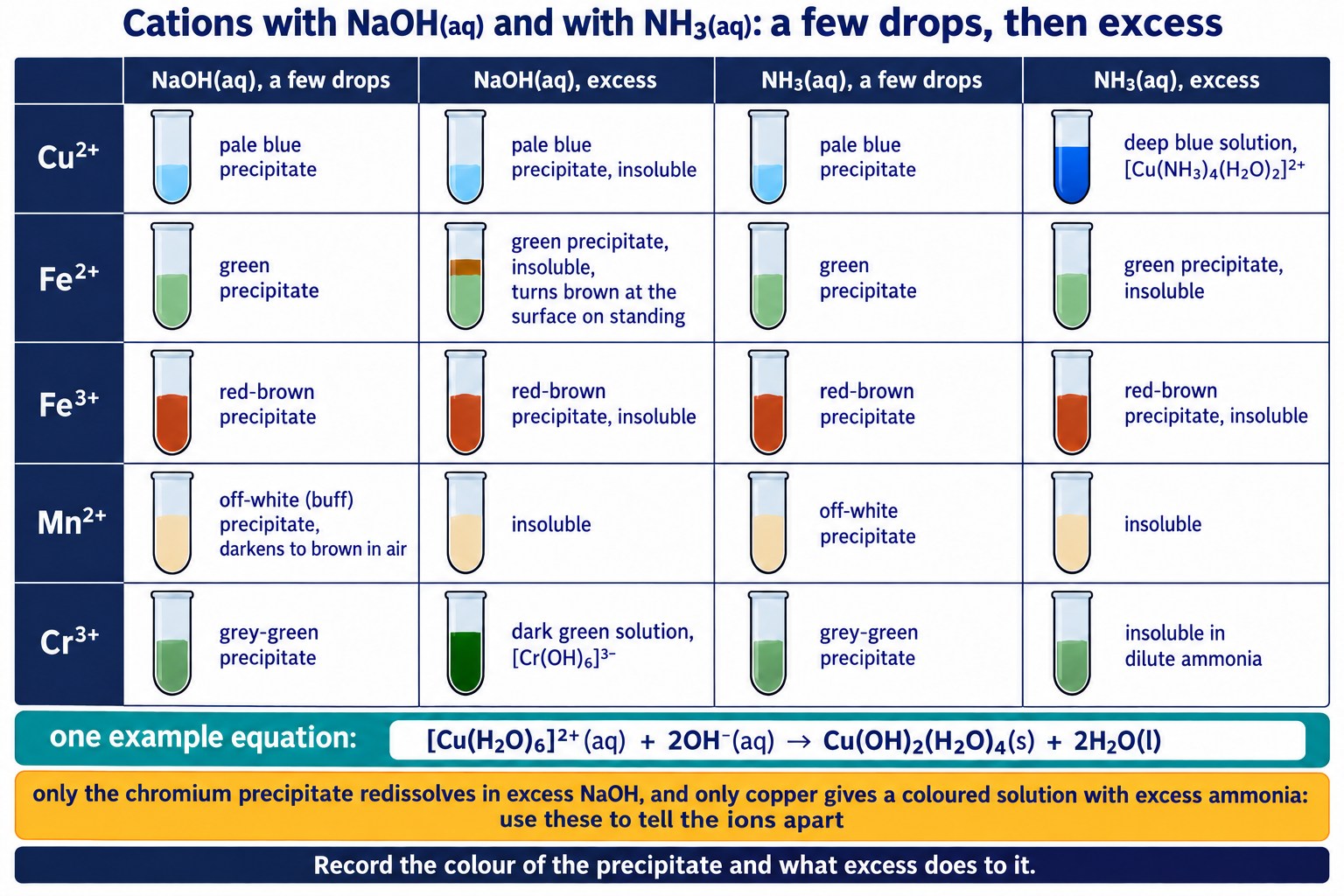
Each cation as a pair of test tubes: a few drops and then excess of sodium hydroxide, then the same with ammonia, colours written in.
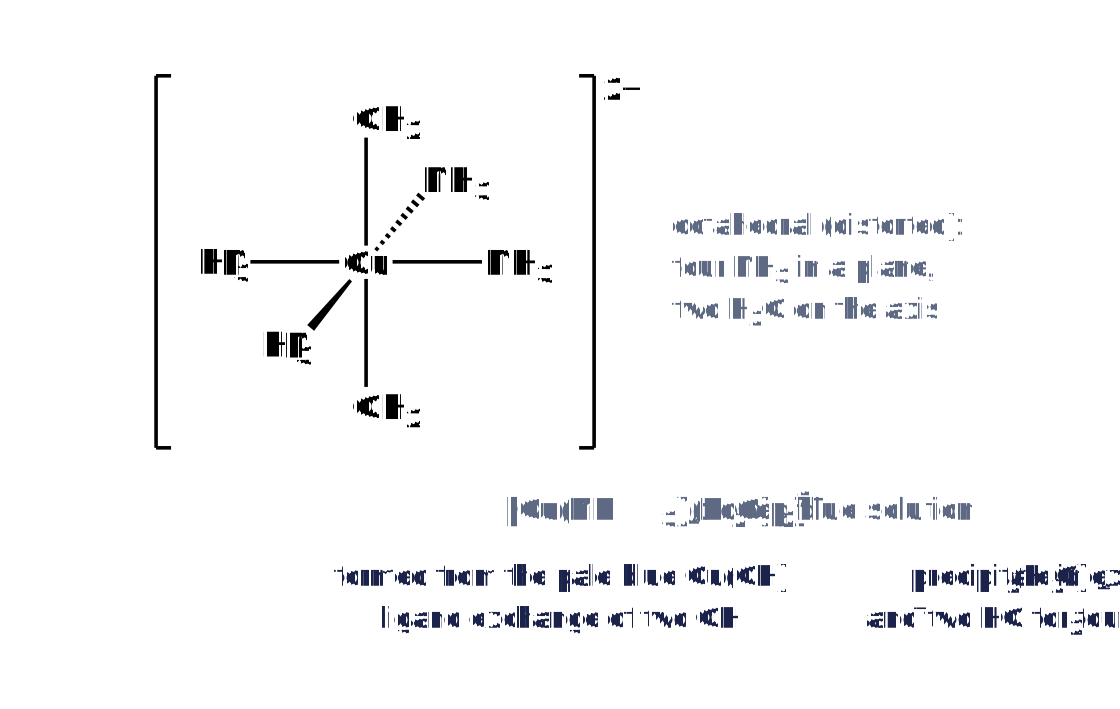
The deep blue [Cu(NH₃)₄(H₂O)₂]²⁺ ion: four ammonia ligands in a square and two water molecules above and below.
Check: Cations with Hydroxide and Ammonia
Match each cation to its precipitate colour, predict what happens in excess of each reagent, and write the ionic equation for a precipitation.
Writing the Equations
Each observation has an equation. Ionic equations with the simple hydrated ions are accepted; the complex formed in excess is written in full.
- Precipitation of 2+ ions: Cu²⁺(aq) + 2OH⁻(aq) → Cu(OH)₂(s); Fe²⁺(aq) + 2OH⁻(aq) → Fe(OH)₂(s); Mn²⁺(aq) + 2OH⁻(aq) → Mn(OH)₂(s).
- Precipitation of 3+ ions: Fe³⁺(aq) + 3OH⁻(aq) → Fe(OH)₃(s); Cr³⁺(aq) + 3OH⁻(aq) → Cr(OH)₃(s).
- Ammonia as the base: Cu²⁺(aq) + 2NH₃(aq) + 2H₂O(l) → Cu(OH)₂(s) + 2NH₄⁺(aq).
- Excess ammonia with copper: Cu(OH)₂(s) + 4NH₃(aq) + 2H₂O(l) → [Cu(NH₃)₄(H₂O)₂]²⁺(aq) + 2OH⁻(aq).
- Excess hydroxide with chromium: Cr(OH)₃(s) + 3OH⁻(aq) → [Cr(OH)₆]³⁻(aq); concentrated ammonia: Cr(OH)₃(s) + 6NH₃(aq) → [Cr(NH₃)₆]³⁺(aq) + 3OH⁻(aq).
- Iron(II) browning: 4Fe(OH)₂(s) + O₂(g) + 2H₂O(l) → 4Fe(OH)₃(s).
Exam focus: State symbols carry marks here: the aqua ion is (aq), the precipitate is (s), the complex that forms in excess is (aq) again.
A Systematic Scheme for an Unknown
An unknown salt is worked through in a fixed order so that nothing is missed and no test spoils the next.
- Look: note the colour of the solid and of its solution. Blue suggests Cu²⁺, pale green Fe²⁺, yellow-brown Fe³⁺; colourless means NH₄⁺ or a Group 1 or 2 metal.
- Dissolve a little in deionised water and divide it into portions, one for each test.
- Anions in order: dilute nitric acid (carbonate), barium nitrate (sulfate), silver nitrate then ammonia (halide).
- NaOH(aq): a few drops then excess, for the cation; warm a portion and test for ammonia with damp red litmus.
- NH₃(aq): a few drops then excess, to confirm the cation.
- Conclude: name the cation and the anion, give the formula of the compound and quote the evidence for each ion.
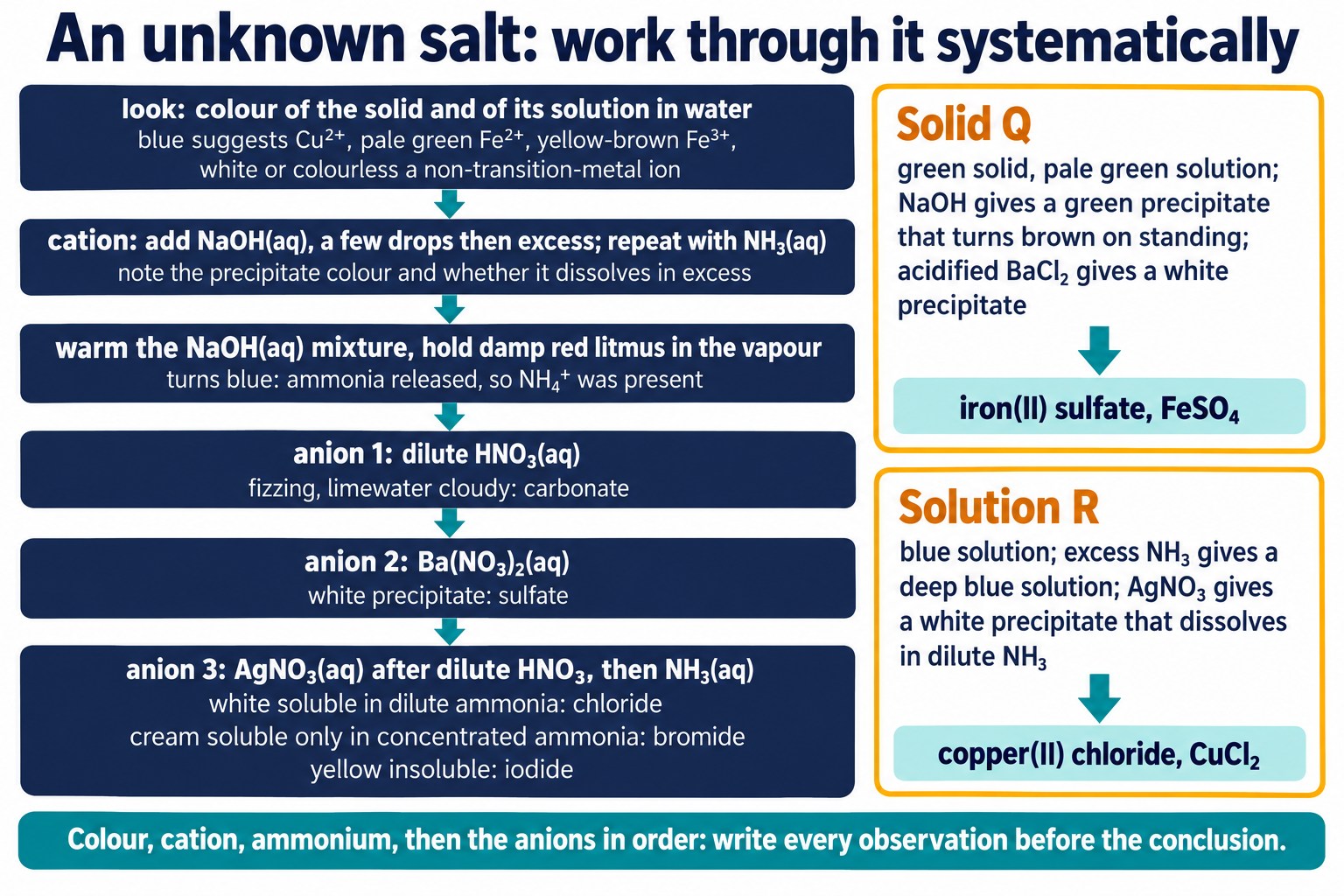
The systematic scheme as a flow chart: appearance, dissolve, anion tests in order, sodium hydroxide, ammonia, conclusion.
Exam focus: Use a fresh portion for each test and say so: “to a fresh portion add …”. The practical this scheme belongs to is Qualitative Analysis of Transition Element Ions and Organic Unknowns.
Worked Unknowns Q and R
Unknown Q: a green solid
Unknown R: a blue solution
Step 1. With NH₃(aq) a pale blue precipitate forms and dissolves in excess to a deep blue solution: Cu²⁺, as [Cu(NH₃)₄(H₂O)₂]²⁺.
Remember: Give one observation for each ion and the matching equation. “Blue solution” alone does not identify copper; the deep blue ammonia complex does.
Check: Identifying an Unknown
Work from a set of observations to the cation and anion, write the formula of the compound and give the equation for each positive test.
Common Exam Points
- Anion order: carbonate (dilute HNO₃, limewater), then sulfate (Ba²⁺, white BaSO₄), then halide (HNO₃, AgNO₃): each removes an ion that would interfere later.
- For the silver nitrate test use nitric acid, never hydrochloric or sulfuric: they would add ions that also give a precipitate.
- Silver halides: AgCl white, dissolves in dilute NH₃; AgBr cream, dissolves in concentrated NH₃; AgI yellow, insoluble.
- Ammonium: warm with NaOH(aq), damp red litmus turns blue; NH₄⁺(aq) + OH⁻(aq) → NH₃(g) + H₂O(l).
- Cu²⁺: pale blue precipitate with both bases; excess ammonia gives the deep blue [Cu(NH₃)₄(H₂O)₂]²⁺ by ligand exchange.
- Fe²⁺: green precipitate that browns in air; Fe³⁺: red-brown precipitate; neither dissolves in excess of either base.
- Cr³⁺: grey-green precipitate that dissolves in excess NaOH to dark green [Cr(OH)₆]³⁻; Mn²⁺: buff precipitate that darkens.
- Write ionic equations with state symbols for every precipitate and every complex formed in excess.
- For an unknown, give one observation and one equation per ion, and test fresh portions each time.
FAQs
Use these quick answers to check the order of the anion tests, the halide test with ammonia, the ammonium test and the colours the transition element cations Cu²⁺, Fe²⁺, Fe³⁺, Mn²⁺, Cr³⁺ give with sodium hydroxide and ammonia solutions.
Why do I test for carbonate ions first, then sulfate, then halides?
Carbonate ions would give white precipitates with barium ions and with silver ions, so they must be found and removed first: dilute nitric acid fizzes and the carbon dioxide turns limewater cloudy. Barium ions then test for sulfate before silver nitrate is used for halides.
How do I tell chloride, bromide and iodide apart after adding silver nitrate?
Acidify with dilute nitric acid first, then add silver nitrate solution. Silver chloride is white and dissolves in dilute ammonia; silver bromide is cream and dissolves only in concentrated ammonia; silver iodide is yellow and stays insoluble even in concentrated ammonia.
How do I test for the ammonium ion?
Warm the solid or solution with aqueous sodium hydroxide and hold damp red litmus paper in the gas: it turns blue because ammonia is released, NH₄⁺(aq) + OH⁻(aq) → NH₃(g) + H₂O(l). Ammonia also gives white smoke of ammonium chloride with hydrogen chloride.
Which hydroxide precipitates dissolve in excess sodium hydroxide?
Only chromium(III) here: the grey-green Cr(OH)₃(H₂O)₃ precipitate dissolves in excess to a dark green solution of [Cr(OH)₆]³⁻.
The pale blue Cu²⁺, green Fe²⁺, red-brown Fe³⁺ and buff Mn²⁺ precipitates stay insoluble in excess sodium hydroxide, although copper dissolves in excess ammonia.
How does ammonia solution help me identify copper(II) ions?
A little ammonia gives the same pale blue precipitate as sodium hydroxide, but in excess the precipitate dissolves to a deep blue solution: Cu(OH)₂(H₂O)₄(s) + 4NH₃(aq) → [Cu(NH₃)₄(H₂O)₂]²⁺(aq) + 2OH⁻(aq) + 2H₂O(l).
No other common cation gives that deep blue colour.

Copyright notice: This OLS revision content, including the explanations, layout, diagrams, tables and embedded learning structure, is authored for Online Learning System by Dr. Mohammed Al-Fatah. It may not be copied, reproduced, redistributed or adapted without written permission.
Keep this note — free
Save your progress across every OCR topic. A free account remembers which topics you have covered, saves your question scores, and syncs across your phone and laptop.
- Track every topic you have finished
- Keep your practice-question scores
- No payment, no card, free forever
Already registered? Log in