Naming Aromatic Compounds
A concise revision guide to naming aromatic compounds: benzene as the parent, numbering the ring for two or more substituents, the phenyl group as a substituent, and worked examples from methylbenzene to 2,4,6-tribromophenol and 3-nitrobenzoic acid.
Before You Start
Aromatic names follow the same IUPAC logic as the chain names you already know.
- A parent is the main part of the name, and prefixes name the groups attached to it.
- Numbers (locants) show where groups are attached and are chosen to be as low as possible.
- Prefixes are listed in alphabetical order, ignoring di- and tri-.
- The simplest names, from methylbenzene to phenylethene, are introduced in Structure and Bonding in Benzene.
Benzene as the Parent
With one substituent, the compound is named as a substituted benzene. No number is needed because all six positions are equivalent.
| Group | Name | Formula |
|---|---|---|
| –CH₃ | methylbenzene | C₆H₅CH₃ |
| –CH₂CH₃ | ethylbenzene | C₆H₅CH₂CH₃ |
| –Cl | chlorobenzene | C₆H₅Cl |
| –NO₂ | nitrobenzene | C₆H₅NO₂ |
| –COOH | benzoic acid (benzenecarboxylic acid) | C₆H₅COOH |
| –CHO | benzaldehyde | C₆H₅CHO |
| –OH | phenol | C₆H₅OH |
| –NH₂ | phenylamine (an aromatic amine) | C₆H₅NH₂ |
- Phenol, phenylamine, benzoic acid and benzaldehyde are parent names: the group is part of the name, not a prefix.
- Benzoic acid is also called benzenecarboxylic acid. Either is accepted.
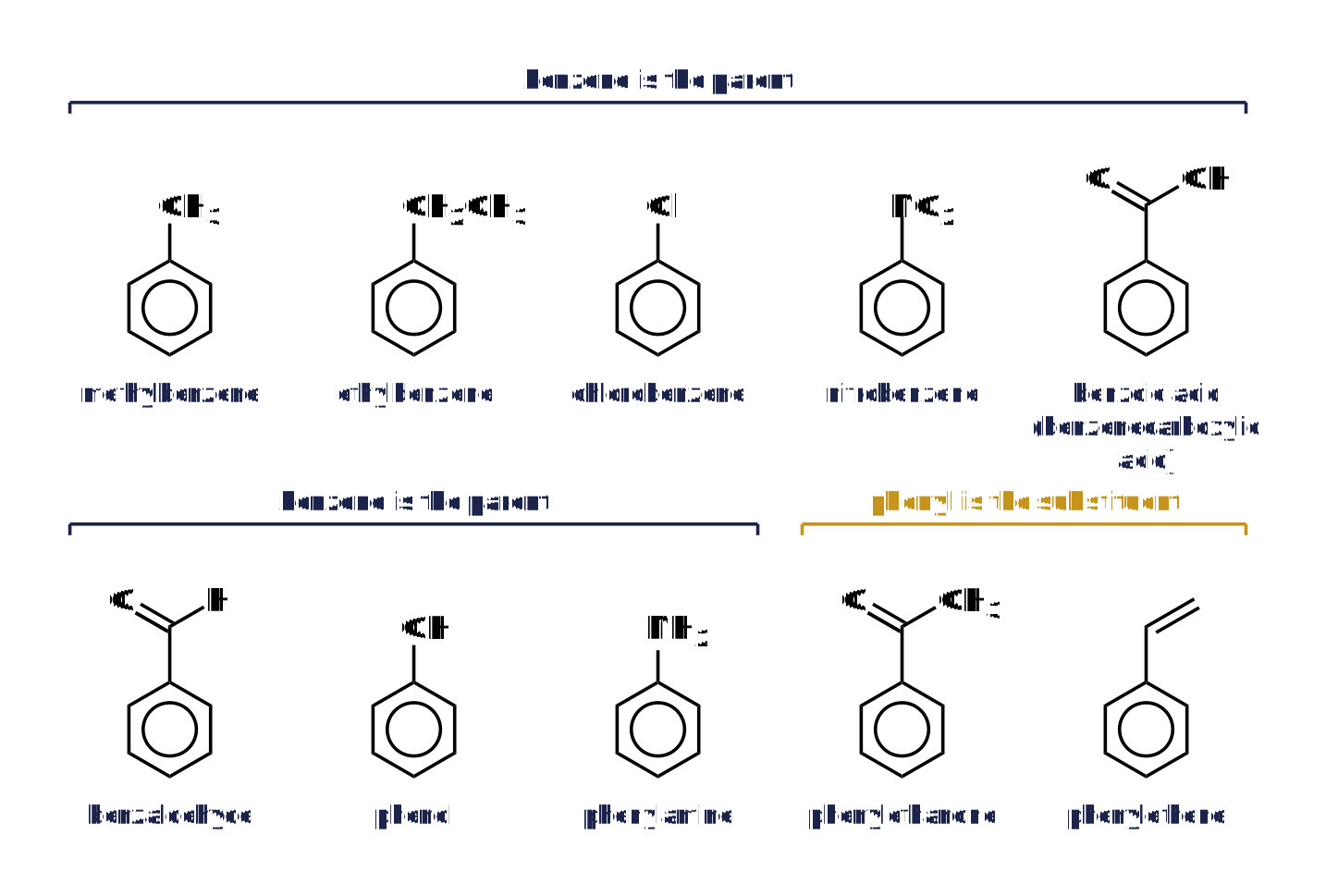
Ten monosubstituted compounds with their names. The first eight are named from benzene; phenylethanone and phenylethene use phenyl as the substituent.
Phenyl as the Substituent
When a longer chain or a functional group is the parent, the ring becomes the substituent phenyl, C₆H₅–, like an alkyl group.
| Name | Formula | Why phenyl |
|---|---|---|
| phenylethanone | C₆H₅COCH₃ | the ketone, ethanone, is the parent |
| phenylethene | C₆H₅CH=CH₂ | the alkene, ethene, is the parent |
| 2-phenylbutane | CH₃CH(C₆H₅)CH₂CH₃ | a four-carbon chain is longer than any name based on the ring |
| 1-phenylethanol | C₆H₅CH(OH)CH₃ | the alcohol on a two-carbon chain is the parent |
- The OH in 1-phenylethanol is on the chain, not the ring, so it is an alcohol and not a phenol.
- Position numbers on the chain are given as usual: 2-phenylbutane has the ring on carbon 2 of butane.
Remember: Ring attached to a chain or group that gives the name: phenyl. Group attached to the ring: …benzene, phenol, phenylamine or benzoic acid.
Check: Parents and Prefixes
Decide whether benzene or phenyl is used in the name of compounds not shown above, and give the correct parent name.
Two or More Substituents: Numbering the Ring
With two or more groups, the ring carbons are numbered 1 to 6 to show where each group sits. Three rules fix the numbers.
- If one group gives the parent its name (OH in phenol, COOH in benzoic acid, NH₂ in phenylamine), that group is on carbon 1. A methyl group is an ordinary prefix, so with a second group on the ring use alphabetical order: 1-chloro-4-methylbenzene (4-chloromethylbenzene is also accepted).
- Number round the ring in the direction that gives the lowest set of locants.
- List the prefixes in alphabetical order, with di- and tri- for repeated groups; the prefixes do not change the alphabetical order.
| Compound | Carbon 1 | Why the numbers |
|---|---|---|
| 1,3-dimethylbenzene | one CH₃ | 1,3 is lower than 1,5 |
| 1-chloro-4-methylbenzene | Cl (c before m) | the two groups are opposite: 1,4 |
| 2-nitrophenol | OH | NO₂ next to the OH |
| 4-nitrophenol | OH | NO₂ opposite the OH |
| 3-nitrobenzoic acid | COOH | NO₂ with one carbon between |
| 2,4,6-tribromophenol | OH | three Br at 2, 4 and 6; the same set either way round |
| 2-methyl-1,3,5-trinitrobenzene (TNT) | one NO₂ | 1,3,5 for the three NO₂ groups puts CH₃ on 2 |
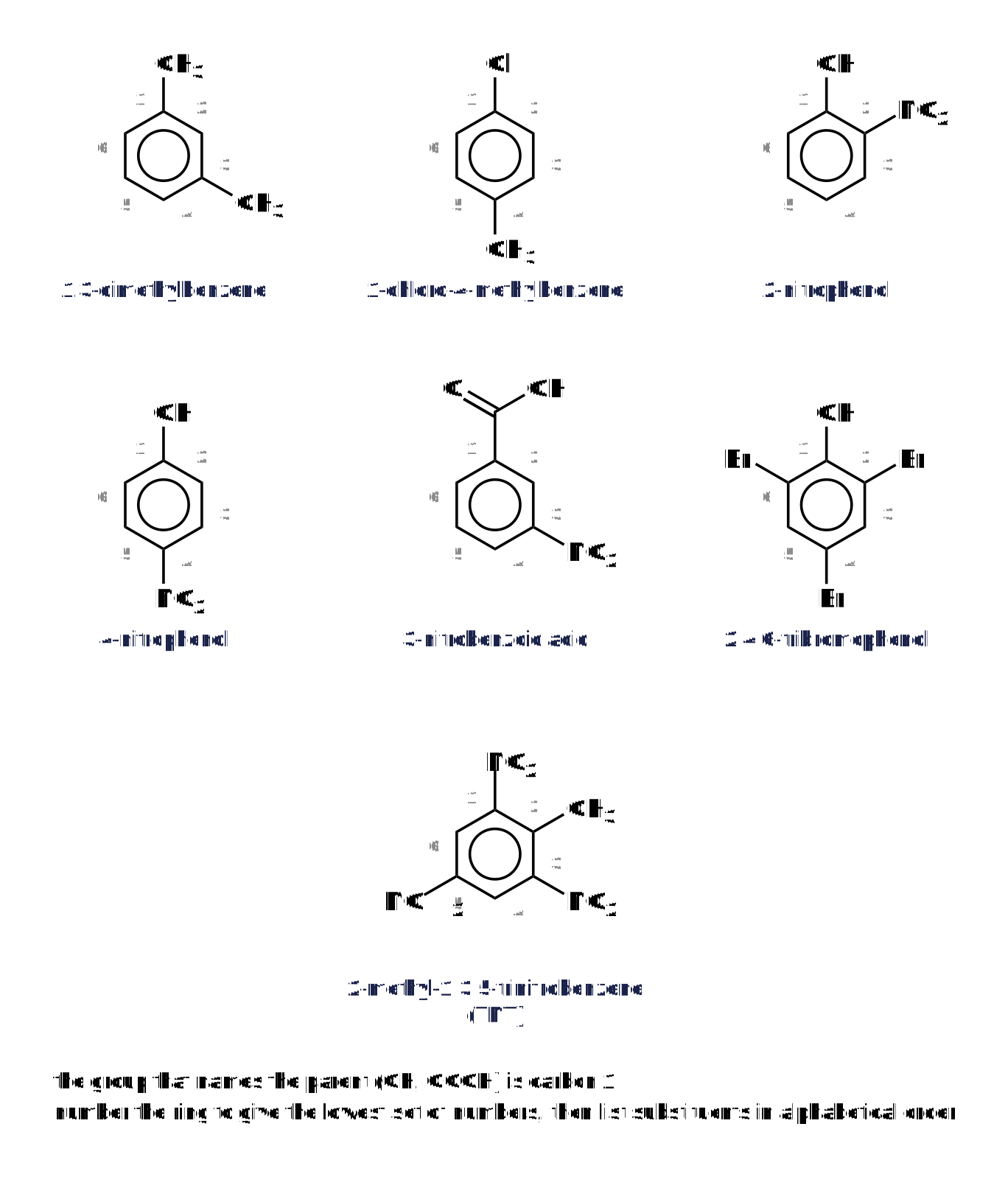
Seven compounds with two or more groups, the ring carbons numbered. The group that names the parent is always carbon 1.
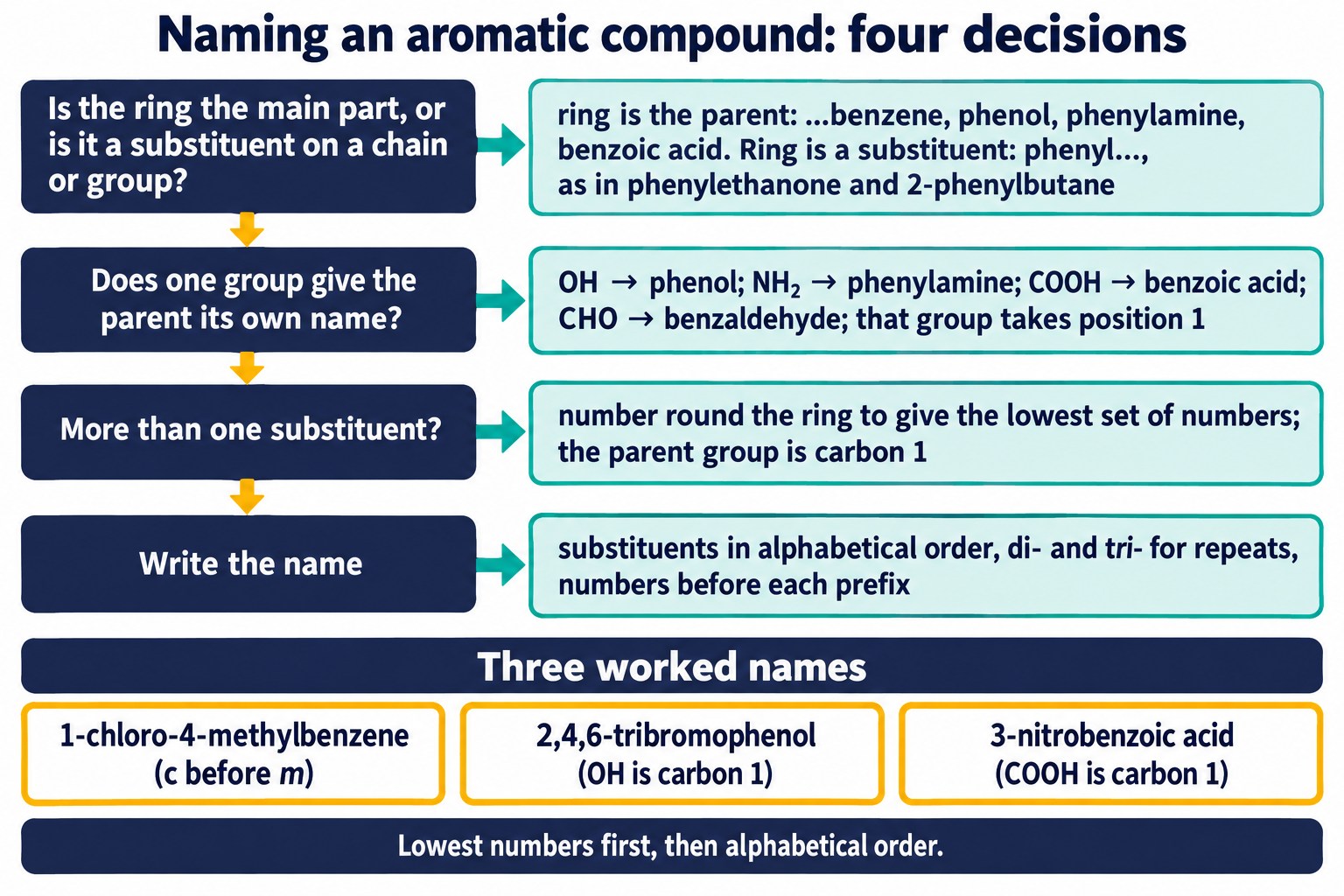
A decision flow chart for any aromatic name: choose the parent, place carbon 1, number for the lowest locants, then list the prefixes alphabetically.
Common mistake: 1-methyl-3-chlorobenzene breaks the alphabetical rule. Chloro comes before methyl, so the name is 1-chloro-3-methylbenzene.
Quick Check: Ring or Chain as the Parent?
Decide what gives each compound its name, then choose the correct name.
Ortho, Meta and Para
Older names use three words for the positions of a second group relative to carbon 1. You may meet them, but use the numbers in your own answers.
| Position | Word | Meaning |
|---|---|---|
| 2 (and 6) | ortho | next to carbon 1 |
| 3 (and 5) | meta | one carbon between |
| 4 | para | opposite carbon 1 |
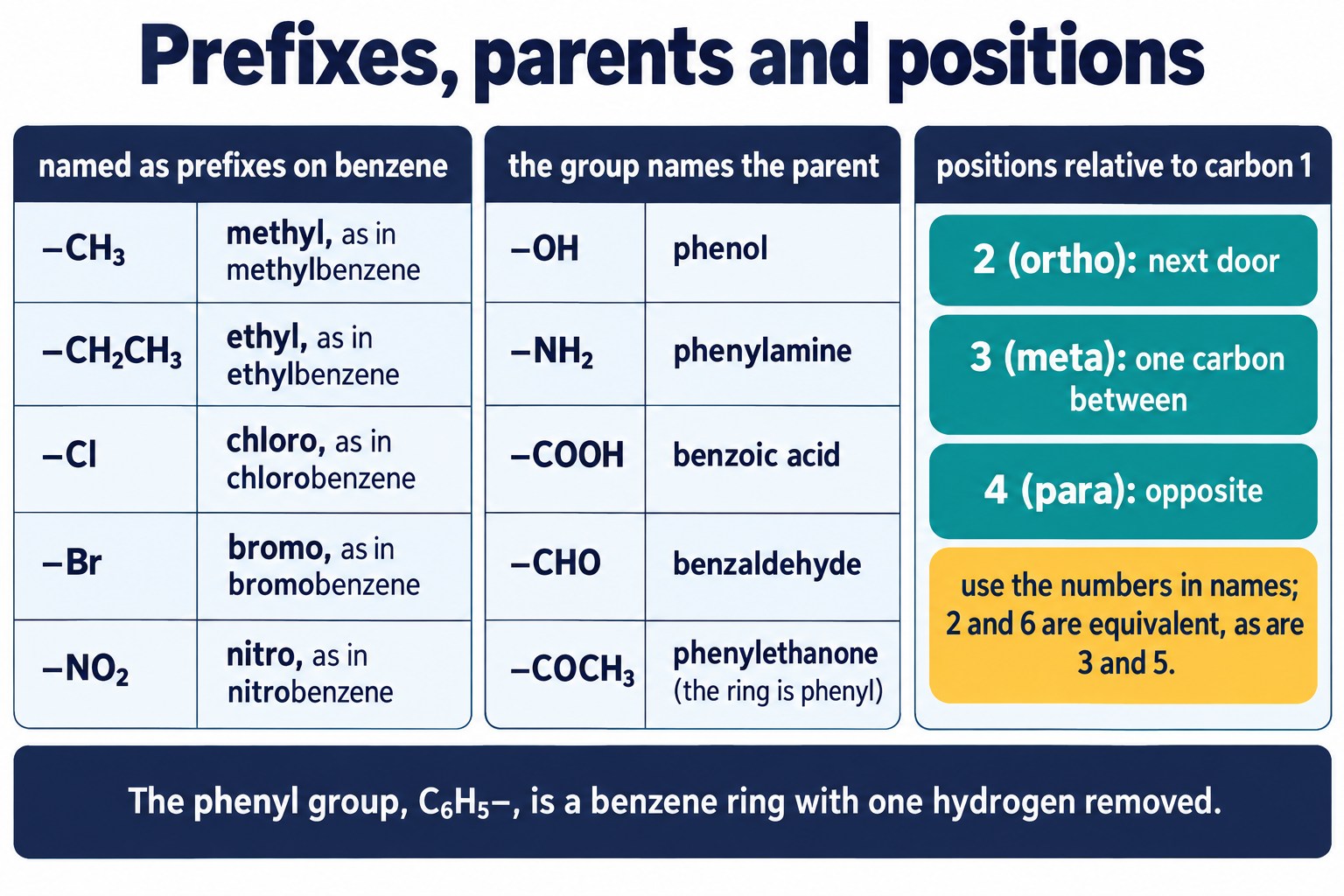
The prefixes, the parent names and the position words ortho, meta and para matched to the numbers 2, 3 and 4.
- Positions 2 and 6 are equivalent, as are 3 and 5, because the ring can be numbered in either direction.
- These positions matter when a group already on the ring directs where the next one goes: Directing Effects in Electrophilic Substitution.
Quick Check: From Old Names to Numbers
Rewrite each older name in modern form, using position numbers.
Worked Examples
Naming from a structure
Answer. 1-bromo-4-methylbenzene.
Drawing from a name
Answer. A hexagon with a circle, OH at the top, NO₂ on the adjacent carbon and NO₂ on the carbon opposite the OH: C₆H₃(NO₂)₂OH.
Checking the locants
Step 1. A ring with CH₃ on two carbons separated by one carbon could be numbered 1,3 or 1,5.
Answer. Choose the lower set: 1,3-dimethylbenzene.
Check: Naming with Numbers
Name compounds with two or three groups on the ring, and pick out names that break the lowest-locant or alphabetical rules.
Common Exam Points
- The group that names the parent (OH, COOH, NH₂) is carbon 1.
- Number the ring to give the lowest set of locants, then list prefixes alphabetically: 1-chloro-4-methylbenzene, not 1-methyl-4-chlorobenzene.
- Di- and tri- are ignored in the alphabetical order: 2,4,6-tribromophenol, 2-methyl-1,3,5-trinitrobenzene.
- Phenyl is used when the chain or functional group is the parent: phenylethanone, phenylethene, 2-phenylbutane.
- Phenol has OH on the ring; 1-phenylethanol has OH on a carbon chain and is an alcohol.
- One substituent needs no number: methylbenzene, not 1-methylbenzene.
- Ortho, meta and para mean positions 2, 3 and 4; use the numbers in names.
FAQs
Use these quick answers to check how aromatic compounds are named: the benzene parent, ring numbering and the phenyl substituent.
When do I use phenyl in a name?
Use phenyl when the benzene ring is a substituent on a chain or group that is the parent, as in phenylethanone, phenylethene and 2-phenylbutane. When the ring itself is the parent the name ends in benzene, as in ethylbenzene.
How do I number the ring when there are two substituents?
Give the substituents the lowest possible locants and list them in alphabetical order, so 1-chloro-4-methylbenzene rather than 1-methyl-4-chlorobenzene. For identical groups use di or tri, as in 1,3-dimethylbenzene and 1,3,5-trimethylbenzene.
Which group takes position 1 in phenol or benzoic acid?
The group that gives the compound its name. In phenol the carbon carrying OH is carbon 1, so the bromine atoms in 2,4,6-tribromophenol are numbered from it. In 3-nitrobenzoic acid the carbon carrying COOH is carbon 1.
Is phenylamine the same as aminobenzene?
Both describe C₆H₅NH₂, but phenylamine is the name to use. Learn the accepted names of the common compounds too: phenol for C₆H₅OH, benzoic acid (benzenecarboxylic acid) for C₆H₅COOH, benzaldehyde for C₆H₅CHO and nitrobenzene for C₆H₅NO₂.
Why are 2-nitrophenol and 4-nitrophenol different compounds?
They are positional isomers. In 2-nitrophenol the nitro group is on the carbon next to the one carrying OH; in 4-nitrophenol it is on the opposite carbon. The two arrangements have different properties, so each needs its own name.

Copyright notice: This OLS revision content, including the explanations, layout, diagrams, tables and embedded learning structure, is authored for Online Learning System by Dr. Mohammed Al-Fatah. It may not be copied, reproduced, redistributed or adapted without written permission.
Keep this note — free
Save your progress across every OCR topic. A free account remembers which topics you have covered, saves your question scores, and syncs across your phone and laptop.
- Track every topic you have finished
- Keep your practice-question scores
- No payment, no card, free forever
Already registered? Log in