Amines as Bases
A concise revision guide to the basicity of amines: how the nitrogen lone pair accepts a proton, the reactions of butylamine and phenylamine with water and with acids to form salts.
Why Amines Are Bases
Choose a step to watch the nitrogen lone pair in ammonia, ethylamine and phenylamine, and see which one accepts a proton most readily.
© Dr. Mohammed Al-Fatah – onlinelearningsystem.net
Before You Start
Amines behave like ammonia. Check the acid-base ideas this page builds on.
- A Brønsted–Lowry base is a proton acceptor. Ammonia accepts H⁺ using the lone pair on nitrogen: NH₃ + H⁺ → NH₄⁺.
- Ammonia is a weak base: NH₃ + H₂O ⇌ NH₄⁺ + OH⁻, with the equilibrium well to the left.
- Ammonia reacts with acids to form ammonium salts: NH₃ + HCl → NH₄Cl.
- Primary, aromatic and aliphatic amines and the formula of butylamine, CH₃CH₂CH₂CH₂NH₂: Amines, Amides and Amino Acids: Structure and Naming.
GCSE Recap: Alkalis, Neutralisation and Strength
Three quick questions on the GCSE ideas this page builds on.
The Lone Pair Accepts a Proton
Every amine has a lone pair on its nitrogen. The lone pair forms a dative covalent bond to a proton, so amines are Brønsted–Lowry bases. The same lone pair makes them nucleophiles (Amines as Nucleophiles).
With water: an alkaline solution
- CH₃CH₂CH₂CH₂NH₂ + H₂O ⇌ CH₃CH₂CH₂CH₂NH₃⁺ + OH⁻: the butylammonium ion and hydroxide ions form.
- The equilibrium lies well to the left: amines are weak bases, and most molecules stay unprotonated.
- Enough OH⁻ forms for the solution to be alkaline: 0.10 mol dm⁻³ butylamine has a pH of about 11 to 12.
- Phenylamine, C₆H₅NH₂, dissolves only slightly and its solution is barely alkaline.
Remember: Write the ion in full and show the charge on nitrogen: CH₃CH₂CH₂CH₂NH₃⁺, the butylammonium ion. The hydroxide ion is what makes the solution alkaline.
Salts with Acids
With an acid the proton transfer is complete. The amine is converted into an alkylammonium salt, an ionic solid that dissolves in water.
| Reaction | Equation | Salt |
|---|---|---|
| butylamine + hydrochloric acid | CH₃CH₂CH₂CH₂NH₂ + HCl → CH₃CH₂CH₂CH₂NH₃⁺Cl⁻ | butylammonium chloride |
| butylamine + sulfuric acid | CH₃CH₂CH₂CH₂NH₂ + H₂SO₄ → CH₃CH₂CH₂CH₂NH₃⁺HSO₄⁻ | butylammonium hydrogensulfate |
| ethylamine + hydrochloric acid | CH₃CH₂NH₂ + HCl → CH₃CH₂NH₃⁺Cl⁻ | ethylammonium chloride |
| phenylamine + hydrochloric acid | C₆H₅NH₂ + HCl → C₆H₅NH₃⁺Cl⁻ | phenylammonium chloride |
- Name the salt by changing -amine to -ammonium and adding the anion: butylammonium chloride, ethylammonium nitrate.
- Phenylamine is almost insoluble in water, but phenylammonium chloride dissolves: adding acid to an oily amine gives a clear solution.
- Adding sodium hydroxide to the salt releases the amine again: CH₃CH₂CH₂CH₂NH₃⁺ + OH⁻ → CH₃CH₂CH₂CH₂NH₂ + H₂O. This is used to purify amines.
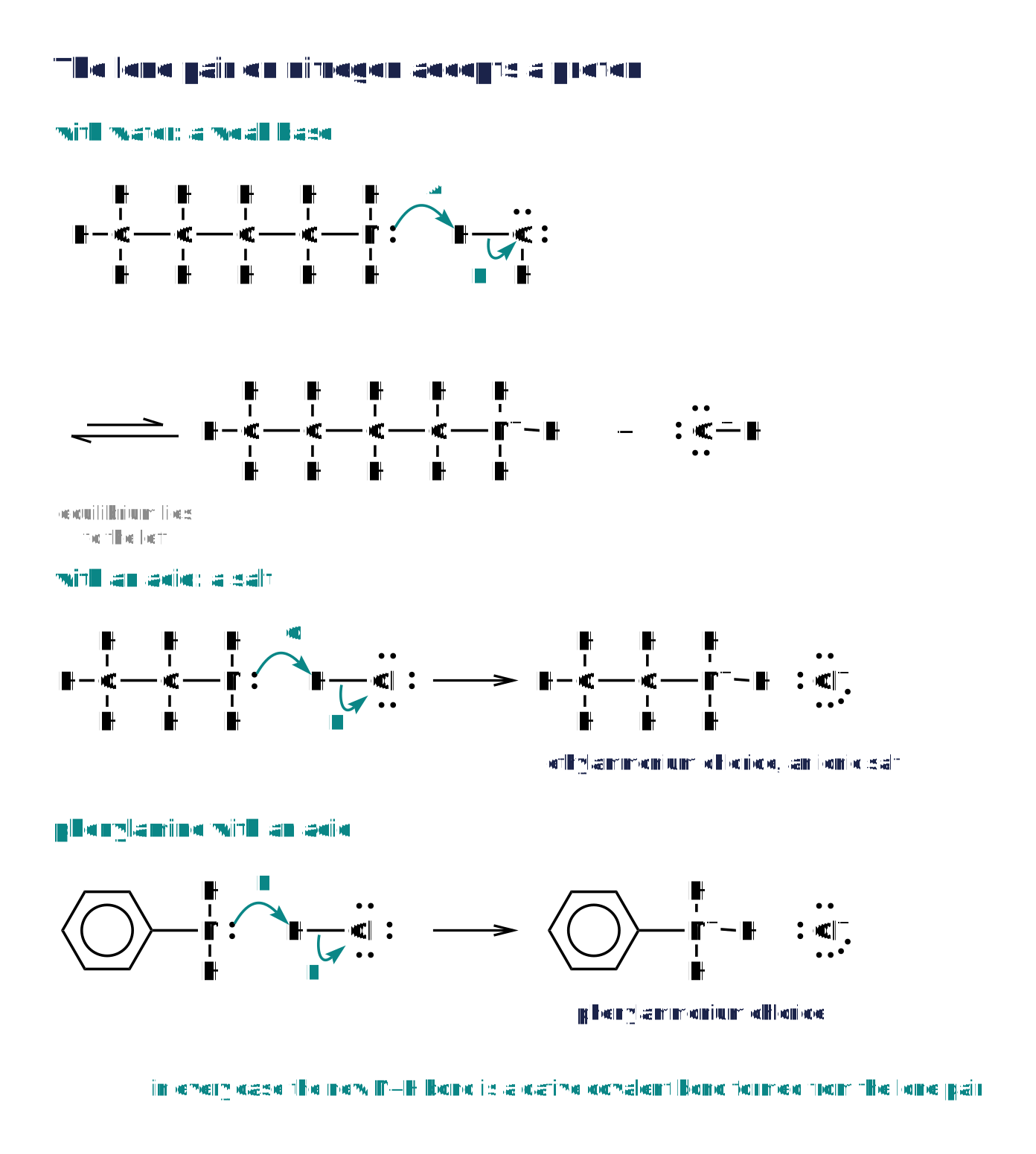
Three proton transfers with the lone pair shown: butylamine with water (an equilibrium), ethylamine with HCl and phenylamine with HCl.
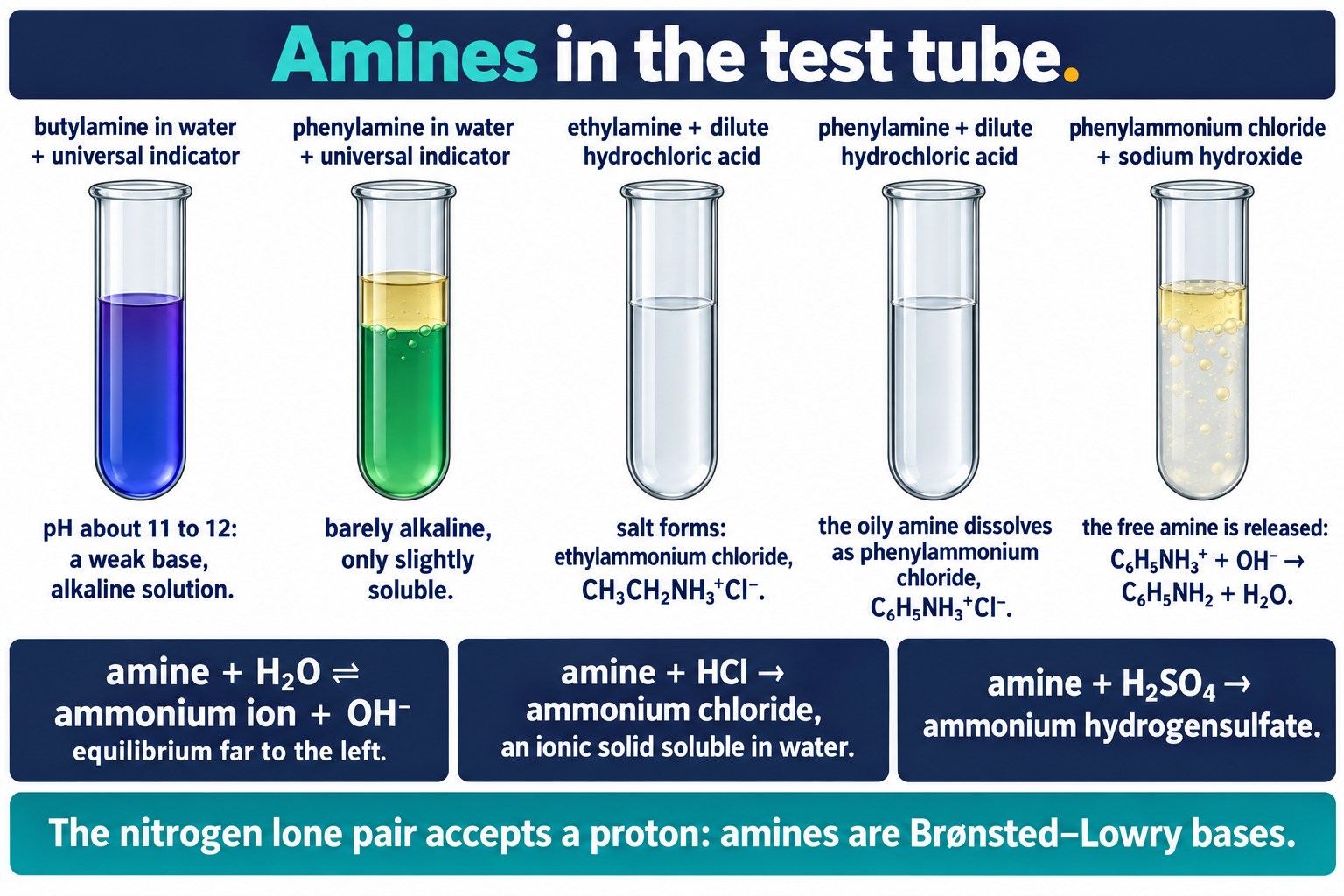
What is seen in the test tube: the alkaline solution, the salt forming with acid, phenylamine dissolving as its salt and reappearing with alkali.
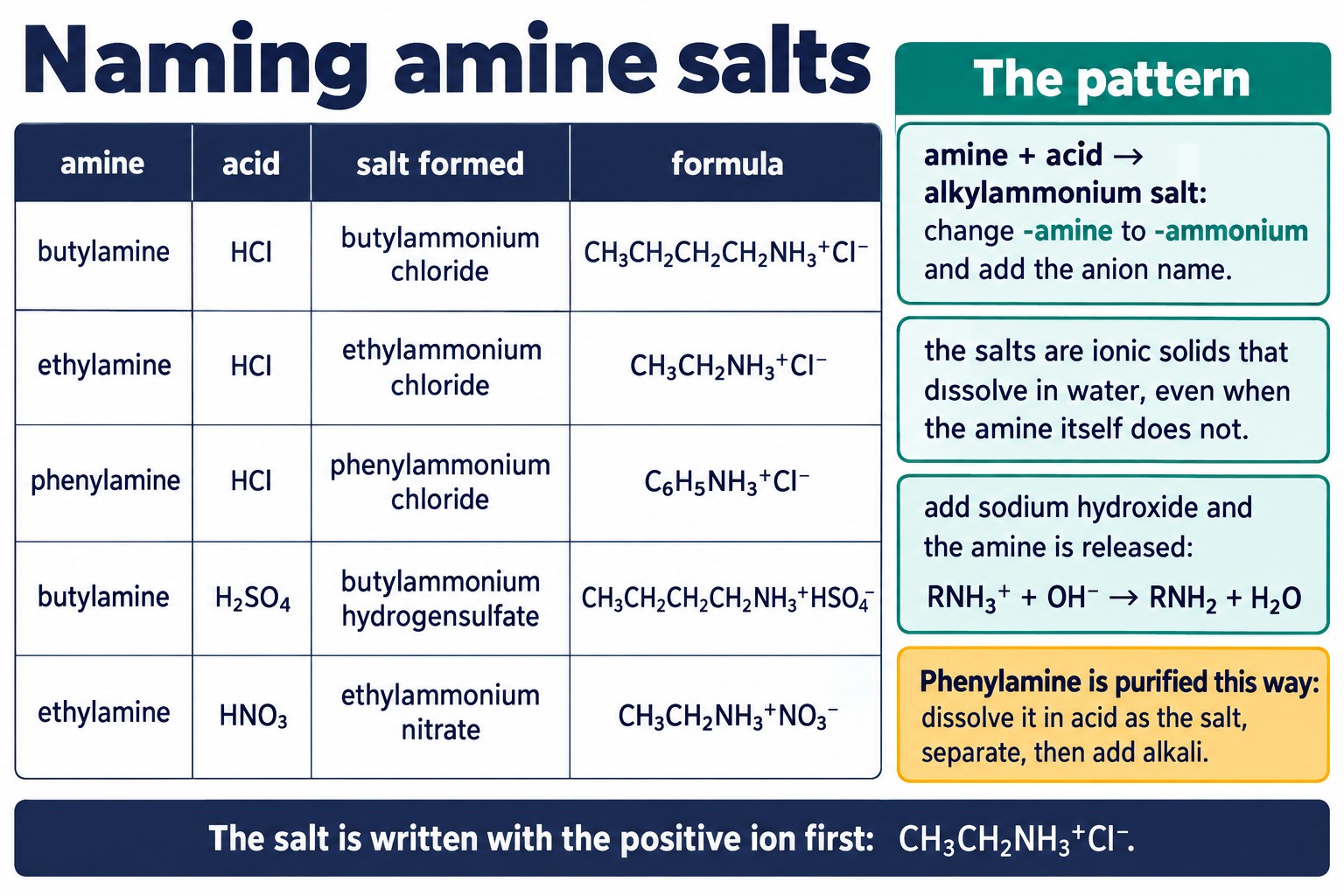
Naming the salts: -amine becomes -ammonium, then add the anion. The pattern is the same for every acid.
Exam focus: The salt is ionic: write it as two ions, CH₃CH₂CH₂CH₂NH₃⁺Cl⁻ or CH₃CH₂NH₃⁺Cl⁻, not as a molecule. The new N–H bond is a dative covalent bond.
Check: Alkaline Solutions and Salts
Write the equations for an amine with water and with an acid, name the salts and explain why the solution of an amine is alkaline.
Quick Check: New Salts and a Titration
Work each one out on paper, then flip the card to compare your working.
What Decides the Strength of a Base
All amines are weak bases, but not equally weak. The strength depends on how available the lone pair on nitrogen is for accepting a proton.
- The more electron density there is on the nitrogen, the more readily the lone pair bonds to H⁺.
- Primary aliphatic amines such as butylamine give solutions of pH about 11 to 12 at 0.10 mol dm⁻³; phenylamine solutions are barely alkaline.
- Whatever the strength, the reaction with a dilute acid goes to completion and gives the salt.
Exam focus: Define basicity through proton acceptance by the nitrogen lone pair, then write the equation with dilute HCl giving the alkylammonium chloride.
Check: Bases and Their Salts
Identify the proton acceptor, predict the salt formed with a dilute acid and explain what happens when alkali is added to the salt.
Common Exam Points
- CH₃CH₂CH₂CH₂NH₂ + H₂O ⇌ CH₃CH₂CH₂CH₂NH₃⁺ + OH⁻: the equilibrium lies to the left, so the amine is a weak base and the solution is alkaline.
- CH₃CH₂CH₂CH₂NH₂ + HCl → CH₃CH₂CH₂CH₂NH₃⁺Cl⁻, butylammonium chloride: an ionic salt, soluble in water. Phenylamine gives phenylammonium chloride.
- The new N–H bond forms from the lone pair on nitrogen: amines are Brønsted–Lowry bases and proton acceptors.
- The strength of a base depends on how available the nitrogen lone pair is; every amine still reacts completely with a dilute acid.
- Adding NaOH to an amine salt releases the free amine: RNH₃⁺ + OH⁻ → RNH₂ + H₂O.
- Phenylamine is only slightly soluble in water but dissolves in acid as its salt.
FAQs
Use these quick answers to check why butylamine and phenylamine are bases, the salts they form with acids and the pH of their solutions.
Why is butylamine a base?
The nitrogen has a lone pair of electrons that can accept a proton, so amines are Brønsted–Lowry bases.
In water, CH₃CH₂CH₂CH₂NH₂ + H₂O ⇌ CH₃CH₂CH₂CH₂NH₃⁺ + OH⁻, and the equilibrium lies well to the left, so the solution is only weakly alkaline.
What forms when an amine reacts with an acid?
A salt. Butylamine and hydrochloric acid give butylammonium chloride, CH₃CH₂CH₂CH₂NH₃⁺Cl⁻, an ionic solid that dissolves in water. Phenylamine gives phenylammonium chloride in the same way, which is one way of dissolving phenylamine, because the free amine is barely soluble.
What decides how strong a base an amine is?
The availability of the nitrogen lone pair. The more readily the lone pair can accept a proton, the stronger the base. Amines are weak bases, so their solutions contain a small proportion of ammonium ions and hydroxide ions in equilibrium with the free amine.
How do I get the amine back from its salt?
Add sodium hydroxide solution. The hydroxide ion removes the proton from the butylammonium ion: CH₃CH₂CH₂CH₂NH₃⁺ + OH⁻ → CH₃CH₂CH₂CH₂NH₂ + H₂O.
The free amine is released, and with phenylamine it separates as an oily layer because it is almost insoluble in water.
What pH should I expect for a solution of an amine?
About 11 to 12 for 0.1 mol dm⁻³ butylamine, which turns red litmus blue. Because the amine is a weak base, only a small fraction of its molecules take a proton from water, so the pH is well below that of sodium hydroxide.

Copyright notice: This OLS revision content, including the explanations, layout, diagrams, tables and embedded learning structure, is authored for Online Learning System by Dr. Mohammed Al-Fatah. It may not be copied, reproduced, redistributed or adapted without written permission.
Keep this note — free
Save your progress across every OCR topic. A free account remembers which topics you have covered, saves your question scores, and syncs across your phone and laptop.
- Track every topic you have finished
- Keep your practice-question scores
- No payment, no card, free forever
Already registered? Log in