PAG 12 Research Skills: Researching, Referencing and Reporting
A focused revision guide to PAG 12 for OCR A Level Chemistry: what the research skills group and CPAC 5 assess, choosing and judging sources, Harvard citations and reference lists, a worked antacid back titration planned from research, evaluating its uncertainty, and reporting your findings.
Recap: Variables, Hazards and Good Evidence
Four quick questions on the GCSE ideas that research skills build on: variables, hazard and risk, repeatable results and peer review.
What PAG 12 Is Testing
PAG 12 is the research skills group of the OCR practical endorsement. It has no fixed experiment. Your teacher assesses it whenever you research a practical, plan from that research and cite your sources.
It draws on four learning outcomes in specification section 1.2.1: investigative approaches (a), software and tools to process data, research and report (g), online and offline research (h) and citing sources correctly (i).
The outcomes are judged through CPAC 5, “Researches, references and reports”. CPAC 5a: you use software or tools to process data, carry out research and report findings.
CPAC 5b: you cite sources of information in a way that shows research has taken place and that it supports your planning and your conclusions.
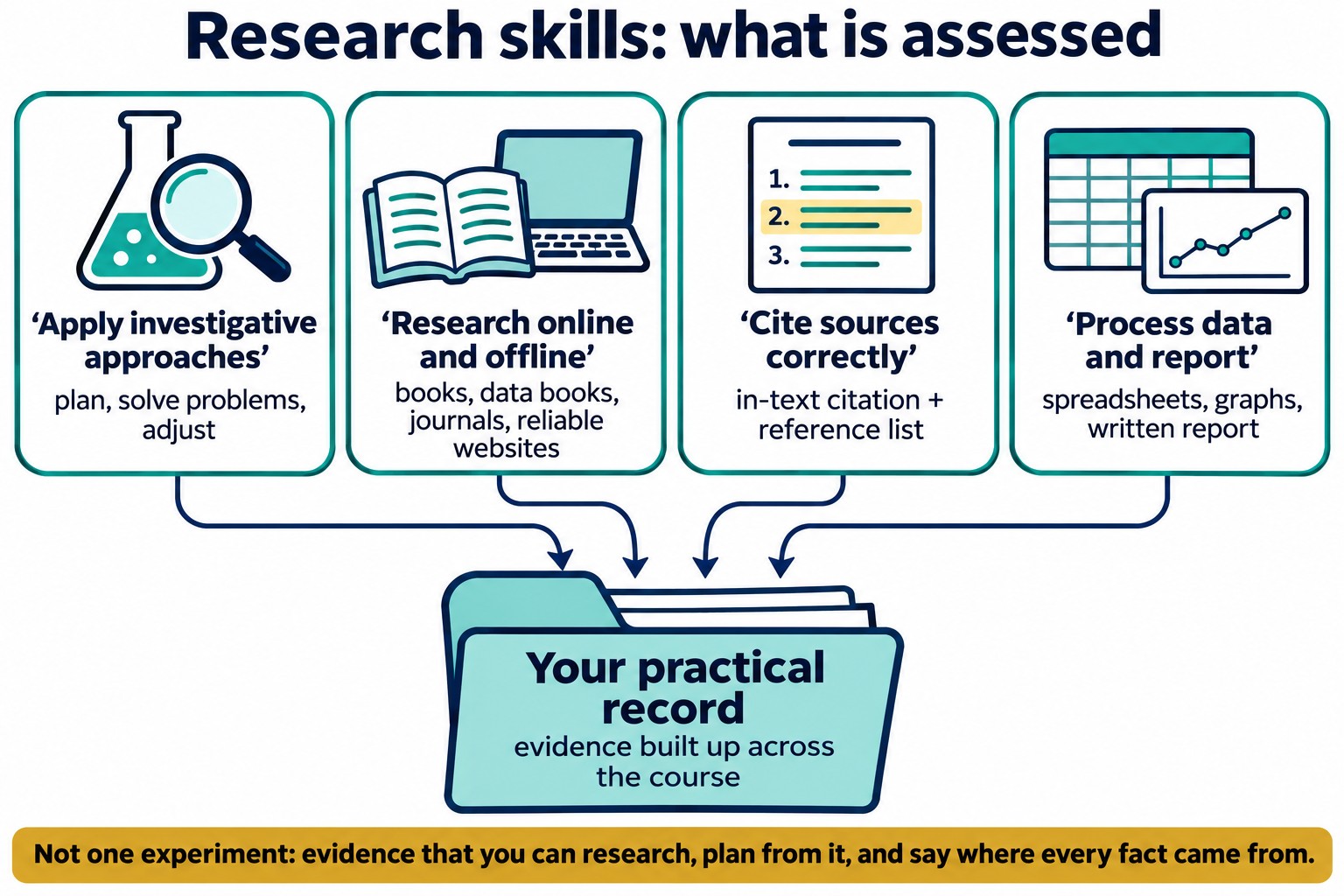
Four skills, one record: research skills are shown across your practical work, not in a single lesson.
The endorsement is reported on your certificate as a separate Pass beside your grade. The written papers also test planning, evaluation and data skills, so the habits on this page earn marks there too.
Key idea: PAG 12 is evidence, built up across the course, that you can find information, judge it, use it to plan an experiment and say exactly where every fact came from.
Choosing and Judging Sources
Research for a practical uses both offline sources (textbooks, data books, printed journals, product labels) and online sources (journal databases, learned society pages, supplier safety data sheets, reliable websites).
A primary source reports original work by the people who did it, such as a journal paper or your own results. A secondary source summarises other work, such as a textbook, a review or a revision page.
Peer review means other experts in the field check a paper’s method, data and conclusions before it is published. It raises reliability, but peer-reviewed work can still contain errors and is still tested by others.
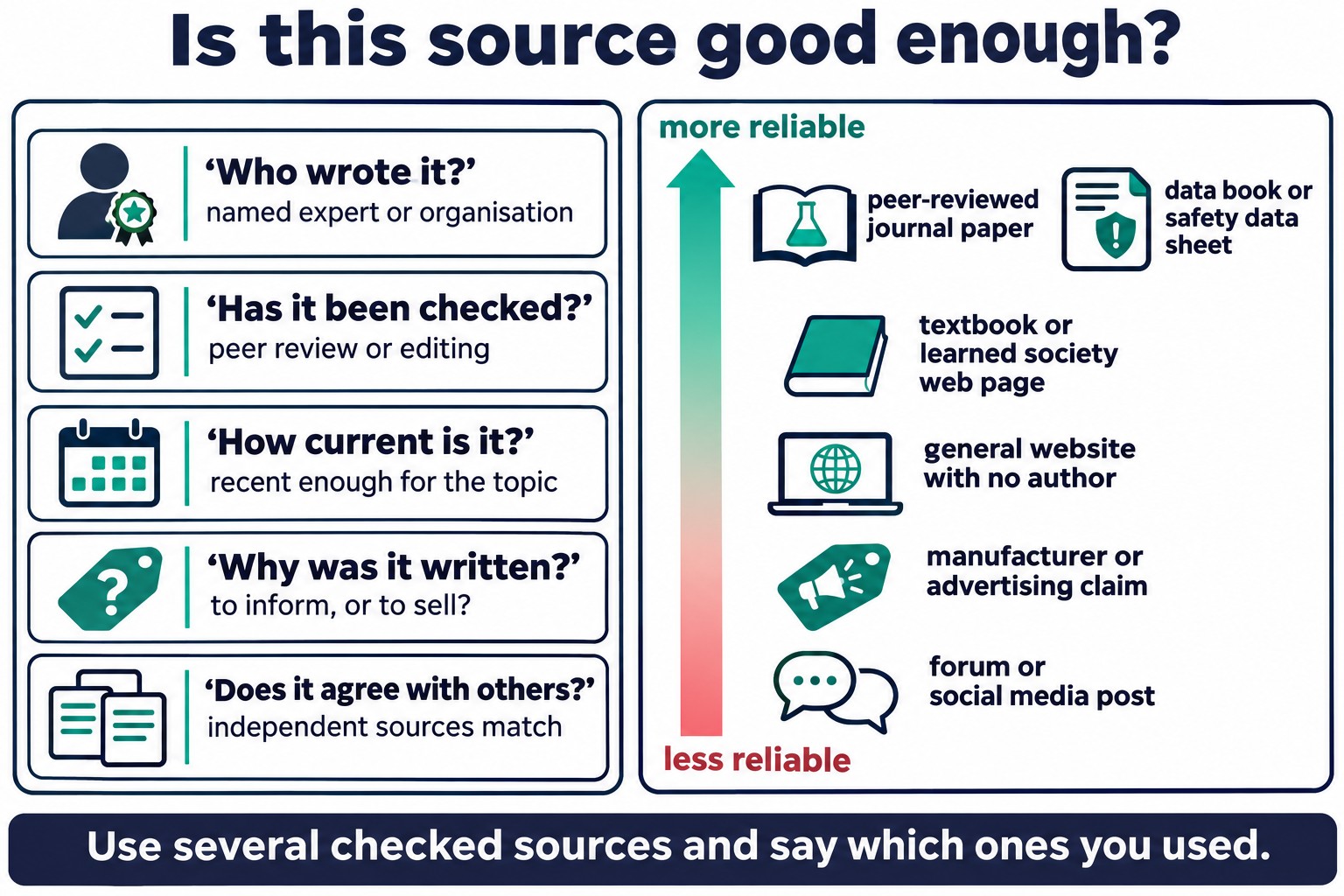
Five checks for any source, and where common source types usually sit on the reliability scale.
| Check | What to look for | Warning sign |
|---|---|---|
| Who wrote it? | A named expert, university, learned society, government body or supplier | No author, an anonymous forum post or a username |
| Has it been checked? | Peer review, an editor, or a published data book | A personal page or social media post that nobody has checked |
| How current is it? | Recent enough for the topic; fixed values such as molar masses do not date | Out-of-date safety advice or superseded data |
| Why was it written? | To inform or to teach | To sell a product: claims may be chosen to look good |
| Does it agree with others? | Independent sources give the same value or explanation | A value found in only one place, or quoted without units or conditions |
Exam wording: “A source is more reliable if it is written by experts, has been peer reviewed or edited, is recent enough for the topic, has no commercial motive and agrees with other independent sources.”
Check: Judging Sources
Four rounds: in each, pick the one statement about sources that is correct.
Citing Sources: the Harvard Style
Citing a source shows that research took place, lets a reader check your facts and gives credit to the people whose work you used. It is the whole of CPAC 5b, and it keeps you clear of plagiarism.
The Harvard style has two parts. An in-text citation such as (Online Learning System, 2026) goes in the sentence where you use the information. A reference list at the end gives the full details of every source cited.
The reference list is in alphabetical order of the author’s surname, or of the organisation when no person is named. Every in-text citation must match one entry, and every entry must be cited somewhere in the text.
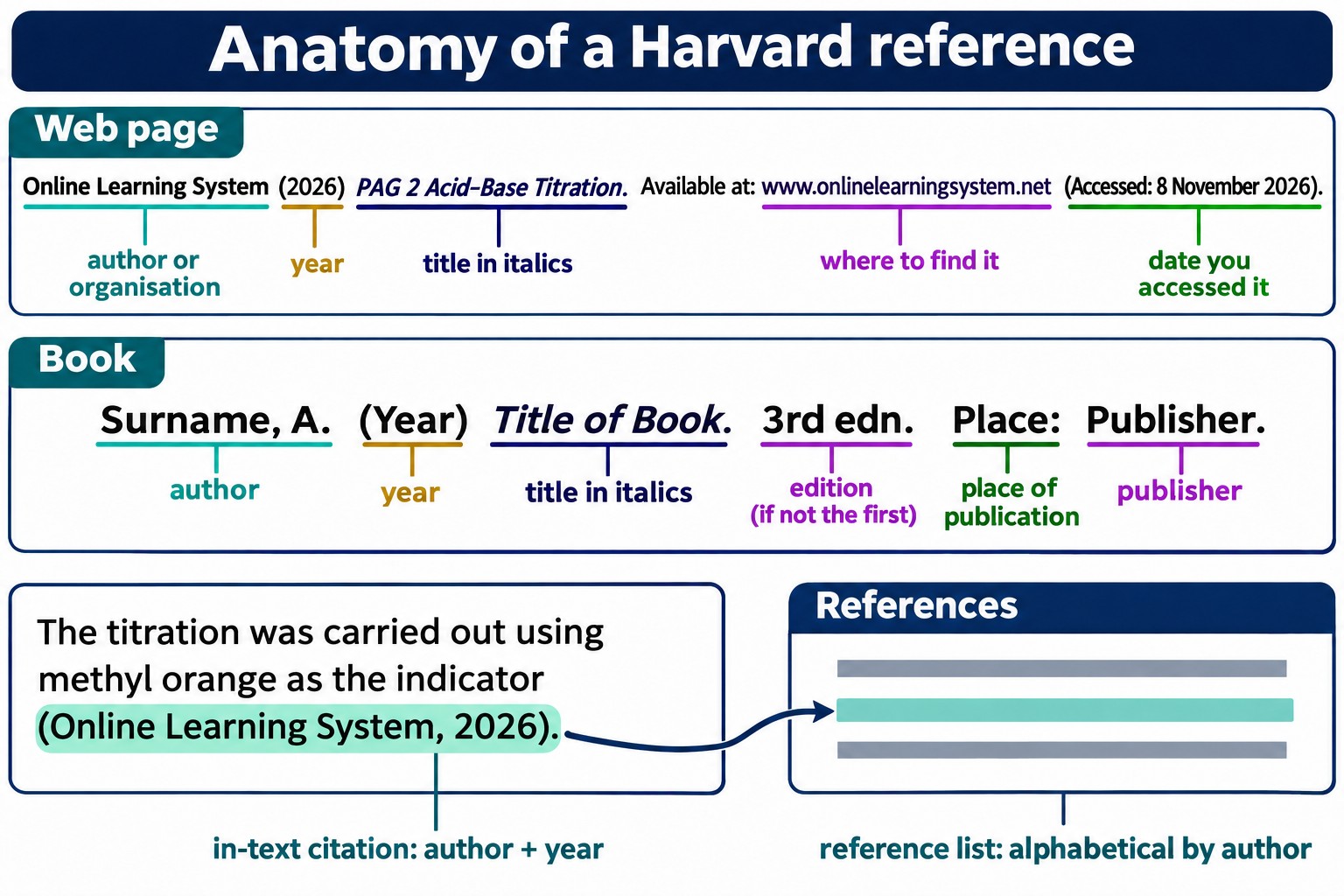
The parts of a Harvard reference for a web page and a book, and how an in-text citation points to its entry.
| Source | Harvard pattern |
|---|---|
| Book | Surname, Initial. (Year) Title. Edition (if not the first). Place: Publisher. |
| Journal paper | Surname, Initial. (Year) ‘Title of paper’, Journal Name, volume(issue), pages. doi if given. |
| Web page | Author or Organisation (Year) Title of page. Available at: URL (Accessed: date). |
| Safety data sheet | Supplier (Year) Safety data sheet: substance name. Available at: URL (Accessed: date). |
| No date given | Write n.d. in place of the year: Organisation (n.d.) Title… |
Two real references in this style, both used on this page:
OCR (2024) A Level Chemistry A H432 Specification. Version 2.8. Cambridge: OCR.
Online Learning System (2026) PAG 2 Acid–Base Titration. Available at: https://www.onlinelearningsystem.net/revision-notes/a-level-chemistry/ocr-a/practical-activity-groups/pag-2-acid-base-titration/ (Accessed: 8 November 2026).
Remember: Schools use slightly different versions of Harvard punctuation. Any version is fine if you use it the same way every time and every citation matches an entry in the list.
Check: Harvard Referencing Rules
Drag the missing words into six rules for citing and listing sources.
Worked Investigation: How Much Acid Does an Antacid Tablet Neutralise?
This example follows one investigation from question to report, showing where research changes the plan. The research question: which of two indigestion tablets neutralises more hydrochloric acid per tablet?
What the research showed
Ingredients. The packets give the active ingredients: tablet A contains 500 mg calcium carbonate in a 1.250 g tablet; tablet B contains 300 mg magnesium hydroxide and 300 mg calcium carbonate in a 1.100 g tablet.
Method. The tablets do not dissolve in water and react slowly with acid, and their binders never dissolve. A direct titration would have no sharp end point, so a back titration is used: add a known excess of acid, then titrate the acid left over.
Indicator. A data book gives methyl orange a colour change between pH 3.1 and 4.4, and phenolphthalein between pH 8.2 and 10. The two reasons below, from the same research, decide the choice.
Magnesium ions from tablet B start to precipitate as magnesium hydroxide at about pH 9 to 10, inside phenolphthalein’s range. That precipitation uses up hydroxide ions, so a phenolphthalein end point would drift and the titre would be too large.
Any carbon dioxide still dissolved forms a weak acid that also reacts with alkali before phenolphthalein turns pink. Methyl orange changes colour below pH 4.4, before either problem starts, and still sits on the steep part of the strong acid–strong base curve.
Safety. Hazards come from the supplier’s safety data sheets or CLEAPSS Hazcards for hydrochloric acid, sodium hydroxide and methyl orange, cited in the risk assessment.
Swipe sideways to see the products →
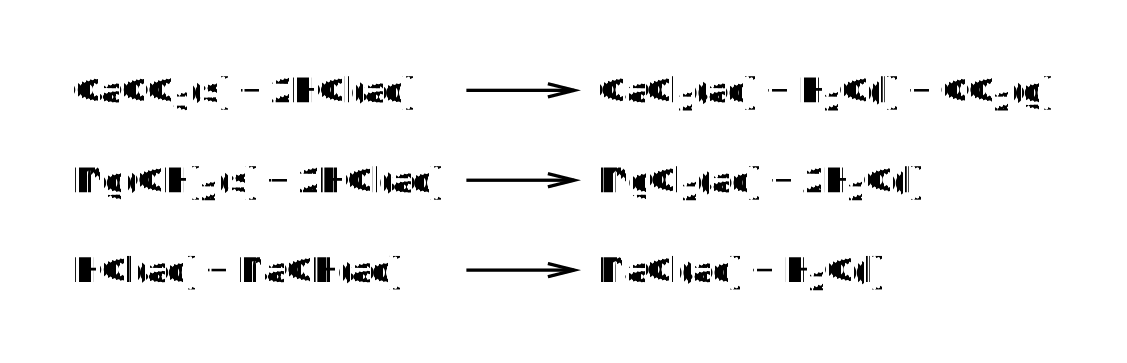
The two neutralisation reactions in the tablets, and the titration of the acid left over.
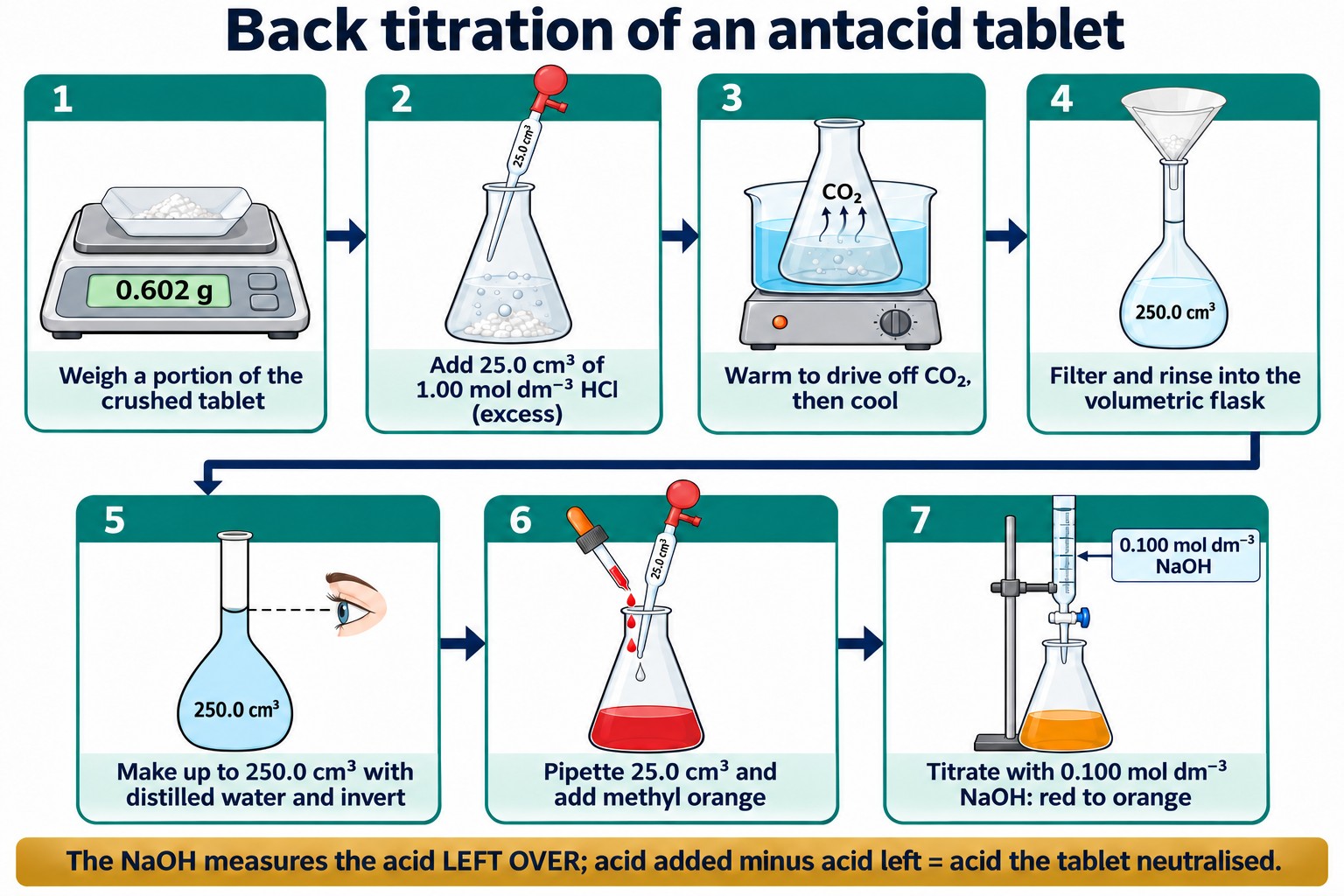
The back titration: the sodium hydroxide measures only the acid left over after the tablet has reacted.
| Step | What you do | Why |
|---|---|---|
| 1 | Crush one tablet and weigh about 0.6 g of the powder by difference into a conical flask. | A portion keeps the expected titre between 15 and 30 cm³; weighing by difference records exactly what went in. |
| 2 | Add 25.0 cm³ of 1.00 mol dm⁻³ HCl from a pipette and swirl until the fizzing stops. | A pipette gives a precisely known amount of acid; it must be in excess so all the active ingredient reacts. |
| 3 | Warm the flask gently in a water bath for a few minutes, then cool it. | Warming completes the reaction and drives out dissolved CO₂, which would otherwise react with the alkali. |
| 4 | Filter into a 250.0 cm³ volumetric flask, rinsing the flask and filter paper into it with distilled water. | The insoluble binder is removed; rinsing transfers every trace of the acid. |
| 5 | Make up to the mark with distilled water, bottom of the meniscus at eye level, then stopper and invert. | The solution must be exactly 250.0 cm³ and evenly mixed so every portion is the same. |
| 6 | Pipette 25.0 cm³ into a conical flask, add three drops of methyl orange and titrate with 0.100 mol dm⁻³ NaOH until red just turns orange. | The titre measures the acid left in one tenth of the solution. |
| 7 | Repeat until two titres agree within 0.10 cm³; repeat the whole method for tablet B. | Concordant titres show the end point is being judged consistently. |
Results
| Tablet | Portion / g | Rough / cm³ | Titre 1 / cm³ | Titre 2 / cm³ | Titre 3 / cm³ | Mean titre / cm³ |
|---|---|---|---|---|---|---|
| A | 0.602 | 20.60 | 20.25 | 20.20 | 20.30 | 20.25 |
| B | 0.598 | 16.50 | 16.20 | 16.25 | 16.15 | 16.20 |
Swipe sideways to see all the columns →
Tablet A, one step per line
The label predicts a little more acid neutralised than was measured:
Tablet B
Conclusion. Tablet B neutralises about 1.6 times as much acid per tablet as tablet A, and both agree with their labels to within 2%. The magnesium hydroxide in B neutralises more acid per gram than calcium carbonate.
Exam wording: “In a back titration a known excess of acid reacts with the solid; titrating the acid left over and subtracting it from the acid added gives the amount of acid the solid neutralised.”
Check: Back Titration of a Magnesium Carbonate Tablet
Work through a back titration of a different tablet, one step per blank.
Finding Sources Online and Offline
Good research starts with specific search terms. “Antacid” returns adverts; “antacid tablet back titration methyl orange” returns methods. Add the name of the technique, the substance and the quantity you want.
Search where checked information lives: the school library and textbook indexes, a chemistry data book, learned society and university pages, journal databases, and supplier safety data sheets.
Keep a research log as you go: what you found, where, the date you accessed it and what you used it for. Writing the reference list at the end is then a few minutes’ work, not a hunt.
| Source | Online or offline | Primary or secondary | Good for |
|---|---|---|---|
| Textbook | Both | Secondary | Background theory and standard methods |
| Data book | Mostly offline | Secondary (a checked compilation) | Molar masses, indicator ranges, constants |
| Peer-reviewed journal paper | Both | Primary | Original methods and results |
| Safety data sheet or CLEAPSS Hazcard | Online | Secondary (checked reference) | Hazards and control measures at a stated concentration |
| Learned society or university page | Online | Secondary | Reliable explanations and practical guides |
| Product label or manufacturer’s site | Both | Primary for the product | Ingredient amounts; watch for commercial bias |
| Forum or social media post | Online | Unchecked | Leads only: never a final source |
Technique point: An encyclopedia or a search engine is a starting point, not a source. Follow it to the original source, read that, and cite what you actually used.
Turning Research Into a Plan
Research is only evidence for CPAC 5b if it shapes the plan. Each decision in a good plan can be traced to a source: the method, the quantities, the indicator, the control variables and the safety measures.
Start with a focused question that names what you change and what you measure. Then use your research to decide which variables to control, and how.
Quantities come from calculation, not guesswork. Before the antacid investigation, the label data gave an expected titre, one step per line:
A titre near 20 cm³ is large enough for a small burette percentage uncertainty but needs only one burette filling. If the estimate had given 3 cm³ or 45 cm³, the tablet portion or the volume of acid would be changed before any practical work.
| Hazard | Risk in this task | Control measure |
|---|---|---|
| Hydrochloric acid, 1.00 mol dm⁻³: low hazard at this concentration, but it irritates eyes and cuts | Splashes while pipetting, swirling or warming | Eye protection; pipette filler; warm gently in a water bath, never boil |
| Sodium hydroxide, 0.100 mol dm⁻³: irritant | Splashes while filling the burette, especially into the eyes | Eye protection; fill the burette below eye level with a funnel, then remove the funnel |
| Methyl orange: the solid is toxic if swallowed; the dilute indicator solution is low hazard | Contact with the mouth from hands | Use only the dilute indicator solution, by dropper; wash hands after the practical |
Remember: Cite the safety data sheet or Hazcard you used for each hazard. Hazard levels depend on concentration, so the source must match the concentration in your plan.
Check: Planning a New Investigation From Research
Order the stages of a plan for a different investigation: how quickly iron tablets break up in acid.
Evaluating the Investigation
A back titration finds the acid neutralised as a difference between two larger amounts. The absolute uncertainties of both amounts add, so the percentage uncertainty in the difference is much larger than in any single reading.
For tablet A, one step per line:
About 4.8% is far more than any single piece of apparatus contributes. Most of it comes from subtracting 2.025 × 10⁻² from 2.500 × 10⁻²: the answer is small, but it carries the uncertainty of both numbers.
Improvement. Use the whole tablet. About 9.9 × 10⁻³ mol of acid then reacts, the titre falls to about 15.1 cm³, and the percentage uncertainty in the acid neutralised falls to about 2%.
Other limitations. The concentration of the hydrochloric acid should be checked by titration against a standard, because every result depends on it. Each tablet type was tested on one tablet only, so tablet-to-tablet variation is unknown.
Exam focus: For a back titration say which two amounts are subtracted, why that makes the percentage uncertainty large, and a change that makes the amount neutralised a bigger share of the acid added.
Check: Evaluating a Back Titration
Judge new back titration results and work out burette uncertainties for different titres.
Recording and Reporting
Records are made at the time, in a lab book or a dated file: the method as actually carried out, any changes and why, every raw reading with its unit and the precision of the apparatus. Nothing is rewritten neatly later.
Software is part of CPAC 5a. A spreadsheet can calculate mean titres and amounts in moles from formulas, so a mistyped reading is easy to spot and correct, and it draws graphs with labelled axes and units.
| Report section | What it contains |
|---|---|
| Aim or research question | One focused question naming what is changed and what is measured |
| Method | The method as carried out, with the reasons from your research cited |
| Results | Raw data in a table, units in the headings, consistent decimal places |
| Analysis | Calculations one step per line, or a graph with a line of best fit |
| Evaluation | Percentage uncertainties, the biggest source of error and a specific improvement |
| Conclusion | An answer to the question, supported by the data and by cited sources |
| References | Every source cited in the text, in alphabetical order, in one style |
The reference list for the antacid report would include the two real references in the Harvard card above, plus one entry for each safety data sheet or Hazcard actually used, with its access date.
Exam wording: “Research supports the plan when it is cited at the point of use: the indicator, the quantities, the control variables and the safety measures each come from a named source.”
Check: Is This Research Good Enough?
Six situations from student plans and reports: decide what is wrong or right, then flip the card.
Common Mistakes
These slips cost CPAC evidence in the lab and marks in written planning questions.
Citing a search engine. Google is how you found a source, not the source itself.
A list with no in-text citations. CPAC 5b needs each source tied to the point in the plan or conclusion it supports.
Missing access dates. Web pages change, so a web reference always gives the date you accessed it.
Copying with a citation only. Copied words need quotation marks; otherwise write the idea in your own words.
Trusting one source. A value that appears in only one place, or with no units or conditions, needs checking against another source.
Phenolphthalein in the antacid titration. Magnesium hydroxide precipitates in its range; methyl orange changes colour first.
Forgetting the subtraction. The titre gives the acid left over, not the acid neutralised.
Common Exam Points
Say
- “The source is reliable because it is peer reviewed and agrees with a second, independent source.”
- “A known excess of acid is added and the excess is titrated.”
- “Methyl orange was chosen because magnesium hydroxide precipitates in phenolphthalein’s range.”
- “Each source is cited at the point in the plan that it supports.”
Do not say
- “I found it on Google.”
- “The website is reliable because it is on the internet.”
- “Peer review proves the results are correct.”
- “The titre is the amount of acid the tablet neutralised.”
Watch for
Choosing and justifying a source; spotting bias in a commercial claim; the parts of a reference; a back titration with a 1 : 2 ratio and a scale-up from a 25.0 cm³ portion to 250.0 cm³; why a small difference has a large percentage uncertainty.
FAQs
Short answers to the questions students most often ask about the research skills group.
Is PAG 12 a separate experiment?
No. It is assessed whenever you research a practical, plan from that research and cite your sources. Many students show it in an investigation they plan themselves, such as a back titration or a rates investigation.
Which referencing style do I have to use?
The Practical Skills Handbook gives guidance; most schools use a version of Harvard. Use one style consistently, and make sure every in-text citation matches an entry in your reference list.
Can I use Wikipedia?
Use it to get started, then follow its links to the original sources, read those and cite them. A reference list that relies on an encyclopedia shows little research.
What counts as a reliable source?
One written by named experts or a recognised organisation, checked by peer review or an editor, recent enough for the topic, written to inform rather than sell, and in agreement with other independent sources.
Why is a back titration used for antacid tablets?
The tablets react slowly and contain insoluble binders, so a direct titration has no sharp end point. Adding a known excess of acid and titrating what is left gives a clear end point and the acid neutralised by difference.

Copyright notice: This OLS revision content, including the explanations, layout, diagrams, tables and embedded learning structure, is authored for Online Learning System by Dr. Mohammed Al-Fatah. It may not be copied, reproduced, redistributed or adapted without written permission.
Keep this note — free
Save your progress across every OCR topic. A free account remembers which topics you have covered, saves your question scores, and syncs across your phone and laptop.
- Track every topic you have finished
- Keep your practice-question scores
- No payment, no card, free forever
Already registered? Log in