Calculating Kp
A concise revision guide to Kp calculations: equilibrium moles from a table, mole fractions, partial pressures in kPa, the value and units of Kp, and using Kp to find a partial pressure or the total pressure.
- 3.1.10ii
- 3.1.10v
What these spec points say
- 3.1.10ii know that Kp is calculated from partial pressures for a system at constant temperature
- 3.1.10v perform calculations involving Kp
The Route to Kp
A Kp question rarely gives partial pressures directly. It gives the moles at the start, something about the equilibrium mixture (often a percentage dissociated or converted) and the total pressure.
The route from that data to Kp always has the same four stages.
- Equilibrium moles of every gas, from an ICE table.
- Mole fractions: (each equilibrium amount) / (the total moles of gas at equilibrium).
- Partial pressures: each mole fraction × the total pressure.
- Kp: substitute the partial pressures into the expression and work out the units.
- Percentage dissociated means the percentage of the starting substance that has broken down: change = −(percentage) / (100) × initial moles.
- The total moles of gas at equilibrium is usually different from the total at the start. Always add up the equilibrium row.
Key idea: Moles → mole fractions → partial pressures → Kp. Each stage uses the one before it, so set the working out as a table with one column per gas.
Worked Example 1: Percentage Dissociated
1.00 mol of phosphorus(V) chloride is heated in a sealed vessel. At equilibrium it is 40.0% dissociated and the total pressure is 4.00 kPa. Calculate Kp.
PCl₅(g) ⇌ PCl₃(g) + Cl₂(g)
Step 2. Total moles of gas at equilibrium = 0.600 + 0.400 + 0.400 = 1.400 mol.
Step 3. Find each mole fraction, then each partial pressure.
| n / mol | PCl₅ | PCl₃ | Cl₂ |
|---|---|---|---|
| I | 1.00 | 0 | 0 |
| C | −0.400 | +0.400 | +0.400 |
| E | 0.600 | 0.400 | 0.400 |
| xmole fraction | (0.600) / (1.400) = 0.4286 | (0.400) / (1.400) = 0.2857 | 0.2857 |
| pkPa | 0.4286 × 4.00 = 1.714 | 0.2857 × 4.00 = 1.143 | 1.143 |
Step 4. Kp = (p(PCl₃) × p(Cl₂)) / (p(PCl₅)) = (1.143 × 1.143) / (1.714).
Step 5. Units = (kPa × kPa) / (kPa) = kPa.
Answer. Kp = 0.762 kPa.
- Check: 1.714 + 1.143 + 1.143 = 4.00 kPa, the total pressure.
- The total moles rose from 1.00 to 1.400, because one mole of gas dissociates into two.
- Four significant figures were kept in the table and the answer was rounded to three at the end.
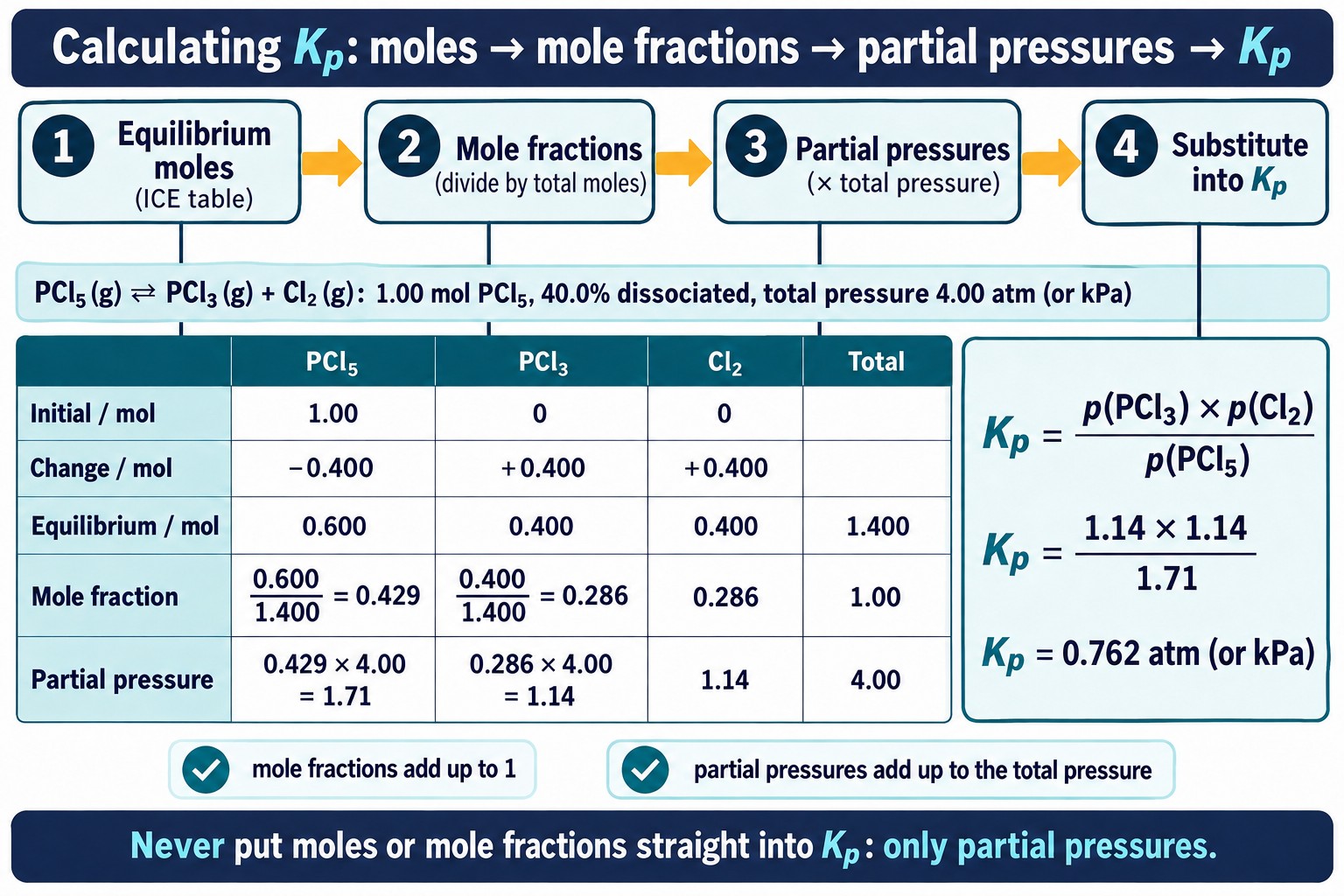
The four-stage route to Kp, from equilibrium moles to mole fractions to partial pressures to the expression, worked through for phosphorus(V) chloride that is 40.0% dissociated.
Exam focus: Most errors come from dividing by the initial total moles. The mole fraction uses the total moles at equilibrium: here 1.400, not 1.00.
Check: Kp From Percentage Dissociated
Calculate equilibrium moles, mole fractions, partial pressures and Kp for dissociations not used on this page.
Worked Example 2: Two Reactants and a Mole Ratio
2.00 mol of sulfur dioxide and 1.00 mol of oxygen are mixed. At equilibrium 60.0% of the sulfur dioxide has been converted into sulfur trioxide and the total pressure is 6.00 kPa. Calculate Kp.
2SO₂(g) + O₂(g) ⇌ 2SO₃(g)
Step 2. Total moles of gas at equilibrium = 0.800 + 0.400 + 1.200 = 2.400 mol.
| n / mol | SO₂ | O₂ | SO₃ |
|---|---|---|---|
| I | 2.00 | 1.00 | 0 |
| C | −1.200 | −0.600 | +1.200 |
| E | 0.800 | 0.400 | 1.200 |
| xmole fraction | (0.800) / (2.400) = 0.3333 | (0.400) / (2.400) = 0.1667 | (1.200) / (2.400) = 0.5000 |
| pkPa | 0.3333 × 6.00 = 2.00 | 0.1667 × 6.00 = 1.00 | 0.5000 × 6.00 = 3.00 |
Step 3. Kp = (p(SO₃)²) / (p(SO₂)² × p(O₂)) = (3.00²) / (2.00² × 1.00) = (9.00) / (4.00).
Step 4. Units = (kPa²) / (kPa² × kPa) = kPa⁻¹.
Answer. Kp = 2.25 kPa⁻¹.
What to notice
- The total moles fell from 3.00 to 2.400, because three moles of gas become two.
- The percentage applied to the sulfur dioxide only. The oxygen change came from the 2 : 1 ratio, not from the percentage.
- The units changed from example 1: kPa⁻¹ here, kPa there. Derive them each time.
Remember: Kp can have units of kPa, kPa⁻¹, kPa⁻², or none at all. Substitute the pressure unit into the expression and cancel, as on page 3.
Check: Kp With Mole Ratios and Units
Calculate Kp with its units from initial moles, a percentage converted and a total pressure, for equilibria not used on this page.
Working Back From Kp
When Kp is known, the expression can be rearranged to find a partial pressure, and from that a total pressure.
Worked example: a missing partial pressure
For N₂O₄(g) ⇌ 2NO₂(g), Kp = 0.640 kPa at a certain temperature. In an equilibrium mixture the partial pressure of N₂O₄ is 2.50 kPa. Find the partial pressure of NO₂ and the total pressure.
Step 1. Kp = (p(NO₂)²) / (p(N₂O₄)), so p(NO₂)² = Kp × p(N₂O₄).
Step 2. p(NO₂)² = 0.640 × 2.50 = 1.60, so p(NO₂) = √1.60.
Worked example: the total pressure for a given dissociation
At the temperature of worked example 1, Kp = 0.762 kPa. At what total pressure, P, would PCl₅ be 50.0% dissociated?
Step 1. Starting from 1.00 mol, the equilibrium amounts are 0.500 mol of each gas: 1.500 mol in total.
Step 3. Kp = ((P) / (3) × (P) / (3)) / ((P) / (3)) = (P) / (3).
Answer. P = 3 × 0.762 = 2.29 kPa.
- At 4.00 kPa the PCl₅ was 40.0% dissociated; at 2.29 kPa it is 50.0% dissociated.
- Lowering the pressure moves the equilibrium towards the side with more moles of gas, as Le Chatelier’s principle predicts.
- Kp itself has not changed, because the temperature is the same.
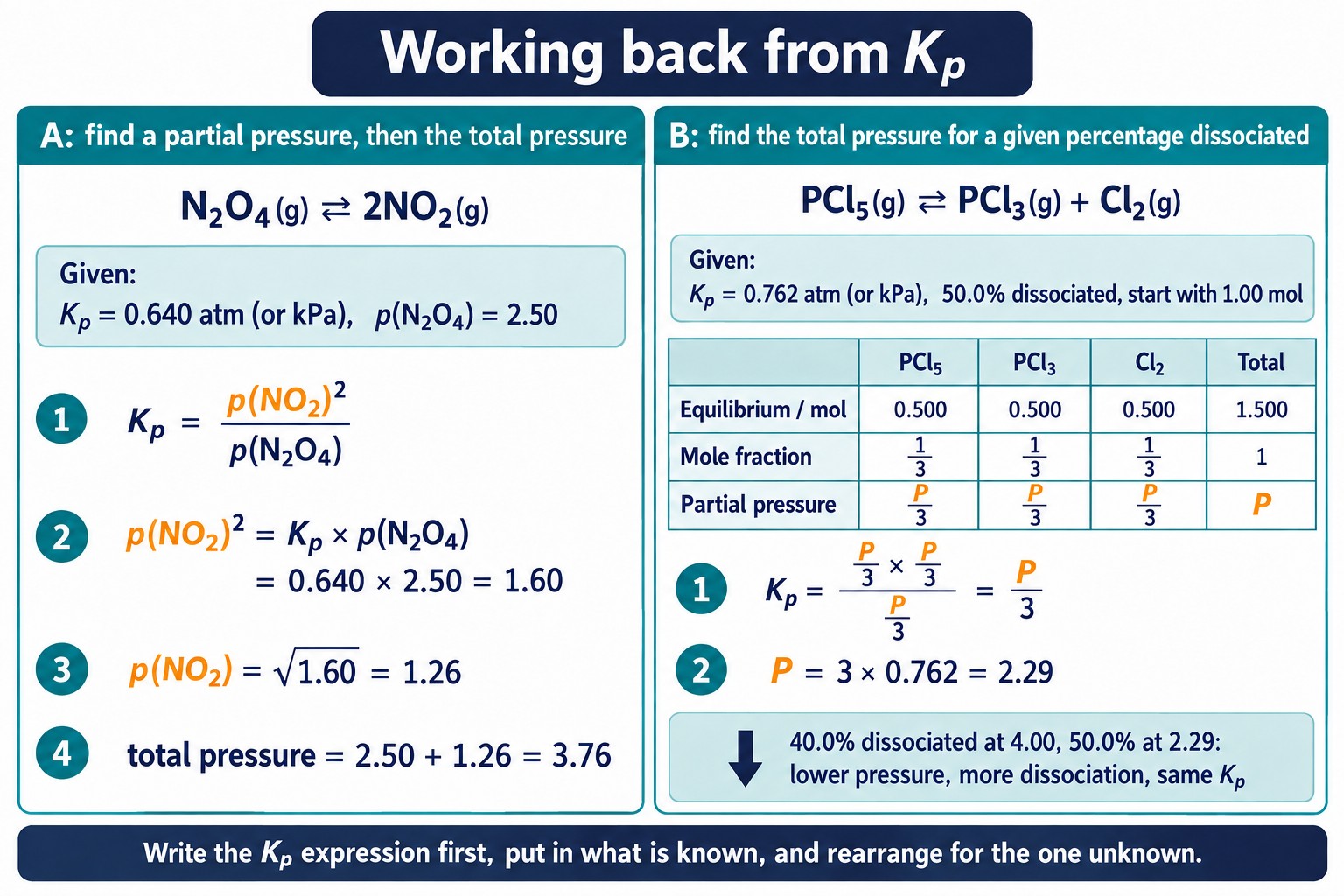
Two calculations that work back from Kp: finding a missing partial pressure and the total pressure, and finding the total pressure at which a gas is 50.0% dissociated.
Exam focus: For a reverse calculation, write the Kp expression first, substitute the values you know, and rearrange for the single unknown. Remember the square root when the unknown partial pressure is squared.
Quick Check: Work Back from a Known Kp
Work out each step on paper, then flip the card to compare. The data are invented for this exercise.
Common Exam Points
Say
- “Total moles at equilibrium = 0.600 + 0.400 + 0.400 = 1.400 mol.”
- “Mole fraction of PCl₅ = (0.600) / (1.400) = 0.429.”
- “Partial pressure of PCl₅ = 0.429 × 4.00 = 1.71 kPa.”
- “Kp = 0.762 kPa”, with the units derived from the expression.
Do not say
- “Mole fraction = (0.600) / (1.00)” (divide by the total at equilibrium, not the initial moles).
- “Kp = (0.400 × 0.400) / (0.600)” (those are moles, not partial pressures).
- “Kp = ([PCl₃][Cl₂]) / ([PCl₅])” (no square brackets in Kp).
- “Kp increases when the pressure is lowered” (only temperature changes Kp).
Watch for
- A gas that is present but does not react, such as an excess reactant: it still counts towards the total moles.
- Percentages quoted for one reactant only: apply the percentage to that reactant, then use the mole ratio.
- Rounding too early: carry four significant figures through the table and round the final answer to three.
- Pressure units: use the unit given in the question (usually kPa or Pa) and carry it into the units of Kp.
Check: Reverse Kp Calculations
Find partial pressures and total pressures from Kp, and carry out full Kp calculations, for equilibria not used on this page.
FAQs
Use these quick answers to check the Kp calculations.
What are the steps in a Kp calculation?
Find the equilibrium moles of each gas, add them for the total, divide to get each mole fraction, multiply by the total pressure for each partial pressure, then substitute into the Kp expression and work out the units.
Which pressure unit should I use?
Use the unit given in the question, usually kPa or Pa. Keep every partial pressure in the same unit, and derive the units of Kp from the expression rather than from memory.
Do the partial pressures have to add up to the total pressure?
Yes, and it is the best check in the calculation. If your partial pressures do not sum to the total pressure, a mole fraction is wrong, often because the total moles at equilibrium was miscounted.
How do I find a partial pressure when Kp is given?
Write the Kp expression, substitute the known partial pressures and rearrange for the unknown. If the unknown is squared or cubed, take the root at the end. The total pressure is then the sum of all the partial pressures.
Can I put moles straight into the Kp expression?
No. Kp needs partial pressures. Moles give the right number only when the powers on top and bottom are equal, so that total moles and total pressure cancel. Converting every time is the safe method.

Copyright notice: This OLS revision content, including the explanations, layout, diagrams, tables and embedded learning structure, is authored for Online Learning System by Dr. Mohammed Al-Fatah. It may not be copied, reproduced, redistributed or adapted without written permission.
Keep this note — free
Save your progress across every AQA topic. A free account remembers which topics you have covered, saves your question scores, and syncs across your phone and laptop.
- Track every topic you have finished
- Keep your practice-question scores
- No payment, no card, free forever
Already registered? Log in