Partial Pressures and Kp Expressions
A concise revision guide to gas equilibria: mole fraction, partial pressure as mole fraction × total pressure, how to write the expression for Kp from the balanced equation and its units for a homogeneous system.
- 3.1.10i
- 3.1.10ii
- 3.1.10iii
- 3.1.10iv
What these spec points say
- 3.1.10i know that the equilibrium constant Kp is deduced from the equation for a reversible reaction occurring in the gas phase
- 3.1.10ii know that Kp is calculated from partial pressures for a system at constant temperature
- 3.1.10iii derive partial pressure from mole fraction and total pressure
- 3.1.10iv construct an expression for Kp for a homogeneous system in equilibrium
Why Gases Have Their Own Constant
At AS (3.1.6 Chemical equilibria, Le Chatelier and Kc) you wrote Kc in terms of concentrations. For gases it is far easier to measure a pressure than a concentration.
So for an equilibrium in which the reacting substances are gases a second constant is used: Kp, the equilibrium constant in terms of partial pressures.
- Kp is built in the same way as Kc, with products over reactants and powers from the equation.
- Each concentration is replaced by the partial pressure of that gas.
- Like Kc, the value of Kp is constant at a given temperature.
Two ideas are needed before the expression can be used: the mole fraction of a gas and its partial pressure.
Definition: The partial pressure of a gas in a mixture is the pressure that the gas would exert if it alone occupied the whole container at the same temperature.
Mole Fraction and Partial Pressure
The mole fraction of a gas, x, is its share of the total number of moles of gas in the mixture:
mole fraction of A, x(A) = (moles of A) / (total moles of gas)
- A mole fraction has no units.
- The mole fractions of all the gases in a mixture add up to 1.
Each gas contributes to the total pressure in proportion to its mole fraction:
partial pressure of A, p(A) = x(A) × total pressure, P
- A partial pressure has the same units as the total pressure.
- The sum of the partial pressures equals the total pressure: P = p(A) + p(B) + p(C) + …
Worked example: from moles to partial pressures
An equilibrium mixture contains 2.0 mol of N₂, 6.0 mol of H₂ and 2.0 mol of NH₃ at a total pressure of 200 kPa.
Step 1. Total moles of gas = 2.0 + 6.0 + 2.0 = 10.0 mol.
| Gas | Moles | Mole fraction | Partial pressure / kPa |
|---|---|---|---|
| N₂ | 2.0 | (2.0) / (10.0) = 0.20 | 0.20 × 200 = 40 |
| H₂ | 6.0 | (6.0) / (10.0) = 0.60 | 0.60 × 200 = 120 |
| NH₃ | 2.0 | (2.0) / (10.0) = 0.20 | 0.20 × 200 = 40 |
| Total | 10.0 | 1.00 | 200 |
Check. The mole fractions add up to 1.00 and the partial pressures add up to 200 kPa.
Worked example: using the sum
A mixture of N₂O₄ and NO₂ has a total pressure of 150 kPa. The partial pressure of NO₂ is 90 kPa.
Step 1. p(N₂O₄) = 150 − 90 = 60 kPa.
Step 2. Mole fraction of NO₂ = (partial pressure) / (total pressure) = (90) / (150) = 0.60.
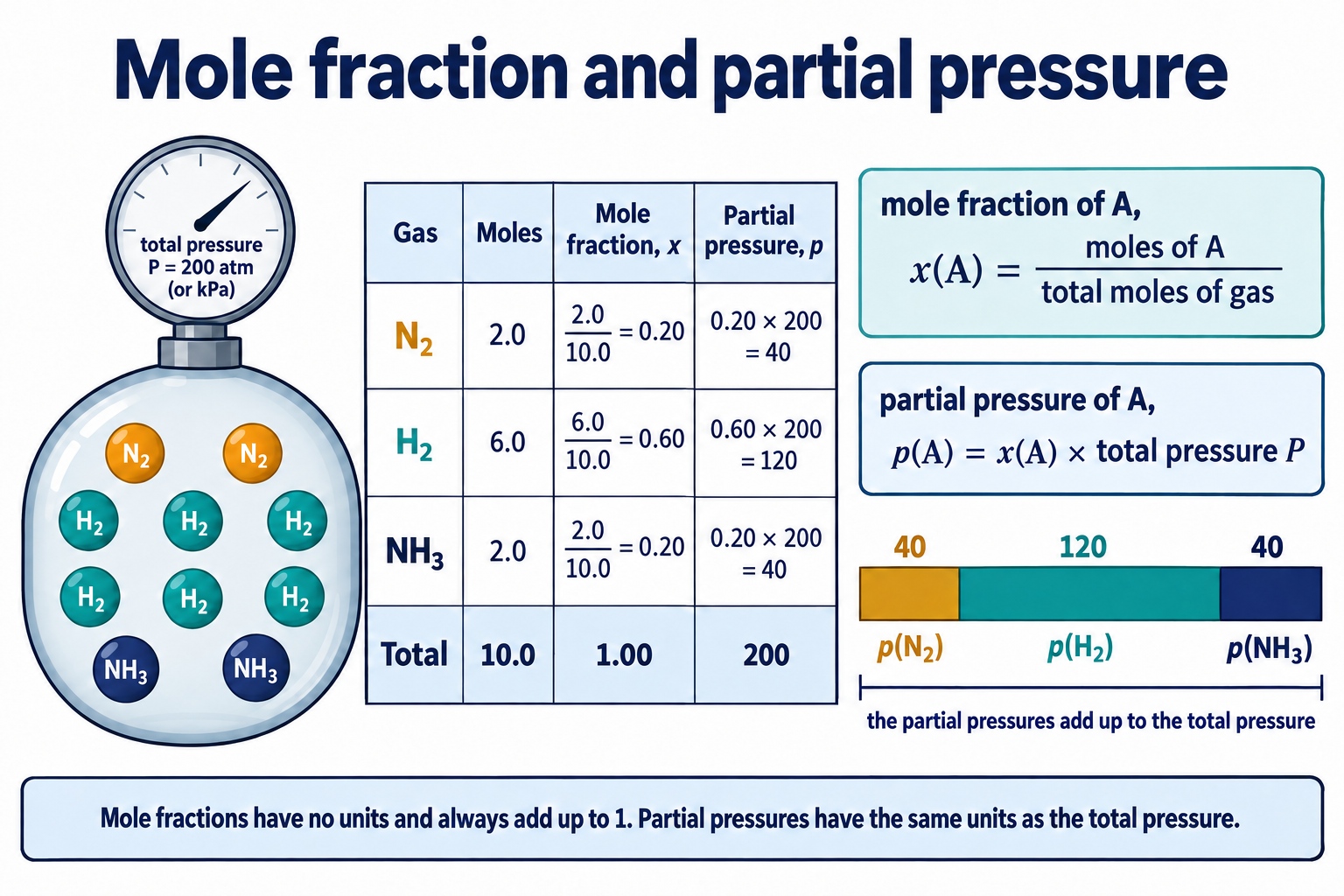
From moles to mole fractions to partial pressures for a mixture of three gases: the mole fractions add up to 1 and the partial pressures add up to the total pressure.
Key idea: Partial pressure = mole fraction × total pressure. Mole fractions add up to 1; partial pressures add up to the total pressure. Use both sums as a check on every calculation.
Check: Mole Fractions and Partial Pressures
Calculate mole fractions and partial pressures, and use their sums, for gas mixtures not used on this page.
Writing a Kp Expression
For the gas equilibrium aA(g) + bB(g) ⇌ cC(g) + dD(g):
Kp = (p(C)ᶜ × p(D)ᵈ) / (p(A)ᵃ × p(B)ᵇ)
- Products go over reactants, as in Kc.
- Each partial pressure is raised to the power of its balancing number.
- Partial pressures are written with a p and no square brackets. Square brackets mean concentration and are marked wrong in Kp.
- The partial pressures are equilibrium values.
| Equation | Kp expression | Units of Kp |
|---|---|---|
| N₂(g) + 3H₂(g) ⇌ 2NH₃(g) | (p(NH₃)²) / (p(N₂) × p(H₂)³) | kPa⁻² |
| 2SO₂(g) + O₂(g) ⇌ 2SO₃(g) | (p(SO₃)²) / (p(SO₂)² × p(O₂)) | kPa⁻¹ |
| N₂O₄(g) ⇌ 2NO₂(g) | (p(NO₂)²) / (p(N₂O₄)) | kPa |
| H₂(g) + I₂(g) ⇌ 2HI(g) | (p(HI)²) / (p(H₂) × p(I₂)) | none |
Units of Kp
The units are found by cancelling, exactly as for Kc, with the pressure unit in place of mol dm⁻³.
Step 1. For the ammonia equilibrium, units = (kPa²) / (kPa × kPa³) = (kPa²) / (kPa⁴).
Answer. Units of Kp = kPa⁻².
Pressures are usually given in kPa or Pa, and sometimes in atm. Keep whichever unit the question uses throughout and do not convert unless asked.
Worked example: substituting into Kp
Use the partial pressures from the ammonia mixture above: p(N₂) = 40, p(H₂) = 120 and p(NH₃) = 40 kPa.
Step 1. Kp = (p(NH₃)²) / (p(N₂) × p(H₂)³) = (40²) / (40 × 120³).
Step 2. Kp = (1600) / (40 × 1 728 000) = (1600) / (69 120 000).
Answer. Kp = 2.31 × 10⁻⁵ kPa⁻².
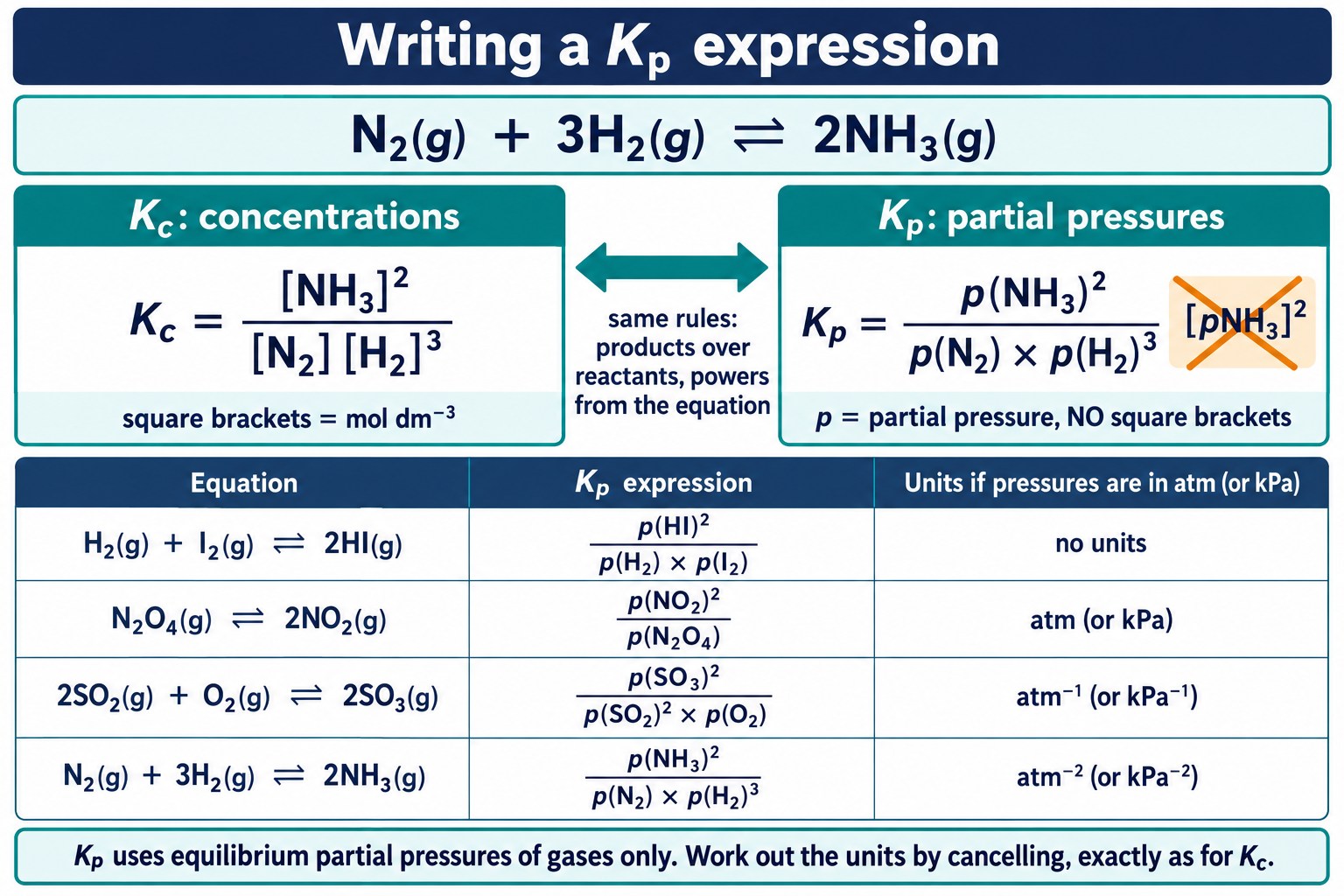
Kc and Kp for the same gas equilibrium side by side, with partial pressures written p and no square brackets, and four gas equilibria with their Kp expressions and units.
Exam focus: In a Kp expression write p(NH₃)², never [NH₃]² or [pNH₃]². Use only partial pressures, never moles or mole fractions, and state the units you have derived.
Check: Kp Expressions and Units
Write Kp expressions, derive their units and substitute partial pressures for gas equilibria not used on this page.
Quick Check: Work Through a New Mixture
Work out each step on paper, then flip the card to compare. The data are invented for this exercise.
Common Exam Points
Say
- “Mole fraction = (moles of the gas) / (total moles of gas).”
- “Partial pressure = mole fraction × total pressure.”
- “Kp = (p(SO₃)²) / (p(SO₂)² × p(O₂)).”
- “Units = (kPa²) / (kPa³) = kPa⁻¹.”
Do not say
- “Kp = ([SO₃]²) / ([SO₂]²[O₂])” (square brackets mean concentration).
- “Partial pressure = moles × total pressure” (use the mole fraction).
- “Kp has the units of pressure” for every reaction (they depend on the equation).
Watch for
- Total moles: add up the moles of every gas at equilibrium, including any that did not react.
- A missing partial pressure: subtract the others from the total pressure.
- Percentages by volume of a gas mixture: these are mole fractions × 100.
- Rounding: keep mole fractions to at least three significant figures until the end.
Check: Partial Pressures and Kp Together
Combine mole fractions, partial pressures and Kp expressions for gas mixtures not used on this page.
FAQs
Use these quick answers to check partial pressures and Kp expressions.
What is the difference between Kc and Kp?
Kc is written with equilibrium concentrations in mol dm⁻³ and Kp with equilibrium partial pressures. Kp is used only for gaseous equilibria, and each partial pressure is written as p(X), never with square brackets.
What is a partial pressure?
The pressure that one gas in a mixture would exert if it occupied the container alone. It equals the mole fraction of that gas multiplied by the total pressure, and all the partial pressures add up to the total pressure.
How do I work out a mole fraction?
Divide the moles of that gas at equilibrium by the total moles of gas at equilibrium. Mole fractions have no units and must add up to 1, which is a quick check on your working.
Why must mole fractions use equilibrium moles, not starting moles?
Kp describes the equilibrium mixture only. Starting amounts change as the reaction proceeds, and the total moles of gas usually changes too, so both the top and the bottom of each mole fraction must use equilibrium values.
What units does Kp have?
Substitute kPa for each partial pressure and cancel. Equal powers top and bottom give no units. For N₂O₄ ⇌ 2NO₂ the units are kPa; for N₂ + 3H₂ ⇌ 2NH₃ they are kPa⁻².

Copyright notice: This OLS revision content, including the explanations, layout, diagrams, tables and embedded learning structure, is authored for Online Learning System by Dr. Mohammed Al-Fatah. It may not be copied, reproduced, redistributed or adapted without written permission.
Keep this note — free
Save your progress across every AQA topic. A free account remembers which topics you have covered, saves your question scores, and syncs across your phone and laptop.
- Track every topic you have finished
- Keep your practice-question scores
- No payment, no card, free forever
Already registered? Log in