Calculating the pH of a Buffer Solution
A concise revision guide to buffer calculations: the pH of a buffer from Ka and the concentrations of the acid and its salt, buffers made by partial neutralisation, the concentrations needed for a chosen pH, and the small pH change when acid or alkali is added.
- 3.1.12.6v
What these spec points say
- 3.1.12.6v calculate the pH of acidic buffer solutions
Before You Start
This page puts numbers on the ideas in Buffer Solutions: How They Work and Why They Matter. It uses the Ka expression and pH = −log[H⁺] from Weak Acids: Ka and pKa.
The Buffer Equation
Start from the Ka expression for the weak acid and rearrange it for [H⁺].
Ka = ([H⁺][A⁻]) / ([HA]) so [H⁺] = (Ka × [HA]) / ([A⁻])
Two approximations make the calculation simple, and both are good because the weak acid barely dissociates in the presence of its salt.
- [HA] at equilibrium = the concentration of weak acid put in.
- [A⁻] at equilibrium = the concentration of salt put in, since the salt is fully dissociated.
The log form
Taking −log of both sides gives an optional rearrangement. Use whichever form you prefer.
pH = pKa + log(([A⁻]) / ([HA]))
| [A⁻] : [HA] | log(([A⁻]) / ([HA])) | pH of an ethanoic acid buffer |
|---|---|---|
| 1 : 10 | −1 | 3.76 |
| 1 : 1 | 0 | 4.76 (= pKa) |
| 10 : 1 | +1 | 5.76 |
Example 1: concentrations given
A buffer contains 0.100 mol dm⁻³ CH₃COOH and 0.150 mol dm⁻³ CH₃COONa. Ka = 1.74 × 10⁻⁵ mol dm⁻³. Calculate the pH.
Step 1. [H⁺] = (Ka × [HA]) / ([A⁻]) = (1.74 × 10⁻⁵ × 0.100) / (0.150) = 1.16 × 10⁻⁵ mol dm⁻³.
Step 2. pH = −log(1.16 × 10⁻⁵).
Key idea: The pH of a buffer depends on Ka and on the ratio of acid to salt. More salt than acid gives a pH above pKa; more acid than salt gives a pH below pKa.
Quick Check: Reasoning With the Buffer Equation
Pick the one accurate statement in each set, using weak acids that are new to this page.
Buffers Made by Mixing or by Partial Neutralisation
When two solutions are mixed, both substances end up in the same total volume. That volume cancels in ([HA]) / ([A⁻]), so moles can be used directly.
Example 2: mixing a weak acid with its salt
50.0 cm³ of 0.200 mol dm⁻³ CH₃COOH is mixed with 50.0 cm³ of 0.100 mol dm⁻³ CH₃COONa. Calculate the pH.
Step 2. [H⁺] = (1.74 × 10⁻⁵ × (1.00 × 10⁻²)) / (5.00 × 10⁻³) = 3.48 × 10⁻⁵ mol dm⁻³.
Answer. pH = −log(3.48 × 10⁻⁵) = 4.46
Example 3: partial neutralisation
20.0 cm³ of 0.200 mol dm⁻³ NaOH is added to 50.0 cm³ of 0.200 mol dm⁻³ CH₃COOH. Calculate the pH.
Step 3. [H⁺] = (1.74 × 10⁻⁵ × (6.00 × 10⁻³)) / (4.00 × 10⁻³) = 2.61 × 10⁻⁵ mol dm⁻³.
Answer. pH = −log(2.61 × 10⁻⁵) = 4.58
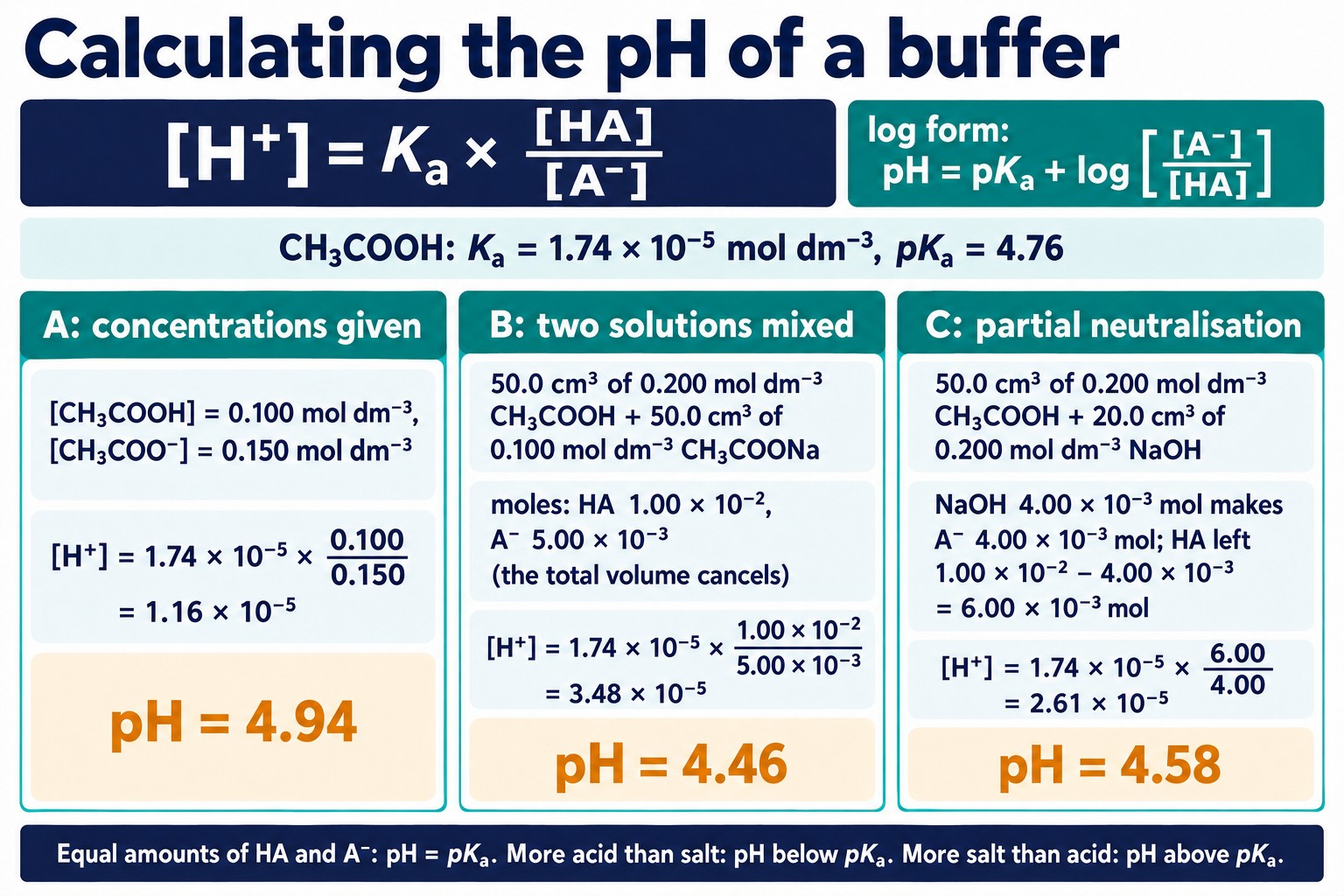
Three routes to the pH of an ethanoic acid buffer: concentrations given (pH 4.94), two solutions mixed (pH 4.46) and partial neutralisation with sodium hydroxide (pH 4.58).
Exam focus: In partial neutralisation, the moles of NaOH added become the moles of A⁻, and the moles of HA left are the starting moles minus the moles of NaOH.
Check: Calculating Buffer pH
Calculate the pH of buffers made from given concentrations, by mixing two solutions and by partial neutralisation, using acids and amounts not used on this page.
Making a Buffer of a Chosen pH
The same equation can be turned round to find the concentration of salt needed for a target pH.
Example 4: concentrations for a given pH
A buffer of pH 5.00 is needed, using 0.100 mol dm⁻³ CH₃COOH. What concentration of CH₃COONa is required, and what mass in 1.00 dm³? Mr(CH₃COONa) = 82.0.
Step 1. [H⁺] = 10⁻⁵·⁰⁰ = 1.00 × 10⁻⁵ mol dm⁻³.
Answer. The buffer needs 0.174 mol dm⁻³ CH₃COONa: 0.174 × 82.0 = 14.3 g dissolved to make 1.00 dm³.
A half-neutralised acid
- When exactly half of a weak acid has been neutralised, [HA] = [A⁻].
- Then [H⁺] = Ka, so pH = pKa: 4.76 for ethanoic acid.
- This is the half-neutralisation point on a weak acid with strong base pH curve (see pH Curves and Indicators).
Remember: To choose a buffer, pick a weak acid whose pKa is within about one unit of the pH wanted, then adjust the ratio of salt to acid.
Check: Designing a Buffer
Work out the concentration or mass of salt needed for a buffer of a given pH, and the pH of a half-neutralised acid, with values not used on this page.
Adding Acid or Alkali to a Buffer
When a small amount of strong acid or alkali is added, react it with the buffer first, in moles, then use the new amounts in the buffer equation.
A buffer of volume 1.00 dm³ contains 0.0500 mol CH₃COOH and 0.0500 mol CH₃COONa. Its pH is 4.76.
Example 5: adding 0.00100 mol of HCl
Step 2. [H⁺] = (1.74 × 10⁻⁵ × 0.0510) / (0.0490) = 1.81 × 10⁻⁵ mol dm⁻³.
Answer. pH = 4.74, a fall of only 0.02.
Example 6: adding 0.00100 mol of NaOH
Step 2. [H⁺] = (1.74 × 10⁻⁵ × 0.0490) / (0.0510) = 1.67 × 10⁻⁵ mol dm⁻³.
Answer. pH = 4.78, a rise of only 0.02.
| 1.00 dm³ of | Starting pH | After 0.00100 mol H⁺ | After 0.00100 mol OH⁻ |
|---|---|---|---|
| The buffer | 4.76 | 4.74 | 4.78 |
| Pure water | 7.00 | 3.00 | 11.00 |
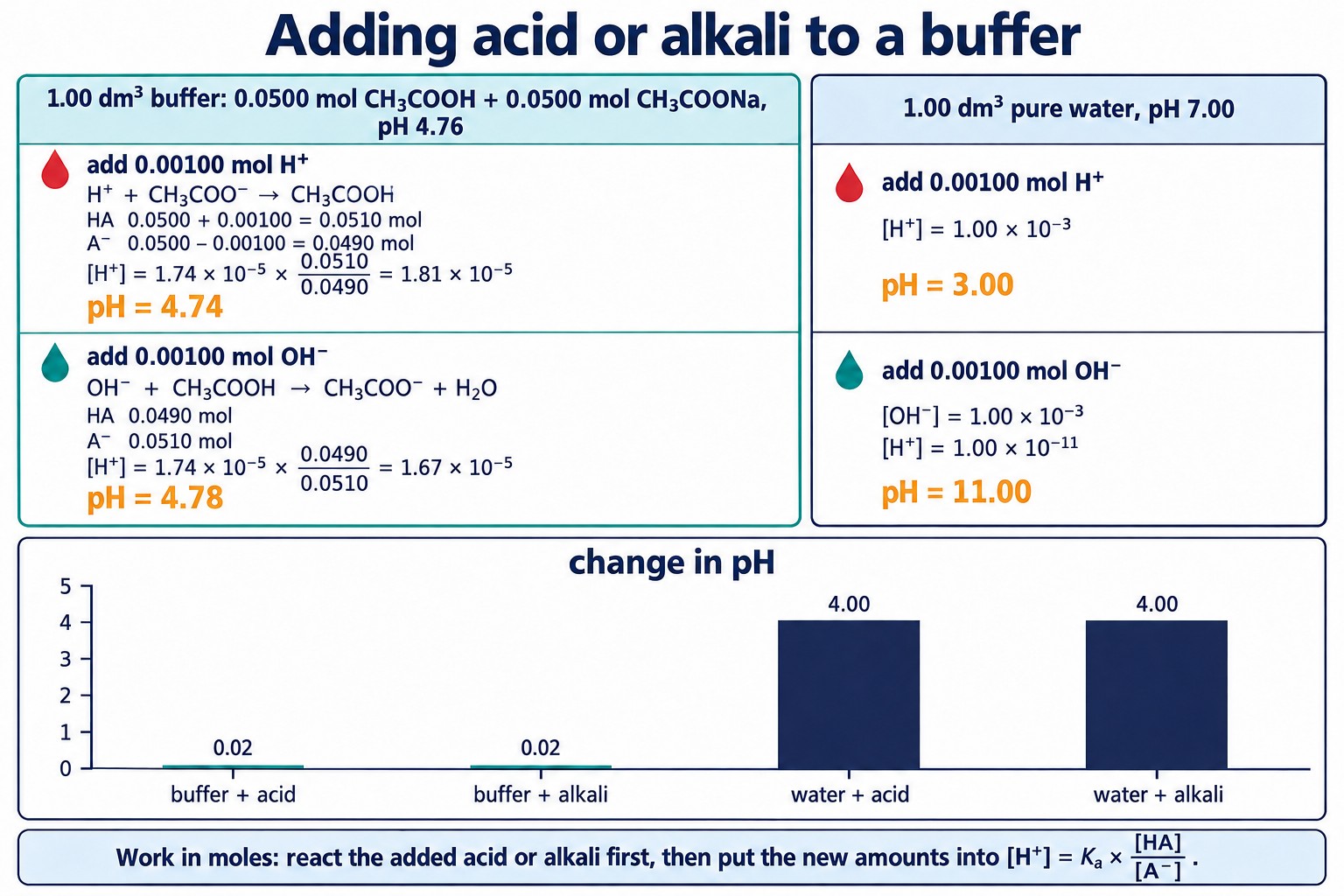
The same 0.00100 mol of acid or alkali added to 1.00 dm³ of buffer and to 1.00 dm³ of water: the buffer moves by 0.02 of a pH unit, the water by 4.00.
Exam focus: Never put the added H⁺ straight into [H⁺]. It reacts with A⁻ first. Add it to HA and subtract it from A⁻, then use the buffer equation.
Common Exam Points
Say
- “[H⁺] = (Ka × [HA]) / ([A⁻]), assuming [HA] equals the initial acid concentration and [A⁻] equals the salt concentration.”
- “The total volume cancels, so moles can be used in the ratio.”
- “At half-neutralisation [HA] = [A⁻], so pH = pKa.”
Do not say
- “[H⁺] = √(Ka × [HA])” for a buffer (that is for a weak acid on its own).
- “The salt concentration is the concentration of NaOH solution used” (work in moles after mixing).
- “The added acid lowers the pH by the amount of acid added” (it reacts with A⁻ first).
Watch for
- Partial neutralisation: subtract the moles of alkali from the moles of acid before using the ratio.
- Answers to 2 decimal places, and Ka with units of mol dm⁻³.
- A question giving pKa rather than Ka: use Ka = 10⁻ᵖᴷᵃ or the log form.
Check: Adding Acid or Alkali to a Buffer
Calculate the new pH of a buffer after a small amount of strong acid or alkali is added, and compare it with water, using buffers and amounts not used on this page.
FAQs
Use these quick answers to check buffer pH calculations.
How do I calculate the pH of a buffer?
Use [H⁺] = (Ka × [HA]) / ([A⁻]), taking [HA] as the acid concentration put in and [A⁻] as the salt concentration, then pH = −log[H⁺]. For 0.100 mol dm⁻³ CH₃COOH with 0.150 mol dm⁻³ CH₃COONa, pH = 4.94.
Why can I use moles instead of concentrations in the buffer equation?
The acid and its salt are in the same total volume, so the volume cancels in the ratio ([HA]) / ([A⁻]). The moles of each can be substituted directly once any reaction has been worked out.
How do I handle a buffer made by partial neutralisation?
Work in moles. The moles of NaOH added become the moles of A⁻, and the moles of HA left are the starting moles minus the moles of NaOH. Then substitute both into [H⁺] = (Ka × [HA]) / ([A⁻]).
Why does the pH equal pKa when a weak acid is half-neutralised?
Half of the acid has become A⁻, so [HA] = [A⁻] and the ratio is 1. The buffer equation then gives [H⁺] = Ka, so pH = pKa, which is 4.76 for ethanoic acid.
How do I find the new pH after adding acid to a buffer?
React the added acid first, in moles: add it to the moles of HA and subtract it from the moles of A⁻. Then use the new amounts in the buffer equation. Never put the added H⁺ straight into [H⁺].

Copyright notice: This OLS revision content, including the explanations, layout, diagrams, tables and embedded learning structure, is authored for Online Learning System by Dr. Mohammed Al-Fatah. It may not be copied, reproduced, redistributed or adapted without written permission.
Keep this note — free
Save your progress across every AQA topic. A free account remembers which topics you have covered, saves your question scores, and syncs across your phone and laptop.
- Track every topic you have finished
- Keep your practice-question scores
- No payment, no card, free forever
Already registered? Log in