Measuring pH and Finding Ka by Experiment
A concise revision guide to pH experiments: using and calibrating a pH meter, the pH of strong and weak acids, bases and salts, how dilution affects strong and weak acids, and finding Ka by experiment.
- 3.1.12.4i
- 3.1.12.4v
- 3.1.12.4vi
What these spec points say
- 3.1.12.4i know that weak acids and weak bases dissociate only slightly in aqueous solution
- 3.1.12.4v perform calculations relating the pH of a weak acid to the concentration of the acid and the dissociation constant Ka
- 3.1.12.4vi convert Ka into pKa and vice versa
Before You Start
This page turns the theory into measurements. It uses Ka and pKa from Weak Acids: Ka and pKa, the curves on pH Curves and Indicators and the buffer equation from Calculating the pH of a Buffer Solution.
The related practical is Required Practical 9: Investigating how pH changes when a weak acid reacts with a strong base and when a strong acid reacts with a weak base.
GCSE Recap: Acids, Alkalis and Their Strength
Three quick questions on the GCSE ideas this page builds on.
Using a pH Meter
A pH meter measures pH to 2 decimal places, far more precisely than universal indicator, which gives only about the nearest whole number.
- Calibrate: dip the electrode into buffer solutions of known pH, usually 4.00, 7.00 and 10.00, and adjust the meter to read each value.
- Rinse the electrode with distilled water and blot it gently dry.
- Place the electrode in the solution and stir gently.
- Wait until the reading is steady, then record it to 2 decimal places.
- Rinse between every solution, and note the temperature: pH changes with temperature.
- Calibration corrects for drift in the electrode, so the readings are accurate.
- Rinsing stops one solution contaminating the next.
- Store the electrode in its storage solution; a dry glass electrode gives slow, unreliable readings.
Exam wording: “Calibrate the pH meter using buffer solutions of known pH. Rinse the electrode with distilled water between measurements and wait for a steady reading.”
Quick Check: Trusting a pH Reading
Pick the one accurate statement in each set about a measurement that may have gone wrong.
The pH of Acids, Bases and Salts
Comparing solutions of the same concentration shows the difference between strong and weak acids and bases, and that many salts are not neutral.
| 0.100 mol dm⁻³ solution | Type | pH at 298 K |
|---|---|---|
| HCl | strong acid | 1.00 |
| CH₃COOH | weak acid | 2.88 |
| NaOH | strong base | 13.00 |
| NH₃ | weak base | about 11.1 |
| CH₃COONa | salt of a weak acid and a strong base | about 8.9 |
| NH₄Cl | salt of a strong acid and a weak base | about 5.1 |
| NaCl | salt of a strong acid and a strong base | 7.00 |
Why some salts are not neutral
- Sodium ethanoate is basic. Ethanoate ions accept protons from water: CH₃COO⁻ + H₂O ⇌ CH₃COOH + OH⁻, so [OH⁻] rises.
- Ammonium chloride is acidic. Ammonium ions donate protons: NH₄⁺ ⇌ NH₃ + H⁺, so [H⁺] rises.
- Sodium chloride is neutral. Neither Na⁺ nor Cl⁻ reacts with water, so [H⁺] = [OH⁻].
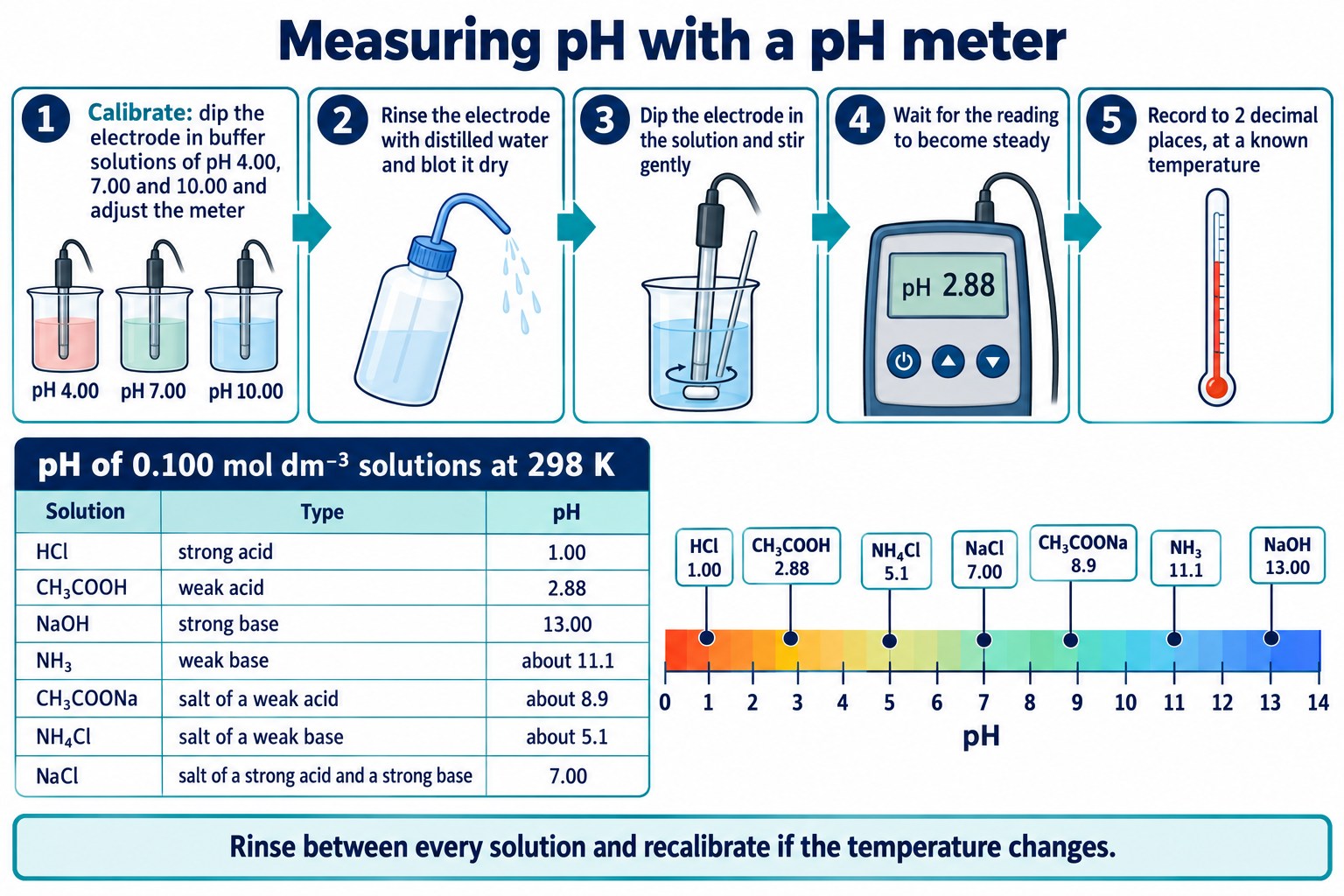
Using a pH meter: calibration with buffers of pH 4.00, 7.00 and 10.00, rinsing, stirring and reading to 2 decimal places, with the pH of seven 0.100 mol dm⁻³ acids, bases and salts.
Key idea: At the same concentration a weak acid has a higher pH than a strong acid, and a weak base a lower pH than a strong base. The salt of a weak acid is basic; the salt of a weak base is acidic.
Diluting Strong and Weak Acids
Diluting each acid by 10, 100 and 1000 times shows another clear difference between strong and weak acids.
| Dilution | Concentration / mol dm⁻³ | pH of HCl | pH of CH₃COOH |
|---|---|---|---|
| None | 0.100 | 1.00 | 2.88 |
| ×10 | 0.0100 | 2.00 | 3.38 |
| ×100 | 0.00100 | 3.00 | 3.88 |
| ×1000 | 0.000100 | 4.00 | about 4.4 |
- Strong acid: [H⁺] equals the acid concentration, so each tenfold dilution lowers [H⁺] ten times and raises the pH by exactly 1.
- Weak acid: [H⁺] = √(Ka × [HA]), so a tenfold dilution lowers [H⁺] only by √10, about 3.16 times, and the pH rises by about 0.5.
- As a weak acid is diluted, a larger fraction of it dissociates, which is why its pH rises more slowly.
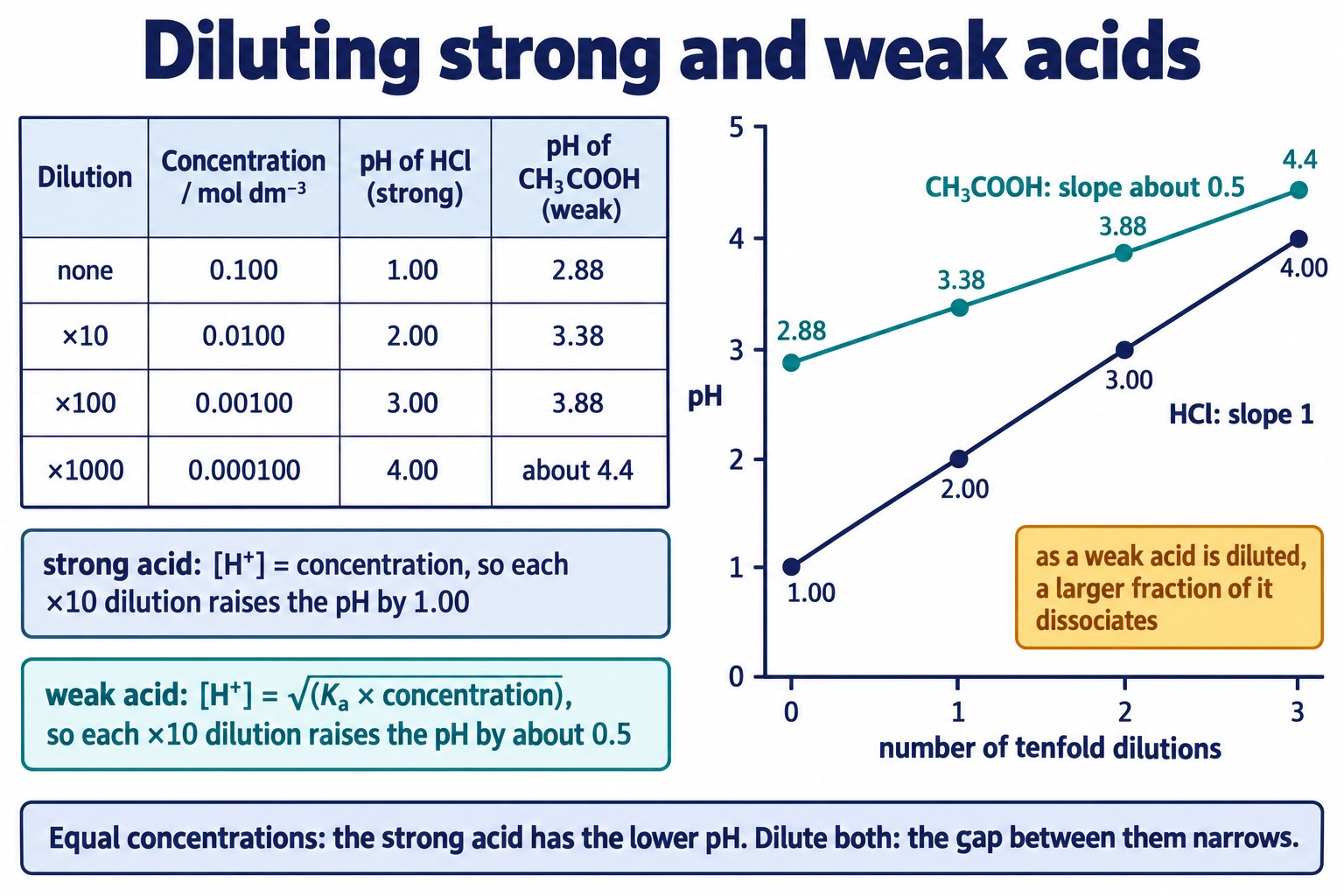
Diluting hydrochloric acid and ethanoic acid 10, 100 and 1000 times: the strong acid rises one pH unit each time, the weak acid only about half a unit.
Exam focus: A pH rise of 1 for each tenfold dilution identifies a strong acid. A rise of about 0.5 identifies a weak acid. At high dilution the ×1000 value shows the approximations beginning to fail.
Check: pH Data for Acids, Bases and Salts
Interpret pH readings for equimolar acids, bases and salts and for diluted strong and weak acids, explaining each value, for substances not used on this page.
Quick Check: What Dilution Reveals
Use each new set of invented readings to make a fast decision.
Finding Ka by Experiment
Method 1: half-neutralisation
- Titrate 25.0 cm³ of the weak acid with NaOH(aq), using phenolphthalein, to find the end point volume, V.
- To a fresh 25.0 cm³ of the acid, add exactly (V) / (2) of the same NaOH(aq).
- Mix, then measure the pH with a calibrated pH meter.
- Half the acid is now A⁻, so [HA] = [A⁻] and pH = pKa.
Example. The half-neutralised solution reads pH 4.20. So pKa = 4.20 and Ka = 10⁻⁴·²⁰ = 6.31 × 10⁻⁵ mol dm⁻³.
The whole pH curve can be plotted instead, and the pH read at half the equivalence volume.
Method 2: the pH of a known concentration
0.370 g of a weak monoprotic acid, HA (Mr = 74.0), is dissolved in water and made up to 100 cm³. The pH is 3.10. Calculate Ka.
Answer. Ka = ([H⁺]²) / ([HA]) = ((7.94 × 10⁻⁴)²) / (0.0500) = 1.26 × 10⁻⁵ mol dm⁻³
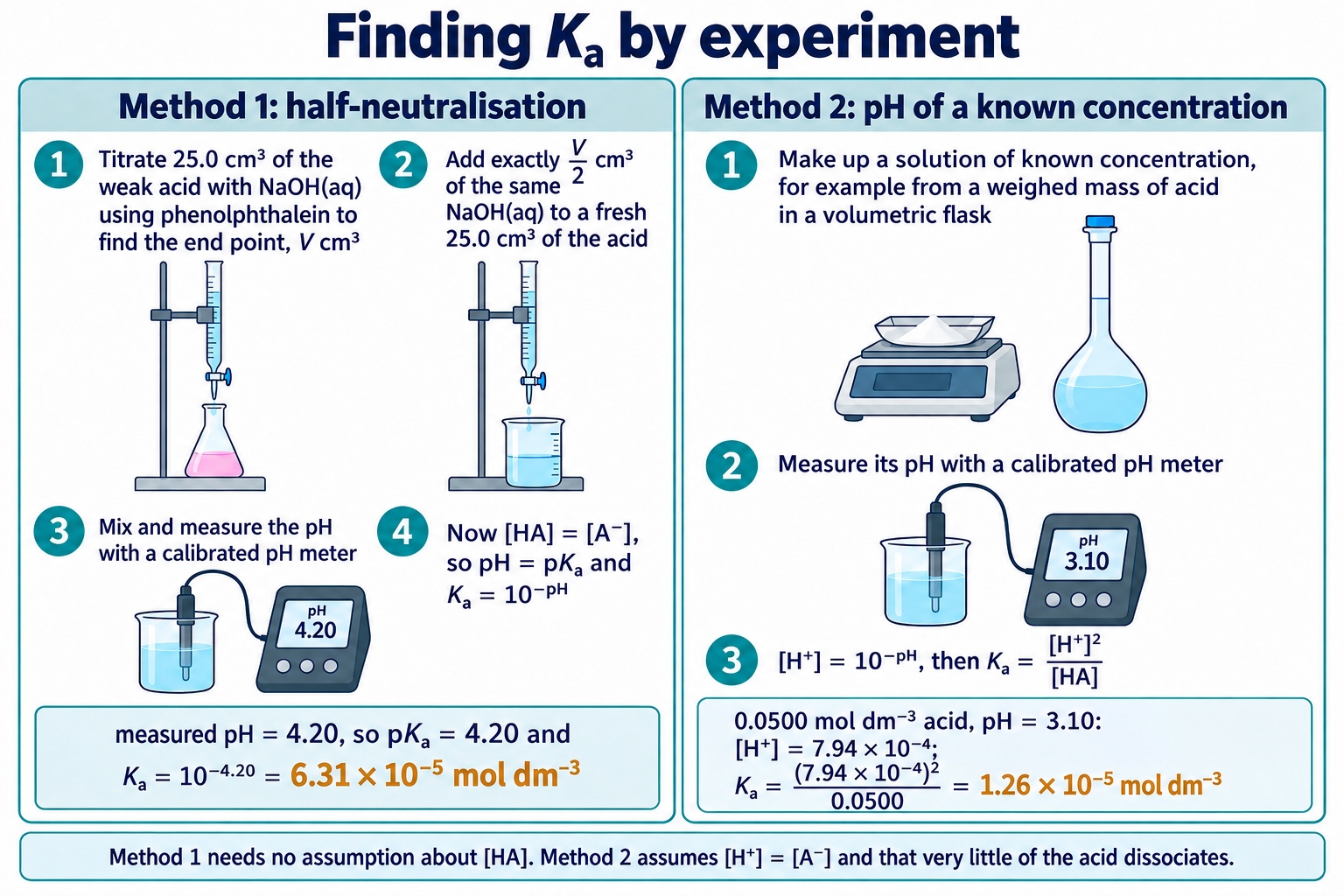
Two ways to find Ka: the half-neutralisation method, where the measured pH equals pKa, and measuring the pH of a weak acid of known concentration made from a weighed mass.
| Method | Advantage | Limitation |
|---|---|---|
| Half-neutralisation | no assumption about how much acid dissociates | needs an accurate end point and volume |
| Known concentration | one solution and one reading | relies on the weak acid approximations |
Exam focus: A pH reading to 2 decimal places limits Ka to about 2 significant figures. Calibrate the meter and keep the temperature constant: Ka changes with temperature.
Check: Finding Ka by Experiment
Use half-neutralisation readings and the pH of solutions of known concentration to calculate Ka and pKa, and evaluate the methods, with data not used on this page.
Common Exam Points
Say
- “Calibrate the pH meter with buffer solutions of known pH before use.”
- “At half-neutralisation [HA] = [A⁻], so pKa equals the measured pH.”
- “The ethanoate ion accepts a proton from water, producing OH⁻, so sodium ethanoate solution is alkaline.”
Do not say
- “All salts are neutral.”
- “Diluting any acid ten times raises its pH by 1” (only for a strong acid).
- “A higher pH means a stronger acid” (compare acids only at the same concentration).
Watch for
- Data tables of pH against dilution: decide strong or weak from the size of each rise.
- Ka from a mass: convert the mass to moles and then to a concentration before using the pH.
- Evaluation: name calibration, rinsing, temperature and a steady reading as ways to improve accuracy.
FAQs
Use these quick answers to check pH measurements and finding Ka by experiment.
Why must a pH meter be calibrated?
The electrode drifts over time, so its readings become inaccurate. Dipping it into buffer solutions of known pH, usually 4.00, 7.00 and 10.00, and adjusting the meter to match makes later readings accurate.
Why is sodium ethanoate solution alkaline?
Ethanoate ions accept protons from water: CH₃COO⁻ + H₂O ⇌ CH₃COOH + OH⁻. This raises [OH⁻], so the pH is about 8.9 at 0.100 mol dm⁻³. The salt of a weak acid and a strong base is basic.
How does dilution show whether an acid is strong or weak?
A tenfold dilution raises the pH of a strong acid by exactly 1. For a weak acid [H⁺] falls only by √10, because a larger fraction dissociates on dilution, so the pH rises by only about 0.5.
How does the half-neutralisation method find Ka?
Titrate the acid to find the end point volume, then add exactly half that volume of the alkali to a fresh portion of the acid. Half the acid is now A⁻, so [HA] = [A⁻] and the measured pH equals pKa.
Why is Ka from a pH reading only reliable to about two significant figures?
An error of 0.01 in pH is about a 2% error in [H⁺], and Ka = ([H⁺]²) / ([HA]) doubles it. Ka also changes with temperature, so calibrate the meter and keep the temperature constant.

Copyright notice: This OLS revision content, including the explanations, layout, diagrams, tables and embedded learning structure, is authored for Online Learning System by Dr. Mohammed Al-Fatah. It may not be copied, reproduced, redistributed or adapted without written permission.
Keep this note — free
Save your progress across every AQA topic. A free account remembers which topics you have covered, saves your question scores, and syncs across your phone and laptop.
- Track every topic you have finished
- Keep your practice-question scores
- No payment, no card, free forever
Already registered? Log in