Polymers: Properties and Disposal
A concise revision guide to the properties and disposal of polymers: why polyalkenes are chemically inert and non-biodegradable, why polyesters and polyamides can be hydrolysed, and the advantages and disadvantages of recycling and other ways of disposing of polymers.
Before You Start
What happens to a polymer after use depends on the bonds in its chain. This page compares polyalkenes with polyesters and polyamides.
- Condensation polymers, their ester and amide links and the forces between their chains: Condensation Polymers: Polyamides and Polyesters.
- Addition polymers from alkenes: Polymerisation Reactions.
- The earlier treatment of waste polymers: Polymer Properties and PVC.
- Hydrolysis of esters with acids and alkalis: Esters, Hydrolysis and Polyesters.
GCSE Recap: Monomers and Plastics
Three quick questions on the GCSE ideas this page builds on.
Polyalkenes Are Chemically Inert
Polyalkenes such as poly(ethene), poly(propene) and PVC are addition polymers. Their chains contain only C–C and C–H bonds, and that makes them chemically inert.
- C–C and C–H bonds are strong and non-polar: no carbon atom is δ+, so there is no site for a nucleophile such as water or OH⁻ to attack.
- Acids, alkalis, water and the enzymes of micro-organisms leave the chain untouched.
- Polyalkenes are therefore non-biodegradable: they persist in the environment for hundreds of years.
- This inertness is useful in service (food packaging, water pipes) but a problem after disposal.
- PVC also contains C–Cl bonds, but these are not hydrolysed under normal conditions either.
Remember: Inert because the chain has only strong, non-polar C–C and C–H bonds: nothing for a nucleophile to attack, so no hydrolysis and no biodegradation.
Polyesters and Polyamides Can Be Hydrolysed
Condensation polymers carry polar links in the backbone: the ester link –COO– and the amide link –CONH–. These can be hydrolysed, so the chain breaks back into its monomers.
- The C=O, C–O and C–N bonds are polar. The carbonyl carbon is δ+ and is attacked by water or by hydroxide ions.
- Hydrolysis is slow in water alone but fast with hot aqueous acid or alkali.
- Enzymes from bacteria and fungi catalyse the same hydrolysis in soil or compost, so polyesters and polyamides are biodegradable.
- The same chemistry breaks down proteins and the ester links of fats in digestion.
| Polyalkenes | Polyesters and polyamides | |
|---|---|---|
| bonds in the chain | C–C and C–H only | ester or amide links as well |
| polarity | non-polar | polar C=O, C–O and C–N |
| attacked by water or OH⁻? | no | yes, at the δ+ carbonyl carbon |
| hydrolysed by acid or alkali? | no | yes |
| biodegradable? | no | yes |
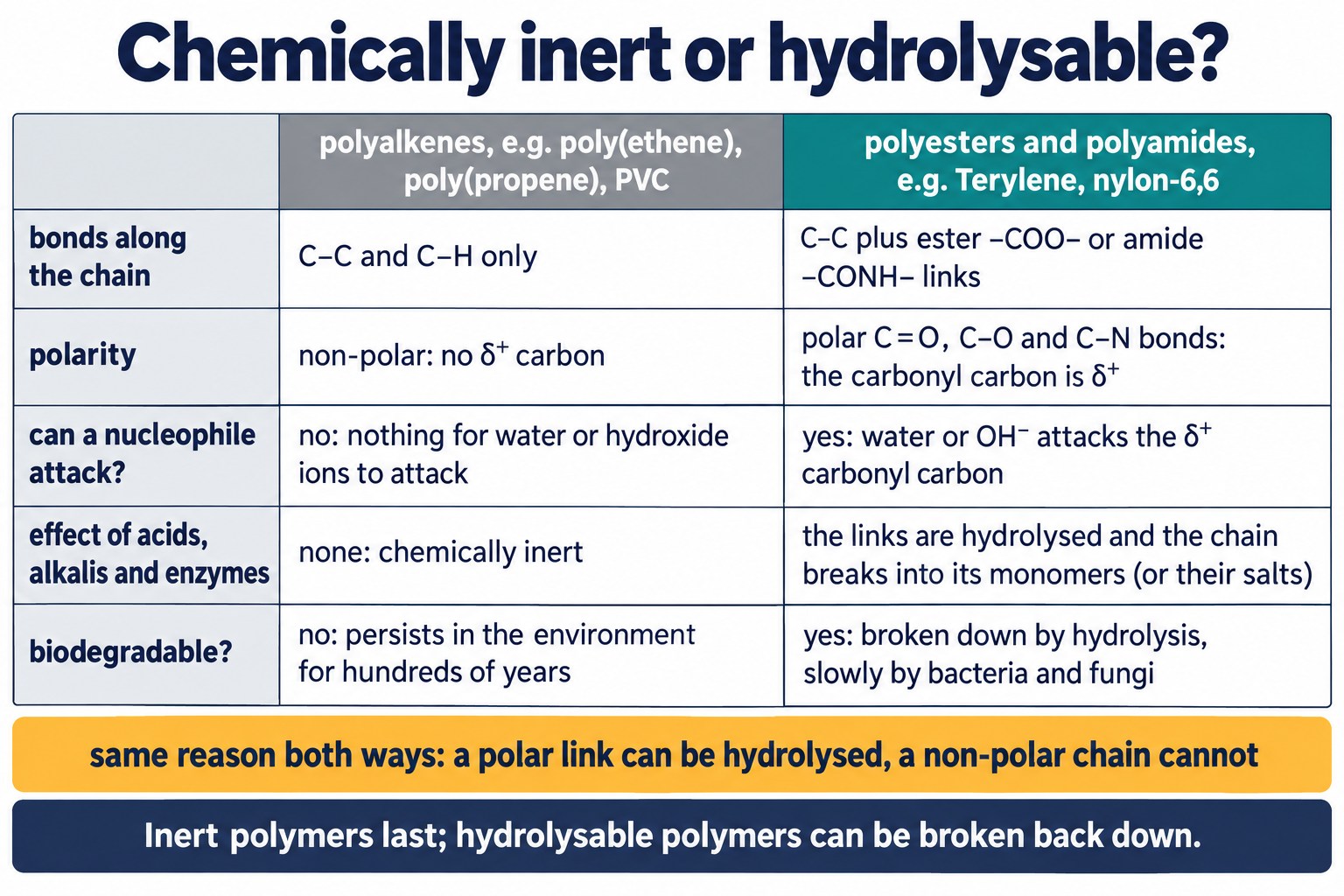
Non-polar C–C and C–H bonds give an inert chain; polar ester and amide links give a chain that water and hydroxide ions can attack.
Exam focus: The explanation is the same both ways: polar links with a δ+ carbon can be attacked and hydrolysed; a non-polar carbon chain cannot.
Check: Inert or Hydrolysable?
Use the polarity of the bonds in a polymer chain to decide whether it resists attack or can be broken down.
Quick Check: Which Chains Can Be Hydrolysed?
Each repeat unit is heated with aqueous sodium hydroxide. Decide what happens to the backbone of the polymer.
Watch: an exam question on polymer waste
An exam question: which of these is not a way of limiting the problems of polymer disposal? All four options are read out. Do you know the answer?
Disposing of Polymers: Advantages and Disadvantages
Waste polymers must go somewhere. Each method of disposal has advantages and disadvantages, and exam questions expect both.
| Method | Advantages | Disadvantages |
|---|---|---|
| landfill | cheap and simple; no sorting | uses land; polyalkenes persist for centuries; additives can leach into soil and water |
| incineration | energy recovered as heat and electricity; volume greatly reduced | releases CO₂; toxic gases such as HCl from PVC unless scrubbers are fitted |
| mechanical recycling | saves crude oil; less landfill; less energy than making new polymer | collection, sorting by type and cleaning cost money and energy; quality falls each cycle |
| feedstock recycling (cracking) | gives pure monomers or fuel from mixed waste | high temperatures, so a high energy cost; expensive plant |
| biodegradable polymers | break down by hydrolysis or by micro-organisms; made from renewable crops | cost more; need the right conditions; can contaminate recycling streams |
- Mechanical recycling needs the waste sorted by polymer type, cleaned, melted and remoulded; the quality falls each time.
- Feedstock recycling cracks polyalkenes back to alkenes and other small molecules that can make new polymer or fuel.
- Polyesters and polyamides can be hydrolysed back to their monomers, which can be purified and repolymerised.
- Biodegradable polymers made from plant starch break down in compost, saving crude oil and landfill space.
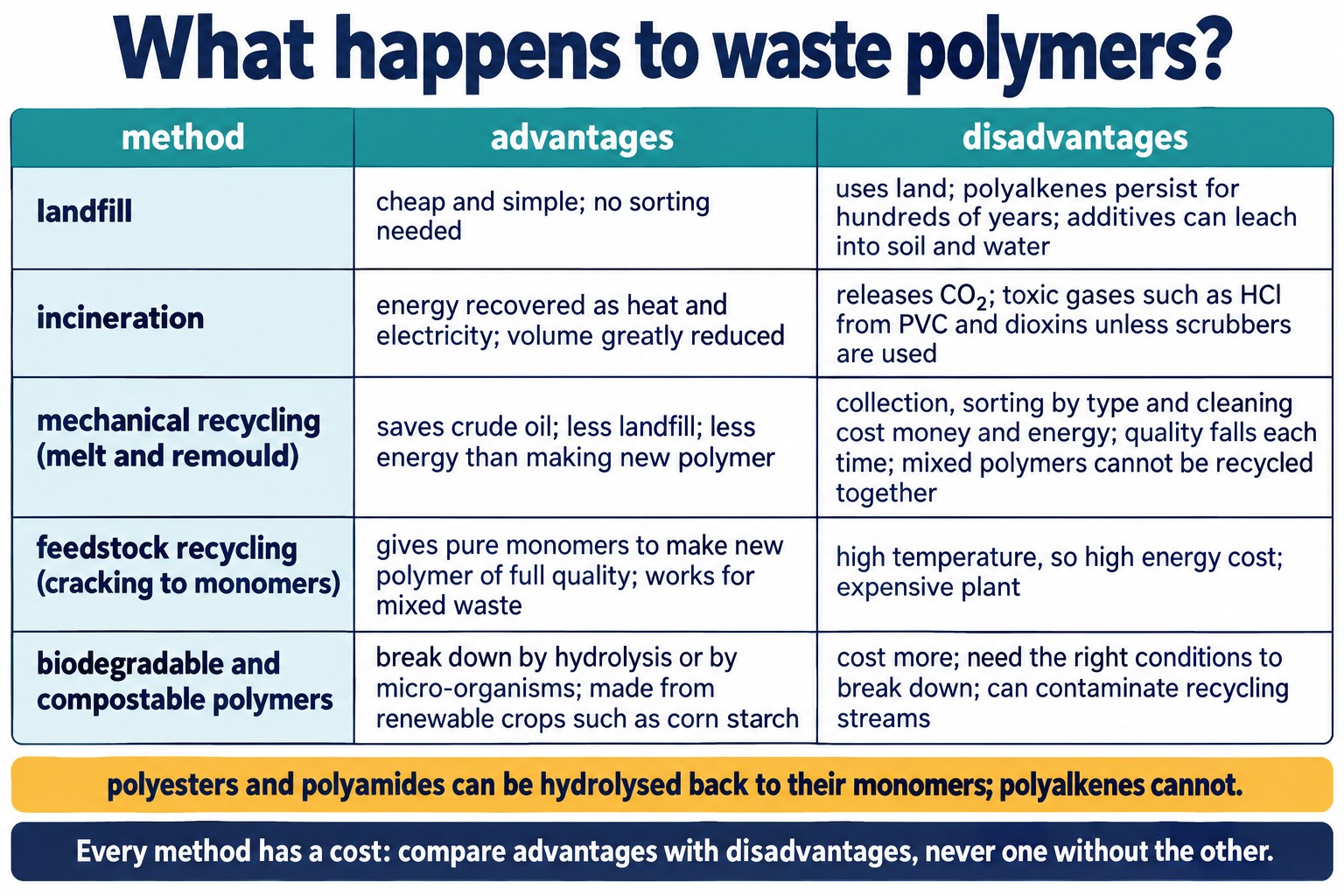
Landfill, incineration, mechanical recycling, feedstock recycling and biodegradable polymers, each with its advantages and disadvantages.
Exam focus: For any method give one advantage and one disadvantage. Recycling: saves crude oil and landfill, but sorting and cleaning cost money and energy and the quality falls.
Check: Breaking Polymers Down
Decide which polymers can be broken back down to small molecules and which persist, and give the reasons.
Quick Check: Scrubbing an Incinerator
Use a reacting masses calculation to judge one cost of incineration. The figures are invented for this exercise.
Common Exam Points
- Polyalkenes are chemically inert because their C–C and C–H bonds are strong and non-polar: no δ+ carbon for a nucleophile to attack.
- Polyesters and polyamides have polar C=O, C–O and C–N bonds; water or OH⁻ attacks the δ+ carbonyl carbon, so they can be hydrolysed.
- Hydrolysable polymers are biodegradable; polyalkenes are not.
- Landfill, incineration, recycling and feedstock cracking each have advantages and disadvantages: give one of each.
- Recycling saves crude oil and landfill but needs collection, sorting, cleaning and energy, and the quality falls.
- Explain every answer through the polarity of the bonds in the chain, not through the name of the polymer alone.
FAQs
Use these quick answers to check why polyalkenes are chemically inert, why polyesters and polyamides can be hydrolysed, and the pros and cons of recycling and incineration.
Why are polyalkenes not biodegradable?
Their backbone is made of strong, non-polar C–C and C–H bonds.
There is no δ+ carbon for a nucleophile such as water or a hydroxide ion to attack, so acids, alkalis and bacteria cannot break the chain. Poly(ethene) and PVC therefore persist for many years.
Why can polyesters and polyamides be hydrolysed?
The ester and amide links contain a polar C=O: the carbonyl carbon is δ+ and open to attack by water, hydroxide ions or acid. Hydrolysis breaks the link and reverses the condensation reaction, so these polymers are biodegradable and bacteria in soil break them down.
What are the advantages and disadvantages of recycling polymers?
Recycling saves crude oil and cuts the amount sent to landfill. Against that, polymers must be collected, sorted by type and cleaned, which costs energy and money, and recycled material is often lower quality. Feedstock recycling cracks polymers back to monomers.
Is incineration a good way to dispose of polymers?
Burning polymers releases energy that can generate electricity and avoids using landfill space. Against that, it produces carbon dioxide, and PVC releases toxic hydrogen chloride, so the flue gases must pass through scrubbers. It also destroys material that could have been recycled.
What makes a polymer biodegradable or compostable?
A biodegradable polymer is broken down by bacteria and fungi in the environment; polyesters and polyamides qualify because their links can be hydrolysed. Compostable polymers made from renewable plant starch break down in compost, reducing landfill without the sorting needed for recycling.

Copyright notice: This OLS revision content, including the explanations, layout, diagrams, tables and embedded learning structure, is authored for Online Learning System by Dr. Mohammed Al-Fatah. It may not be copied, reproduced, redistributed or adapted without written permission.
Keep this note — free
Save your progress across every AQA topic. A free account remembers which topics you have covered, saves your question scores, and syncs across your phone and laptop.
- Track every topic you have finished
- Keep your practice-question scores
- No payment, no card, free forever
Already registered? Log in