3.3.13
Amino Acids,
Proteins and DNA
Section 3.3.13 covers amino acids (3.3.13.1): their acidic and basic properties, zwitterions and the ions formed in acid and alkali; proteins and enzymes (3.3.13.2-3.3.13.3): the peptide link, drawing peptides and the amino acids they hydrolyse to, separation by thin-layer chromatography with ninhydrin and Rf values, primary, secondary and tertiary structure held by hydrogen bonds and sulfur–sulfur bonds, and enzymes with stereospecific active sites and inhibitor drugs. DNA and cisplatin (3.3.13.4-3.3.13.5) cover nucleotides, the double helix, complementary base pairs and how cisplatin prevents DNA replication.
Revision Notes
3 revision notes, in the order the specification teaches them.
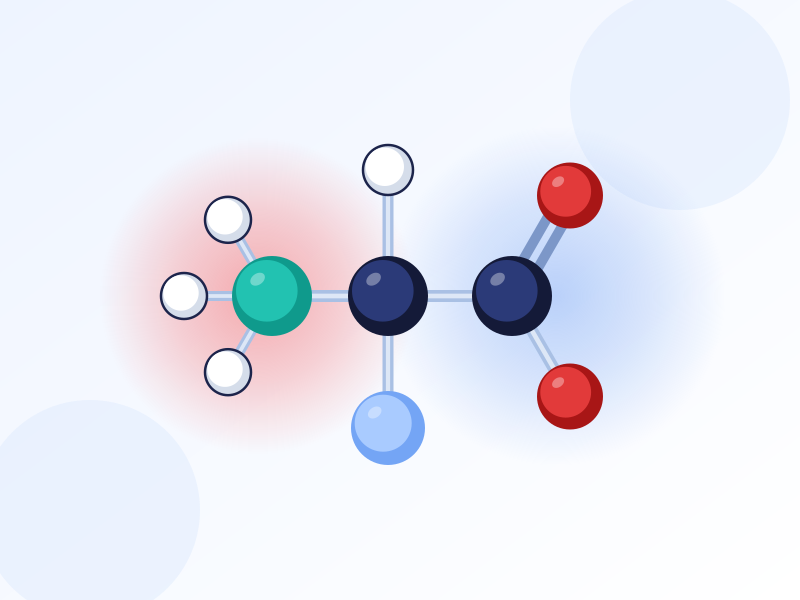
Amino Acids and Zwitterions
Amino acids: zwitterions, acid and base behaviour, the isoelectric point and chirality.
Start revising
Peptides and Proteins
Peptides and proteins: the peptide link, dipeptides and tripeptides, hydrolysis, protein structure and enzymes.
Start revising
DNA and Cisplatin
DNA and cisplatin: nucleotides, the sugar-phosphate backbone, complementary base pairs and how cisplatin stops DNA replication.
Start revisingSummary Map
Download, print and revise the key facts of this topic at a glance.
Summary maps
Download, print and revise the key facts of this topic at a glance.

Amino Acids Map
AQA A Level Chemistry · 3.3.13 Amino acids, proteins and DNA
Every reaction on one A4 page: reagents, conditions and reaction type for each arrow, colour coded, with the key tests.
Amino Acids, Proteins and DNA Map
AQA A-level Chemistry · 3.3.13 Amino acids, proteins and DNA
All of 3.3.13 on one A4 page: amino acids, peptides, protein structure, chromatography, enzymes, DNA and cisplatin.
© 2026 Online Learning System. For personal study: printing is allowed; editing, copying and redistribution are not.
Virtual Lessons
Recorded video lessons that teach the topic step by step.
The Virtual Lessons for 3.3.13 Amino acids, proteins and DNA are being recorded.
MCQ Bank
Multiple-choice papers on this topic, marked the moment you submit.
The MCQ papers for 3.3.13 Amino acids, proteins and DNA are being written.
SAQ Bank
Written, drawn and worked exam practice on this topic.
The exam practice papers for 3.3.13 Amino acids, proteins and DNA are being written.
Revision Game
Match reagents to products, with your board's reagents and conditions.
The revision game for 3.3.13 Amino acids, proteins and DNA is being built.
Study Cards
Pick a deck, then turn each card to check what you remember.
Specification
Every specification point in this topic, in the exam board's own words. Rate how confident you are with each one.
Self-assessment · 47 points
Sign in to rate how confident you feel about each point. Your ratings are saved to your account, follow you to any device, and appear beside your KASP analytics, kept apart from your marks.
3.3.13.1
3.3.13.2
3.3.13.3
3.3.13.4
- ii
know that a nucleotide is made up from a phosphate ion bonded to 2-deoxyribose which is in turn bonded to one of the four bases
Revise - iii b
know that DNA nucleotides are linked by covalent bonds between the phosphate group of one nucleotide and the 2-deoxyribose of another
Revise - v
explain how hydrogen bonding between base pairs leads to the two complementary strands of DNA
Revise
3.3.13.5
- v
appreciate that society needs to assess the balance between the benefits and adverse effects of drugs such as cisplatin
Revise
Keep this note — free
Save your progress across every AQA topic. A free account remembers which topics you have covered, saves your question scores, and syncs across your phone and laptop.
- Track every topic you have finished
- Keep your practice-question scores
- No payment, no card, free forever
Already registered? Log in