DNA and Cisplatin
A concise revision guide to DNA and cisplatin for AQA A Level Chemistry: nucleotides, the sugar-phosphate backbone, complementary base pairs and the double helix, and how cisplatin prevents DNA replication.
Recap: Hydrogen Bonds, Polymers and Ligands
This page joins three ideas you have met already. Check them first.
Before You Start
DNA and cisplatin bring together ideas from across the course. Check these first.
- Hydrogen bonds form between a lone pair on N or O and an H bonded to N, O or F: Hydrogen Bonding.
- A condensation reaction joins two molecules with loss of water, and repeating it builds a polymer: Condensation Polymers.
- A ligand is replaced when a stronger or more plentiful ligand takes its place: Ligand Substitution.
- Cisplatin is the cis isomer of the square planar complex [Pt(NH₃)₂Cl₂]: Stereoisomerism in Complex Ions.
The Three Parts of a Nucleotide
DNA is a polymer, and its monomer is the nucleotide. Each nucleotide has three parts, joined by covalent bonds.
| Part | What it is | Role in DNA |
|---|---|---|
| Phosphate ion | A phosphorus atom bonded to four oxygen atoms | Links one nucleotide to the next |
| 2-deoxyribose | A pentose sugar with no O–H group on carbon 2 | Holds the phosphate and the base together |
| Base | Adenine (A), cytosine (C), guanine (G) or thymine (T) | Carries the genetic code and pairs with a base on the other strand |
The phosphate bonds to the 2-deoxyribose, which in turn bonds to one of the four bases. The structures of all these parts are in the AQA data booklet, so students need to recognise and use them, not memorise them.
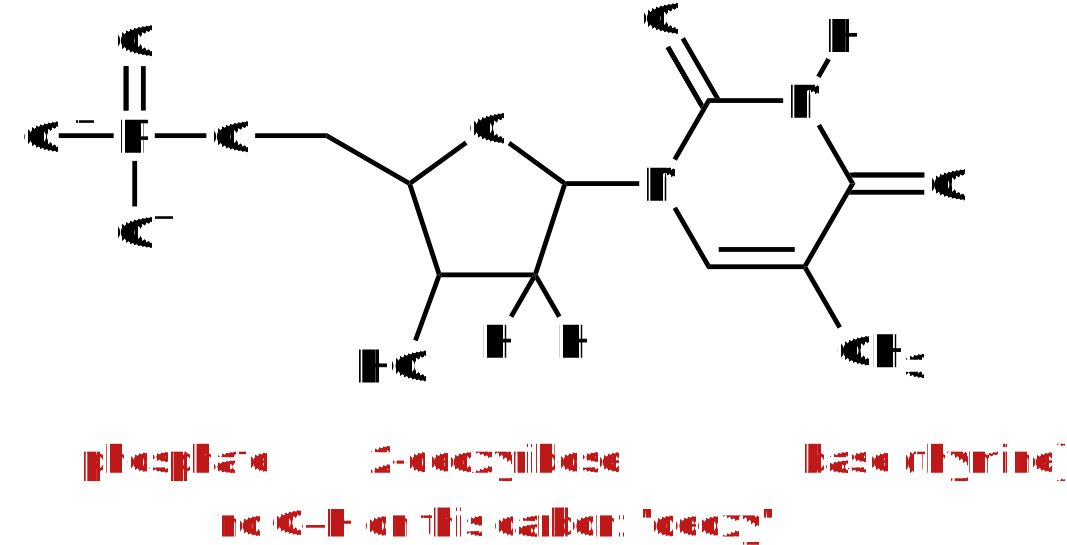
A nucleotide containing the base thymine. Carbon 2 of the sugar carries two hydrogen atoms and no O–H group, which is what deoxy means.
Remember: The order along a nucleotide is always phosphate, then sugar, then base. The base never bonds directly to the phosphate.
Quick Check: A Different Nucleotide
Describe a nucleotide with a different base.
Building a Strand of DNA
A single strand of DNA is a polymer of nucleotides. Each new link is a covalent bond between the phosphate group of one nucleotide and the 2-deoxyribose of the next. Water is lost as each link forms.
Sugar and phosphate therefore alternate along the chain, forming the sugar-phosphate backbone. The bases are attached to this backbone and point out to the side.
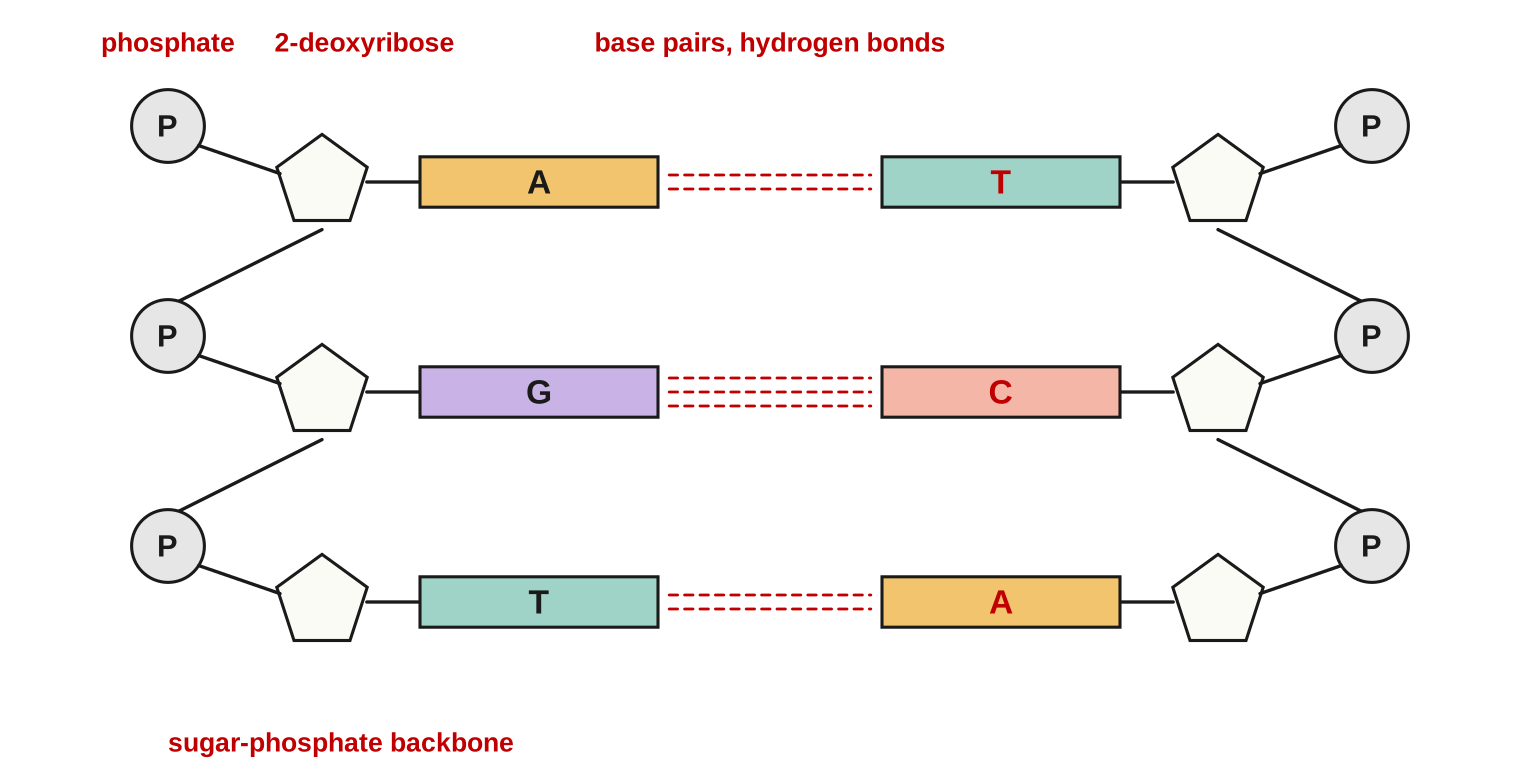
Two strands drawn flat. Phosphate and 2-deoxyribose alternate along each backbone, and the bases meet in the middle in A-T and G-C pairs.
In DNA, two of these strands run alongside each other and twist together into a double helix. The backbones lie on the outside and the bases are stacked on the inside.
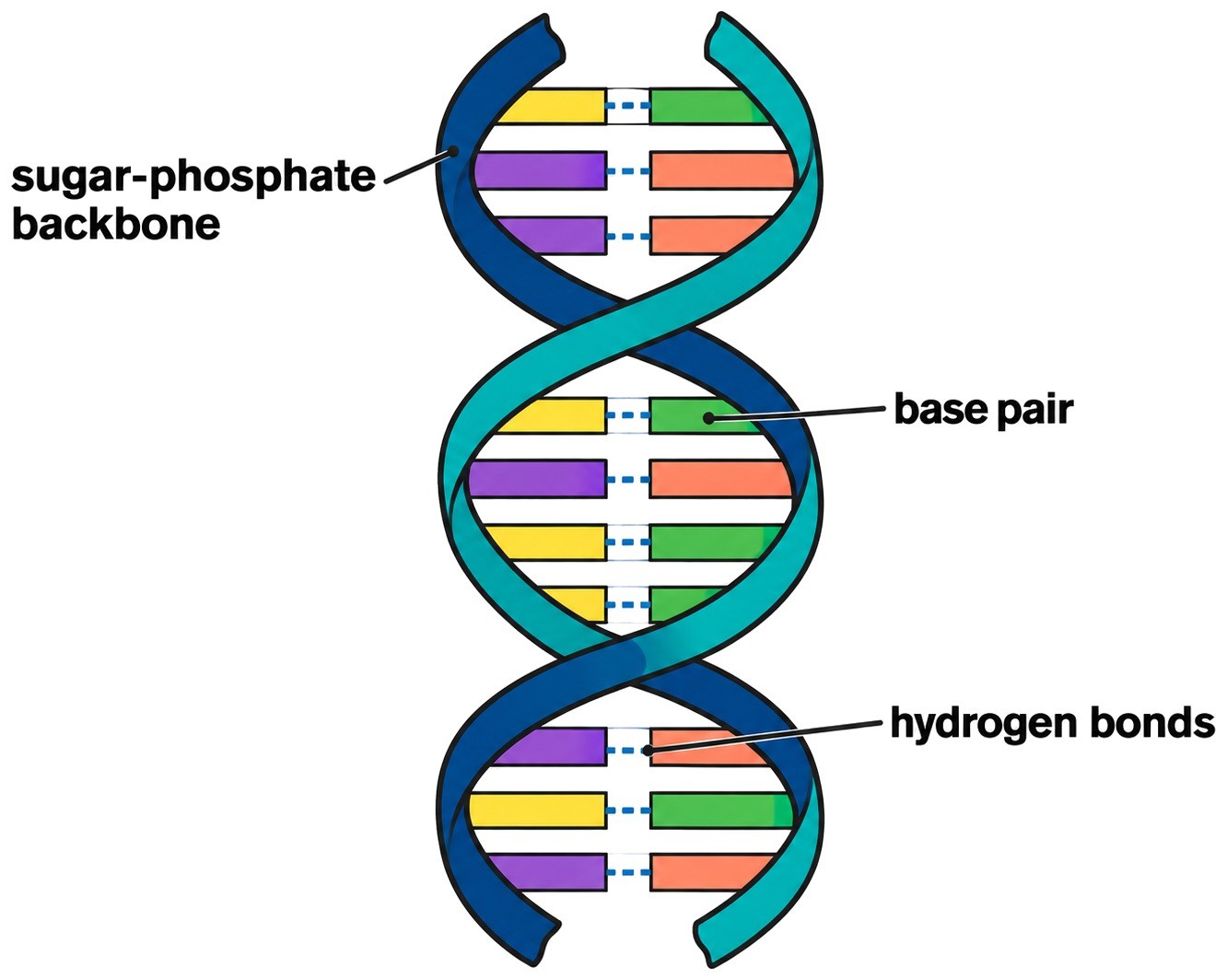
DNA exists as two complementary strands twisted into a double helix, with the bases inside and the backbones outside.
Complementary Base Pairs
The two strands are held together by hydrogen bonds between bases. Only certain pairs have N–H groups and lone pairs in matching positions, so adenine always pairs with thymine and guanine always pairs with cytosine.
| Base pair | Hydrogen bonds | Note |
|---|---|---|
| A with T | 2 | Two hydrogen bonds between the bases |
| G with C | 3 | Three hydrogen bonds, so this pair is held more strongly |
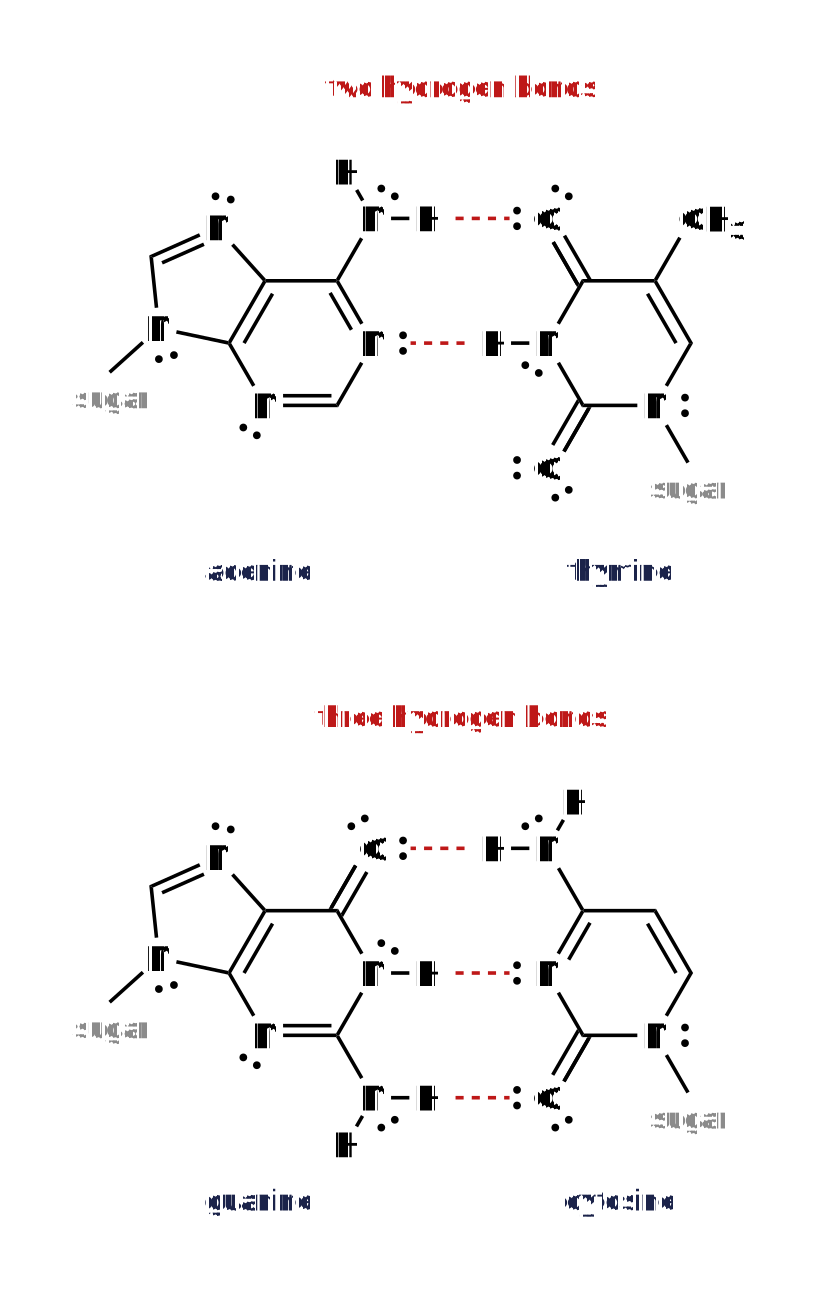
Hydrogen bonds between adenine and thymine (two) and between guanine and cytosine (three). Each N–H points at a lone pair on N or O across the gap.
The strands are called complementary because each base on one strand can pair with only one base on the other. Knowing the sequence on one strand therefore fixes the sequence on the second strand.
Worked example: the complementary strand
One strand reads A T T G C A. Find the other strand and the total number of hydrogen bonds.
Step 2. Count the pairs: four A-T pairs and two G-C pairs.
Step 3. Total: (4 × 2) + (2 × 3) = 14.
Answer: T A A C G T, with 14 hydrogen bonds.
Exam answer model: The hydrogen bonds form between complementary base pairs: adenine with thymine and guanine with cytosine. This holds the two strands of DNA together.
Quick Check: Counting Bases
Use the pairing rules on new strands and percentages.
How Cisplatin Stops DNA Replication
Cisplatin is the Pt(II) complex cis-[Pt(NH₃)₂Cl₂], used as an anticancer drug. It is square planar, with the two chloride ligands next to each other. This is the isomer that works, because only the cis arrangement can reach neighbouring bases.
Inside a cell, the chloride ligands are replaced in a ligand replacement reaction. A nitrogen atom on guanine uses its lone pair to form a coordinate bond to platinum, taking the place of a chloride ligand.
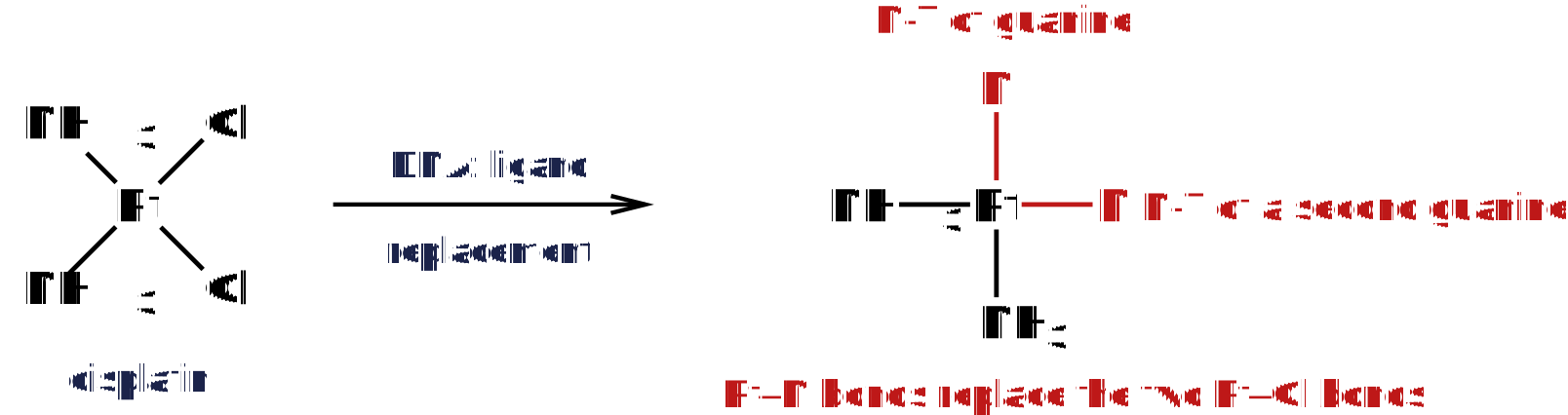
Ligand replacement on DNA: two Pt–N bonds to guanine replace the two Pt–Cl bonds, while the two NH₃ ligands stay on the platinum.
Both chloride ligands can be replaced, so one platinum centre can bond to two guanine bases on the same DNA. This distorts the strand, so the two strands cannot separate properly.
A cell must separate its DNA strands and copy them before it divides. With cisplatin bonded in place, DNA replication is blocked, so the cancer cell cannot divide and dies.
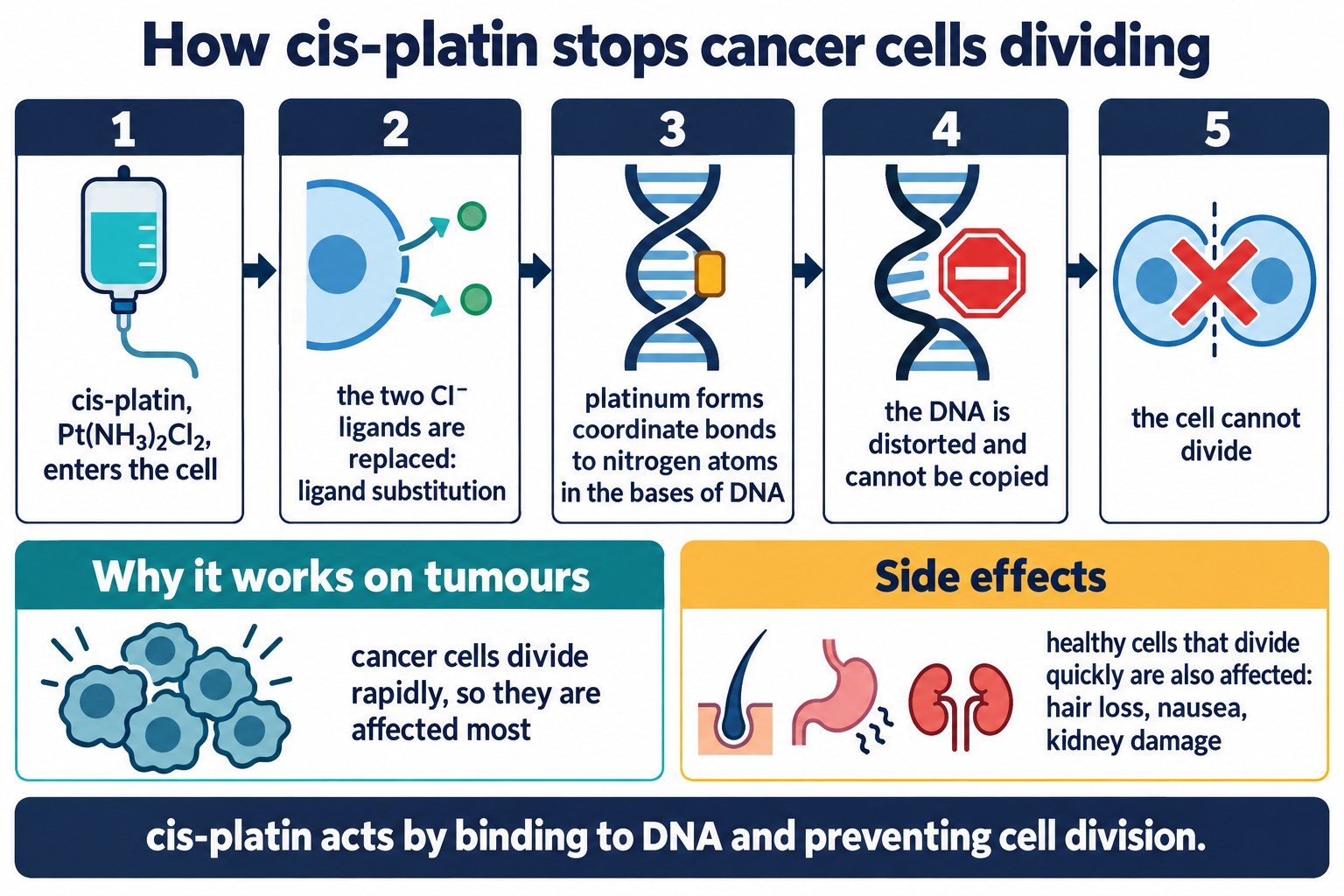
Cisplatin in action: the Pt(II) complex binds to guanine on DNA, and the distorted DNA can no longer be copied.
Exam answer model: Cisplatin bonds to DNA by ligand replacement: a Pt–N bond forms to a nitrogen atom of guanine in place of a Pt–Cl bond. This prevents DNA replication in cancer cells.
Benefits and Adverse Effects
Cisplatin acts on any cell that is copying its DNA, not only on cancer cells. Healthy cells that divide quickly are affected too, such as those in hair follicles, in the lining of the gut and in bone marrow.
This explains adverse effects such as hair loss, nausea and a weakened immune system. Giving the drug in small, controlled doses and targeting it at the tumour reduces the harm.
| Benefits | Adverse effects |
|---|---|
| Kills cancer cells that cannot be removed by surgery | Also stops healthy, rapidly dividing cells from dividing |
| Can stop a tumour growing or spreading | Causes hair loss, nausea and other side effects |
| Can save or lengthen a life | Doses must be limited and the patient monitored closely |
Exam focus: Society must assess the balance between the benefits of a drug and its adverse effects. A strong answer gives one of each, then weighs them for a life-threatening disease.
Quick Check: From Drug to Blocked Copying
Put the stages of cisplatin action in the correct order.
Quick Check: Exam-Style Problems
Five harder questions that combine the ideas on this page.
Common Exam Points
- A nucleotide is a phosphate ion bonded to 2-deoxyribose, which is bonded to one of the bases adenine, cytosine, guanine or thymine.
- The structures are in the Data Booklet: use them to identify where bonds form.
- A single strand is a polymer of nucleotides joined by covalent bonds between the phosphate of one nucleotide and the 2-deoxyribose of the next.
- The linked nucleotides form a sugar-phosphate backbone, and the bases are attached to it.
- DNA has two complementary strands in a double helix, held by hydrogen bonds between A and T (two) and between G and C (three).
- Cisplatin is a Pt(II) complex that binds to DNA by ligand replacement: Pt–N bonds to guanine replace Pt–Cl bonds.
- This prevents DNA replication in cancer cells, but it also harms healthy cells that divide quickly.
- Society has to balance the benefits of the drug against its adverse effects.
FAQs
Use these quick answers to check nucleotides, the structure of DNA and the way cisplatin acts.
What is a nucleotide made of?
A nucleotide is a phosphate ion bonded to 2-deoxyribose, which is in turn bonded to one of four bases: adenine, cytosine, guanine or thymine. The order along the unit is always phosphate, sugar, base.
What holds the two strands of DNA together?
Hydrogen bonds between complementary base pairs hold the strands together. Adenine forms two hydrogen bonds with thymine, and guanine forms three hydrogen bonds with cytosine.
Why are the two strands called complementary?
Each base can pair with only one other base, so the sequence on one strand fixes the sequence on the other. If one strand contains A at a position, the other must contain T there.
How does cisplatin bind to DNA?
It binds by ligand replacement. A nitrogen atom on guanine donates its lone pair to platinum, forming a Pt–N coordinate bond in place of a Pt–Cl bond. The two NH₃ ligands stay on the platinum.
Why does cisplatin have adverse effects?
It prevents DNA replication in any cell that is dividing, not only in cancer cells. Rapidly dividing healthy cells, such as those in hair follicles, are damaged as well, which is why hair loss occurs.

Copyright notice: This OLS revision content, including the explanations, layout, diagrams, tables and embedded learning structure, is authored for Online Learning System by Dr. Mohammed Al-Fatah. It may not be copied, reproduced, redistributed or adapted without written permission.
Keep this note — free
Save your progress across every AQA topic. A free account remembers which topics you have covered, saves your question scores, and syncs across your phone and laptop.
- Track every topic you have finished
- Keep your practice-question scores
- No payment, no card, free forever
Already registered? Log in