Amino Acids and Zwitterions
A concise revision guide to 2-amino acids: the general formula RCH(NH₂)COOH, their acidic and basic properties, the zwitterion and the isoelectric point, the ions formed in acidic and alkaline solution, their chiral centres.
Amino Acids at Different pH
Choose a step to watch alanine gain and lose protons as the pH changes, then see which way each ion moves in an electric field.
© Dr. Mohammed Al-Fatah – onlinelearningsystem.net
Before You Start
Amino acids carry two functional groups you already know. Check these first.
- The general formula RCH(NH₂)COOH, the names glycine, alanine and serine, and how to draw a 2-amino acid: Amines, Amides and Amino Acids: Structure and Naming.
- A carboxylic acid, –COOH, is a weak acid that gives up a proton to a base: 3.3.9 Carboxylic Acids and Derivatives.
- An amine, –NH₂, is a weak base that accepts a proton on its nitrogen lone pair: Amines as Bases.
- A chiral carbon carries four different groups and gives two non-superimposable mirror-image forms (enantiomers): Optical Isomerism and Chirality.
2-Amino Acids
A 2-amino acid (α-amino acid) has the amine group on carbon 2 of the acid, the carbon next to the –COOH group. The general formula is RCH(NH₂)COOH.
| Amino acid | R group | Systematic name | Type of side chain |
|---|---|---|---|
| glycine | H | 2-aminoethanoic acid | neutral: no chiral carbon |
| alanine | CH₃ | 2-aminopropanoic acid | neutral |
| serine | CH₂OH | 2-amino-3-hydroxypropanoic acid | neutral, polar |
| cysteine | CH₂SH | 2-amino-3-sulfanylpropanoic acid | neutral; forms S–S links in proteins |
| lysine | (CH₂)₄NH₂ | 2,6-diaminohexanoic acid | basic: a second –NH₂ |
| glutamic acid | CH₂CH₂COOH | 2-aminopentanedioic acid | acidic: a second –COOH |
- About twenty 2-amino acids occur naturally, and proteins are built from them.
- Carbon 2 carries H, NH₂, COOH and R: four different groups, so it is chiral in every 2-amino acid except glycine (R = H).
- Naturally occurring amino acids are a single enantiomer (the L form); a laboratory synthesis gives a racemic mixture of both.
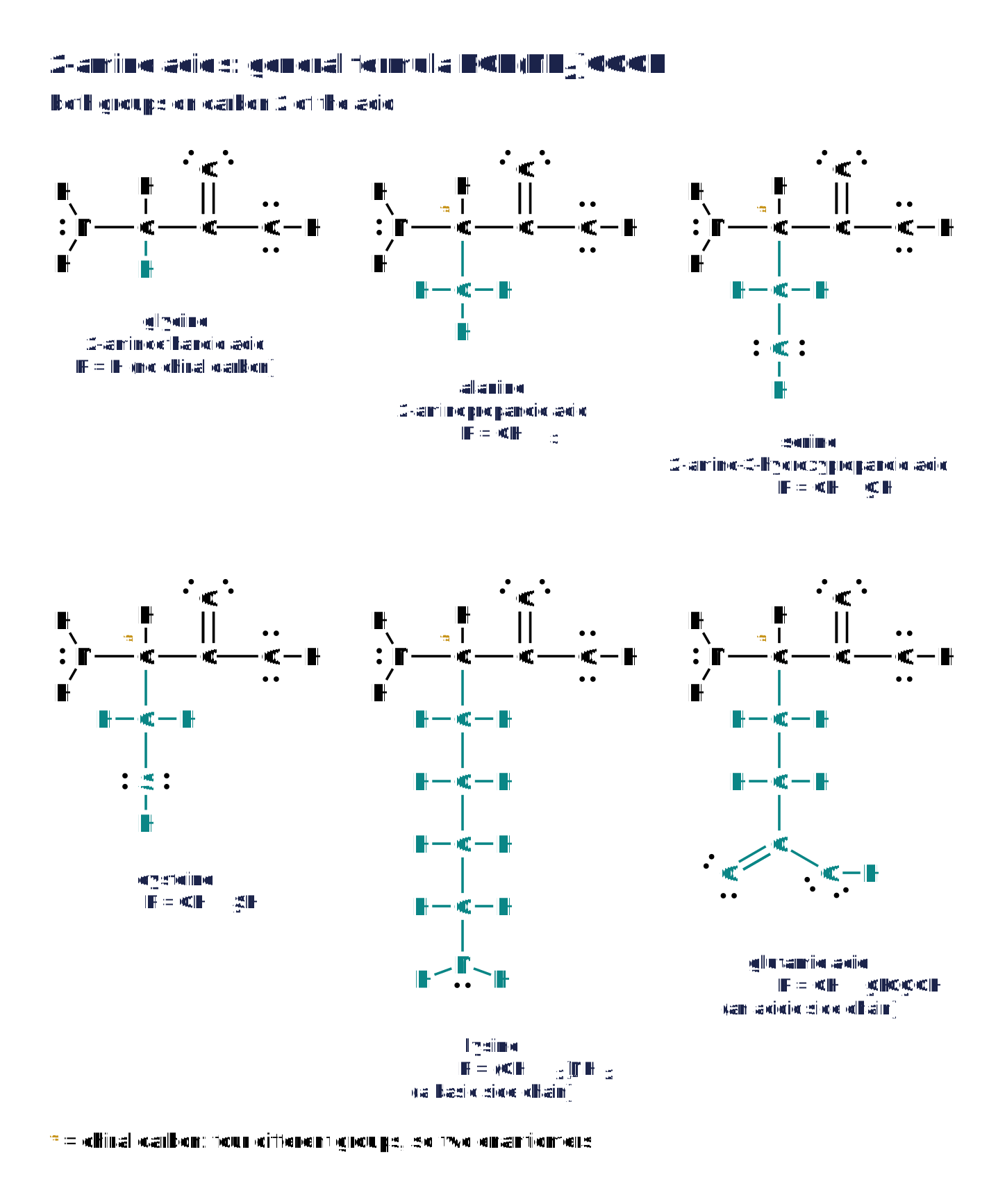
Six 2-amino acids drawn displayed with their R groups, the chiral carbon starred on every one except glycine, and the general formula RCH(NH₂)COOH.
Remember: Glycine is the only common 2-amino acid with no chiral carbon: two of the four groups on carbon 2 are hydrogen atoms.
Check: Structure and Chirality
Identify 2-amino acids from their formulae, name them, and decide which carbon atoms are chiral.
Both Acid and Base: Amphoteric Behaviour
An amino acid has an acidic group and a basic group in the same molecule, so it reacts with both acids and alkalis: it is amphoteric.
| Added | Group that reacts | Species formed | Example with alanine |
|---|---|---|---|
| acid (H⁺, e.g. HCl) | –NH₂ accepts a proton | cation, H₃N⁺CHRCOOH | CH₃CH(NH₃⁺)COOH Cl⁻, the chloride salt |
| alkali (OH⁻, e.g. NaOH) | –COOH gives up a proton | anion, H₂NCHRCOO⁻ | CH₃CH(NH₂)COO⁻ Na⁺, the sodium salt |
- In acid: H₂NCH(CH₃)COOH + HCl → H₃N⁺CH(CH₃)COOH Cl⁻. The molecule carries a positive charge.
- In alkali: H₂NCH(CH₃)COOH + NaOH → H₂NCH(CH₃)COO⁻ Na⁺ + H₂O. The molecule carries a negative charge.
- The –COOH behaves like any carboxylic acid (proton donor) and the –NH₂ like any amine (proton acceptor).
Exam focus: Draw the charge on the right atom: the positive charge sits on the nitrogen of –NH₃⁺ and the negative charge on the oxygen of –COO⁻. Write the counter-ion when a salt is asked for.
The Zwitterion
Inside one amino acid molecule the acid group can hand its proton to the amine group. The result is a zwitterion: an ion with a positive and a negative charge but no overall charge.
- Internal proton transfer: H₂NCH(CH₃)COOH → H₃N⁺CH(CH₃)COO⁻.
- The zwitterion has –NH₃⁺ and –COO⁻ on the same molecule; the charges cancel, so the net charge is zero.
- In the solid, amino acids exist as zwitterions held in an ionic lattice: white crystalline solids with high melting points (glycine decomposes above 230 °C).
- The charged groups attract water molecules, so amino acids dissolve in water but not in non-polar solvents such as hexane.
- In solution the zwitterion is the main species near neutral pH, at the isoelectric point (below).
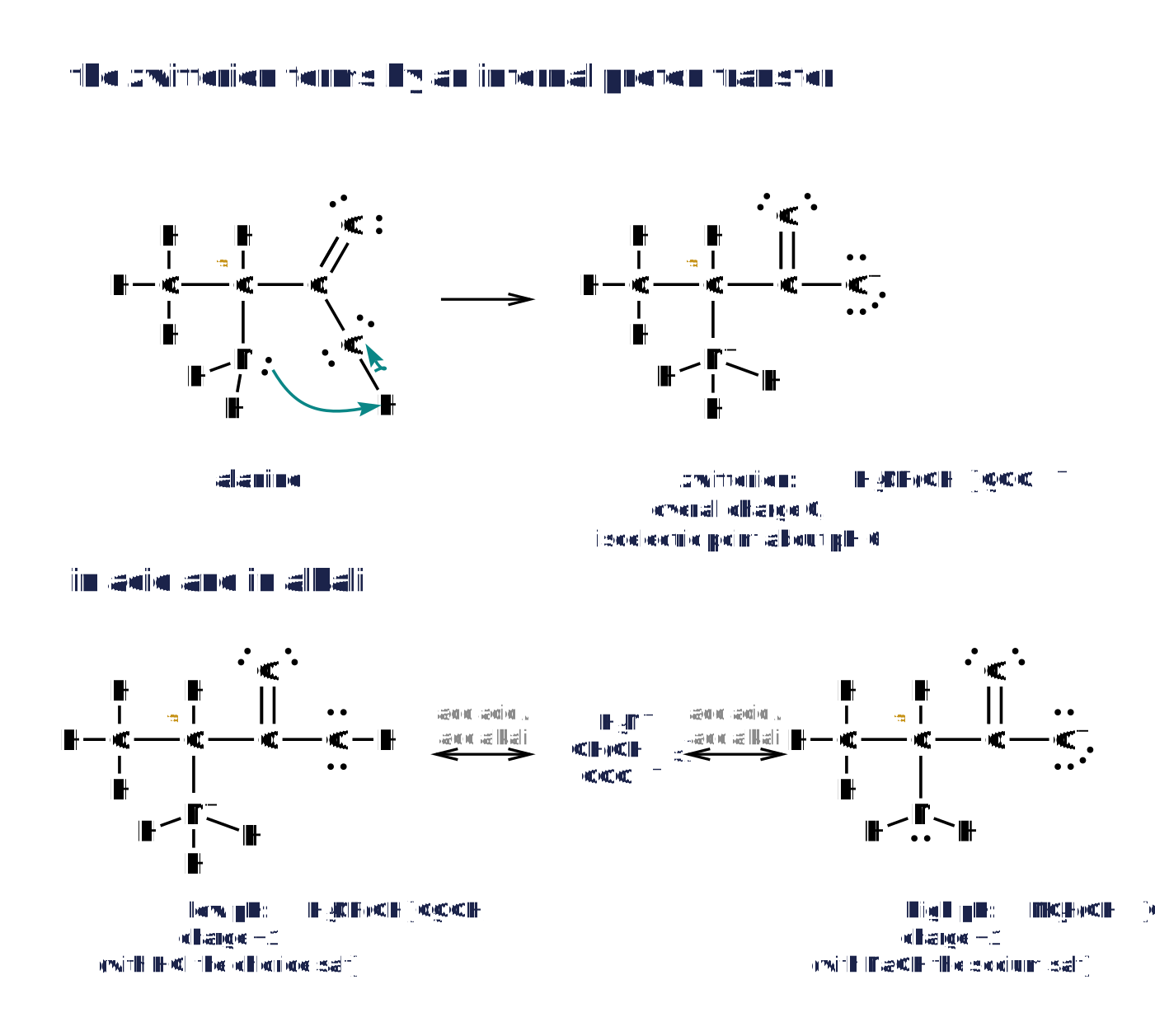
Alanine as the neutral molecule, the zwitterion formed by internal proton transfer, the cation in acid and the anion in alkali, with charges and the chiral carbon marked.
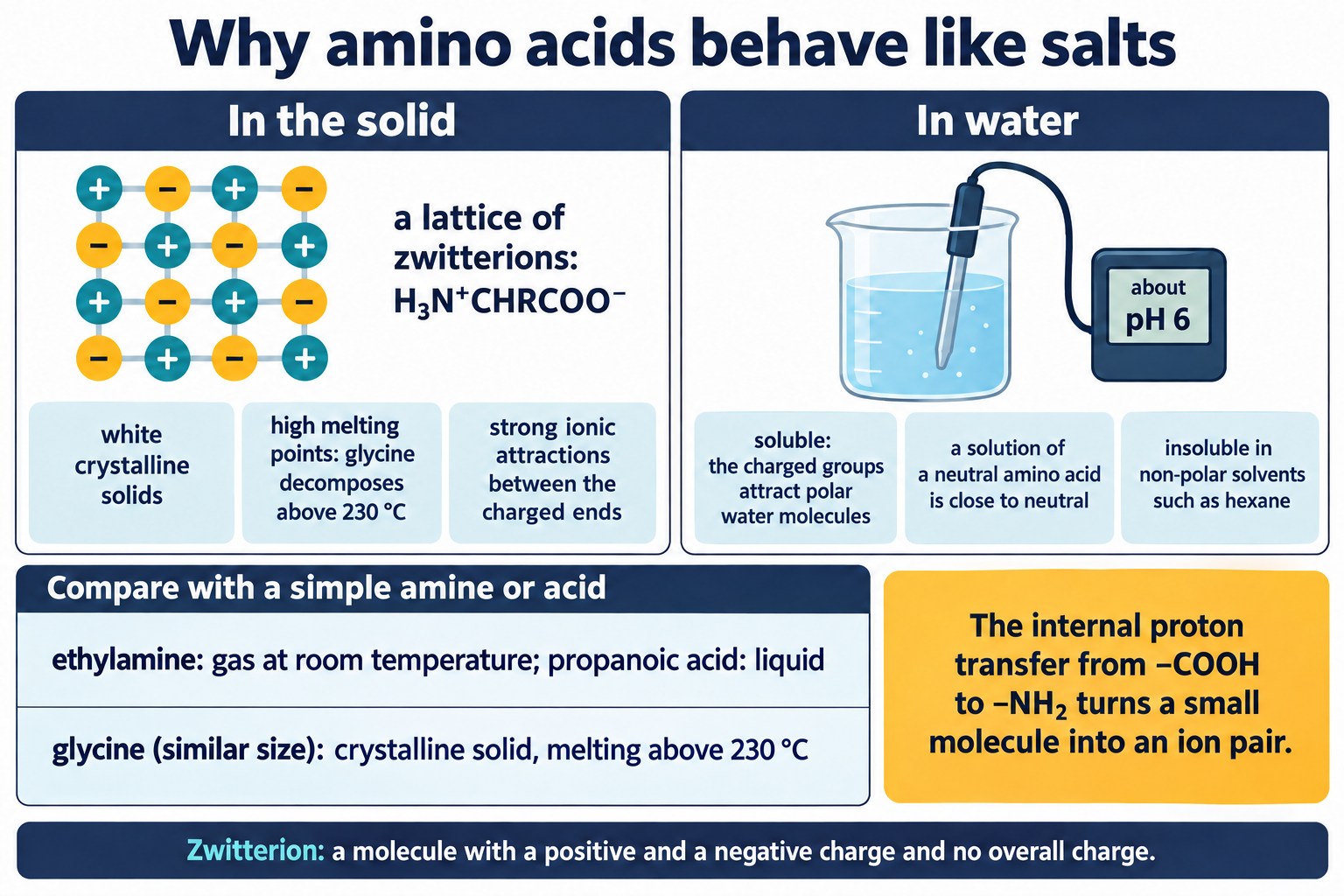
Why amino acids behave like salts: a lattice of zwitterions, high melting points, solubility in water, and a near-neutral pH reading for a solution.
Remember: Zwitterion comes from the German for “hybrid”: one molecule, two opposite charges, zero overall charge. It is the form present in the solid and at the isoelectric point.
Check: Zwitterions and Ions
Draw the species present in acid, in alkali and at the isoelectric point, and explain the melting points and solubility of amino acids.
The Isoelectric Point
The isoelectric point (pI) is the pH at which an amino acid exists as the zwitterion, with no net charge. Below it the cation dominates; above it, the anion.
| pH | Main species | Net charge | Formula for alanine |
|---|---|---|---|
| well below pI (e.g. pH 1) | cation | +1 | H₃N⁺CH(CH₃)COOH |
| at pI (about 6) | zwitterion | 0 | H₃N⁺CH(CH₃)COO⁻ |
| well above pI (e.g. pH 13) | anion | −1 | H₂NCH(CH₃)COO⁻ |
- For a neutral R group the isoelectric point is about pH 6: glycine 5.97, alanine 6.00.
- An acidic R group lowers it: glutamic acid 3.22, because the second –COOH also loses a proton.
- A basic R group raises it: lysine 9.74, because the second –NH₂ also accepts a proton.
- Going up the pH scale, the –COOH loses its proton first, then the –NH₃⁺.
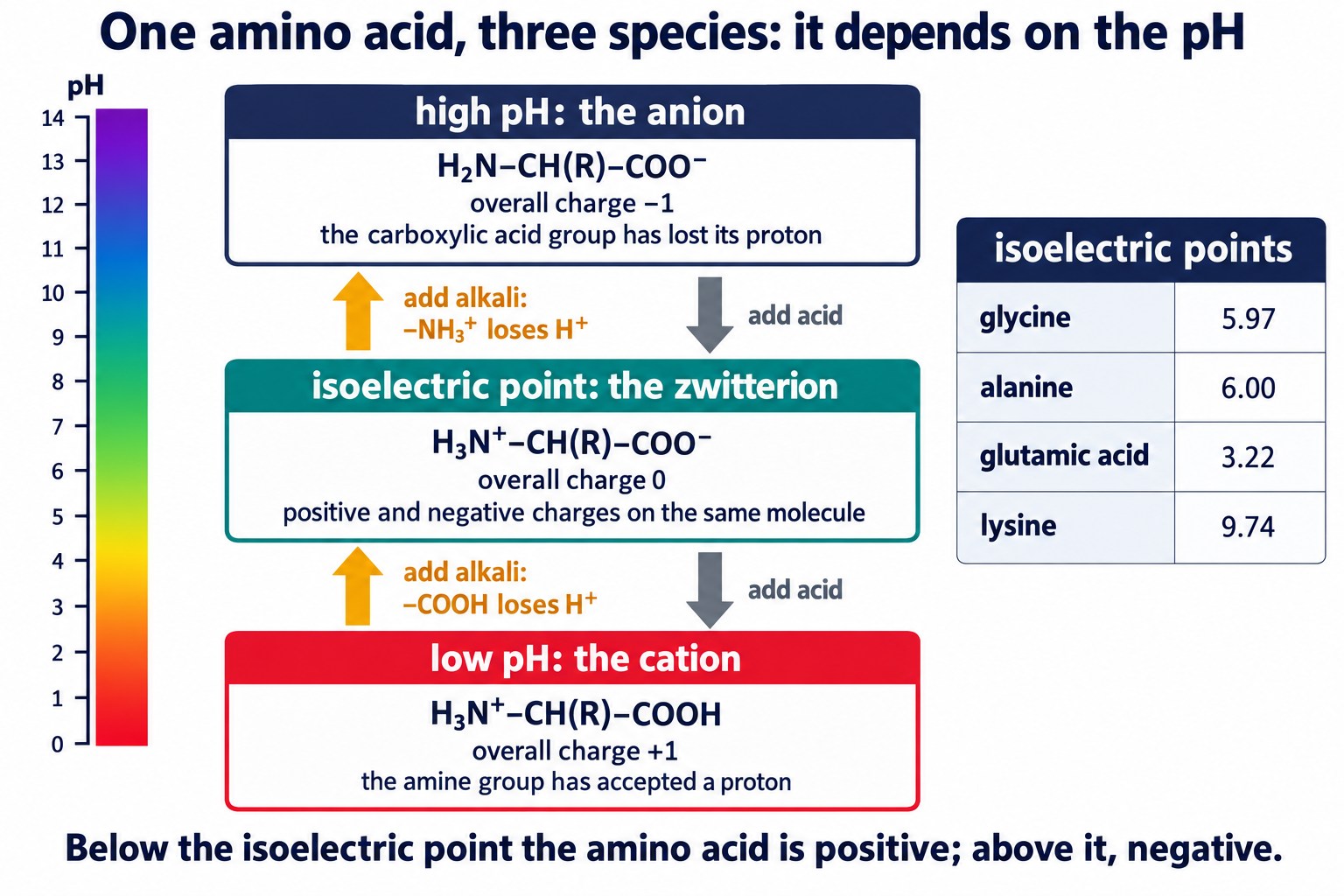
One amino acid, three species: the cation, the zwitterion and the anion placed on a pH ladder with the isoelectric point marked and the isoelectric points of four amino acids.
Worked example
Exam focus: Below the isoelectric point: positive. Above it: negative. At it: the zwitterion. Quote the pI value given in the question and compare it with the pH.
Check: The Isoelectric Point
Use isoelectric point values to predict the charge on an amino acid at a given pH and the species present.
Quick Check: Applying the Isoelectric Point
Pick the one accurate statement in each set. The isoelectric points of P, X and Y are invented for this exercise.
Common Exam Points
- General formula RCH(NH₂)COOH: both groups on carbon 2. Every 2-amino acid except glycine has a chiral carbon.
- In acid the amine group is protonated: H₃N⁺CHRCOOH. In alkali the acid group loses its proton: H₂NCHRCOO⁻.
- The zwitterion H₃N⁺CHRCOO⁻ forms by internal proton transfer; it has no overall charge and is the form in the solid.
- High melting points and solubility in water come from the ionic zwitterion lattice and the attraction of the charged groups for water.
- The isoelectric point is the pH at which the zwitterion is the main species: about 6 for a neutral R group, lower for acidic R, higher for basic R.
- Put the charges on the right atoms: + on the nitrogen of –NH₃⁺, − on the oxygen of –COO⁻.
FAQs
Use these quick answers to check the zwitterion, the ions an amino acid forms in acid and alkali, the isoelectric point, chirality and the properties of the solid.
What is a zwitterion?
An ion carrying both a positive and a negative charge but no overall charge. In an amino acid the acidic COOH group donates its proton to the basic NH₂ group of the same molecule, giving H₃N⁺CHRCOO⁻. Solid amino acids exist as zwitterions.
What happens to an amino acid in acid and in alkali?
In acid the amine group gains a proton, giving the cation H₃N⁺CHRCOOH, for example the chloride salt with HCl.
In alkali the carboxylic acid group loses its proton, giving the anion H₂NCHRCOO⁻, for example the sodium salt with NaOH. Amino acids are amphoteric.
What is the isoelectric point?
The pH at which the amino acid exists as the zwitterion with no net charge, about 6 for a neutral R group. Below it the cation dominates, above it the anion. Glutamic acid, with an acidic R group, has 3.2; lysine 9.7.
Why is glycine the only common amino acid that is not chiral?
Every 2-amino acid has four groups on carbon 2: H, NH₂, COOH and R. In glycine R is also H, so two groups are the same and there is no chiral centre. In all the others the four groups differ, so two enantiomers exist.
Why do amino acids have such high melting points?
In the solid the molecules exist as zwitterions, H₃N⁺CHRCOO⁻, so strong electrostatic attractions between the opposite charges hold an ionic lattice together, far stronger than hydrogen bonds. The same charges make amino acids soluble in water but insoluble in non-polar solvents.

Copyright notice: This OLS revision content, including the explanations, layout, diagrams, tables and embedded learning structure, is authored for Online Learning System by Dr. Mohammed Al-Fatah. It may not be copied, reproduced, redistributed or adapted without written permission.
Keep this note — free
Save your progress across every AQA topic. A free account remembers which topics you have covered, saves your question scores, and syncs across your phone and laptop.
- Track every topic you have finished
- Keep your practice-question scores
- No payment, no card, free forever
Already registered? Log in