Reactions of Alkenes with Sulfuric Acid
A concise revision guide to the electrophilic addition of concentrated sulfuric acid to alkenes, the alkyl hydrogensulfate intermediate, hydrolysis to an alcohol, and how carbocation stability decides the major product with unsymmetrical alkenes.
- 3.3.4.2i-b
- 3.3.4.2iii-b
- 3.3.4.2iv-a
- 3.3.4.2iv-b
- 3.3.4.2iv-c
- 3.3.4.2iv-d
What these spec points say
- 3.3.4.2i-b know the electrophilic addition reaction of alkenes with H2SO4
- 3.3.4.2iii-b outline the electrophilic addition mechanism for reactions of alkenes with H2SO4
- 3.3.4.2iv-a explain the formation of major and minor products in addition reactions of unsymmetrical alkenes
- 3.3.4.2iv-b explain the formation of products in addition reactions of unsymmetrical alkenes by reference to the relative stability of primary carbocation intermediates
- 3.3.4.2iv-c explain the formation of products in addition reactions of unsymmetrical alkenes by reference to the relative stability of secondary carbocation intermediates
- 3.3.4.2iv-d explain the formation of products in addition reactions of unsymmetrical alkenes by reference to the relative stability of tertiary carbocation intermediates
Before You Start
This page builds on GCSE work on acids, catalysts, alcohols and the addition reactions of alkenes.
- Sulfuric acid, H2SO4, is a strong acid that releases H+ ions in water.
- A catalyst speeds up a reaction and is unchanged at the end.
- Alcohols contain the -OH functional group; ethanol is CH3CH2OH.
- Alkenes undergo addition reactions across the C=C double bond.
GCSE Recap: pH, Catalysts and Alcohols
Four quick GCSE questions on acids, catalysts and alcohols before the reaction itself.
The Overall Reaction
Alkenes react with cold, concentrated sulfuric acid in an addition reaction. The C=C double bond opens, a hydrogen atom adds to one carbon atom and the hydrogensulfate group, OSO2OH, adds to the other.
The product is an alkyl hydrogensulfate. With ethene the product is ethyl hydrogensulfate, CH3CH2OSO2OH.
CH2=CH2 + H2SO4 → CH3CH2OSO2OH
Key idea: This is the same addition pattern as HBr. Sulfuric acid supplies H+ as the electrophile and the hydrogensulfate ion, HSO4–, adds to the carbocation.
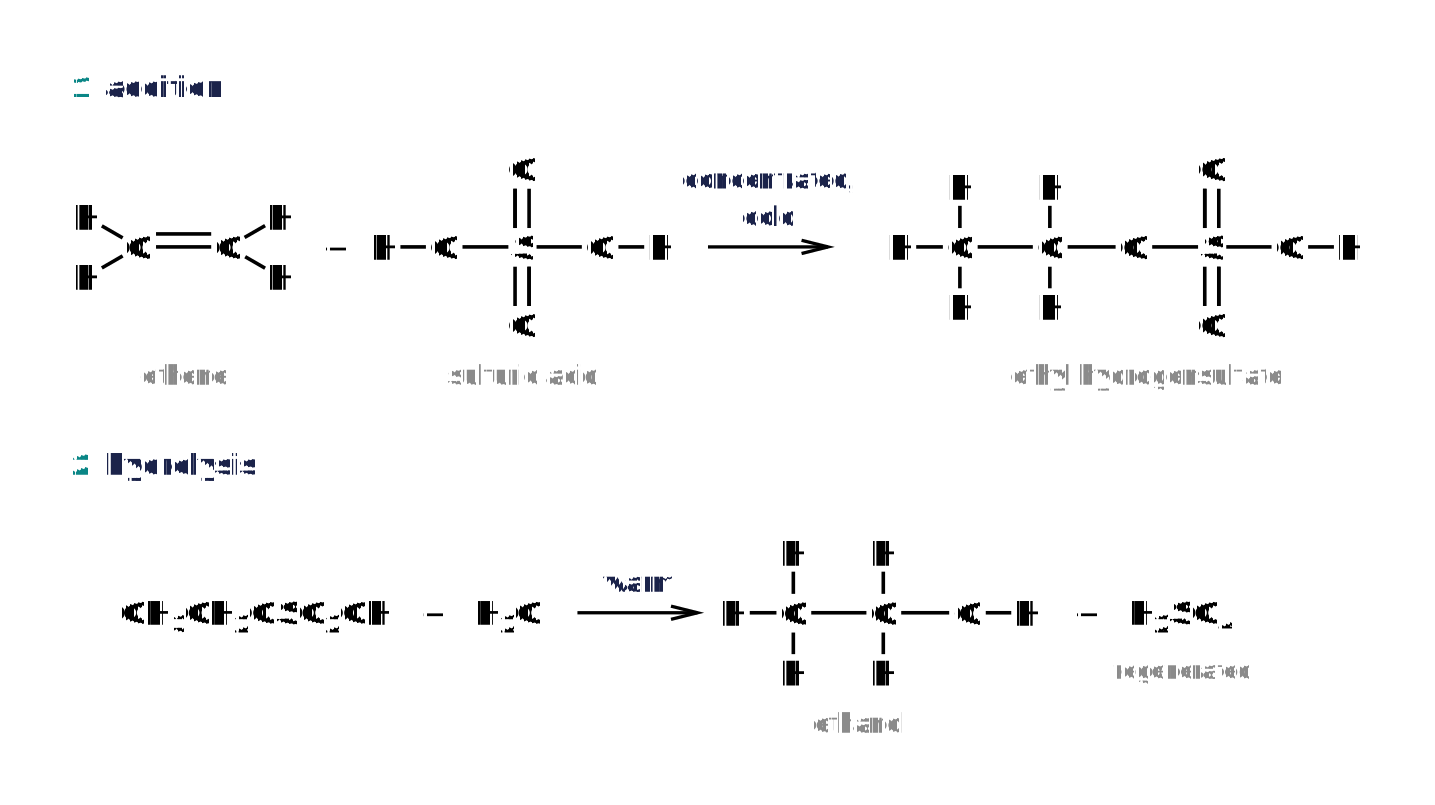
The hydrogen atom and the hydrogensulfate group add across the double bond to give ethyl hydrogensulfate.
Quick Check: Where the Two Groups Go
Apply the addition pattern to an alkene whose two double-bond carbons are identical.
Why Sulfuric Acid Acts as an Electrophile
Sulfuric acid contains two O-H bonds. Oxygen is much more electronegative than hydrogen, so each O-H bond is polar and the hydrogen atom carries a partial positive charge, Hδ+.
The electron-rich π bond of the alkene is attracted to this Hδ+. The hydrogen atom accepts a pair of electrons from the π bond, so it is the electrophile.
Electrophile: An electron-pair acceptor. In this reaction the Hδ+ of an O-H bond in sulfuric acid is attracted to the π bond and starts the electrophilic addition mechanism.
Exam focus: Draw the whole sulfuric acid molecule, H-O-SO2-O-H, in the mechanism and show the dipole on the O-H bond that reacts. The electrophile is the hydrogen atom, not the sulfur atom.
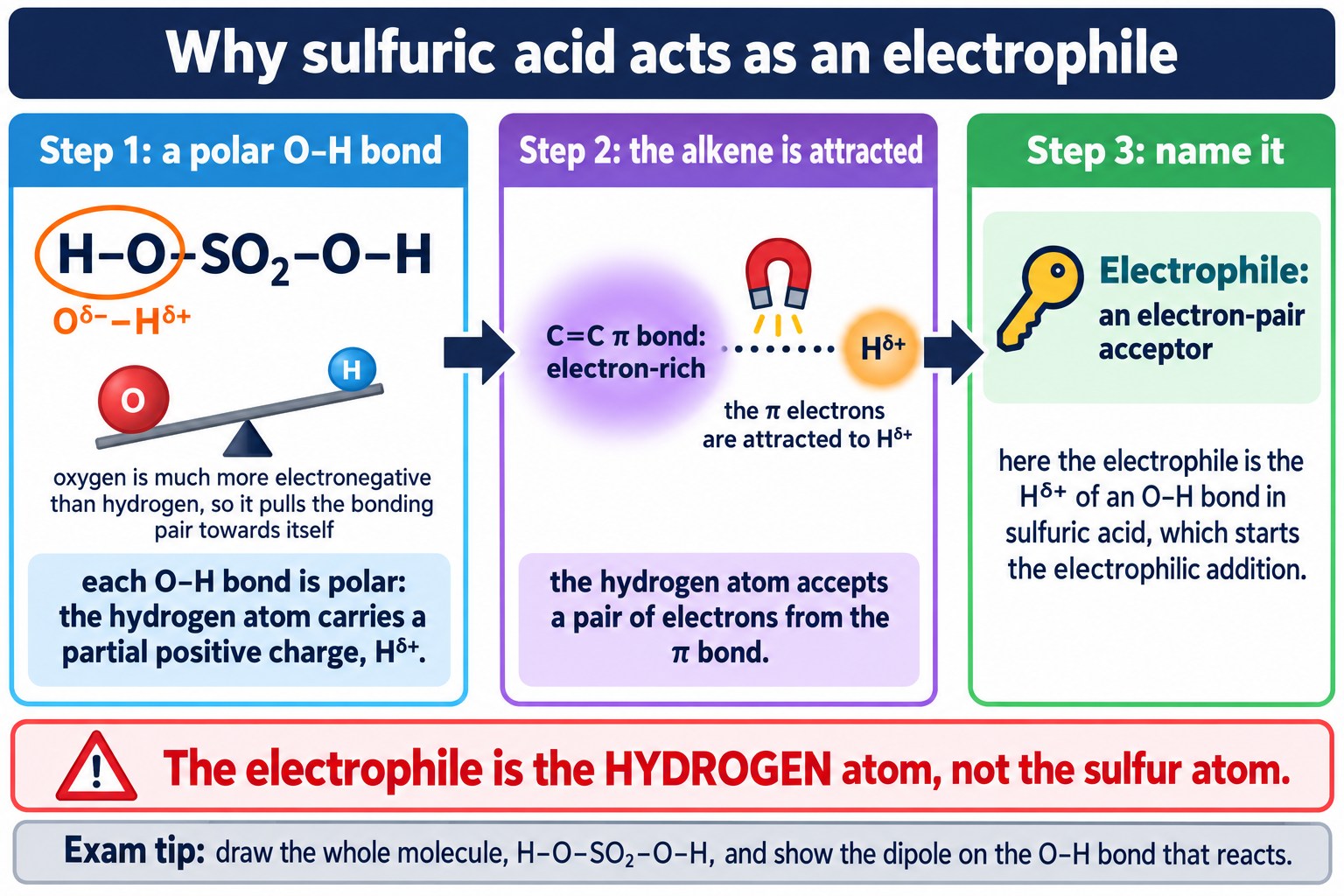
Oxygen pulls electron density from hydrogen in each O–H bond, so the Hδ+ atom accepts a pair of electrons from the alkene π bond and acts as the electrophile.
Quick Check: Concentrated or Strong?
Decide whether the student's reason for using concentrated acid is the right one.
The Electrophilic Addition Mechanism
The π bond donates a pair of electrons to the Hδ+ of an O-H bond, forming a new C-H bond.
At the same time the O-H bond breaks by heterolytic fission: both electrons move to the oxygen atom, producing the hydrogensulfate ion, HSO4–.
One carbon atom from the original double bond is left with a positive charge, giving a carbocation intermediate. A lone pair on an oxygen atom of the hydrogensulfate ion then forms a bond to the carbocation, giving the alkyl hydrogensulfate.
Step 1: the π bond attacks Hδ+
A curly arrow goes from the C=C bond to the hydrogen atom of an O-H bond in H2SO4.
Step 2: the O-H bond breaks heterolytically
A curly arrow goes from the O-H bond to the oxygen atom, forming HSO4– and leaving a carbocation.
Step 3: HSO4– attacks the carbocation
A curly arrow goes from a lone pair on the negatively charged oxygen atom to C+, forming the C-O bond of the alkyl hydrogensulfate.
Exam focus: AQA asks for this mechanism by name. Start every curly arrow at an electron pair and show the carbocation with its positive charge on the correct carbon atom.
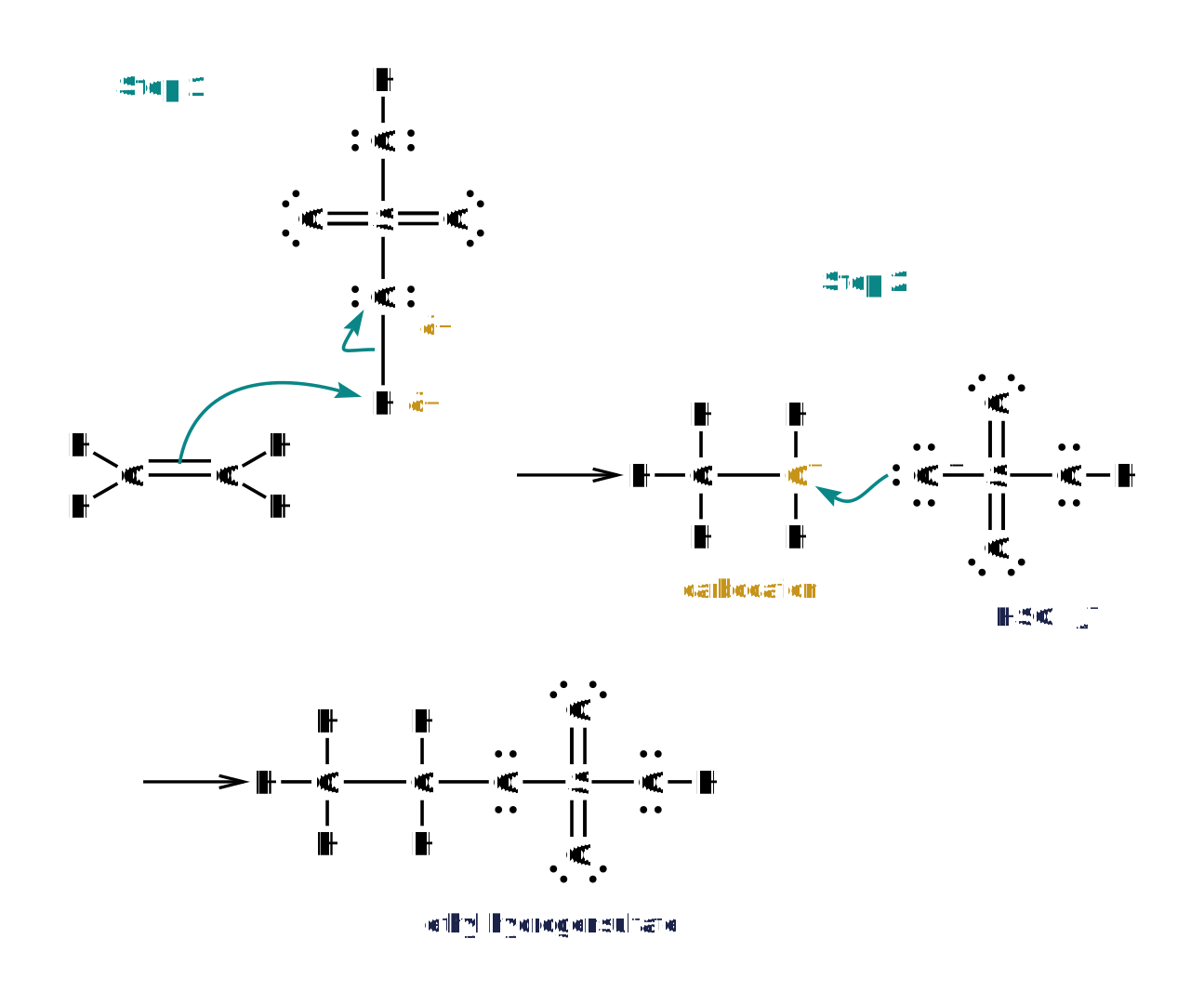
Electrophilic addition of sulfuric acid to ethene. The carbocation intermediate is attacked by the hydrogensulfate ion.
Quick Check: Order the Mechanism for a New Alkene
Put the steps for turning cyclohexene into cyclohexanol in the right order.
Hydrolysis to an Alcohol
Alkyl hydrogensulfates are not usually the final product. Adding water and warming hydrolyses the alkyl hydrogensulfate to an alcohol and regenerates sulfuric acid.
CH3CH2OSO2OH + H2O → CH3CH2OH + H2SO4
Because the sulfuric acid is used in the first step and released again in the second, it acts as a catalyst for the overall conversion of an alkene into an alcohol. The overall change is a hydration of the alkene.
| Stage | Reagents and conditions | Product |
|---|---|---|
| Addition | Concentrated H2SO4, cold | Alkyl hydrogensulfate |
| Hydrolysis | Water, warm | Alcohol and regenerated H2SO4 |
| Overall | H2O with H2SO4 catalyst | Alcohol |
Key idea: Industrially, ethanol is made by the direct hydration of ethene with steam and a phosphoric acid catalyst. The sulfuric acid route is an indirect, two-step way to the same overall reaction.
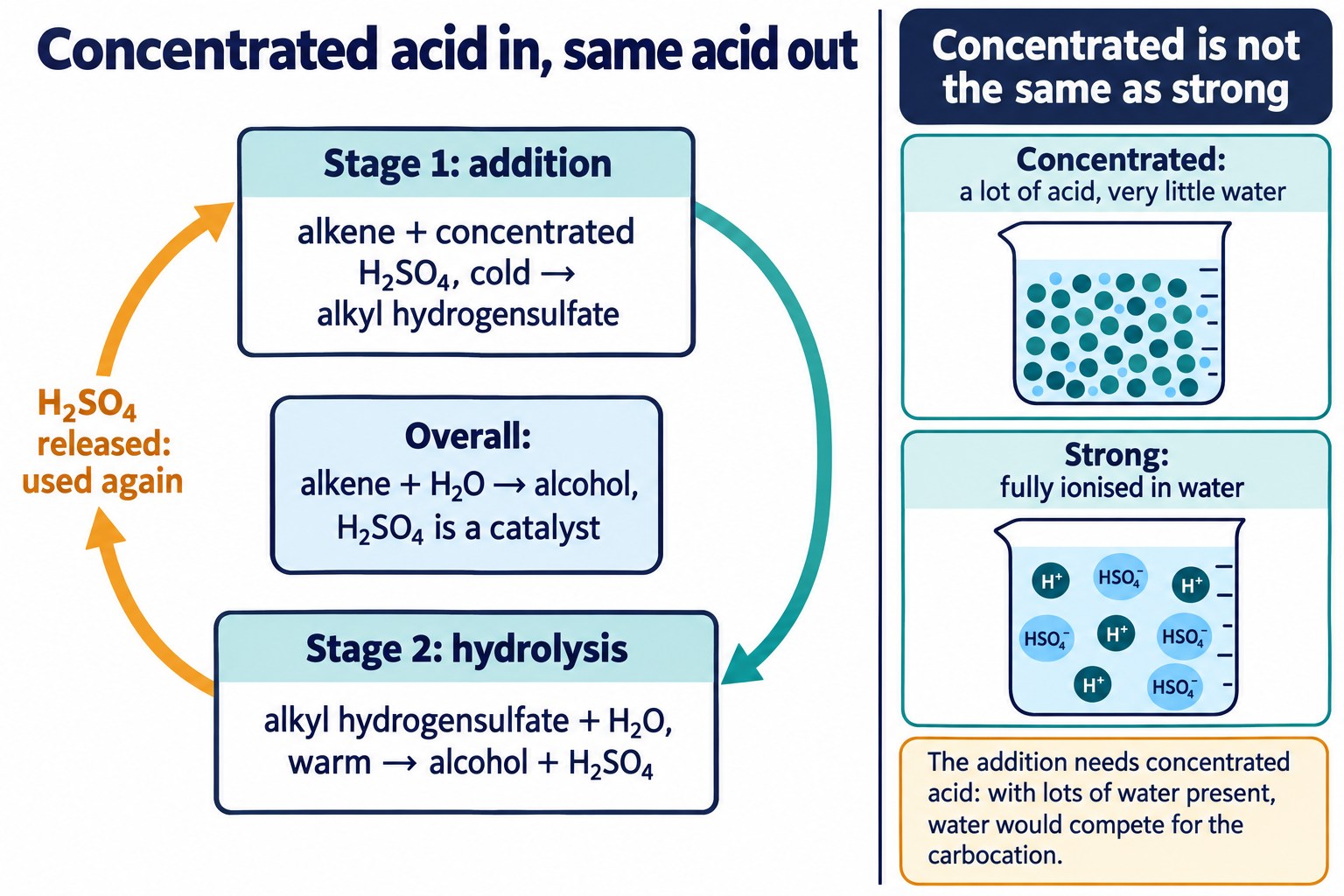
Sulfuric acid is used in the addition stage and released again on hydrolysis, so overall it acts as a catalyst for the hydration of the alkene.
Unsymmetrical Alkenes and the Major Product
With an unsymmetrical alkene such as propene, H+ can add to either carbon atom of the C=C bond, so two different carbocations are possible. As with HBr, the reaction proceeds mainly through the more stable carbocation.
Adding H+ to the CH2 end of propene gives a secondary carbocation, which is stabilised by two electron-releasing alkyl groups. Adding it to the middle carbon gives a primary carbocation.
The secondary carbocation is more stable, so the hydrogensulfate group ends up on the middle carbon. The major product is 1-methylethyl hydrogensulfate, which hydrolyses to propan-2-ol.
The minor product hydrolyses to propan-1-ol.
| Carbocation type | Alkyl groups attached to C+ | Relative stability |
|---|---|---|
| Primary | One alkyl group | Less stable |
| Secondary | Two alkyl groups | More stable |
| Tertiary | Three alkyl groups | Most stable |
Exam focus: Explain the major product by comparing the stability of the two carbocation intermediates. Alkyl groups release electron density towards the positive carbon and stabilise it.
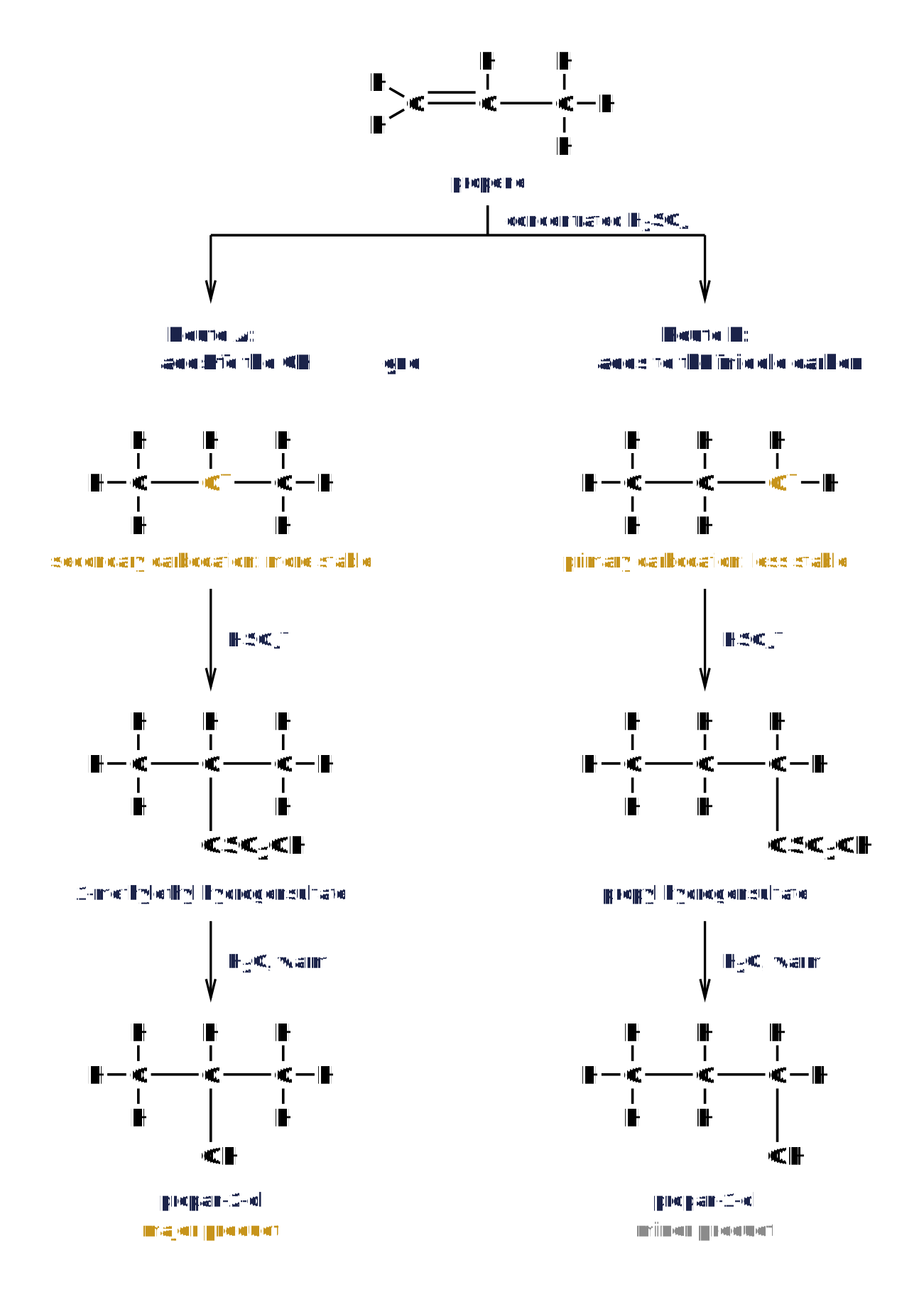
The secondary carbocation is more stable, so the major product after hydrolysis is propan-2-ol.
Quick Check: Which Alcohol Wins?
Compare the two possible carbocations before you choose.
Quick Check: Five Alkenes to Work Through
Work each one out on paper, then turn the card over to check your reasoning against the full working.
Common Exam Mistakes
- Using dilute sulfuric acid. The addition needs concentrated acid; water would compete for the carbocation.
- Forgetting the hydrolysis step when asked how an alkene is converted into an alcohol using sulfuric acid.
- Drawing the curly arrow from the hydrogen atom rather than from the π bond, or starting the second arrow at the oxygen atom instead of the O-H bond.
- Attaching the hydrogensulfate group through sulfur. It bonds to the carbon atom through an oxygen atom.
Exam focus: Write the product as CH3CH2OSO2OH or draw the full structure. The name is ethyl hydrogensulfate.
Quick Check: The Whole Page in Six Rounds
Pick the one accurate statement in each round, from the electrophile to the alcohol at the end.
FAQs
These questions secure the conditions, products and catalyst role in sulfuric acid addition.
Why must the sulfuric acid be concentrated?
In dilute acid, water molecules compete with HSO4– for the carbocation. Concentrated acid gives the alkyl hydrogensulfate cleanly, and this is then hydrolysed with water in a separate step.
Is the sulfuric acid used up?
No. It is used in the addition step and released again when the alkyl hydrogensulfate is hydrolysed. Overall, water has been added across the C=C bond and the acid has acted as a catalyst.
Which alcohol forms from but-1-ene by this route?
Mainly butan-2-ol. H+ adds to the CH2 end to give the more stable secondary carbocation, so the hydrogensulfate group, and then the OH group, end up on carbon 2. Butan-1-ol is the minor product.
How can a neutral H2SO4 molecule be an electrophile?
Its O-H bonds are polar, so each hydrogen carries δ+. The π bond donates an electron pair to one Hδ+ atom, so that hydrogen acts as the electrophile even though the molecule is neutral overall.
How is this route different from hydration with steam?
Steam hydration is one step at about 300 °C and 60 to 70 atm with a phosphoric acid catalyst. The sulfuric acid route has two steps, addition then hydrolysis, under much milder conditions.

Copyright notice: This OLS revision content, including the explanations, layout, diagrams, tables and embedded learning structure, is authored for Online Learning System by Dr. Mohammed Al-Fatah. It may not be copied, reproduced, redistributed or adapted without written permission.
Keep this note — free
Save your progress across every AQA topic. A free account remembers which topics you have covered, saves your question scores, and syncs across your phone and laptop.
- Track every topic you have finished
- Keep your practice-question scores
- No payment, no card, free forever
Already registered? Log in