Electron Configuration
A concise revision guide to quantum shells, subshells, s and p orbital shapes, electronic configuration notation, Hund’s rule and the Pauli exclusion principle for Cambridge International AS & A Level Chemistry (9701).
- 1.3.1-a
- 1.3.1-b
- 1.3.2-a
- 1.3.2-b
- 1.3.3
- 1.3.4
- 1.3.5-a
- 1.3.5-b
- 1.3.6-a
- 1.3.6-b
- 1.3.7
- 1.3.8-a
- 1.3.8-b
- 1.3.9
What these spec points say
- 1.3.1-a understand the terms shells, sub-shells and orbitals
- 1.3.1-b understand the term principal quantum number (n)
- 1.3.2-a describe the number of orbitals making up s, p and d sub-shells
- 1.3.2-b describe the number of electrons that can fill s, p and d sub-shells
- 1.3.3 describe the order of increasing energy of the sub-shells within the first three shells and the 4s and 4p sub-shells
- 1.3.4 describe the electronic configurations to include the number of electrons in each shell, sub-shell and orbital
- 1.3.5-a explain the electronic configurations in terms of energy of the electrons
- 1.3.5-b explain the electronic configurations in terms of inter-electron repulsion
- 1.3.6-a determine the electronic configuration of atoms given the atomic or proton number, using either the full electronic configuration (e.g. for Fe: 1s2 2s2 2p6 3s2 3p6 3d6 4s2) or the shorthand electronic configuration (e.g. for Fe: [Ar] 3d6 4s2)
- 1.3.6-b determine the electronic configuration of ions given the atomic or proton number and charge, using either the full electronic configuration or the shorthand electronic configuration
- 1.3.7 understand and use the electrons in boxes notation, e.g. for Fe: [Ar] with 3d and 4s boxes
- 1.3.8-a describe and sketch the shape of s orbitals
- 1.3.8-b describe and sketch the shape of p orbitals
- 1.3.9 describe a free radical as a species with one or more unpaired electrons
Shapes of Atomic Orbitals: s, p and d
Choose a step to watch each type of orbital form round a nucleus on fixed x, y and z axes, then build up a full second shell.
Filling Orbitals: Electrons in Boxes
Choose a step to watch electrons fill the orbitals in order of energy, from hydrogen to zinc, then see which electrons leave first when iron forms its ions.
© Dr. Mohammed Al-Fatah – onlinelearningsystem.net
© Dr. Mohammed Al-Fatah – onlinelearningsystem.net
GCSE Recap: Electron Shells 2,8,8
Before you start, check that you can still place electrons in shells the GCSE way.
From the Bohr Model to the Quantum Model
At GCSE level, electrons are often shown moving in circular or spherical shells around the nucleus. This early model is useful because it explains why noble gas arrangements are particularly stable.
At A Level, the model becomes more detailed. Electrons are not treated as tiny particles moving in fixed paths. Instead, an orbital describes a region of space where there is a high probability of finding an electron.
Key idea: The quantum model replaces fixed electron orbits with probability-based orbitals.
Shells, Subshells and Orbitals
The quantum model describes electron arrangement using three linked levels of organisation: shells, subshells and orbitals.
| Term | Meaning | Key notation |
|---|---|---|
| Shell | A principal energy level around the nucleus. | Defined by the principal quantum number, n. |
| Subshell | A subdivision of a shell. Common subshells are s, p, d and f. | Defined by the angular momentum quantum number, l. |
| Orbital | A specific region in a subshell where an electron is most likely to be found. | Each orbital can hold a maximum of 2 electrons. |
Each type of subshell has a fixed number of orbitals. An s subshell has 1 orbital, a p subshell has 3 orbitals and a d subshell has 5 orbitals.
Each orbital holds up to 2 electrons, so s, p and d subshells hold a maximum of 2, 6 and 10 electrons.
Exam focus: Avoid saying that an orbital is a shell. A shell contains subshells, and subshells contain orbitals.
s, p and d Orbital Shapes
Orbitals describe the mathematical probability of locating an electron in a region around the nucleus. Each orbital has a three-dimensional shape, but these shapes are approximations that help us visualise electron distribution.
The s orbital is spherical. The p orbitals are dumbbell-shaped and are arranged at right angles to each other. The d orbitals have more complex shapes, with four of the five d orbitals having a four-lobed cloverleaf arrangement.
Remember: Orbital diagrams are models. They show regions of high electron probability, not solid surfaces or fixed paths.
Quick Check: Shells, Subshells and Orbitals
Answer three short questions on what an orbital is and how many electrons a subshell or shell can hold.
Writing Electronic Configuration
An atom’s electronic configuration shows how its electrons are arranged within atomic orbitals. The notation combines the main energy level, the subshell type and the number of electrons in that subshell.
For example, oxygen is written as 1s² 2s² 2p⁴. The large number shows the main energy level, the letter shows the subshell type, and the superscript shows the number of electrons in that subshell.
Electrons fill subshells in order of increasing energy. For the early part of the sequence, the order is 1s → 2s → 2p → 3s → 3p → 4s → 3d → 4p.
Long configurations can be shortened by using a noble gas core. The symbol [Ar] stands for the 18 electrons of argon, 1s² 2s² 2p⁶ 3s² 3p⁶.
Manganese (25 electrons) is 1s² 2s² 2p⁶ 3s² 3p⁶ 4s² 3d⁵, which shortens to [Ar] 4s² 3d⁵.
Write the configuration in full when the question asks for the full electronic configuration. The 3d and 4s subshells can be written in either order, so [Ar] 3d⁵ 4s² is also correct.
Exam focus: The 4s subshell fills before 3d because 4s is lower in energy than 3d before the 3d subshell is occupied.
Quick Check: Electrons in a Named Subshell
Write each configuration on paper, then type the number of electrons asked for.
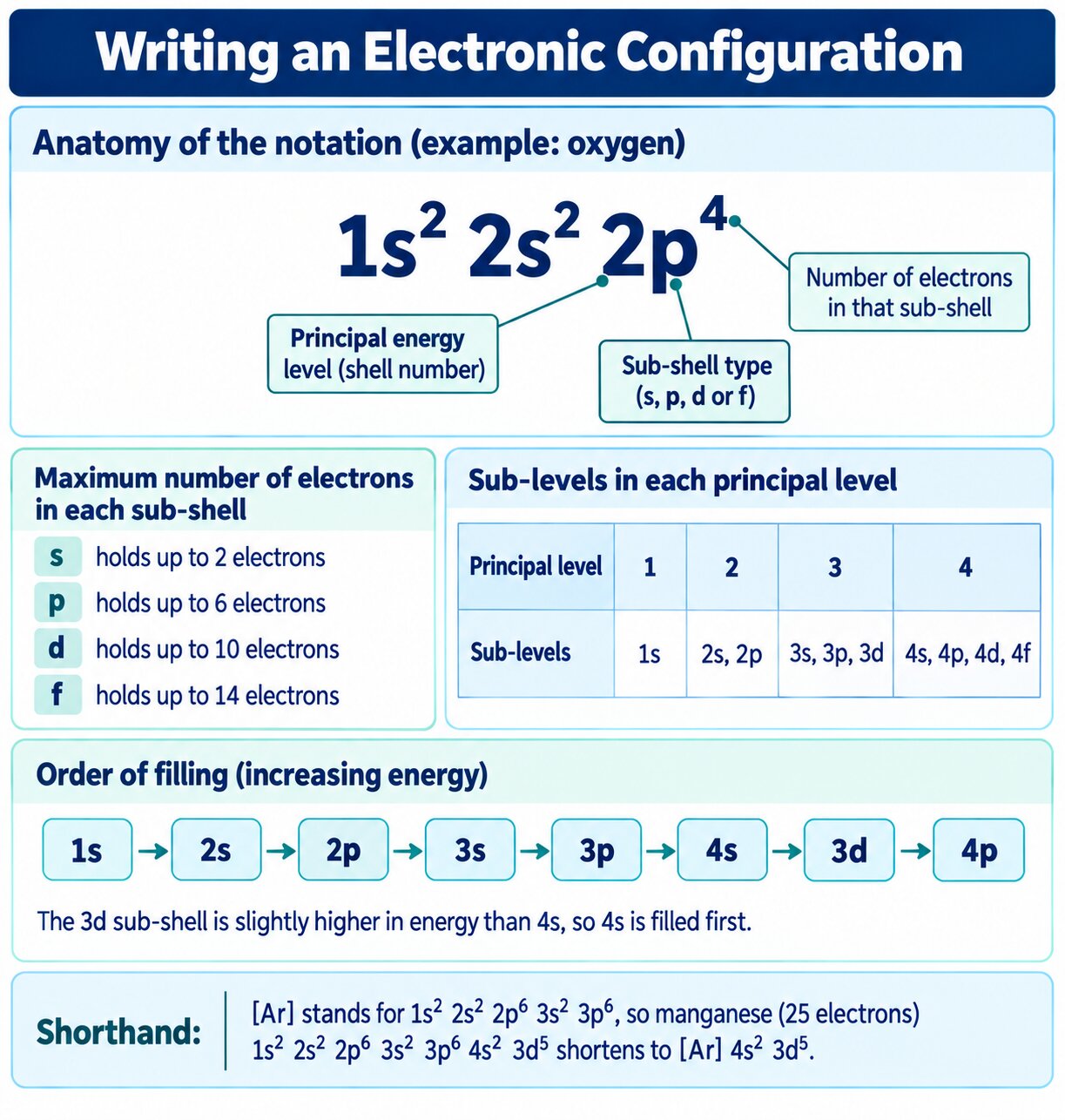
This notation shows the shell number, subshell letter and the number of electrons present in that subshell.
Watch: the potassium atom and the K+ ion
Potassium loses one electron to become K+. Which electron goes first, and why that one?
Electronic Configuration of Ions
When ions form, electrons are either lost or gained. A positive ion forms when electrons are lost. A negative ion forms when electrons are gained.
For magnesium, the atom is written as 1s² 2s² 2p⁶ 3s², but Mg²⁺ is written as 1s² 2s² 2p⁶ because two electrons have been lost.
For oxygen, the atom is written as 1s² 2s² 2p⁴, but O²⁻ is written as 1s² 2s² 2p⁶ because two electrons have been gained.
Remember: Ion formation changes the number of electrons, not the number of protons.
Quick Check: Ions with the Same Configuration
Count the electrons in each species and click every one that has the configuration shown.
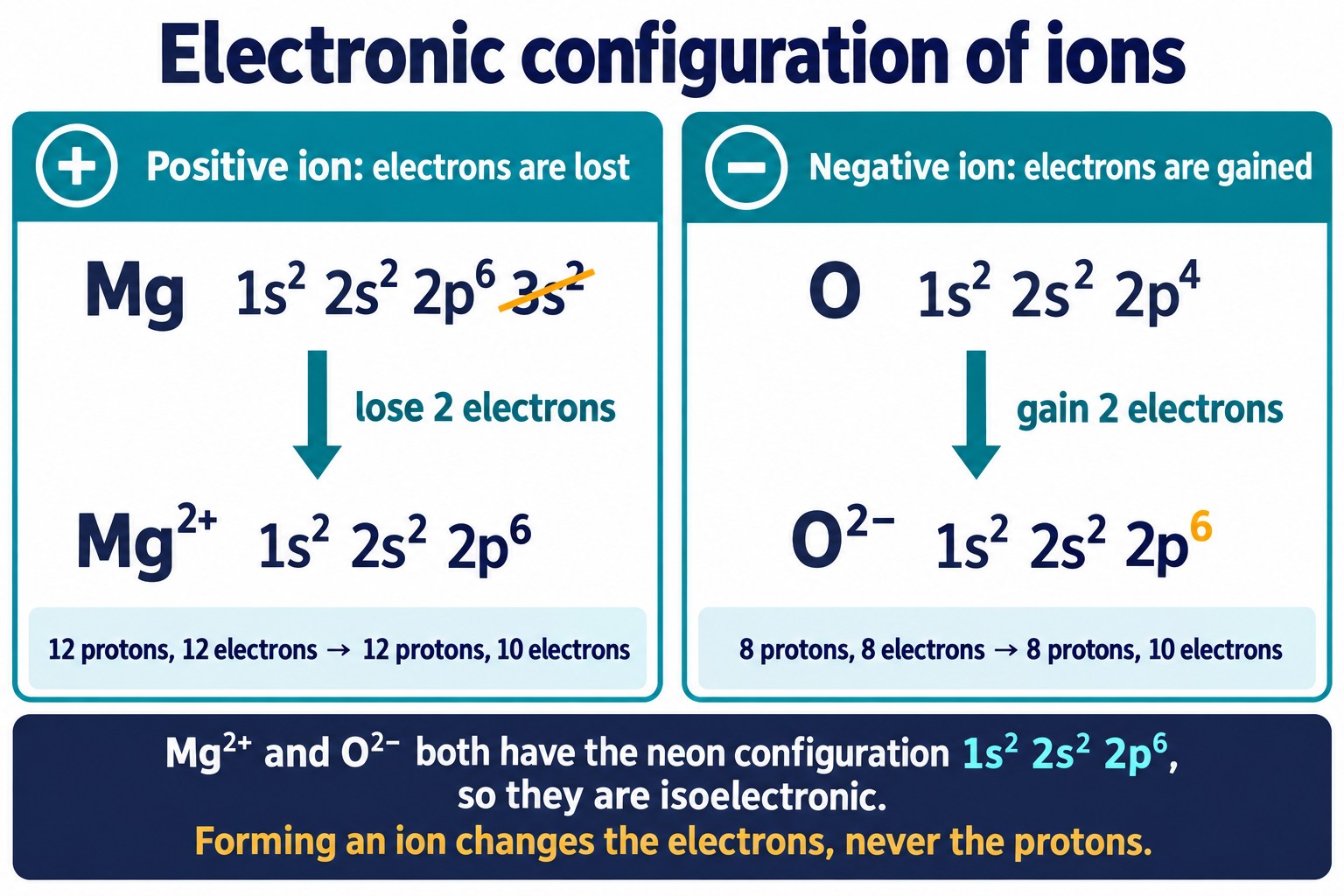
Positive ions have fewer electrons than their atoms. Negative ions have more electrons than their atoms.
Hund’s Rule
Hund’s rule states that electrons occupy orbitals singly before any pairing occurs in orbitals of the same energy.
This minimises electron-electron repulsion. In a p subshell, there are three p orbitals, so one electron enters each p orbital before any two electrons pair up in the same orbital.
Exam focus: When filling p orbitals, show one arrow in each box first, then pair electrons only after each equal-energy orbital contains one electron.
Pauli Exclusion Principle and Spin Diagrams
The Pauli exclusion principle states that no two electrons in the same orbital can have the same spin. This means paired electrons in one orbital must be shown with opposite spins.
In spin diagrams, each box represents one orbital, and each arrow represents one electron. Opposite arrow directions represent opposite electron spins.
Remember: One orbital can hold a maximum of two electrons, and those two electrons must have opposite spin.
Quick Check: Judge the Box Diagrams
In each round, pick the one statement that is accurate.
Quick Check: Draw Electrons-in-Boxes Diagrams
Draw each diagram on paper before you flip the card.
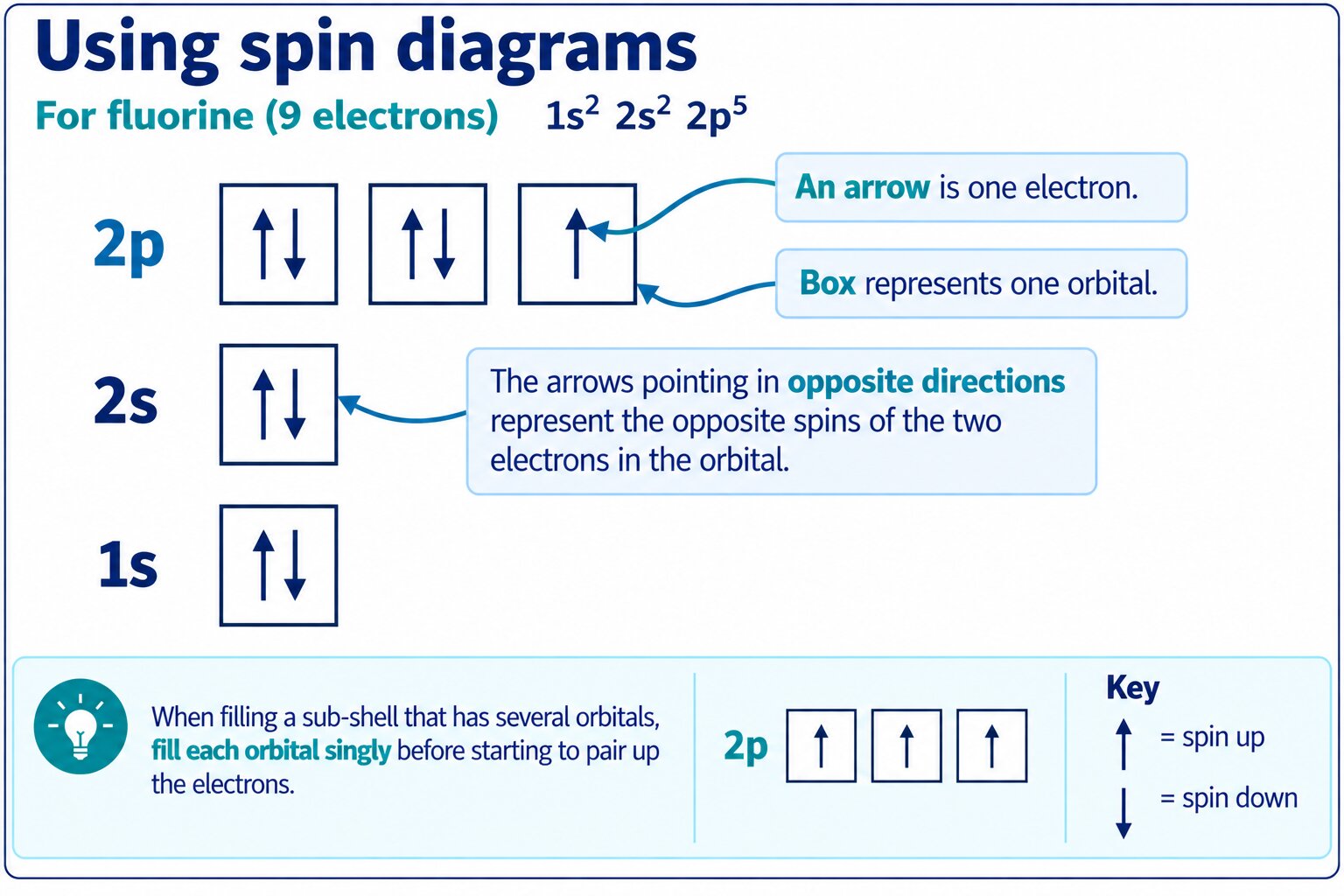
Each box is one orbital. Arrows in opposite directions show paired electrons with opposite spin.
Why Electrons Fill Orbitals the Way They Do
Cambridge wants the filling rules explained, not only applied. Two ideas cover every case: electrons take the lowest available energy, and electrons repel one another.
- Sub-shells fill in order of energy. 1s is lowest, then 2s, 2p, 3s, 3p. The 4s sub-shell is slightly lower in energy than 3d in a neutral atom, so potassium is [Ar] 4s1, not [Ar] 3d1, and 4s fills before 3d in the first-row transition metals.
- Orbitals of equal energy fill singly first (Hund’s rule). Two electrons in the same orbital share the same small region of space and repel strongly; placing them in separate p orbitals of equal energy keeps them further apart, so nitrogen is 2p1 2p1 2p1 with three parallel spins, not 2p2 2p1.
- Paired electrons have opposite spins. An orbital can hold two electrons only if their spins are opposite; this partly offsets the repulsion of sharing an orbital.
- The half-filled and full d sub-shells. Chromium is [Ar] 3d5 4s1 and copper [Ar] 3d10 4s1: spreading the electrons over six orbitals, or completing the d sub-shell, lowers the repulsion enough to be worth promoting one 4s electron.
Exam sentence: Electrons occupy the lowest-energy sub-shell available and fill orbitals of equal energy singly with parallel spins before pairing, because this minimises inter-electron repulsion.
Quick Check: Explain the Filling Rule
Write a short explanation, then compare it with the mark points and the model answer.
Ions of d-Block Elements
When a d-block atom forms a positive ion, the 4s electrons are lost before the 3d electrons. The 4s sub-shell fills first, but once 3d contains electrons, 4s is higher in energy, so it also empties first.
| Atom | Ion |
|---|---|
| Manganese, [Ar] 3d5 4s2 | Mn2+ is [Ar] 3d5 |
| Chromium, [Ar] 3d5 4s1 | Cr3+ is [Ar] 3d3 |
| Copper, [Ar] 3d10 4s1 | Cu2+ is [Ar] 3d9 |
Common mistake: Writing Mn2+ as [Ar] 3d3 4s2. In the d-block, 4s is filled first and emptied first.
Free Radicals: Species with Unpaired Electrons
An electrons-in-boxes diagram makes it obvious when an atom or molecule has an unpaired electron. Cambridge defines a free radical as a species with one or more unpaired electrons.
A chlorine atom, Cl•, has seven outer electrons with one left unpaired; the methyl radical •CH3 has an unpaired electron on carbon.
Radicals are highly reactive because pairing that electron by forming a bond releases energy.
The dot in the formula shows the unpaired electron. You meet radicals again in the free-radical substitution of alkanes by chlorine (Topic 15), where ultraviolet light splits the Cl-Cl bond homolytically to give two chlorine radicals.
Key idea: Unpaired electron in the boxes diagram means free radical: write it with a dot and expect it to react.
Quick Check: Spotting a Free Radical
Count electrons to find the species that must have an unpaired electron.
Common Exam Points
Quantum model questions often test precise language about orbitals, correct electronic configurations, and correct use of Hund’s rule and the Pauli exclusion principle.
Define an orbital accurately
An orbital is a region of space where an electron is most likely to be found. It can hold a maximum of two electrons.
Use the correct filling order
Remember that 4s fills before 3d in the usual Aufbau sequence for neutral atoms. The exceptions are chromium (3d⁵ 4s¹) and copper (3d¹⁰ 4s¹). When d-block ions form, the 4s electrons are lost first.
Apply Hund’s rule
Place electrons singly in equal-energy orbitals before pairing them.
Apply Pauli correctly
Two electrons in the same orbital must have opposite spins.
Electron Configuration FAQs
Use these quick answers to secure the key wording for Cambridge International AS & A Level Chemistry.
What is an orbital?
An orbital is a region of space where an electron is most likely to be found. Each orbital can hold a maximum of two electrons.
What is the difference between a shell and a subshell?
A shell is a principal energy level. A subshell is a subdivision within a shell, such as s, p, d or f.
What shape is an s orbital?
An s orbital is spherical, so it has the same shape in all directions around the nucleus.
What shape are p orbitals?
p orbitals are dumbbell-shaped. The three p orbitals, px, py and pz, are arranged at right angles to each other.
What does Hund’s rule state?
Hund’s rule states that electrons occupy orbitals singly before any pairing occurs in orbitals of the same energy.
What does the Pauli exclusion principle state?
No two electrons in the same orbital can have the same spin. Two electrons in the same orbital must have opposite spins.

Copyright notice: This OLS revision content, including the explanations, layout, diagrams, tables and embedded learning structure, is authored for Online Learning System by Dr. Mohammed Al-Fatah. It may not be copied, reproduced, redistributed or adapted without written permission.
Keep this note — free
Save your progress across every Cambridge topic. A free account remembers which topics you have covered, saves your question scores, and syncs across your phone and laptop.
- Track every topic you have finished
- Keep your practice-question scores
- No payment, no card, free forever
Already registered? Log in