Alcohol
A concise revision guide to the alcohol functional group, the hydroxyl group, the -ol suffix, naming diols and triols, and the priority of the -OH group in organic nomenclature.
- 13.1.5
What these spec points say
- 13.1.5 understand and use systematic nomenclature of simple aliphatic organic molecules with functional groups detailed in the table on pages 29 and 30, up to six carbon atoms (six plus six for esters, straight chains only for esters and nitriles)
GCSE Recap: The Alcohols You Already Know
Start with the alcohols you met at GCSE before learning the A Level naming rules.
What Is an Alcohol?
An alcohol is an organic compound containing the hydroxyl functional group, written as -OH.
The oxygen atom in the -OH group is bonded to a carbon atom in the organic molecule. This functional group determines the characteristic chemistry of alcohols.
In naming, the -OH group is usually shown using the suffix -ol.
Key idea: The alcohol functional group is the hydroxyl group, -OH. Do not confuse this with the hydroxide ion, OH–.

The hydroxyl group is the identifying functional group of alcohols and is written as -OH in organic formulae.
Quick Check: Spot the Alcohol
Decide which of these compounds contains a hydroxyl group bonded to carbon.
Naming Alcohols Using the -ol Suffix
Alcohols are named using the suffix -ol.
If the position of the -OH group needs to be shown, the position number is placed between the name stem and the -ol suffix.
For example, propan-1-ol has a three-carbon chain and the -OH group is attached to carbon 1.
| Homologous series | Functional group | Prefix | Suffix | Example |
|---|---|---|---|---|
| Alcohols | -OH | hydroxy- | -ol | propan-1-ol |
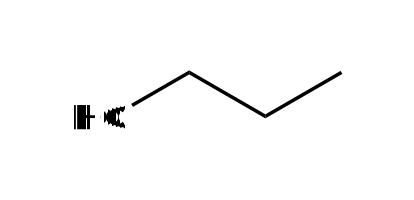
The number 1 shows that the -OH group is bonded to the first carbon atom in the propyl chain.
Quick Check: Name That Alcohol
Pick the correct name for each alcohol from its formula.
Alcohols with Two or More -OH Groups
If a molecule contains two or more -OH groups, prefixes such as di- and tri- are used.
In these cases, the final e in the alkane stem is retained before the suffix. For example, ethane becomes ethane-1,2-diol, not ethan-1,2-diol.
Two -OH groups
Use -diol, with numbers showing the positions of both -OH groups.
Three -OH groups
Use -triol, with numbers showing the positions of all three -OH groups.
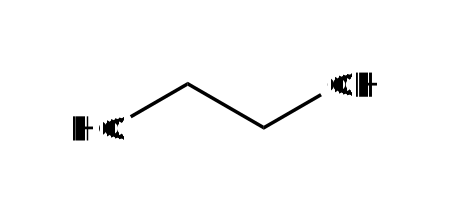
Ethane-1,2-diol contains two -OH groups, so the diol suffix is used and the e in ethane is retained.
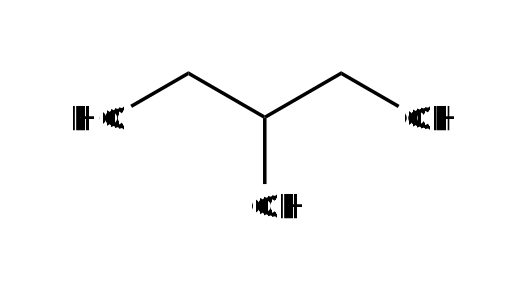
Propane-1,2,3-triol contains three -OH groups, so each position is included before the triol suffix.
Quick Check: Diols and Triols
Type the missing numbers to complete the names of these alcohols with more than one -OH group.
Watch: an -OH group and a branch on one chain
An alcohol group and a methyl branch sit on the same four-carbon chain. Which one decides the numbering?
Priority of the -OH Group
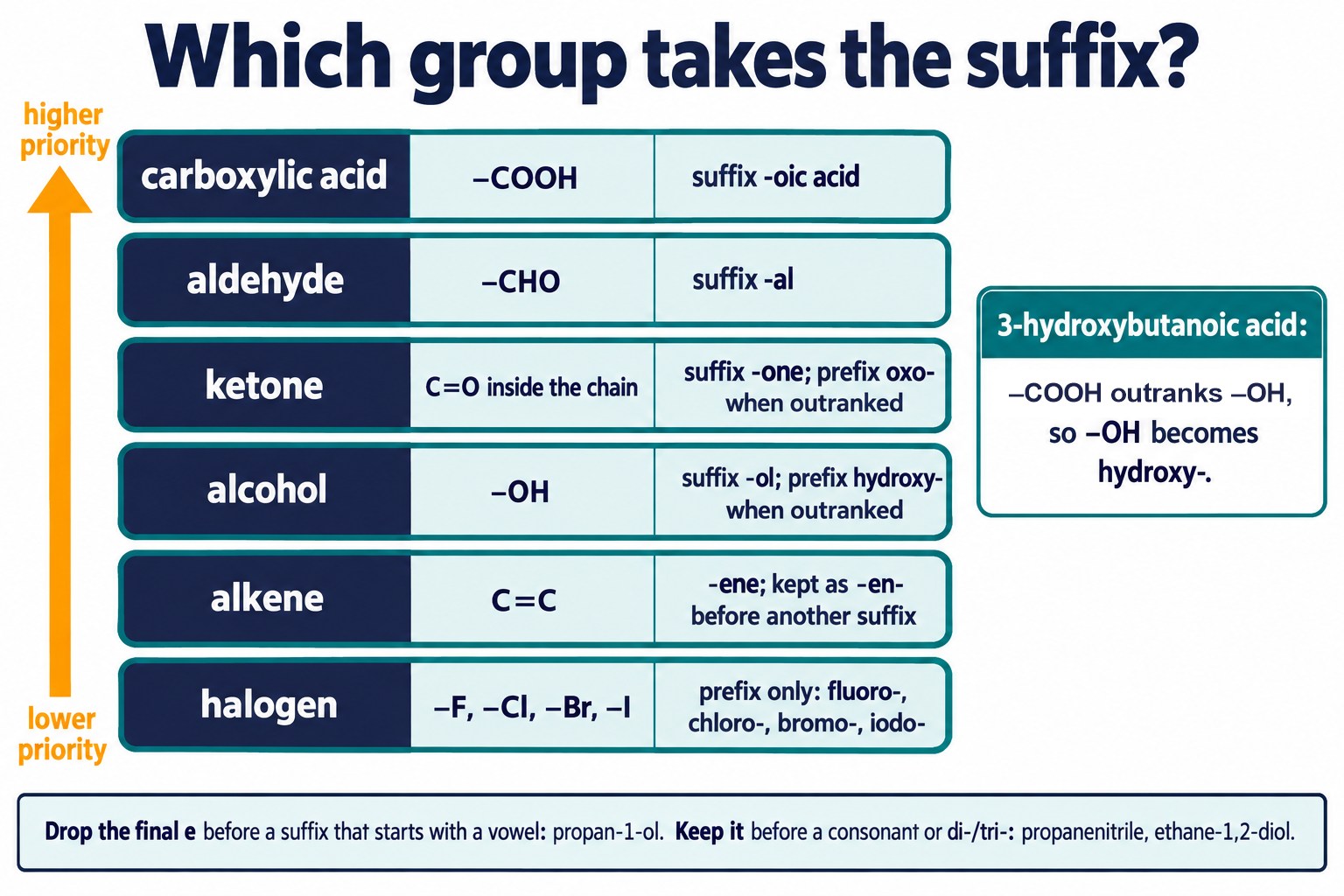
The -OH group has higher priority than both halogenoalkanes and alkenes when naming organic molecules.
This means the carbon chain is numbered so that the -OH group is on the lowest possible carbon, often carbon 1.
If a molecule also contains a C=C double bond or halogen substituents, these are still included in the name, but the -OH group controls the main suffix and the numbering direction.
Exam focus: When several groups are present, first identify the highest-priority group that will control the suffix and numbering.
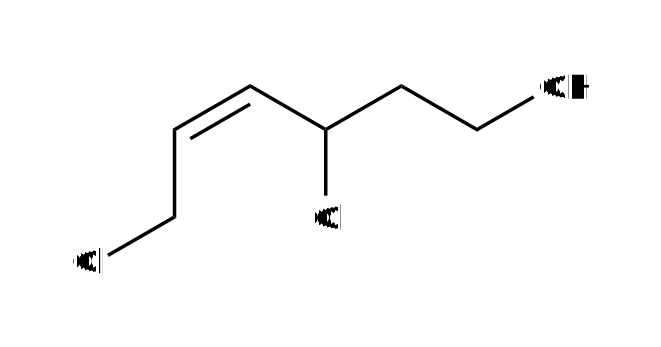
The -ol suffix and carbon 1 position are used because the -OH group has higher naming priority than the C=C bond and chloro substituents.
Quick Check: Explain the Numbering
Write a short explanation of how the -OH group controls the name of a halogen-containing alcohol.
When Alcohol Is Named as Hydroxy-
If a compound contains an -OH group and another functional group with higher priority, the higher-priority group takes the suffix form.
In that situation, the -OH group is named using the prefix hydroxy-.
This is why it is important to recognise whether -OH is acting as the main functional group or as a substituent in the name.
| Naming situation | How -OH appears in the name | Example naming logic |
|---|---|---|
| -OH is the main functional group | Use the suffix -ol | propan-1-ol |
| A higher-priority group controls the suffix | Use the prefix hydroxy- | The higher-priority group takes the suffix form |
Remember: The usual alcohol naming pattern is -ol, but hydroxy- is used when the -OH group is not the highest-priority group.
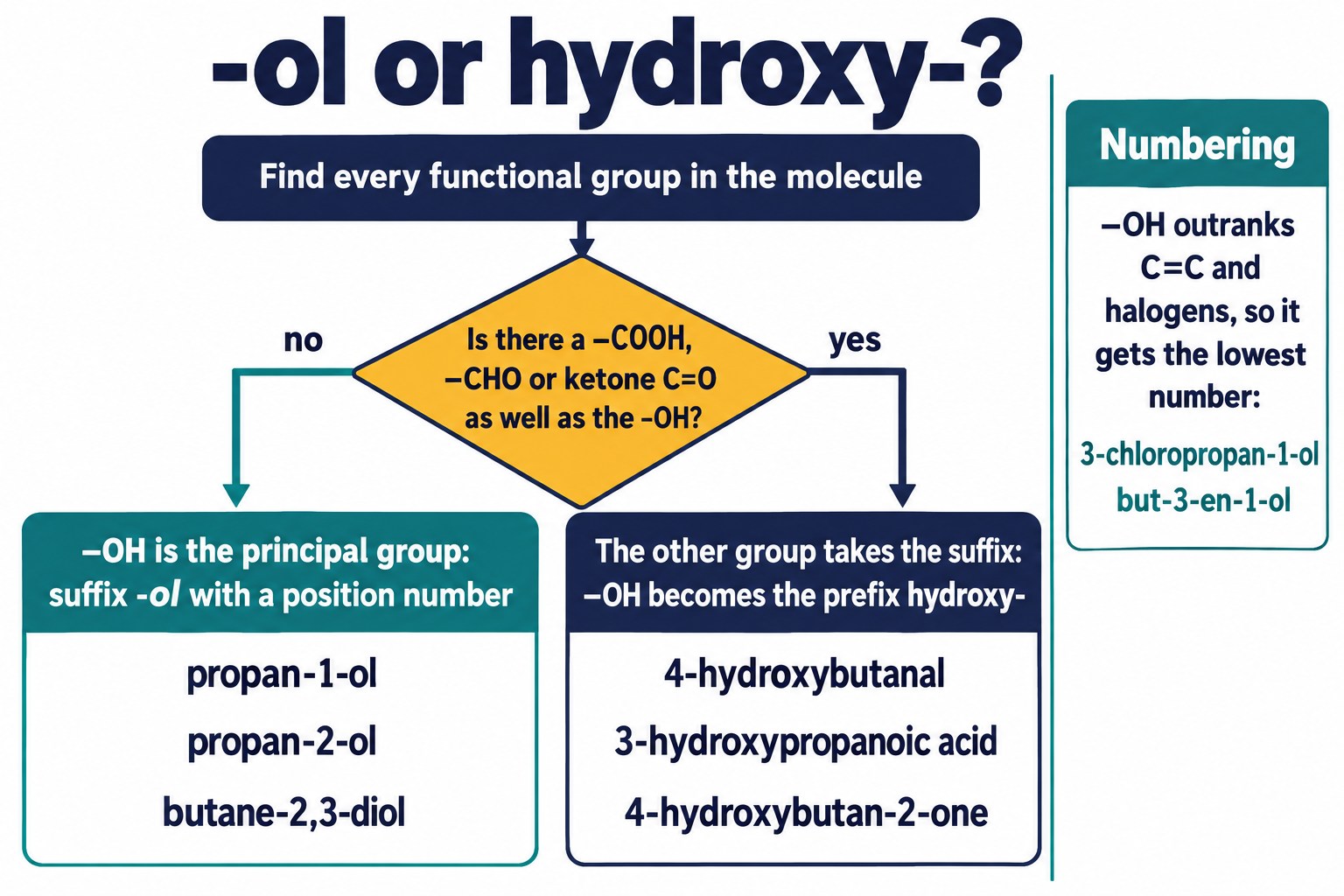
The OH group is a suffix, -ol, unless a higher-priority group is present; then it becomes the prefix hydroxy-.
Quick Check: When -OH Becomes Hydroxy-
Name a molecule in which the -OH group is not the highest-priority group.
Quick Check: Alcohol Naming Summary
Pull the whole page together by choosing the accurate statement about each new molecule.
FAQs
These questions cover the alcohol naming points that cost marks.
Is the -OH in an alcohol the same as a hydroxide ion?
No. The -OH group is covalently bonded to carbon and is not an ion. Hydroxide, OH⁻, is a negative ion found in ionic compounds such as sodium hydroxide.
Why is it ethane-1,2-diol and not ethan-1,2-diol?
The suffix -diol starts with d, a consonant, so the e of ethane is kept.
Where does the position number go in an alcohol name?
Between the stem and the suffix, as in propan-2-ol. It shows which carbon carries the -OH group.
When is the -OH group called hydroxy-?
When a higher-priority group, such as an aldehyde or carboxylic acid, takes the suffix. The -OH group then becomes the prefix hydroxy-, as in 2-hydroxypropanoic acid.
Do I number from the end nearer the -OH or nearer a halogen?
Nearer the -OH group. It has higher priority than halogens and C=C bonds, so it gets the lowest number.

Copyright notice: This OLS revision content, including the explanations, layout, diagrams, tables and embedded learning structure, is authored for Online Learning System by Dr. Mohammed Al-Fatah. It may not be copied, reproduced, redistributed or adapted without written permission.
Keep this note — free
Save your progress across every Cambridge topic. A free account remembers which topics you have covered, saves your question scores, and syncs across your phone and laptop.
- Track every topic you have finished
- Keep your practice-question scores
- No payment, no card, free forever
Already registered? Log in