Producing Alkanes
A concise Cambridge International AS Level Chemistry revision guide to the two ways of producing alkanes named in 14.1.1.
They are the addition of hydrogen to an alkene with a platinum or nickel catalyst and heat, and the cracking of a longer-chain alkane by heating with aluminium oxide.
- 14.1.1(a)
- 14.1.1(b)
What these spec points say
- 14.1.1(a) recall the reaction (reagents and conditions) by which alkanes can be produced: addition of hydrogen to an alkene in a hydrogenation reaction, H2(g) and Pt/Ni catalyst and heat
- 14.1.1(b) recall the reaction (reagents and conditions) by which alkanes can be produced: cracking of a longer chain alkane, heat with Al2O3
Hydrogenation on a Catalyst Surface
Choose a step to watch ethene and hydrogen meet on a nickel surface and leave as ethane.
© Dr. Mohammed Al-Fatah – onlinelearningsystem.net
GCSE Recap: Formulae and Balancing
Before you start, check the general formulae and the atom counting this page depends on.
Two Routes to an Alkane
Cambridge 14.1.1 asks you to recall the reagents and conditions for two reactions that produce alkanes. Both are met again elsewhere in the syllabus, but here the alkane is the product you are asked about.
| Route | Starting material | Reagents and conditions | Type of reaction | Example |
|---|---|---|---|---|
| Hydrogenation | An alkene | H2(g) with a Pt or Ni catalyst, heat | Addition | CH3CH=CH2 + H2 → CH3CH2CH3 |
| Cracking | A longer-chain alkane | Heat with Al2O3 | Thermal decomposition (C-C bonds broken) | C10H22 → C8H18 + C2H4 |

Producing alkanes: adding hydrogen across the C=C bond of an alkene, or cracking a longer alkane over hot aluminium oxide.
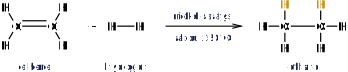
Key idea: Hydrogenation makes an alkane from a smaller, unsaturated molecule; cracking makes an alkane (and an alkene) from a larger, saturated one.
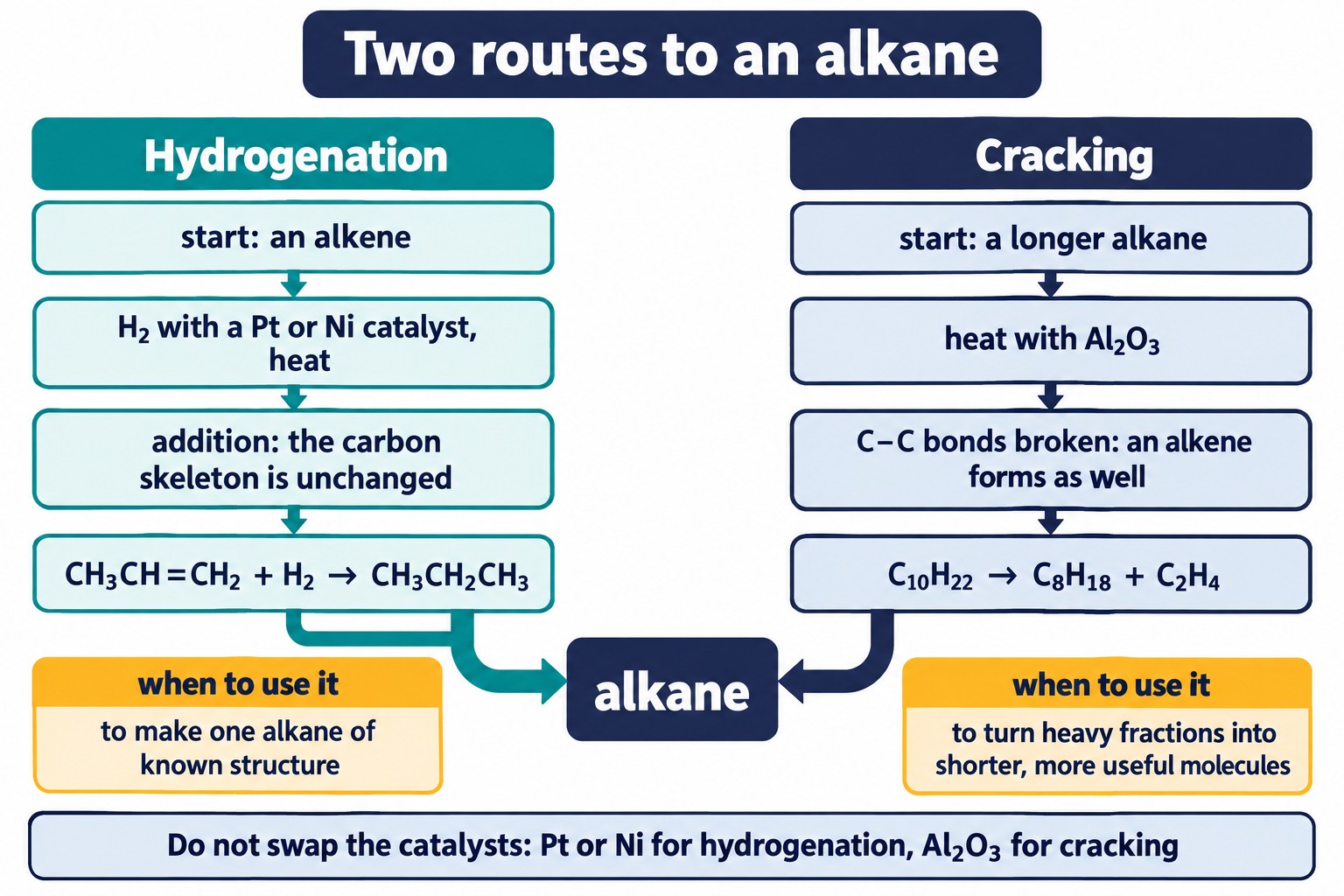
Hydrogenation keeps the carbon skeleton; cracking breaks it and gives an alkene too.
Quick Check: Picking the Right Route
Decide which starting material and route would give one pure alkane.
Hydrogenation of Alkenes
Hydrogen adds across the C=C double bond of an alkene in the presence of a platinum or nickel catalyst with heat.
The π bond breaks, two new C-H σ bonds form, and the product is the saturated alkane with the same carbon skeleton.
The catalyst provides a surface on which the H2 molecule is split into atoms that add to the alkene.
Because the carbon skeleton is unchanged, the alkane formed is easy to predict: but-1-ene and but-2-ene both give butane; 2-methylpropene gives 2-methylpropane. The reaction is used industrially to make saturated fats from vegetable oils, where the same catalyst and conditions apply.
Exam sentence: Alkenes are converted to alkanes by addition of hydrogen: H2(g) with a platinum or nickel catalyst and heat.
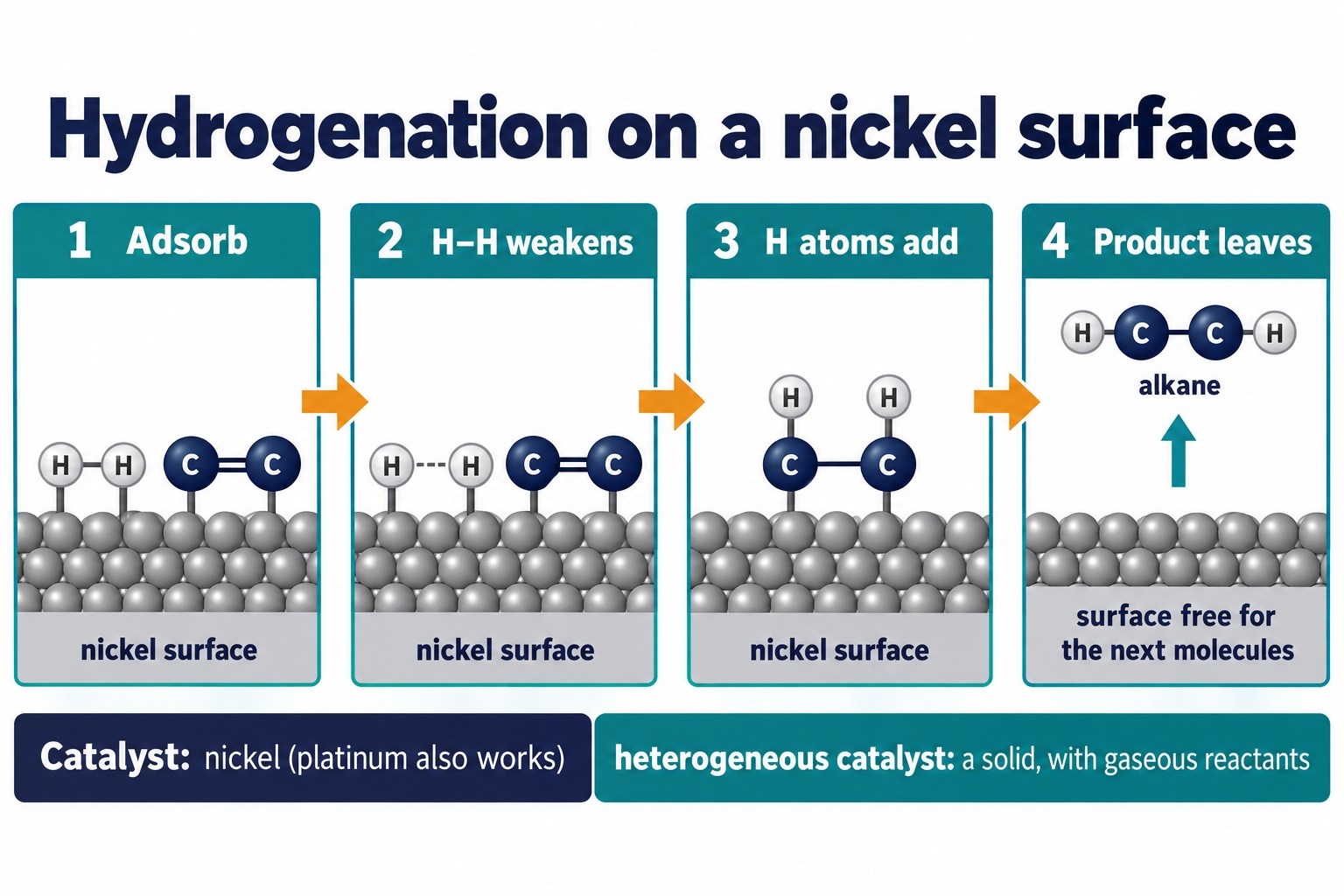
Hydrogen and the alkene are held on the metal surface, the H–H bond breaks and one hydrogen atom adds to each carbon of the C=C.
Quick Check: Predict the Product
Work each answer out on paper, then flip the card to compare.
Cracking a Longer Alkane
Heating a long-chain alkane with aluminium oxide, Al2O3, breaks a C-C bond and produces a shorter alkane together with an alkene.
The Cambridge wording is simply “heat with Al2O3“; the oxide acts as a catalyst.
Any C-C bond can break, so a mixture forms, but in each equation the carbon and hydrogen atoms must balance and one product is an alkene.
- C12H26 → C7H16 + C5H10 (heptane and pentene)
- C12H26 → C8H18 + 2C2H4 (octane and two ethene molecules)
Cracking is also how refineries obtain more useful alkanes and alkenes of lower relative molecular mass from the heavy fractions of crude oil (14.1.4); the full industrial context is on the Cracking page.
Exam focus: Quote the conditions exactly as the syllabus does: heat with Al2O3 for cracking; H2 with Pt or Ni and heat for hydrogenation.
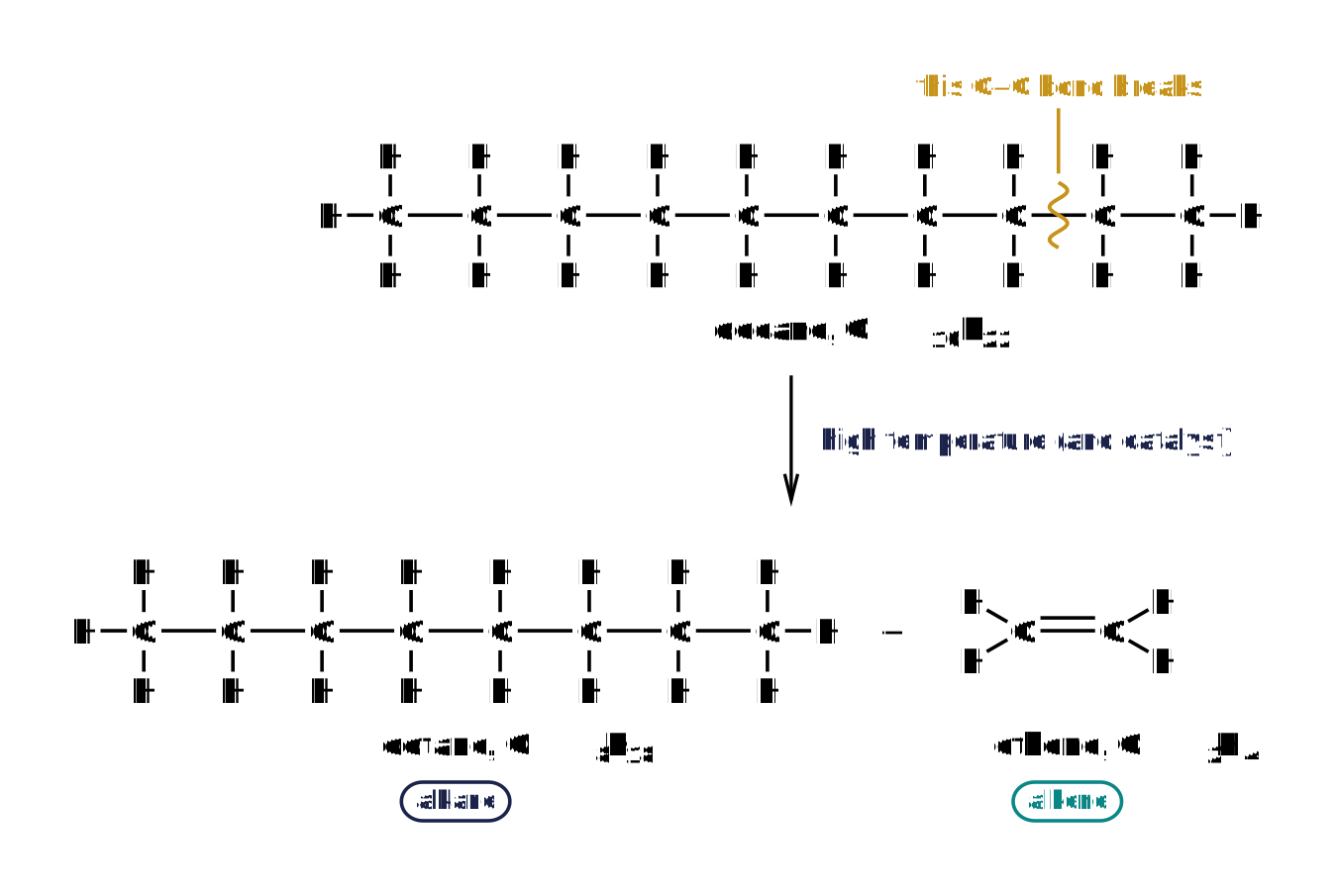
Cracking decane: one C–C bond breaks, giving the shorter alkane octane and the alkene ethene.
Quick Check: Finish the Cracking Equation
Balance the equation to find the formula of the missing alkene.
Quick Check: Pick the Accurate Statement
In each round, choose the one statement that is accurate.
Common Exam Mistakes
- Giving the hydrogenation catalyst as “a catalyst” without naming platinum or nickel.
- Writing a cracking equation with two alkanes as products. One product must be an alkene for the hydrogen atoms to balance.
- Describing hydrogenation as a substitution. It is an addition reaction: the alkene gains two hydrogen atoms and nothing is lost.
- Confusing the cracking catalyst (Al2O3) with the hydrogenation catalyst (Pt or Ni).
Exam sentence: Alkanes are produced by hydrogenating an alkene with H2 over Pt or Ni with heat, or by cracking a longer alkane by heating with Al2O3.
FAQs
These questions cover the alkane-producing reactions students most often confuse.
Which catalyst is used for hydrogenation?
Platinum or nickel, with heat. Aluminium oxide is the cracking catalyst, not the hydrogenation one.
What does but-2-ene give with hydrogen?
Butane. The carbon skeleton is unchanged; one hydrogen atom adds to each carbon of the double bond.
Why must one cracking product be an alkene?
An alkane already carries the most hydrogen its chain can hold. Splitting it leaves too few hydrogen atoms for two alkanes.
Is hydrogenation a substitution reaction?
No. Hydrogen adds across the C=C bond and nothing leaves, so it is addition.
Is C12H26 → C7H16 + C5H10 balanced?
Yes. Carbon: 12 = 7 + 5. Hydrogen: 26 = 16 + 10. The products are heptane and a pentene.

Copyright notice: This OLS revision content, including the explanations, layout, diagrams, tables and embedded learning structure, is authored for Online Learning System by Dr. Mohammed Al-Fatah. It may not be copied, reproduced, redistributed or adapted without written permission.
Keep this note — free
Save your progress across every Cambridge topic. A free account remembers which topics you have covered, saves your question scores, and syncs across your phone and laptop.
- Track every topic you have finished
- Keep your practice-question scores
- No payment, no card, free forever
Already registered? Log in