The Gaseous State
A concise revision guide to the gaseous state for Cambridge International AS Level Chemistry: how collisions with the wall cause gas pressure, the two properties of an ideal gas, and calculations with pV = nRT, including finding Mᵣ.
GCSE Recap: Particles in a Gas
A quick check of what you already know about gases, moles and temperature before the Cambridge detail.
Where Gas Pressure Comes From
The molecules of a gas move quickly, in straight lines and in random directions, until they hit something. Much of the time that something is the wall of the container.
Each molecule that hits the wall bounces off and pushes on it for an instant. Gas pressure is the total force of all these collisions on each unit area of the wall.
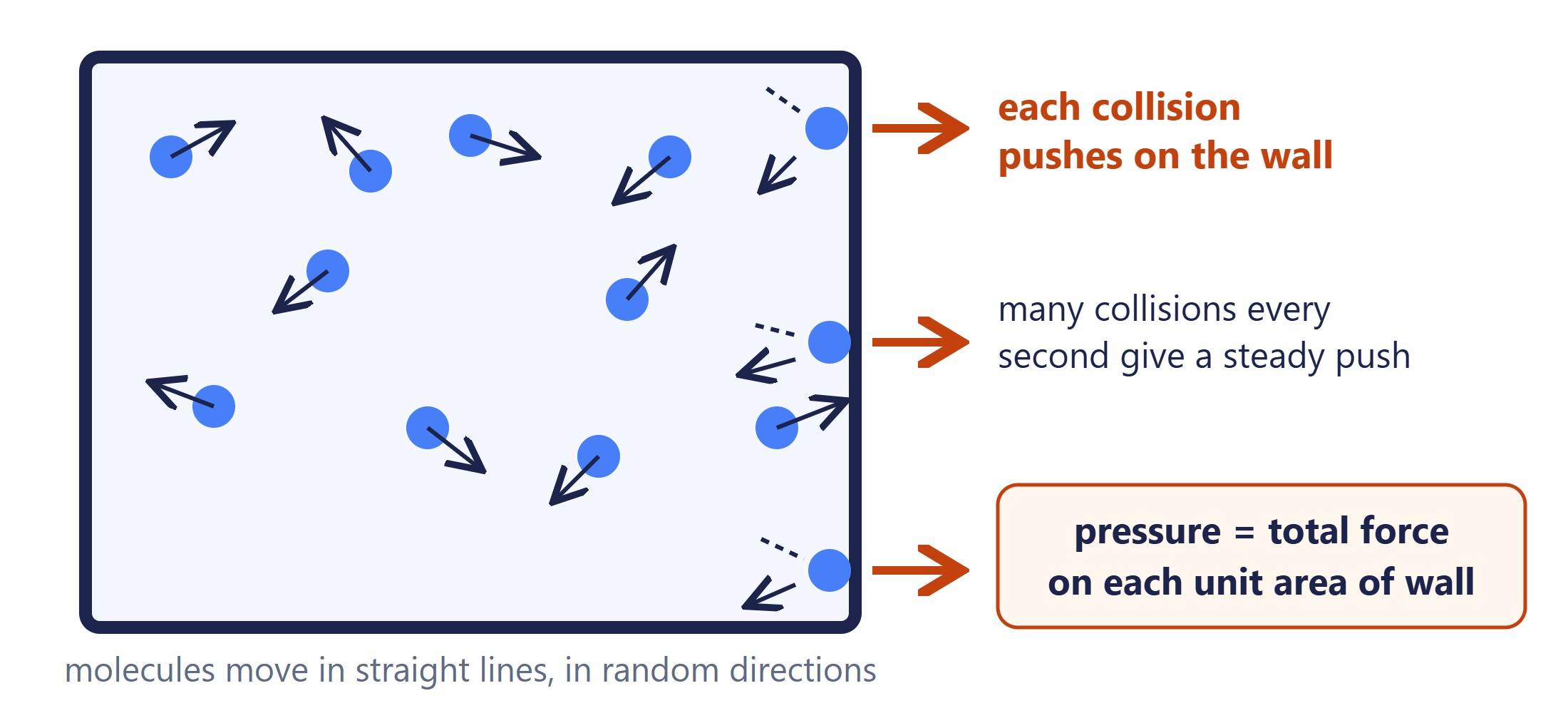
Gas pressure comes from molecules striking the walls: every collision pushes on the wall, and billions of collisions each second add up to a steady pressure.
A single collision is tiny, but there are an enormous number of them each second, so the wall feels a steady push. Pressure acts equally on every wall because the motion is random.
| Change made | What happens to the molecules | Effect on pressure |
|---|---|---|
| More gas in the same container | More molecules strike the wall each second | Rises |
| Same gas in a smaller container | Molecules have less far to travel, so they strike the wall more often | Rises |
| Same gas at a higher temperature | Molecules move faster, so they strike the wall more often and harder | Rises |
Exam answer model: Gas molecules collide with the walls of the container. Each collision exerts a force on the wall, and pressure is the total force per unit area.
Common mistake: Do not explain pressure by molecules hitting each other. Collisions between molecules do not push on the container, so the answer must mention the wall.
Quick Check: The Pressure in a Tyre
Apply the collision idea to a new situation.
The Ideal Gas Model
An ideal gas is a model that makes the behaviour of gases simple enough to calculate. The Cambridge syllabus asks for two properties of the model.
- Zero particle volume: the particles themselves take up no space, so all of the container is empty space for them to move in.
- No intermolecular forces of attraction: the particles do not pull on each other, so each one moves independently until it hits something.
No real gas is perfectly ideal, because real molecules have size and do attract each other. The model still works well when those two effects are small, which is the case when the molecules are far apart and moving fast.
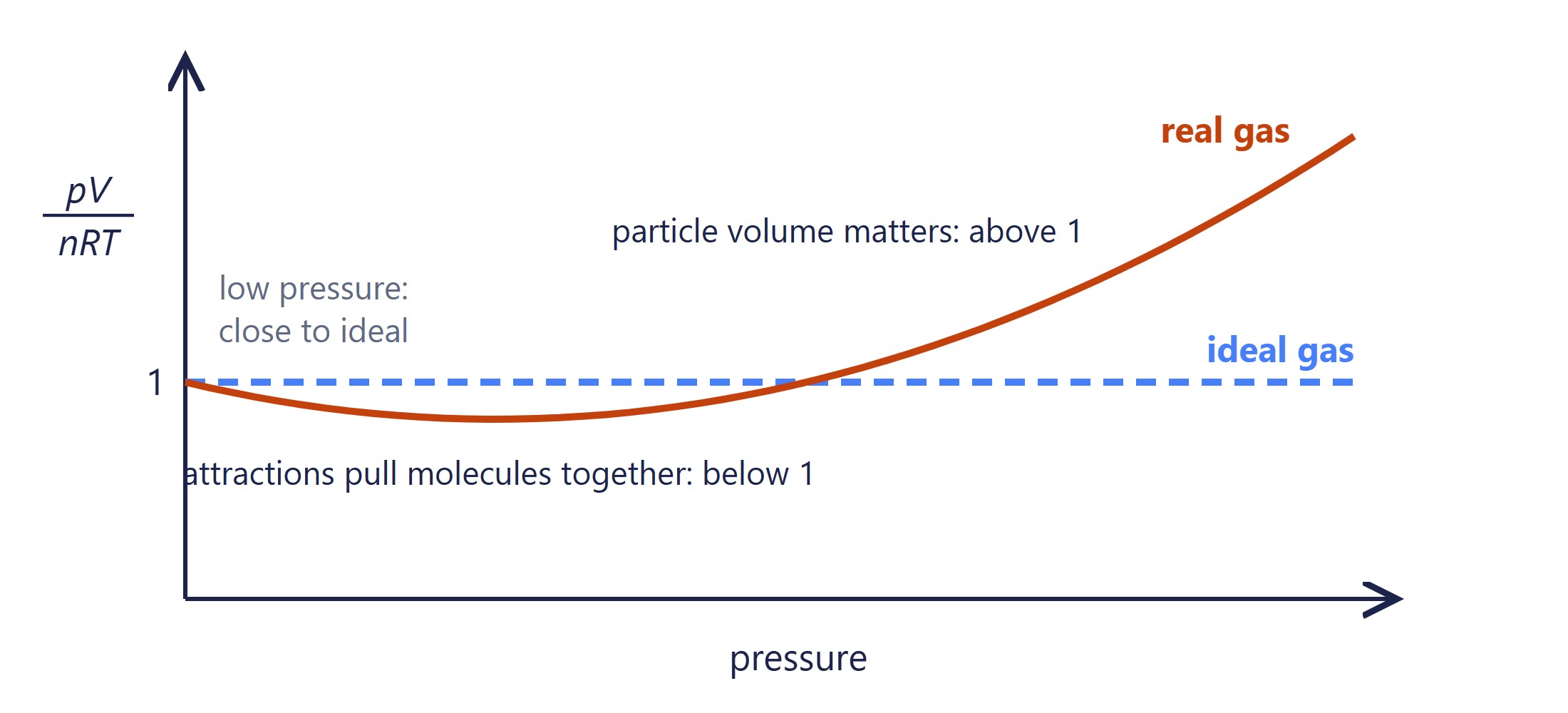
A sketch of how a real gas departs from ideal behaviour: (pV) / (nRT) stays at 1 for an ideal gas, while attractions pull a real gas below 1 and particle volume pushes it above 1 at high pressure.
| Condition | Effect on the molecules | Behaviour |
|---|---|---|
| Low pressure | Molecules far apart, so their volume is tiny compared with the space and attractions are weak | Close to ideal |
| High temperature | Molecules move fast, so attractions have little time to act | Close to ideal |
| High pressure | Molecules crowded together, so their own volume matters | Far from ideal |
| Low temperature | Molecules move slowly, so attractions pull them together and the gas nears condensing | Far from ideal |
Key idea: Polar molecules such as ammonia attract each other more strongly than noble gas atoms such as helium, so helium behaves more like an ideal gas under the same conditions.
Quick Check: Ideal or Not?
Decide which gases and conditions fit the ideal gas model.
The Ideal Gas Equation
For an ideal gas, pressure, volume, amount and temperature are linked by the ideal gas equation, pV = nRT. The equation only gives the right answer in SI units, so convert every value before substituting.
| Symbol | Quantity | SI unit | Conversion |
|---|---|---|---|
| p | Pressure | Pa | 1 kPa = 1000 Pa |
| V | Volume | m³ | 1 dm³ = 10⁻³ m³; 1 cm³ = 10⁻⁶ m³ |
| n | Amount of gas | mol | n = (mass) / (Mᵣ) |
| R | Molar gas constant | J K⁻¹ mol⁻¹ | 8.31, given in the table of constants on every paper |
| T | Temperature | K | T in K = temperature in °C + 273 |
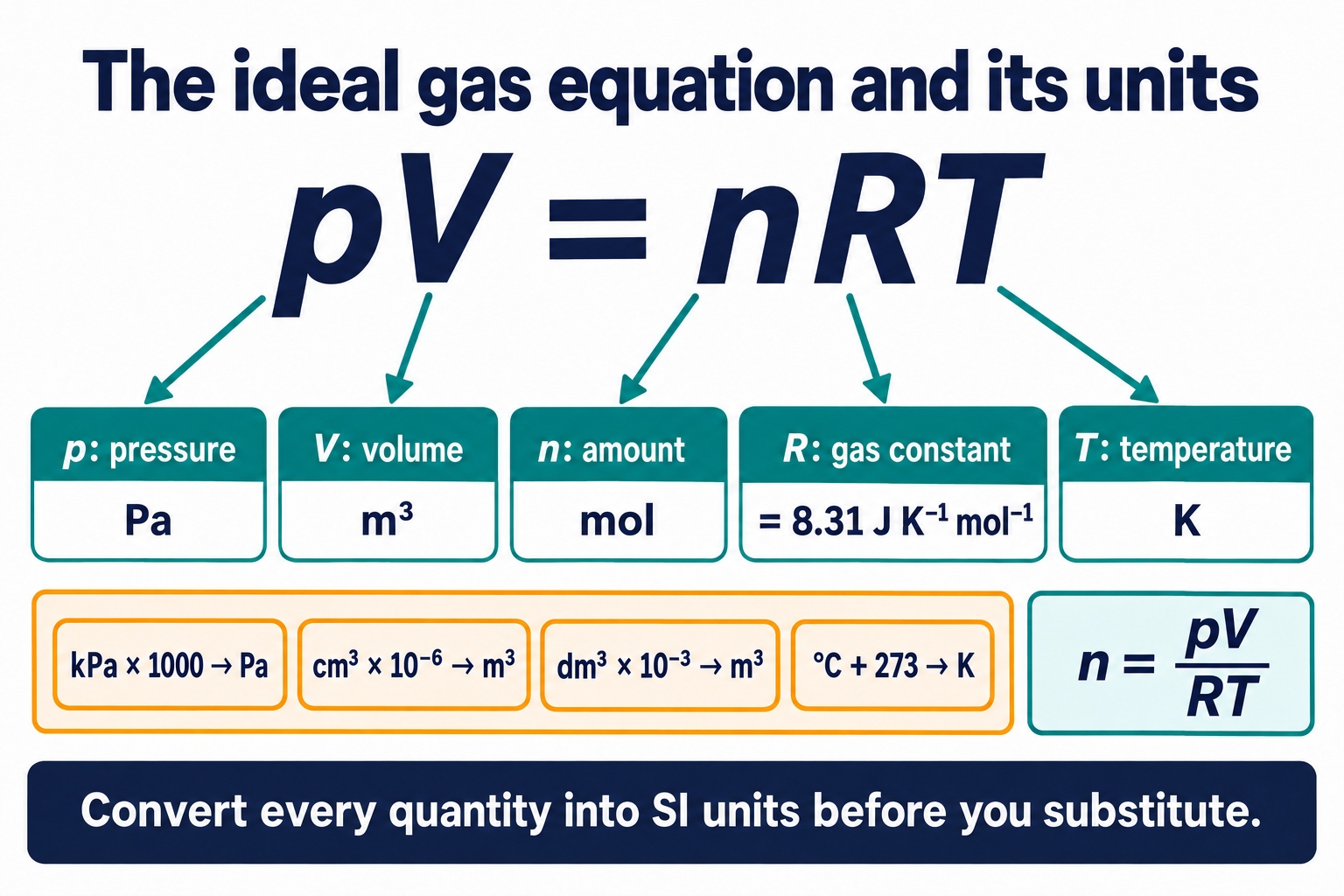
The ideal gas equation with each symbol, its SI unit and the conversions most often needed before substituting.
Worked example: finding a volume
Find the volume of 0.0500 mol of nitrogen at 25 °C and 101 kPa.
Step 1. Convert: T = 25 + 273 = 298 K and p = 101 000 Pa.
Answer: 0.00123 m³, which is 1.23 dm³ or 1230 cm³.
Worked example: finding a pressure
Find the pressure of 2.20 g of carbon dioxide (Mᵣ 44.0) in a 500 cm³ flask at 127 °C.
Step 2. Convert: V = 500 × 10⁻⁶ = 5.00 × 10⁻⁴ m³ and T = 127 + 273 = 400 K.
Answer: 332 000 Pa, which is 332 kPa.
Unit check: A volume of 1.23 m³ for a small amount of gas would fill a large cupboard, so an answer like that usually means a conversion has been missed. Check the size of every answer.
Equal Volumes, Equal Moles
Rearranging the equation gives V = (nRT) / (p). Nothing in it depends on which gas is present, because the ideal gas model ignores the size of the particles and the forces between them.
So, at the same temperature and pressure, equal volumes of gases contain equal numbers of moles. This is why one value of the molar volume can be used for every gas.
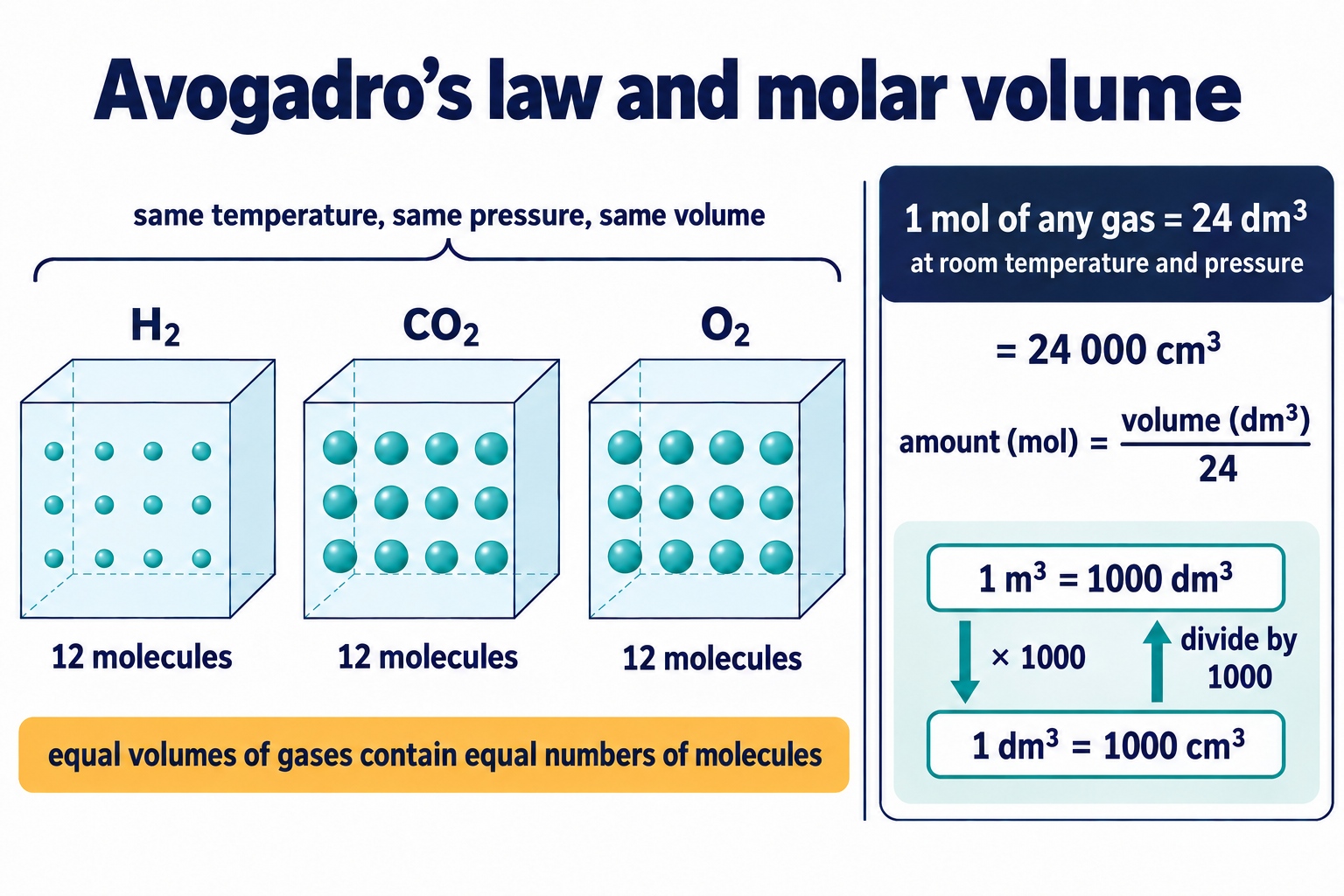
Equal volumes of different gases at the same temperature and pressure hold the same number of molecules, so one mole of any gas fills about 24 dm³ at room conditions.
Putting n = 1 mol, T = 293 K and p = 101 000 Pa into the equation gives V = 0.0241 m³, or 24.1 dm³.
That agrees closely with the molar volume of 24.0 dm³ mol⁻¹ at room conditions, which is used in Molar Volume Calculations.
Quick Check: Substitute and Convert
Use pV = nRT with new values. Watch the units.
Finding Mᵣ with the Ideal Gas Equation
Since n = (m) / (Mᵣ), the equation can be rewritten as pV = ((m) / (Mᵣ))RT. Rearranging gives Mᵣ = (mRT) / (pV), with m in grams and every other quantity in SI units.
Measuring it for a volatile liquid
Step 1. Draw a little of the liquid into a small syringe and weigh it.
Step 4. Record the increase in gas volume once the plunger stops moving, then the oven temperature and the atmospheric pressure.
Worked example: Mᵣ of a volatile liquid
A 0.200 g sample of a liquid gives 106 cm³ of vapour at 100 °C and 101 kPa. Find Mᵣ.
Step 1. Convert: V = 106 × 10⁻⁶ m³, T = 373 K and p = 101 000 Pa.
Answer: Mᵣ = 57.9, which fits propanone, C₃H₆O (Mᵣ 58.0).
Worked example: Mᵣ from a gas density
A gas has a density of 1.25 g dm⁻³ at 273 K and 101 kPa. Find Mᵣ.
Step 1. Use 1.00 dm³, so m = 1.25 g and V = 1.00 × 10⁻³ m³.
Answer: Mᵣ = 28.1, which fits nitrogen, N₂ (Mᵣ 28.0).
| Source of error | Effect on the volume measured | Effect on Mᵣ |
|---|---|---|
| Oven only just above the boiling point, so some vapour condenses | Too small | Too high |
| Vapour leaks past the plunger or seal | Too small | Too high |
| Temperature recorded lower than the true value | Not changed | Too low |
Exam focus: Mᵣ is inversely proportional to the volume, so a volume that reads low always gives an Mᵣ that is too high. State the direction of the error and give the reason.
Quick Check: The Syringe Method in Order
Put the measurement steps for a new liquid into the correct order.
Quick Check: Exam-Style Problems
Five harder questions that combine the ideas on this page.
Common Exam Mistakes
- Explaining pressure without mentioning collisions with the wall of the container.
- Leaving temperature in °C. Add 273 first, because T must be in kelvin.
- Leaving volume in cm³ or dm³. Convert to m³: divide cm³ by 10⁶ and dm³ by 10³.
- Leaving pressure in kPa. Multiply by 1000 to reach Pa.
- Stating only one property of an ideal gas. Give both: zero particle volume and no intermolecular forces.
- Using grams in place of moles for n. Find n from (m) / (Mᵣ), or use Mᵣ = (mRT) / (pV).
Where This Sits in the Cambridge Syllabus
This page covers learning outcomes 4.1.1 to 4.1.3 for Papers 1 and 2. The moles and molar volume work behind it is in Calculations with Solutions and Gases, and the solid state half of Topic 4 continues in Structure Types.
FAQs
Use these quick answers to check the origin of gas pressure, the ideal gas model and calculations with pV = nRT.
Why does a gas exert pressure on its container?
Gas molecules move quickly in random directions and collide with the walls. Each collision exerts a small force, and the total force on each unit area of wall is the pressure of the gas.
What are the two properties of an ideal gas?
An ideal gas has zero particle volume and no intermolecular forces of attraction. Real gases come closest to this at low pressure and high temperature, because the molecules are then far apart and moving fast.
What units must I use in pV = nRT?
Use pressure in Pa, volume in m³, amount in mol and temperature in K, with R = 8.31 J K⁻¹ mol⁻¹. Convert every value before substituting, because mixed units give an answer that is wrong by a large factor.
How do I find Mᵣ from gas measurements?
Replace n with (m) / (Mᵣ) and rearrange to give Mᵣ = (mRT) / (pV). Measure the mass of a volatile liquid, the volume of its vapour, the temperature and the pressure, then substitute with m in grams.
Why is helium closer to ideal than ammonia?
Helium atoms are small and have only very weak attractions between them. Ammonia molecules form hydrogen bonds with each other, so their attractions affect how they move and strike the wall.

Copyright notice: This OLS revision content, including the explanations, layout, diagrams, tables and embedded learning structure, is authored for Online Learning System by Dr. Mohammed Al-Fatah. It may not be copied, reproduced, redistributed or adapted without written permission.
Keep this note — free
Save your progress across every Cambridge topic. A free account remembers which topics you have covered, saves your question scores, and syncs across your phone and laptop.
- Track every topic you have finished
- Keep your practice-question scores
- No payment, no card, free forever
Already registered? Log in