Topic 10
Alcohols, Halogenoalkanes
& Spectra
Topic 10 is the organic chemistry of Unit 2. Part 10A Alcohols covers naming and classification, oxidation with acidified dichromate(VI), the substitution and elimination reactions of alcohols, and the practical techniques for preparing and purifying a liquid. Part 10B Halogenoalkanes builds the language of mechanisms, then nucleophilic substitution, elimination and the rates of hydrolysis. Part 10C Spectra reads mass spectra and infrared spectra and combines them with chemical tests to identify unknowns. Core Practicals 5, 6, 7 and 8 belong to this topic.
Revision Notes
3 revision notes, in the order the specification teaches them.
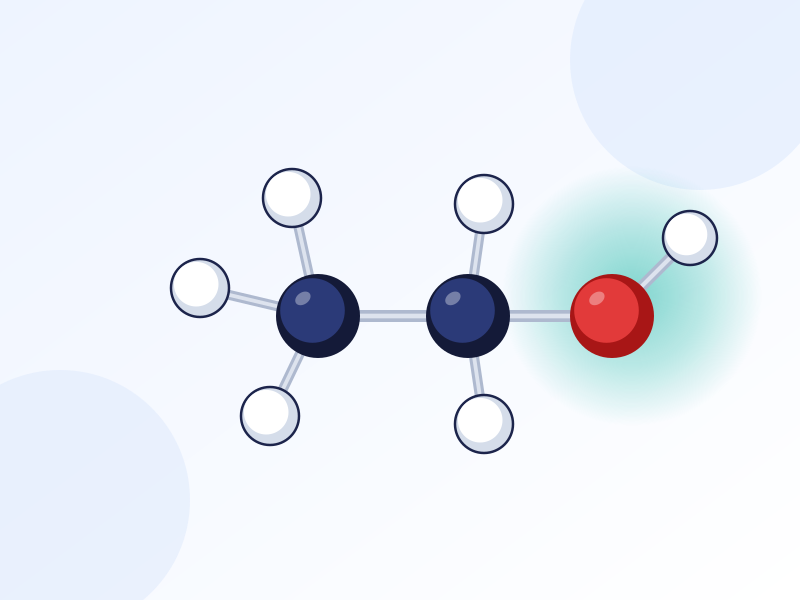
Topic 10A Alcohols
Naming and classifying alcohols, their hydrogen bonding, oxidation with acidified dichromate(VI), substitution and elimination reactions, and the techniques for preparing and purifying a liquid product (Core Practical 7).
Start revising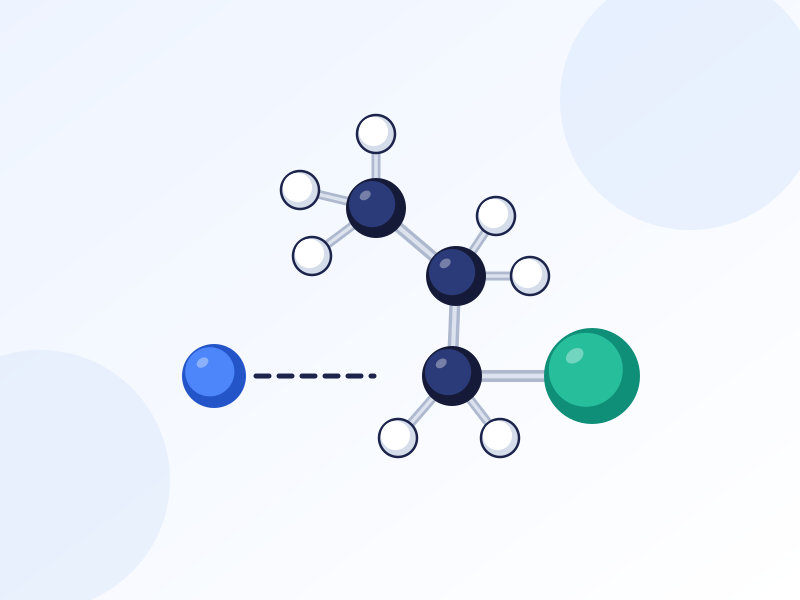
Topic 10B Halogenoalkanes
Reaction types and mechanisms, naming and classifying halogenoalkanes, nucleophilic substitution with hydroxide, water, ammonia and cyanide, elimination with ethanolic KOH, and rates of hydrolysis (Core Practicals 5 and 6).
Start revising
Topic 10C Spectra
Molecular ions and fragmentation in mass spectra, infrared absorptions of functional groups, and combining spectra with chemical tests to identify unknown compounds (Core Practical 8).
Start revisingSummary Map
Every reaction of the topic on one printable page.
The summary map for Topic 10 Alcohols, Halogenoalkanes and Spectra is being drawn.
Virtual Lessons
Recorded video lessons that teach the topic step by step.
The Virtual Lessons for Topic 10 Alcohols, Halogenoalkanes and Spectra are being recorded.
MCQ Bank
Multiple-choice papers on this topic, marked the moment you submit.
The MCQ papers for Topic 10 Alcohols, Halogenoalkanes and Spectra are being written.
SAQ Bank
Written, drawn and worked exam practice on this topic.
The exam practice papers for Topic 10 Alcohols, Halogenoalkanes and Spectra are being written.
Revision Game
Match reagents to products, with your board's reagents and conditions.
The revision game for Topic 10 Alcohols, Halogenoalkanes and Spectra is being built.
Study Cards
Pick a deck, then turn each card to check what you remember.
Specification
Every specification point in this topic, in the exam board's own words. Rate how confident you are with each one.
Self-assessment · 70 points
Sign in to rate how confident you feel about each point. Your ratings are saved to your account, follow you to any device, and appear beside your KASP analytics, kept apart from your marks.
10.1
10.2
10.3
10.4
10.5
- 10.5
understand the link between bond polarity and the type of reaction mechanism a compound will undergo
Revise
10.6
10.7
10.8
- i
understand the reactions of halogenoalkanes with: aqueous alkali, including KOH(aq) to produce alcohols (where the hydroxide ion acts as a nucleophile)
Revise - ii
understand the reactions of halogenoalkanes with: ethanolic potassium hydroxide to produce alkenes by an elimination reaction (where the hydroxide ion acts as a base)
Revise - iii
understand the reactions of halogenoalkanes with: aqueous silver nitrate in ethanol (where water acts as a nucleophile)
Revise - iv
understand the reactions of halogenoalkanes with: alcoholic ammonia under pressure to produce amines (where the ammonia acts as a nucleophile)
Revise - v
understand the reactions of halogenoalkanes with: alcoholic potassium cyanide to produce nitriles (where the cyanide ion acts as a nucleophile) Students should know this is an example of increasing the length of the carbon chain.
Revise
10.9
- i
understand the mechanisms of the nucleophilic substitution reactions between primary halogenoalkanes and: aqueous potassium hydroxide
Revise - ii
understand the mechanisms of the nucleophilic substitution reactions between primary halogenoalkanes and: ammonia SN1 and SN2 substitution mechanisms will be tested in Unit 4.
Revise
10.10
- i
understand that experimental observations and data can be used to compare the relative rates of hydrolysis of: primary, secondary and tertiary structural isomers of a halogenoalkane
Revise - ii
understand that experimental observations and data can be used to compare the relative rates of hydrolysis of: primary chloro-, bromo- and iodoalkanes using aqueous silver nitrate in ethanol
Revise
10.11
10.12
10.13
10.14
- 10.14
CORE PRACTICAL 6 Chlorination of 2-methylpropan-2-ol with concentrated hydrochloric acid.
Revise
10.15
10.16
10.17
- ii c
understand the reactions of alcohols with 50% concentrated sulfuric acid and potassium bromide to produce bromoalkanes
Revise - ii d
understand the reactions of alcohols with red phosphorus and iodine to produce iodoalkanes
Revise - iii a
understand the reactions of alcohols with concentrated phosphoric acid to form alkenes by elimination
Revise - iii b
know that descriptions of the mechanisms of alcohol elimination reactions are not required
Revise
10.18
- i
understand that potassium dichromate(VI) in dilute sulfuric acid can oxidise: primary alcohols to produce aldehydes (which give a positive result with Benedict’s or Fehling’s solution) if the product is distilled as it forms
Revise - ii
understand that potassium dichromate(VI) in dilute sulfuric acid can oxidise: primary alcohols to produce carboxylic acids (which give a positive result with sodium carbonate or sodium hydrogencarbonate) if the reagents are heated under reflux
Revise - iii a
understand that potassium dichromate(VI) in dilute sulfuric acid can oxidise secondary alcohols to ketones
Revise
10.19
- i
understand, the following techniques in the preparation and purification of a liquid organic compound: heating under reflux
Revise - ii
understand, the following techniques in the preparation and purification of a liquid organic compound: extraction with a solvent using a separating funnel
Revise - iii
understand, the following techniques in the preparation and purification of a liquid organic compound: distillation
Revise - iv
understand, the following techniques in the preparation and purification of a liquid organic compound: drying with an anhydrous salt
Revise - v
understand, the following techniques in the preparation and purification of a liquid organic compound: boiling temperature determination
Revise
10.20
10.21
10.22
- i
be able to use infrared spectra, or data from infrared spectra, to deduce functional groups present in organic compounds, and predict infrared absorptions, given wavenumber data, due to familiar functional groups including: C–H stretching absorptions in alkanes, alkenes and aldehydes
Revise - ii
be able to use infrared spectra, or data from infrared spectra, to deduce functional groups present in organic compounds, and predict infrared absorptions, given wavenumber data, due to familiar functional groups including: C=C stretching absorption in alkenes
Revise - iii
be able to use infrared spectra, or data from infrared spectra, to deduce functional groups present in organic compounds, and predict infrared absorptions, given wavenumber data, due to familiar functional groups including: O–H stretching absorptions in alcohols and carboxylic acids
Revise - iv
be able to use infrared spectra, or data from infrared spectra, to deduce functional groups present in organic compounds, and predict infrared absorptions, given wavenumber data, due to familiar functional groups including: C=O stretching absorptions in aldehydes, ketones and carboxylic acids
Revise - v
be able to use infrared spectra, or data from infrared spectra, to deduce functional groups present in organic compounds, and predict infrared absorptions, given wavenumber data, due to familiar functional groups including: C–X stretching absorption in halogenoalkanes
Revise - vi
be able to use infrared spectra, or data from infrared spectra, to deduce functional groups present in organic compounds, and predict infrared absorptions, given wavenumber data, due to familiar functional groups including: N-H stretching absorption in amines
Revise
10.23
Keep this note — free
Save your progress across every Edexcel IAL topic. A free account remembers which topics you have covered, saves your question scores, and syncs across your phone and laptop.
- Track every topic you have finished
- Keep your practice-question scores
- No payment, no card, free forever
Already registered? Log in