Reactions of Metal Ions with Sodium Hydroxide and Ammonia
A concise revision guide to the test-tube reactions of Cr³⁺, Mn²⁺, Fe²⁺, Fe³⁺, Co²⁺, Ni²⁺, Cu²⁺ and Zn²⁺ ions with aqueous sodium hydroxide and aqueous ammonia: observations, ionic equations and what happens in excess.
- 17.22-a
- 17.22-b
- 17.22-c
- 17.22-d
- 17.22-e
- 17.22-f
- 17.22-g
- 17.22-h
- 17.22-i
- 17.22-j
- 17.22-k
- 17.22-l
- 17.22-m
- 17.22-n
- 17.22-o
- 17.22-p
- 17.22-q
- 17.22-r
- 17.22-s
- 17.22-t
- 17.22-u
- 17.22-v
- 17.22-w
- 17.22-x
- 17.22-y
- 17.22-z
- 17.22-aa
- 17.22-ab
- 17.22-ac
- 17.22-ad
- 17.22-ae
- 17.22-af
- 17.23-a
- 17.23-b
- 17.23-c
What these spec points say
- 17.22-a be able to record observations and write suitable equations for reactions of Cr3+(aq) with aqueous sodium hydroxide
- 17.22-b be able to record observations and write suitable equations for reactions of Cr3+(aq) with aqueous sodium hydroxide in excess
- 17.22-c be able to record observations and write suitable equations for reactions of Cr3+(aq) with aqueous ammonia
- 17.22-d be able to record observations and write suitable equations for reactions of Cr3+(aq) with aqueous ammonia in excess
- 17.22-e be able to record observations and write suitable equations for reactions of Mn2+(aq) with aqueous sodium hydroxide
- 17.22-f be able to record observations and write suitable equations for reactions of Mn2+(aq) with aqueous sodium hydroxide in excess
- 17.22-g be able to record observations and write suitable equations for reactions of Mn2+(aq) with aqueous ammonia
- 17.22-h be able to record observations and write suitable equations for reactions of Mn2+(aq) with aqueous ammonia in excess
- 17.22-i be able to record observations and write suitable equations for reactions of Fe2+(aq) with aqueous sodium hydroxide
- 17.22-j be able to record observations and write suitable equations for reactions of Fe2+(aq) with aqueous sodium hydroxide in excess
- 17.22-k be able to record observations and write suitable equations for reactions of Fe2+(aq) with aqueous ammonia
- 17.22-l be able to record observations and write suitable equations for reactions of Fe2+(aq) with aqueous ammonia in excess
- 17.22-m be able to record observations and write suitable equations for reactions of Fe3+(aq) with aqueous sodium hydroxide
- 17.22-n be able to record observations and write suitable equations for reactions of Fe3+(aq) with aqueous sodium hydroxide in excess
- 17.22-o be able to record observations and write suitable equations for reactions of Fe3+(aq) with aqueous ammonia
- 17.22-p be able to record observations and write suitable equations for reactions of Fe3+(aq) with aqueous ammonia in excess
- 17.22-q be able to record observations and write suitable equations for reactions of Co2+(aq) with aqueous sodium hydroxide
- 17.22-r be able to record observations and write suitable equations for reactions of Co2+(aq) with aqueous sodium hydroxide in excess
- 17.22-s be able to record observations and write suitable equations for reactions of Co2+(aq) with aqueous ammonia
- 17.22-t be able to record observations and write suitable equations for reactions of Co2+(aq) with aqueous ammonia in excess
- 17.22-u be able to record observations and write suitable equations for reactions of Ni2+(aq) with aqueous sodium hydroxide
- 17.22-v be able to record observations and write suitable equations for reactions of Ni2+(aq) with aqueous sodium hydroxide in excess
- 17.22-w be able to record observations and write suitable equations for reactions of Ni2+(aq) with aqueous ammonia
- 17.22-x be able to record observations and write suitable equations for reactions of Ni2+(aq) with aqueous ammonia in excess
- 17.22-y be able to record observations and write suitable equations for reactions of Cu2+(aq) with aqueous sodium hydroxide
- 17.22-z be able to record observations and write suitable equations for reactions of Cu2+(aq) with aqueous sodium hydroxide in excess
- 17.22-aa be able to record observations and write suitable equations for reactions of Cu2+(aq) with aqueous ammonia
- 17.22-ab be able to record observations and write suitable equations for reactions of Cu2+(aq) with aqueous ammonia in excess
- 17.22-ac be able to record observations and write suitable equations for reactions of Zn2+(aq) with aqueous sodium hydroxide
- 17.22-ad be able to record observations and write suitable equations for reactions of Zn2+(aq) with aqueous sodium hydroxide in excess
- 17.22-ae be able to record observations and write suitable equations for reactions of Zn2+(aq) with aqueous ammonia
- 17.22-af be able to record observations and write suitable equations for reactions of Zn2+(aq) with aqueous ammonia in excess
- 17.23-a be able to write ionic equations to show amphoteric behaviour in reactions in 17.22
- 17.23-b be able to write ionic equations to show deprotonation in reactions in 17.22
- 17.23-c be able to write ionic equations to show ligand exchange in reactions in 17.22
From Aqua Ion to Hydroxide
Choose a step to watch hydroxide ions take protons from the water ligands of a metal aqua ion until a neutral complex precipitates.
© Dr. Mohammed Al-Fatah – onlinelearningsystem.net
Before You Start
This page builds on Ligands, Complex Ions and Their Shapes and Ligand exchange and the Stability of Complexes.
What you need to remember
- A precipitate is an insoluble solid that forms when two solutions are mixed.
- Aqueous sodium hydroxide gives a blue precipitate with copper(II) ions: this test was met before A Level.
- In solution a metal ion is an aqua ion, such as [Cu(H₂O)₆]²⁺, with six water ligands.
- Aqueous ammonia is a weak base: NH₃(aq) + H₂O(l) ⇌ NH₄⁺(aq) + OH⁻(aq).
- Ammonia is also a ligand: it has a lone pair on the nitrogen atom.
GCSE Recap: Testing for Ions
Three quick questions on the GCSE ion tests this page builds on.
The Observations
Each test starts with a few drops of the reagent, which is then added until it is in excess.
| Ion | Aqua ion and colour | A few drops of NaOH(aq) or NH₃(aq) | Excess NaOH(aq) | Excess NH₃(aq) |
|---|---|---|---|---|
| Cr³⁺ | [Cr(H₂O)₆]³⁺: green solution (violet when pure) | grey-green precipitate, Cr(OH)₃(H₂O)₃ | dissolves: dark green solution, [Cr(OH)₆]³⁻ | dissolves: purple solution, formed slowly, [Cr(NH₃)₆]³⁺ |
| Mn²⁺ | [Mn(H₂O)₆]²⁺: very pale pink solution (almost colourless) | off-white (pale brown) precipitate, Mn(OH)₂(H₂O)₄; darkens to brown on standing in air | no further change: precipitate remains | no further change: precipitate remains |
| Fe²⁺ | [Fe(H₂O)₆]²⁺: pale green solution | green precipitate, Fe(OH)₂(H₂O)₄; turns orange-brown at the surface on standing in air | no further change: precipitate remains | no further change: precipitate remains |
| Fe³⁺ | [Fe(H₂O)₆]³⁺: yellow-brown solution | orange-brown precipitate, Fe(OH)₃(H₂O)₃ | no further change: precipitate remains | no further change: precipitate remains |
| Co²⁺ | [Co(H₂O)₆]²⁺: pink solution | blue precipitate, Co(OH)₂(H₂O)₄; turns pink on standing | no further change: precipitate remains | dissolves: yellow-brown solution, which darkens in air, [Co(NH₃)₆]²⁺ |
| Ni²⁺ | [Ni(H₂O)₆]²⁺: green solution | green precipitate, Ni(OH)₂(H₂O)₄ | no further change: precipitate remains | dissolves: blue solution, [Ni(NH₃)₆]²⁺ |
| Cu²⁺ | [Cu(H₂O)₆]²⁺: blue solution | pale blue precipitate, Cu(OH)₂(H₂O)₄ | no further change: precipitate remains | dissolves: deep blue solution, [Cu(NH₃)₄(H₂O)₂]²⁺ |
| Zn²⁺ | [Zn(H₂O)₄]²⁺: colourless solution | white precipitate, Zn(OH)₂(H₂O)₂ | dissolves: colourless solution, [Zn(OH)₄]²⁻ | dissolves: colourless solution, [Zn(NH₃)₄]²⁺ |
- A few drops of either reagent give the same precipitate: the metal hydroxide.
- The differences appear only when the reagent is in excess.
- The zinc aqua ion is sometimes written with six water ligands. The observations are the same.
- Pure [Cr(H₂O)₆]³⁺ is violet, but solutions of chromium(III) salts usually look green.
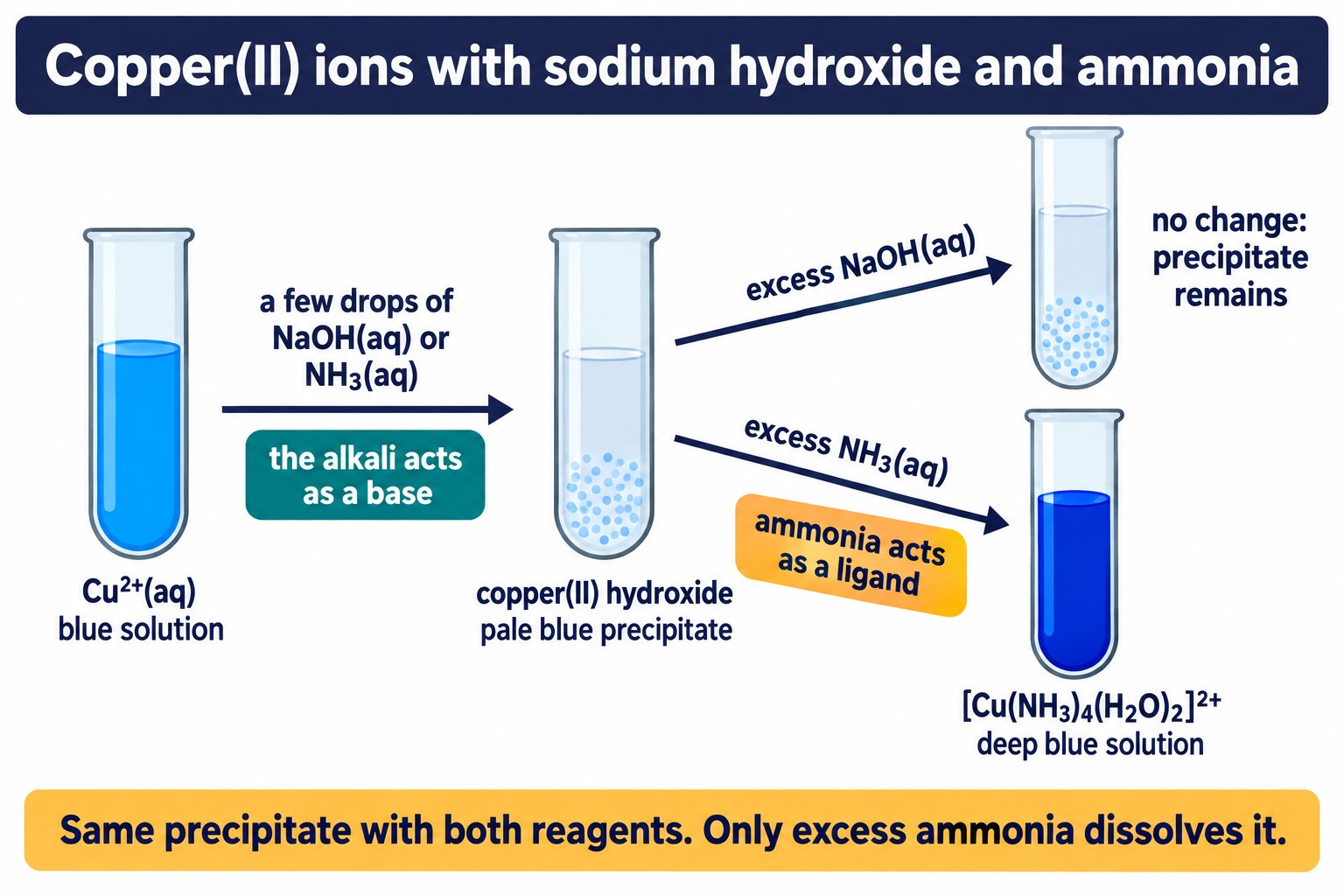
Copper(II) ions: a pale blue precipitate with a few drops of either alkali, which dissolves only in excess ammonia to give a deep blue solution.
A Few Drops: Precipitation of the Hydroxide
Hydroxide ions remove H⁺ ions from water ligands of the aqua ion. This is deprotonation, an acid–base reaction.
- Each H⁺ removed lowers the charge of the complex by one.
- When the charge reaches zero, the neutral complex is insoluble and forms a precipitate.
- A 2+ ion needs two OH⁻ ions. A 3+ ion needs three.
- The oxidation number of the metal and the number of ligands do not change.
| Ion | With OH⁻(aq) | With NH₃(aq) |
|---|---|---|
| Cr³⁺ | [Cr(H₂O)₆]³⁺ + 3OH⁻ → Cr(OH)₃(H₂O)₃ + 3H₂O | [Cr(H₂O)₆]³⁺ + 3NH₃ → Cr(OH)₃(H₂O)₃ + 3NH₄⁺ |
| Mn²⁺ | [Mn(H₂O)₆]²⁺ + 2OH⁻ → Mn(OH)₂(H₂O)₄ + 2H₂O | [Mn(H₂O)₆]²⁺ + 2NH₃ → Mn(OH)₂(H₂O)₄ + 2NH₄⁺ |
| Fe²⁺ | [Fe(H₂O)₆]²⁺ + 2OH⁻ → Fe(OH)₂(H₂O)₄ + 2H₂O | [Fe(H₂O)₆]²⁺ + 2NH₃ → Fe(OH)₂(H₂O)₄ + 2NH₄⁺ |
| Fe³⁺ | [Fe(H₂O)₆]³⁺ + 3OH⁻ → Fe(OH)₃(H₂O)₃ + 3H₂O | [Fe(H₂O)₆]³⁺ + 3NH₃ → Fe(OH)₃(H₂O)₃ + 3NH₄⁺ |
| Co²⁺ | [Co(H₂O)₆]²⁺ + 2OH⁻ → Co(OH)₂(H₂O)₄ + 2H₂O | [Co(H₂O)₆]²⁺ + 2NH₃ → Co(OH)₂(H₂O)₄ + 2NH₄⁺ |
| Ni²⁺ | [Ni(H₂O)₆]²⁺ + 2OH⁻ → Ni(OH)₂(H₂O)₄ + 2H₂O | [Ni(H₂O)₆]²⁺ + 2NH₃ → Ni(OH)₂(H₂O)₄ + 2NH₄⁺ |
| Cu²⁺ | [Cu(H₂O)₆]²⁺ + 2OH⁻ → Cu(OH)₂(H₂O)₄ + 2H₂O | [Cu(H₂O)₆]²⁺ + 2NH₃ → Cu(OH)₂(H₂O)₄ + 2NH₄⁺ |
| Zn²⁺ | [Zn(H₂O)₄]²⁺ + 2OH⁻ → Zn(OH)₂(H₂O)₂ + 2H₂O | [Zn(H₂O)₄]²⁺ + 2NH₃ → Zn(OH)₂(H₂O)₂ + 2NH₄⁺ |
- Ammonia acts as a base here, not as a ligand: it accepts H⁺ and becomes NH₄⁺.
- The precipitate is the same with both reagents.
- The precipitates are often written without the water ligands, for example Cu(OH)₂.
Changes on standing
- The green iron(II) hydroxide turns orange-brown at the surface: oxygen in the air oxidises it to iron(III) hydroxide.
- The off-white manganese(II) hydroxide darkens to brown as air oxidises it.
- The blue cobalt(II) hydroxide slowly turns pink.
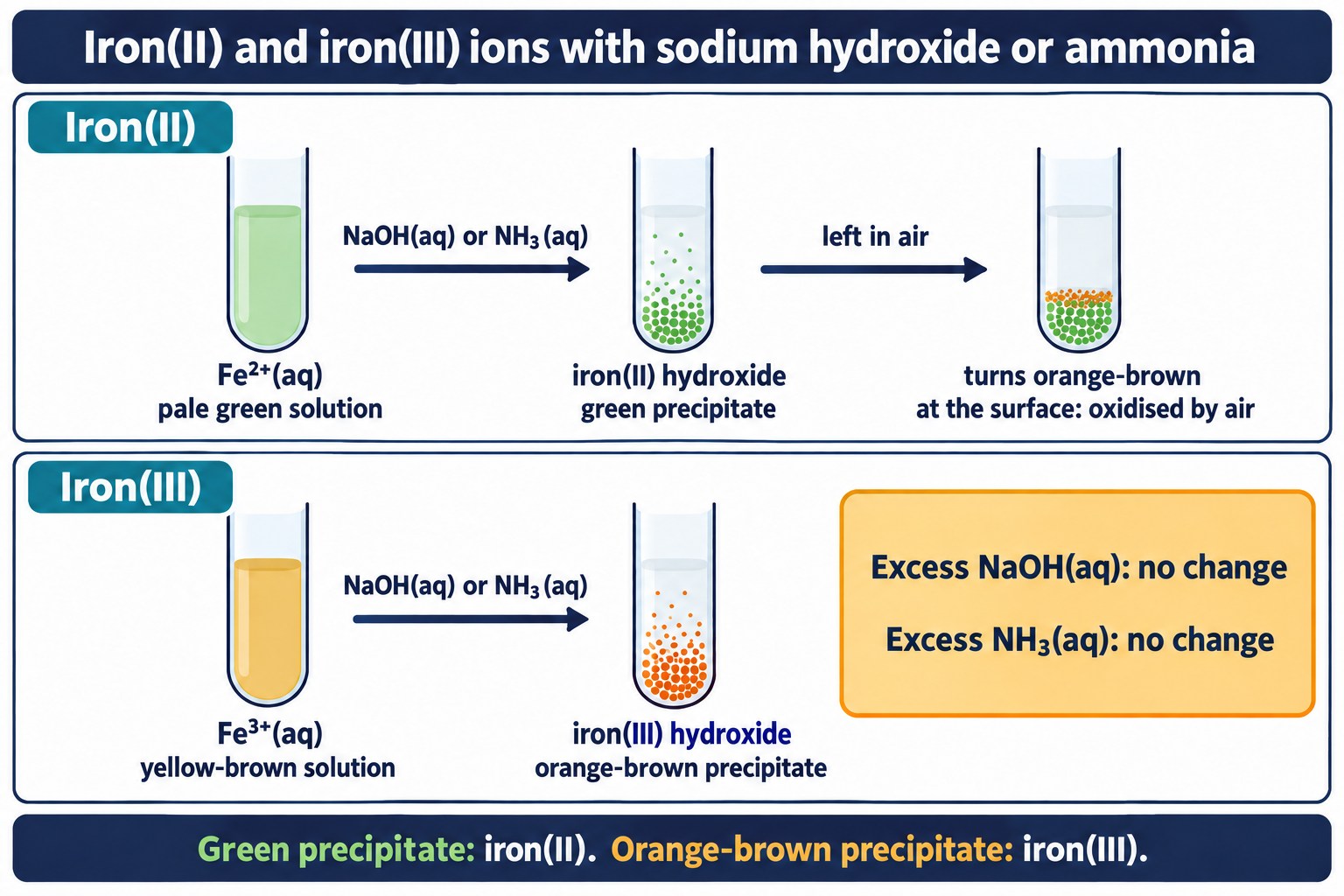
Iron(II) ions give a green precipitate and iron(III) ions an orange-brown precipitate. Neither dissolves in excess sodium hydroxide or ammonia.
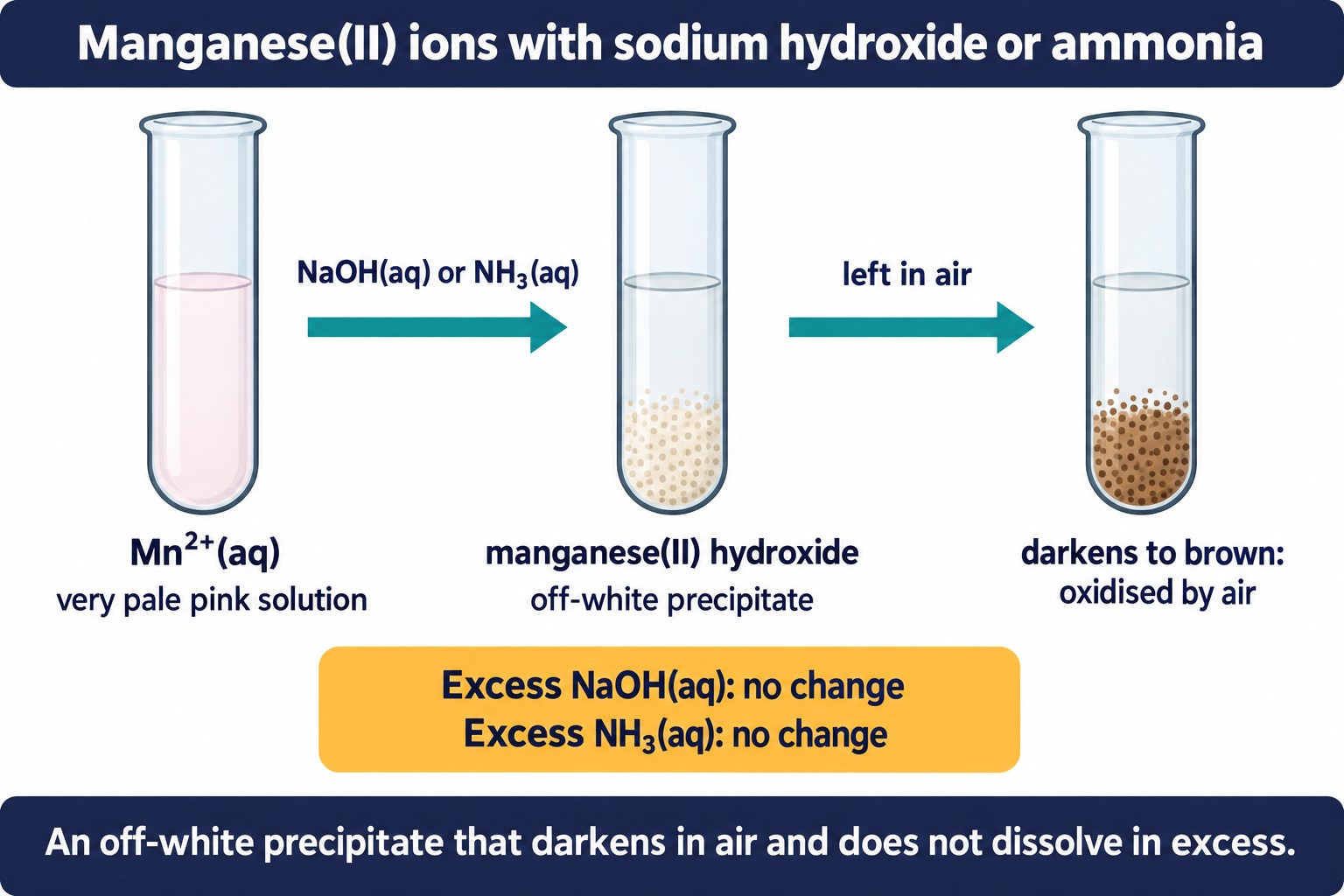
Manganese(II) ions give an off-white precipitate that darkens in air and does not dissolve in excess of either reagent.
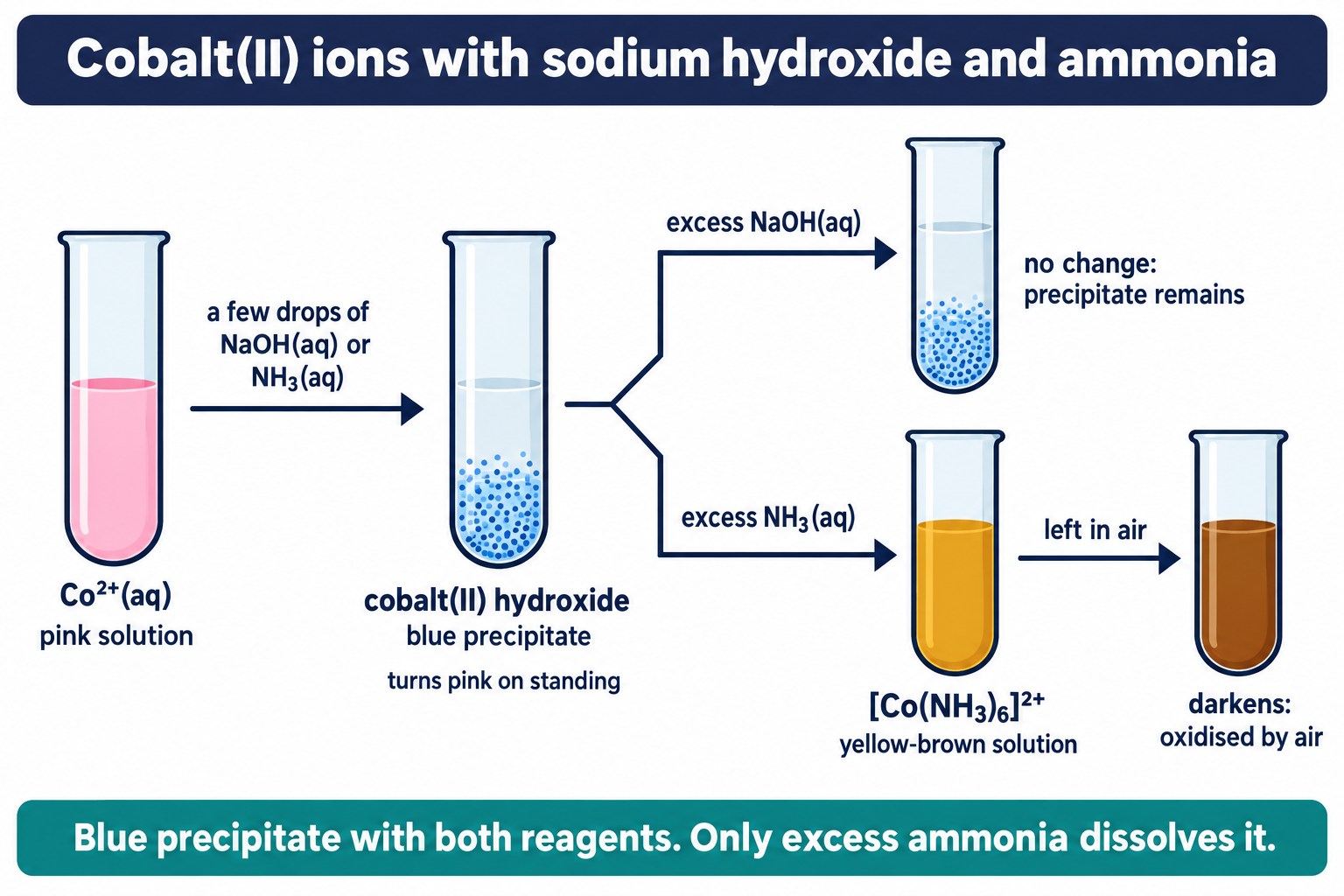
Cobalt(II) ions: a blue precipitate that does not dissolve in excess sodium hydroxide but dissolves in excess ammonia to give a yellow-brown solution.
Check: Hydroxide Precipitates
Use the idea that the precipitate is the neutral metal hydroxide: count the hydroxide ions needed, write ionic equations and explain why both reagents give the same solid.
Excess Sodium Hydroxide: Amphoteric Hydroxides
An amphoteric hydroxide reacts with both acids and bases. It dissolves in excess sodium hydroxide and also in acid.
| Hydroxide | With excess OH⁻ (acting as an acid) | With H⁺ (acting as a base) | Observation in excess NaOH |
|---|---|---|---|
| chromium(III) hydroxide | Cr(OH)₃(H₂O)₃ + 3OH⁻ → [Cr(OH)₆]³⁻ + 3H₂O | Cr(OH)₃(H₂O)₃ + 3H⁺ → [Cr(H₂O)₆]³⁺ | grey-green precipitate dissolves: dark green solution |
| zinc hydroxide | Zn(OH)₂(H₂O)₂ + 2OH⁻ → [Zn(OH)₄]²⁻ + 2H₂O | Zn(OH)₂(H₂O)₂ + 2H⁺ → [Zn(H₂O)₄]²⁺ | white precipitate dissolves: colourless solution |
- In excess sodium hydroxide, more H⁺ ions are removed from the water ligands. The complex becomes negatively charged and dissolves.
- The hydroxides of Mn²⁺, Fe²⁺, Fe³⁺, Co²⁺, Ni²⁺ and Cu²⁺ do not dissolve in excess sodium hydroxide. They are basic, not amphoteric.
- Every hydroxide on this page dissolves in dilute acid to give back the aqueous metal ion.
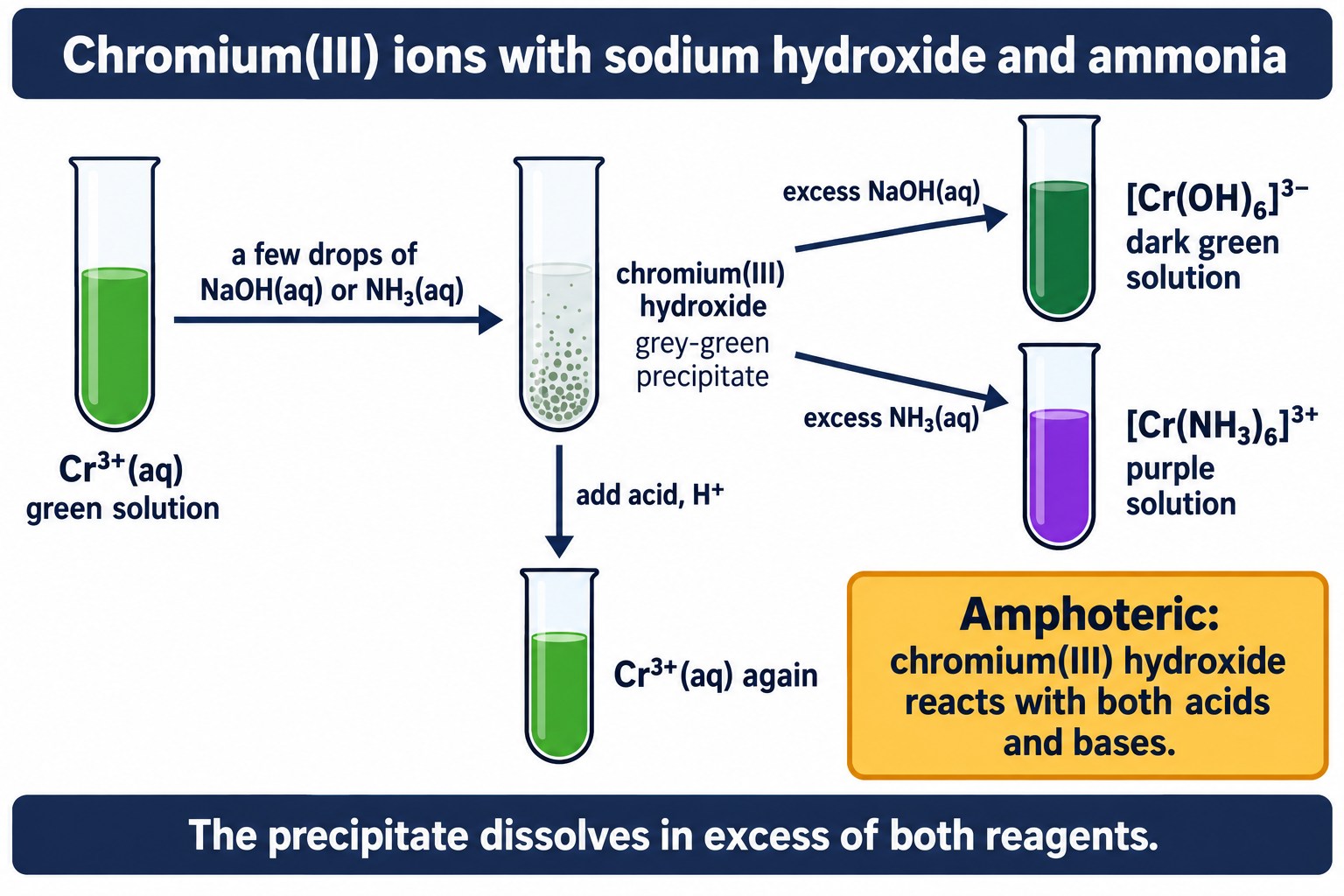
Chromium(III) hydroxide dissolves in excess sodium hydroxide to give a dark green solution and in excess ammonia to give a purple solution.
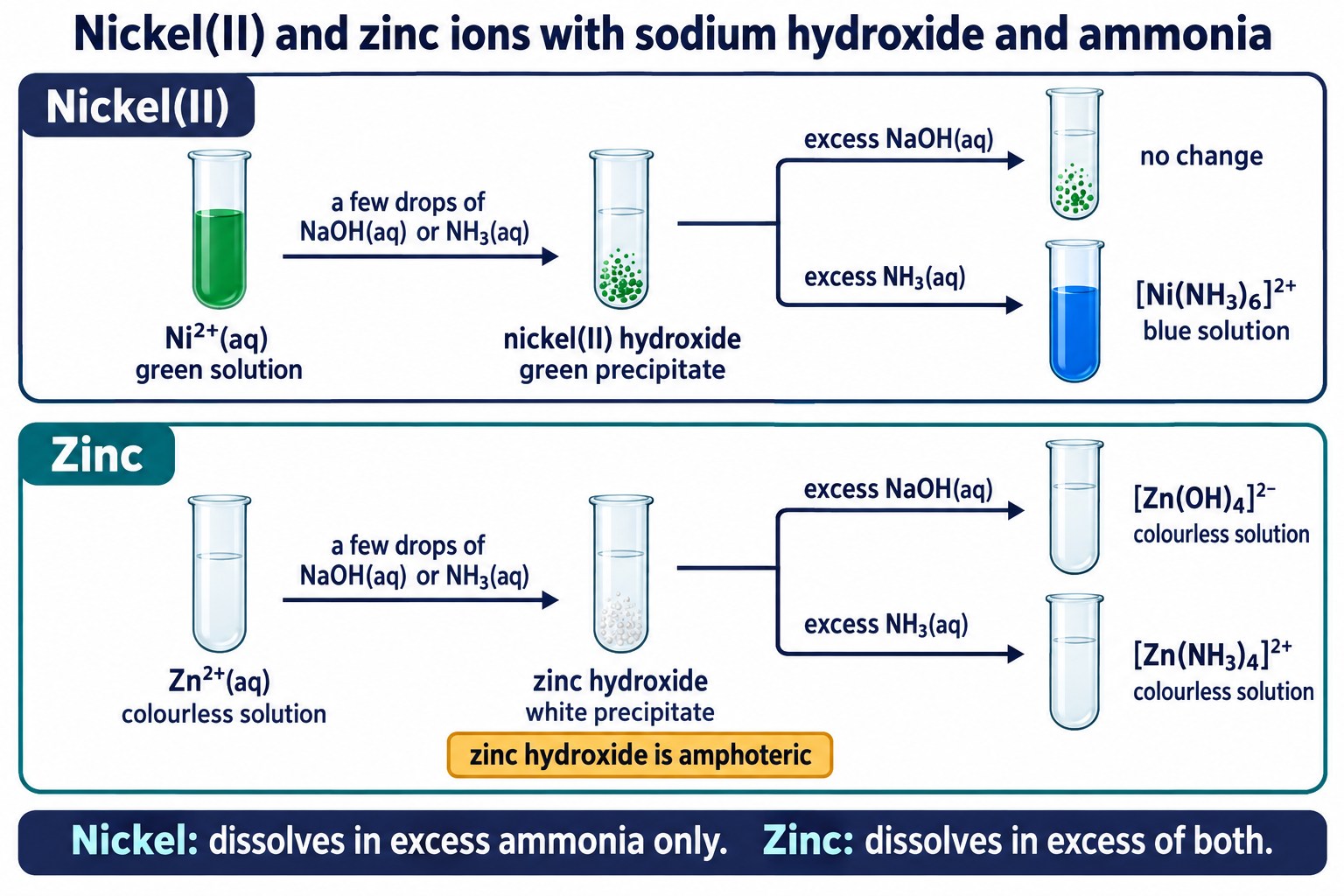
Nickel(II) and zinc ions: both hydroxides dissolve in excess ammonia, and zinc hydroxide also dissolves in excess sodium hydroxide.
Key idea: Amphoteric means able to react with both acids and bases. A hydroxide that dissolves in excess sodium hydroxide and in acid is amphoteric.
Excess Ammonia: Ligand Exchange
In excess, ammonia acts as a ligand. Some hydroxide precipitates dissolve because ammonia molecules replace ligands round the metal ion.
| Ion | Equation | Observation |
|---|---|---|
| Cr³⁺ | Cr(OH)₃(H₂O)₃ + 6NH₃ → [Cr(NH₃)₆]³⁺ + 3H₂O + 3OH⁻ | grey-green precipitate dissolves: purple solution, formed slowly |
| Co²⁺ | Co(OH)₂(H₂O)₄ + 6NH₃ → [Co(NH₃)₆]²⁺ + 4H₂O + 2OH⁻ | blue precipitate dissolves: yellow-brown solution, which darkens in air |
| Ni²⁺ | Ni(OH)₂(H₂O)₄ + 6NH₃ → [Ni(NH₃)₆]²⁺ + 4H₂O + 2OH⁻ | green precipitate dissolves: blue solution |
| Cu²⁺ | Cu(OH)₂(H₂O)₄ + 4NH₃ → [Cu(NH₃)₄(H₂O)₂]²⁺ + 2H₂O + 2OH⁻ | pale blue precipitate dissolves: deep blue solution |
| Zn²⁺ | Zn(OH)₂(H₂O)₂ + 4NH₃ → [Zn(NH₃)₄]²⁺ + 2H₂O + 2OH⁻ | white precipitate dissolves: colourless solution |
- This is ligand exchange: the complex ion formed is soluble, so the precipitate dissolves.
- With copper the exchange is incomplete: only four ammonia ligands enter, and two water ligands remain.
- The cobalt solution darkens in air as [Co(NH₃)₆]²⁺ is oxidised to [Co(NH₃)₆]³⁺.
- The hydroxides of Mn²⁺, Fe²⁺ and Fe³⁺ do not dissolve in excess ammonia.
- The overall ligand exchange equations are on Ligand exchange and the Stability of Complexes.
Remember: A few drops of ammonia: it is a base, and the hydroxide precipitates. Excess ammonia: it is a ligand, and some precipitates dissolve as complex ions.
Check: Excess Sodium Hydroxide and Excess Ammonia
Explain what dissolving in excess shows: amphoteric behaviour with sodium hydroxide, and ligand exchange with ammonia.
Using the Tests to Identify Ions
- Fe²⁺ gives a green precipitate and Fe³⁺ an orange-brown precipitate. Neither dissolves in excess of either reagent.
- Cr³⁺ and Fe²⁺ both give green precipitates. Only the chromium(III) hydroxide dissolves in excess sodium hydroxide.
- Cu²⁺ and Co²⁺ both give blue precipitates. In excess ammonia, copper gives a deep blue solution and cobalt a yellow-brown one.
- Ni²⁺ and Fe²⁺ both give green precipitates. Only the nickel(II) hydroxide dissolves in excess ammonia, to give a blue solution.
- Zn²⁺ gives a white precipitate that dissolves in excess of both reagents to give colourless solutions.
- Mn²⁺ gives an off-white precipitate that darkens in air and dissolves in neither reagent.
- Cu²⁺ is recognised by the deep blue solution in excess ammonia.
Worked example 1
A green solution gives a grey-green precipitate with a few drops of sodium hydroxide. The precipitate dissolves in excess to give a dark green solution. Identify the metal ion and write the equations.
Step 2. Precipitation: [Cr(H₂O)₆]³⁺ + 3OH⁻ → Cr(OH)₃(H₂O)₃ + 3H₂O
Step 3. In excess: Cr(OH)₃(H₂O)₃ + 3OH⁻ → [Cr(OH)₆]³⁻ + 3H₂O
Answer. The ion is Cr³⁺, and its hydroxide is amphoteric.
Worked example 2: an unfamiliar ion
An ion X²⁺ forms a hydroxide precipitate with aqueous sodium hydroxide. Write the ionic equation.
Answer. [X(H₂O)₆]²⁺ + 2OH⁻ → X(OH)₂(H₂O)₄ + 2H₂O
These test-tube reactions are used in practical work to identify metal ions in unknown compounds.
Quick Check: Separating a Mixture of Ions
Use the data in the question to follow each metal through two filtrations.
Common Exam Points
Say
- “A pale blue precipitate forms, which dissolves in excess ammonia to give a deep blue solution.”
- “Chromium(III) hydroxide is amphoteric: it dissolves in excess sodium hydroxide and in acid.”
- “Ammonia acts as a base with a few drops and as a ligand in excess.”
Do not say
- “The solution turns cloudy” (state the colour and that it is a precipitate).
- “A blue solution forms” for copper(II) hydroxide (it is a pale blue precipitate).
- “The precipitate is [Cu(OH)₂(H₂O)₄]²⁺” (the precipitate has no overall charge).
Watch for
- Observations need a colour and a state: solution or precipitate.
- An equation for a reaction in excess starts from the hydroxide precipitate.
- Charges must balance: check the total charge on each side.
- Iron(II) hydroxide darkening in air is oxidation, not a reaction with the reagent.
- The cobalt ammonia complex darkens in air because it is oxidised.
Check: Identifying Ions from Test-Tube Reactions
Interpret described observations with sodium hydroxide and ammonia, write the ionic equations and decide which reagent tells two ions apart.
FAQs
Use these quick answers to check the reactions of aqueous metal ions with sodium hydroxide and ammonia.
What do I see when sodium hydroxide is added to copper(II) ions?
A pale blue precipitate of copper(II) hydroxide forms: [Cu(H₂O)₆]²⁺ + 2OH⁻ → Cu(OH)₂(H₂O)₄ + 2H₂O. The precipitate has no overall charge, which is why it is insoluble. It does not dissolve in excess sodium hydroxide.
Why does a little ammonia give the same precipitate as sodium hydroxide?
A few drops of ammonia act as a base, not as a ligand: [Cu(H₂O)₆]²⁺ + 2NH₃ → Cu(OH)₂(H₂O)₄ + 2NH₄⁺. The same pale blue hydroxide precipitate forms. Only excess ammonia replaces ligands.
Why does the copper(II) hydroxide precipitate dissolve in excess ammonia?
Ammonia molecules act as ligands and form a soluble complex ion by ligand exchange: Cu(OH)₂(H₂O)₄ + 4NH₃ → [Cu(NH₃)₄(H₂O)₂]²⁺ + 2OH⁻ + 2H₂O. The pale blue precipitate dissolves to give a deep blue solution.
How do I tell iron(II) ions from iron(III) ions?
Add sodium hydroxide solution. Iron(II) ions give a green precipitate, which turns orange-brown at the surface as oxygen in the air oxidises it. Iron(III) ions give an orange-brown precipitate straight away. Neither precipitate dissolves in excess.
What does amphoteric mean?
An amphoteric hydroxide reacts with both acids and bases. Grey-green chromium(III) hydroxide dissolves in excess sodium hydroxide to give a dark green solution of [Cr(OH)₆]³⁻. It also dissolves in acid, giving [Cr(H₂O)₆]³⁺ again.

Copyright notice: This OLS revision content, including the explanations, layout, diagrams, tables and embedded learning structure, is authored for Online Learning System by Dr. Mohammed Al-Fatah. It may not be copied, reproduced, redistributed or adapted without written permission.
Keep this note — free
Save your progress across every Edexcel IAL topic. A free account remembers which topics you have covered, saves your question scores, and syncs across your phone and laptop.
- Track every topic you have finished
- Keep your practice-question scores
- No payment, no card, free forever
Already registered? Log in