Ligand exchange and the Stability of Complexes
A concise revision guide to ligand exchange: replacing water ligands by ammonia and chloride in copper(II) and cobalt(II) complexes, changes in coordination number and colour, and why bidentate and polydentate ligands give more stable complexes, with oxygen and carbon monoxide in haemoglobin.
- 17.17-b
- 17.24i
- 17.24ii
- 17.24iii
- 17.25-a
- 17.25-b
What these spec points say
- 17.17-b know that ligand exchange occurs when oxygen bound to haemoglobin is replaced by carbon monoxide
- 17.24i understand that ligand exchange, and an accompanying colour change, occurs in the formation of: [Cu(NH3)4(H2O)2]2+ from [Cu(H2O)6]2+ via Cu(OH)2(H2O)4
- 17.24ii understand that ligand exchange, and an accompanying colour change, occurs in the formation of: [CuCl4]2- from [Cu(H2O)6]2+
- 17.24iii understand that ligand exchange, and an accompanying colour change, occurs in the formation of: [CoCl4]2- from [Co(H2O)6]2+
- 17.25-a understand that substitution of a monodentate ligand by a bidentate ligand leads to a more stable complex ion due to positive increase in ΔSsystem
- 17.25-b understand that substitution of a monodentate ligand by a hexadentate ligand leads to a more stable complex ion due to positive increase in ΔSsystem
The Chelate Effect
Choose a step to count the particles as bidentate and multidentate ligands push water out of a complex ion, and see why entropy makes the new complex more stable.
© Dr. Mohammed Al-Fatah – onlinelearningsystem.net
Before You Start
This page builds on Ligands, Complex Ions and Their Shapes and Colour of Transition metal Ions.
What you need to remember
- A ligand donates a lone pair of electrons to a central metal ion to form a dative (coordinate) covalent bond.
- The coordination number is the number of dative (coordinate) covalent bonds to the central metal ion.
- In water, a metal ion exists as an aqua ion such as [Cu(H₂O)₆]²⁺, which is octahedral.
- Small ligands such as H₂O and NH₃ give octahedral complexes. The larger Cl⁻ ion gives tetrahedral complexes.
- The colour of a complex depends on the metal, its oxidation number, the ligands and the coordination number.
- A positive entropy change favours a reaction: see Topic 12 Entropy and Energetics.
What Ligand Exchange Means
In a ligand exchange reaction, one ligand in a complex is replaced by another. Most examples start from an aqua ion, in which water ligands are replaced.
- The incoming ligand uses a lone pair to form a new dative (coordinate) covalent bond to the metal ion.
- The oxidation number of the metal does not change, so the reaction is not a redox reaction.
- All of the ligands may be replaced, or only some of them.
- The coordination number and the shape may stay the same or may change.
- The colour changes, because different ligands split the d orbitals by a different amount.
| Incoming ligand | Compared with H₂O | Effect on the coordination number |
|---|---|---|
| NH₃ | similar size, no charge | stays at 6: the complex stays octahedral |
| Cl⁻ | larger, and negatively charged | falls from 6 to 4: the complex becomes tetrahedral |
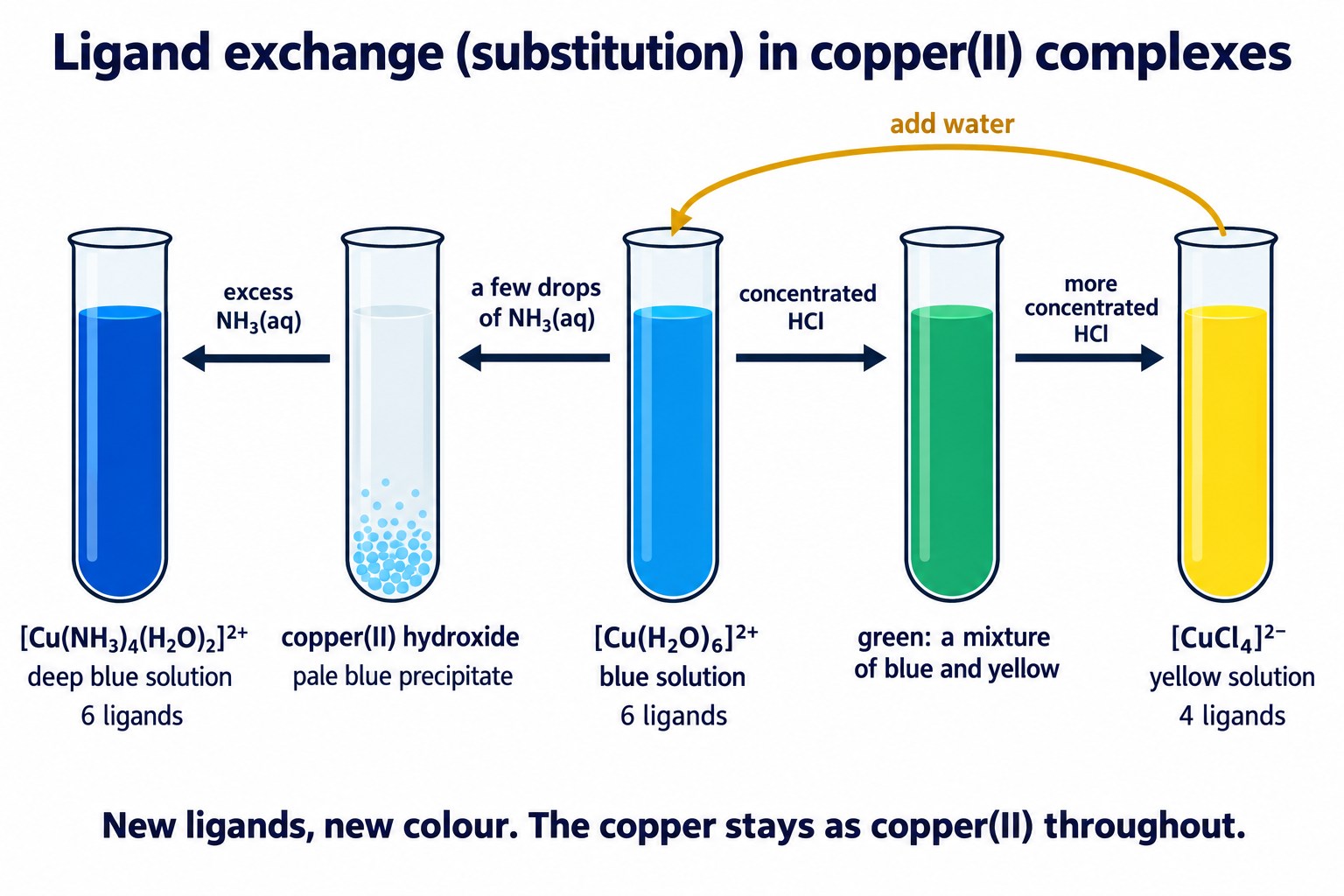
Ligand exchange in copper(II) complexes: ammonia gives a deep blue solution and concentrated hydrochloric acid gives a yellow solution.
Key idea: Ligand exchange swaps one ligand for another. The oxidation number of the metal stays the same, but the colour changes, and the coordination number changes when the new ligand is larger.
Copper(II) with Ammonia
Aqueous copper(II) ions are blue: [Cu(H₂O)₆]²⁺. Aqueous ammonia is added drop by drop, and then in excess.
| Ammonia added | Observation | Copper species formed |
|---|---|---|
| a few drops | pale blue precipitate | Cu(OH)₂(H₂O)₄, copper(II) hydroxide |
| excess | precipitate dissolves to give a deep blue solution | [Cu(NH₃)₄(H₂O)₂]²⁺ |
The overall change is a ligand exchange reaction:
[Cu(H₂O)₆]²⁺(aq) + 4NH₃(aq) → [Cu(NH₃)₄(H₂O)₂]²⁺(aq) + 4H₂O(l)
The two stages
- A few drops: ammonia acts as a base. [Cu(H₂O)₆]²⁺ + 2NH₃ → Cu(OH)₂(H₂O)₄ + 2NH₄⁺
- Excess: ammonia acts as a ligand and the precipitate dissolves. Cu(OH)₂(H₂O)₄ + 4NH₃ → [Cu(NH₃)₄(H₂O)₂]²⁺ + 2H₂O + 2OH⁻
The precipitate stage is explained on Reactions of Metal Ions with Sodium Hydroxide and Ammonia.
Preparing a transition metal complex, often a salt of this deep blue ion, is a core practical: see Core Practical 14.
What to notice
- Only four of the six water ligands are replaced: the exchange is incomplete.
- The coordination number stays at 6 and the shape stays octahedral, because NH₃ and H₂O are similar in size and both are uncharged.
- The charge stays at 2+, because both ligands are neutral molecules.
- The two water ligands that remain are opposite each other, above and below the square of four ammonia ligands.
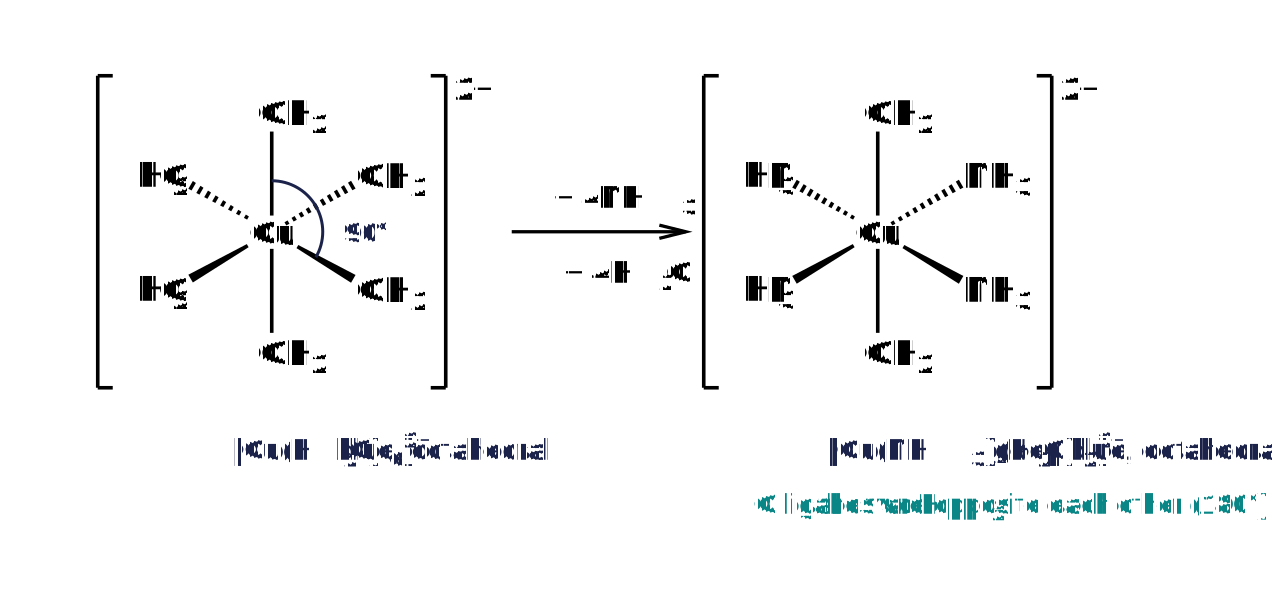
The hexaaquacopper(II) ion and the tetraamminediaquacopper(II) ion. Both are octahedral, and the two remaining water ligands are opposite each other.
Check: Ligand Exchange with Ammonia
Decide what changes and what stays the same when ammonia replaces water ligands: the number of ligands replaced, the coordination number, the shape, the charge and the colour.
Copper(II) and Cobalt(II) with Chloride Ions
Concentrated hydrochloric acid supplies a high concentration of chloride ions. With aqueous copper(II) ions, four chloride ligands replace all six water ligands.
[Cu(H₂O)₆]²⁺(aq) + 4Cl⁻(aq) ⇌ [CuCl₄]²⁻(aq) + 6H₂O(l)
- Colour: blue → green → yellow. The green solution is a mixture of the blue and yellow complexes.
- Coordination number: 6 → 4. The shape changes from octahedral to tetrahedral.
- Reason: Cl⁻ ions are larger than water molecules and are charged, so only four fit round the Cu²⁺ ion.
- Charge: (2+) + 4 × (1−) = 2−.
A reversible reaction
- Adding more concentrated hydrochloric acid moves the equilibrium to the right: the solution turns yellow.
- Adding water lowers the chloride concentration and moves the equilibrium to the left: the solution turns blue again.
Cobalt(II)
[Co(H₂O)₆]²⁺(aq) + 4Cl⁻(aq) ⇌ [CoCl₄]²⁻(aq) + 6H₂O(l)
- The pink solution turns blue as concentrated hydrochloric acid is added.
- The coordination number again falls from 6 to 4, and the shape changes from octahedral to tetrahedral.
- Adding water turns the blue solution pink again.
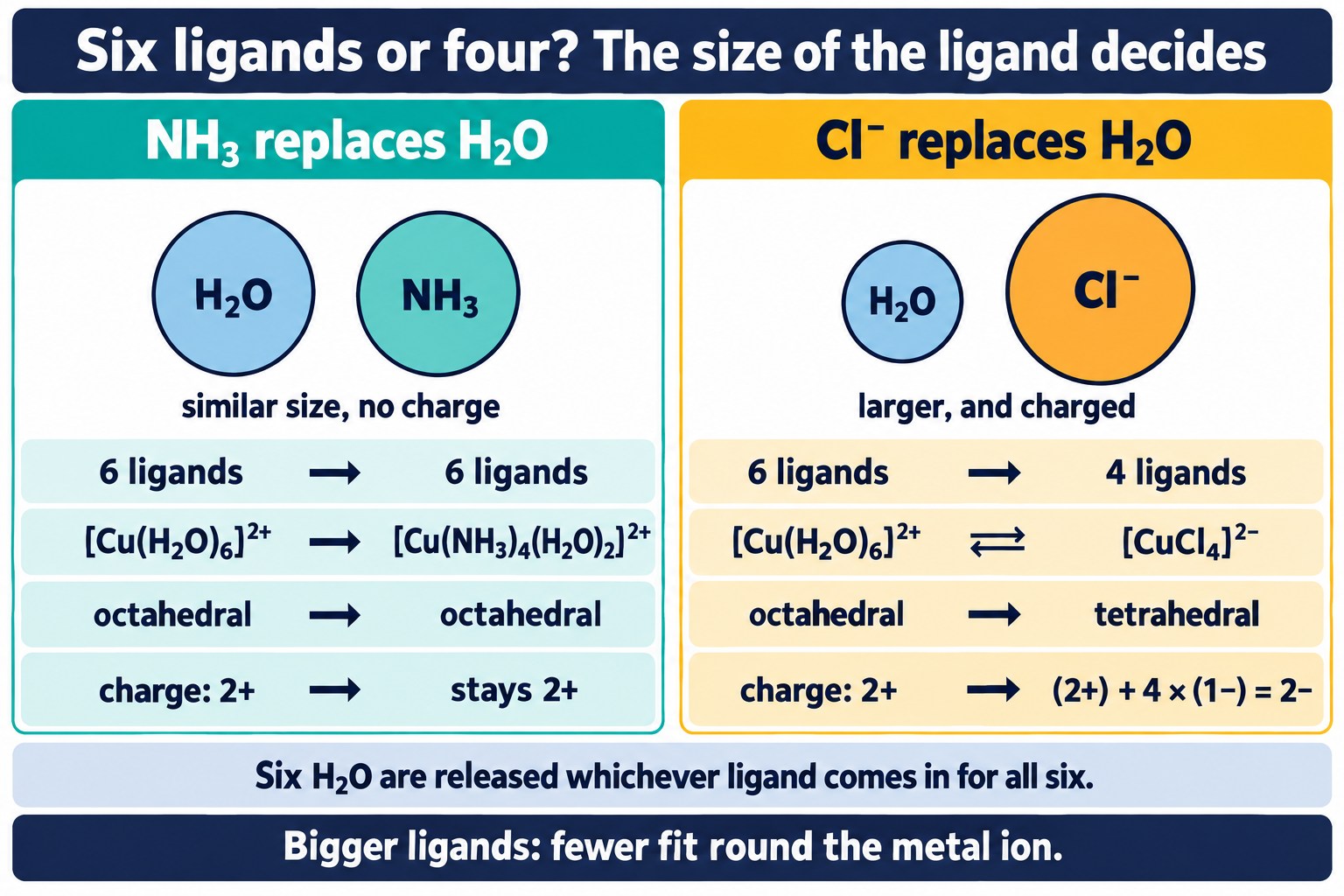
Ammonia and water are similar in size, so six ligands still fit round the metal ion. Chloride ions are larger, so only four fit.
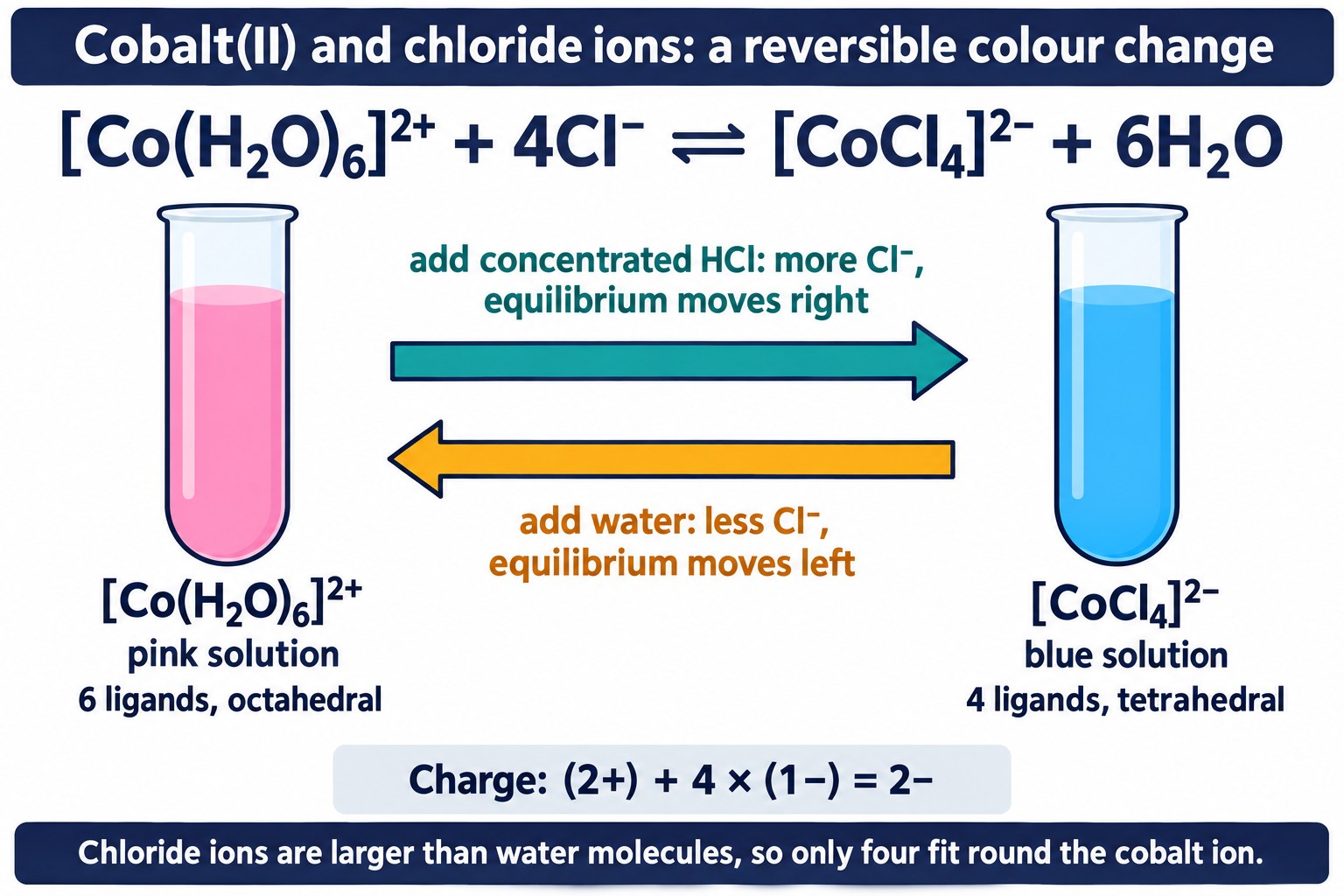
The cobalt(II) equilibrium: concentrated hydrochloric acid turns the pink solution blue, and adding water turns it pink again.
Common error: Dissolving solid copper(II) chloride in water gives blue [Cu(H₂O)₆]²⁺, not [CuCl₄]²⁻. The chloride complex forms only when the concentration of chloride ions is very high.
Check: Chloride Ions and a Change in Coordination Number
Work with chloride complexes: the change in the number of ligands, the shape, the overall charge and what dilution does to the equilibrium.
Summary and Unfamiliar Reactions
| Reaction | Complex formed | Colour change | Coordination number | Shape |
|---|---|---|---|---|
| [Cu(H₂O)₆]²⁺ + 4NH₃ | [Cu(NH₃)₄(H₂O)₂]²⁺ | blue → deep blue | 6 → 6 | octahedral → octahedral |
| [Cu(H₂O)₆]²⁺ + 4Cl⁻ | [CuCl₄]²⁻ | blue → yellow | 6 → 4 | octahedral → tetrahedral |
| [Co(H₂O)₆]²⁺ + 4Cl⁻ | [CoCl₄]²⁻ | pink → blue | 6 → 4 | octahedral → tetrahedral |
Writing an equation for an unfamiliar complex
Questions often give the formula of a new complex. The equation is built in the same way each time.
- Write the aqua ion and the incoming ligand on the left.
- Write the new complex on the right, with its charge.
- Release one water molecule for every water ligand replaced.
- Check that the total charge is the same on both sides.
Worked example 1
Excess ammonia converts [Ni(H₂O)₆]²⁺ into [Ni(NH₃)₆]²⁺. Write the equation.
Answer. [Ni(H₂O)₆]²⁺ + 6NH₃ → [Ni(NH₃)₆]²⁺ + 6H₂O
Worked example 2
One thiocyanate ion, SCN⁻, replaces one water ligand in [Fe(H₂O)₆]³⁺ to give a blood-red complex. Deduce its formula and write the equation.
Answer. [Fe(H₂O)₆]³⁺ + SCN⁻ → [Fe(SCN)(H₂O)₅]²⁺ + H₂O
Quick Check: Equation for a New Complex
Use the ligand count and the charges to choose the correct equation for an unfamiliar complex.
Haemoglobin: Oxygen and Carbon Monoxide
Haemoglobin is the protein that carries oxygen in red blood cells. It contains iron(II) ions, each at the centre of a complex.
- Four dative (coordinate) covalent bonds to the iron(II) ion come from nitrogen atoms of the haem group, which is a polydentate ligand.
- A fifth comes from the protein chain, globin.
- An oxygen molecule can form a dative (coordinate) covalent bond at the sixth position.
- Oxygen is bound weakly and reversibly: it is picked up in the lungs and released in the tissues.
- The structure of the haem group does not need to be learned.
Carbon monoxide
- Carbon monoxide is also a ligand. It replaces the oxygen in a ligand exchange reaction.
- The bond from CO to iron(II) is much stronger than the bond from O₂.
- The exchange is not readily reversed, so the haemoglobin can no longer carry oxygen.
- Less oxygen reaches the tissues, which is why carbon monoxide is toxic.
haemoglobin–O₂ + CO → haemoglobin–CO + O₂
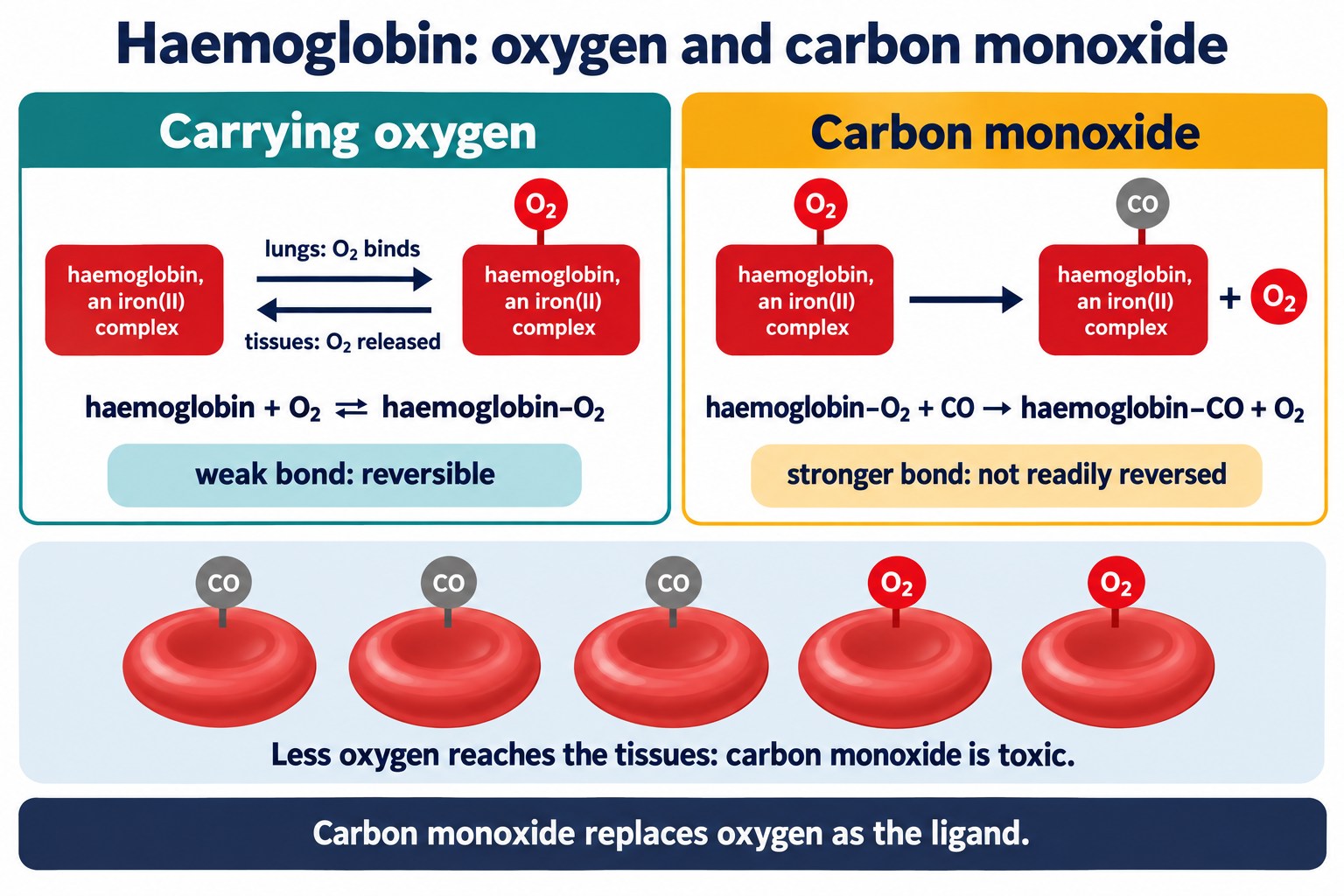
Oxygen binds to haemoglobin reversibly. Carbon monoxide binds more strongly and is not readily released, so less oxygen is carried.
Stability: Bidentate and Polydentate Ligands
When a bidentate or polydentate ligand replaces monodentate ligands, the new complex is more stable. The reason is entropy.
Counting the particles
[Cu(H₂O)₆]²⁺(aq) + 3H₂NCH₂CH₂NH₂(aq) → [Cu(H₂NCH₂CH₂NH₂)₃]²⁺(aq) + 6H₂O(l)
- There are 4 particles on the left and 7 on the right.
- More particles in solution means more disorder.
- ΔSsystem is therefore positive, and large.
- A large positive ΔSsystem makes the reaction very favourable, so the new complex is more stable than the aqua ion.
EDTA⁴⁻
[Cu(H₂O)₆]²⁺(aq) + EDTA⁴⁻(aq) → [Cu(EDTA)]²⁻(aq) + 6H₂O(l)
- EDTA⁴⁻ is hexadentate: one ion forms six bonds to the metal ion.
- One EDTA⁴⁻ ion releases six water molecules: 2 particles become 7.
- The increase in ΔSsystem is even larger, so the EDTA complex is very stable.
| Incoming ligand | Particles before | Particles after | ΔSsystem |
|---|---|---|---|
| 3 × H₂NCH₂CH₂NH₂ (bidentate) | 4 | 7 | positive |
| 1 × EDTA⁴⁻ | 2 | 7 | positive, larger |
| 6 × NH₃ (monodentate) | 7 | 7 | close to zero |
Worked example
Explain why the reaction [Ni(NH₃)₆]²⁺ + 3H₂NCH₂CH₂NH₂ → [Ni(H₂NCH₂CH₂NH₂)₃]²⁺ + 6NH₃ goes almost to completion.
Step 1. Count the particles: 1 + 3 = 4 on the left and 1 + 6 = 7 on the right.
Step 2. More particles are formed, so ΔSsystem is positive.
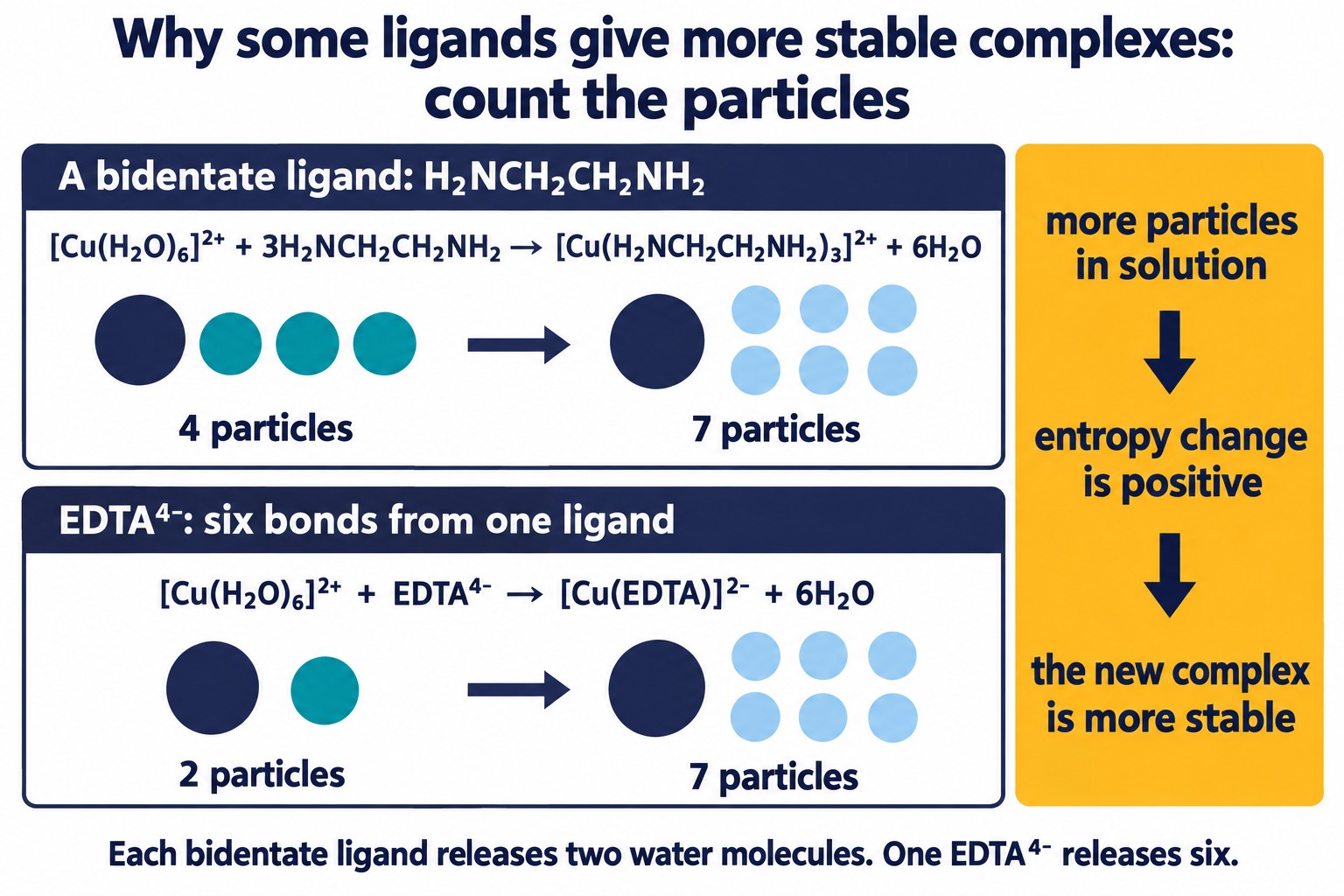
Counting particles: one bidentate ligand releases two water molecules, and one EDTA⁴⁻ ion releases six. More particles means a positive entropy change.
Exam focus: State the numbers of particles on each side, then link the increase to a positive ΔSsystem. “More stable” on its own does not explain anything.
Quick Check: Counting the Particles
Count the particles on each side of these new reactions, then rank them.
Common Exam Points
Say
- “The coordination number changes from 6 to 4 because chloride ions are larger than water molecules.”
- “The exchange is incomplete: only four of the six water ligands are replaced by ammonia.”
- “Carbon monoxide forms a stronger bond to the iron(II) than oxygen does, and is not readily released.”
- “Four particles form seven, so ΔSsystem is positive.”
Do not say
- “[Cu(NH₃)₆]²⁺ forms in excess ammonia” (the product is [Cu(NH₃)₄(H₂O)₂]²⁺).
- “[CuCl₄]²⁻ is square planar” (it is tetrahedral).
- “The oxidation number of copper changes” (it stays at +2: only the ligands change).
- “The complex is more stable because the ligand forms stronger bonds” (the explanation is entropy).
Watch for
- Charges: neutral ligands leave the charge unchanged, and each Cl⁻ lowers it by one.
- Six water molecules are released when four chloride ions replace six water ligands.
- State both colours in an observation: the colour before and the colour after.
- Use ⇌ for the reactions with chloride ions: they are reversed by adding water.
Check: Ligand Exchange, Colour and Coordination Number
Bring the copper(II) reactions together: predict observations, deduce formulae and charges, and explain each change in colour and coordination number.
FAQs
Use these quick answers to check ligand exchange reactions, their colour changes and the stability of complexes.
What happens when ammonia is added to copper(II) sulfate solution?
A little ammonia gives a pale blue precipitate of copper(II) hydroxide. Excess ammonia dissolves it to give a deep blue solution: [Cu(H₂O)₆]²⁺ + 4NH₃ → [Cu(NH₃)₄(H₂O)₂]²⁺ + 4H₂O. Only four of the six water ligands are replaced.
Why does the coordination number change when chloride ions replace water?
Chloride ions are larger than water molecules, so only four fit round the metal ion: [Cu(H₂O)₆]²⁺ + 4Cl⁻ ⇌ [CuCl₄]²⁻ + 6H₂O. The coordination number falls from 6 to 4 and the shape changes from octahedral to tetrahedral.
Why does copper(II) solution turn green before yellow with concentrated hydrochloric acid?
The reaction is an equilibrium. Part of the way, the solution holds both blue [Cu(H₂O)₆]²⁺ and yellow [CuCl₄]²⁻, so the mixture looks green. More chloride ions shift it to yellow. Adding water reverses the change, back to blue.
What is the colour change when cobalt(II) ions react with chloride ions?
Pink [Co(H₂O)₆]²⁺ turns to blue [CoCl₄]²⁻ with concentrated hydrochloric acid: [Co(H₂O)₆]²⁺ + 4Cl⁻ ⇌ [CoCl₄]²⁻ + 6H₂O. The shape changes from octahedral to tetrahedral. Adding water turns the solution pink again.
Why are complexes with bidentate and polydentate ligands more stable?
The reason is entropy. In [Cu(H₂O)₆]²⁺ + EDTA⁴⁻ → [Cu(EDTA)]²⁻ + 6H₂O, two particles become seven. The increase in the number of particles in solution makes ΔSsystem positive, so the new complex is more stable.

Copyright notice: This OLS revision content, including the explanations, layout, diagrams, tables and embedded learning structure, is authored for Online Learning System by Dr. Mohammed Al-Fatah. It may not be copied, reproduced, redistributed or adapted without written permission.
Keep this note — free
Save your progress across every Edexcel IAL topic. A free account remembers which topics you have covered, saves your question scores, and syncs across your phone and laptop.
- Track every topic you have finished
- Keep your practice-question scores
- No payment, no card, free forever
Already registered? Log in