Calculating Kc from Experimental Data
A concise revision guide to calculating Kc: setting out initial, change and equilibrium amounts in a table, turning moles into concentrations, finding the value and units of Kc, using Kc to find an equilibrium amount, and how titration and colorimetry measure what is present at equilibrium.
- 11.2
What these spec points say
- 11.2 be able to calculate a value, with units where appropriate, for the equilibrium constant (Kc and Kp) for homogeneous and heterogeneous reactions, from experimental data
Kc from an ICE Table: Hydrogen Iodide
Seal hydrogen and iodine in a box, watch them react to a dynamic equilibrium, and fill in the ICE table row by row, from the amounts you mix to the value of Kc.
© Dr. Mohammed Al-Fatah – onlinelearningsystem.net
The ICE Table Method
A Kc expression needs equilibrium concentrations, but a question usually gives the amounts mixed at the start and only one amount at equilibrium.
The gap is filled with an ICE table: a row each for the Initial moles, the Change in moles and the Equilibrium moles, with a column for every substance in the equation.
- Write the balanced equation and put the initial moles under each substance. Products usually start at zero.
- Find one change from the data: equilibrium moles minus initial moles for the substance you are told about.
- Use the balancing numbers to find every other change. Reactants fall and products rise.
- Add each change to the initial moles to get the equilibrium moles.
- Divide each equilibrium amount by the volume to get concentrations in mol dm⁻³.
- Substitute into the Kc expression and work out the units.
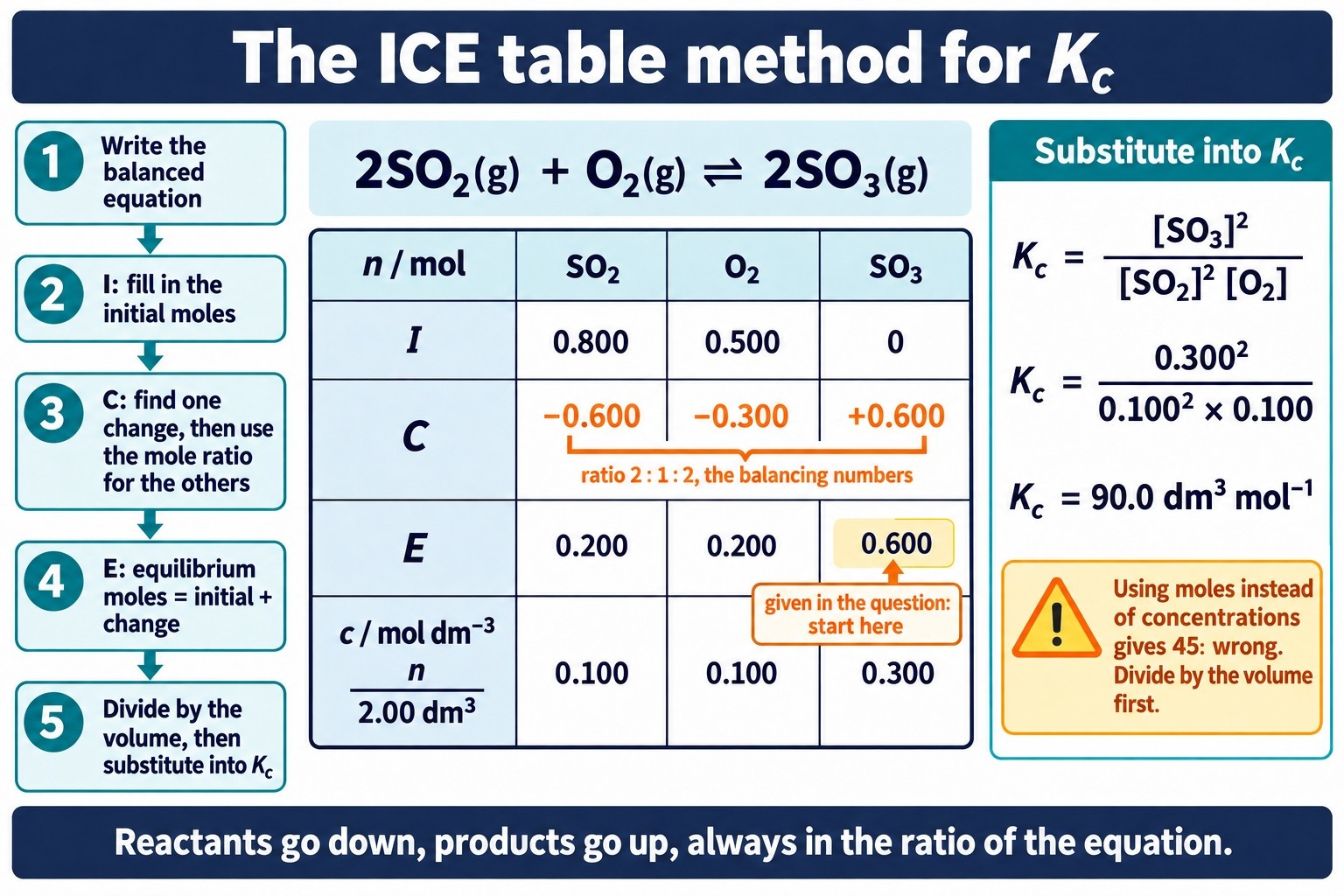
The ICE table method: initial, change and equilibrium moles for each substance, the changes in the ratio of the balancing numbers, then division by the volume before substituting into Kc.
Key idea: The changes are always in the ratio of the balancing numbers in the equation. One measured equilibrium amount is therefore enough to find all the others.
Worked Example 1: The Volume Cancels
Ethanoic acid and ethanol react to form ethyl ethanoate and water:
CH₃COOH + C₂H₅OH ⇌ CH₃COOC₂H₅ + H₂O
1.00 mol of ethanoic acid is mixed with 2.00 mol of ethanol and left to reach equilibrium. The equilibrium mixture contains 0.155 mol of ethanoic acid. Calculate Kc.
Step 2. Complete the table.
| n / mol | CH₃COOH | C₂H₅OH | CH₃COOC₂H₅ | H₂O |
|---|---|---|---|---|
| I | 1.00 | 2.00 | 0 | 0 |
| C | −0.845 | −0.845 | +0.845 | +0.845 |
| E | 0.155 | 1.155 | 0.845 | 0.845 |
Step 4. Kc = (0.845 × 0.845) / (0.155 × 1.155) = (0.7140) / (0.1790).
Answer. Kc = 3.99, with no units.
- The volume cancels only when the total of the powers is the same on the top and the bottom of the expression.
- In that case Kc has no units, and the question often does not give a volume at all.
- Say so in the answer: “V cancels” earns the mark for using moles.
Exam focus: If no volume is given, call it V, write each concentration as (moles) / (V) and show that V cancels. Do not simply ignore it.
Check: ICE Tables
Complete ICE tables and calculate Kc where the volume cancels, for equilibria and amounts not used on this page.
Worked Example 2: The Volume Does Not Cancel
0.800 mol of sulfur dioxide and 0.500 mol of oxygen are sealed in a 2.00 dm³ vessel and heated with a catalyst. At equilibrium 0.600 mol of sulfur trioxide is present. Calculate Kc, with units.
2SO₂(g) + O₂(g) ⇌ 2SO₃(g)
| n / mol | SO₂ | O₂ | SO₃ |
|---|---|---|---|
| I | 0.800 | 0.500 | 0 |
| C | −0.600 | −0.300 | +0.600 |
| E | 0.200 | 0.200 | 0.600 |
| cmol dm⁻³ | 0.100 | 0.100 | 0.300 |
Step 3. Kc = ([SO₃]²) / ([SO₂]²[O₂]) = (0.300²) / (0.100² × 0.100) = (0.0900) / (0.00100).
Step 4. Units = ((mol dm⁻³)²) / ((mol dm⁻³)³) = dm³ mol⁻¹.
Answer. Kc = 90.0 dm³ mol⁻¹.
What goes wrong
- Using moles instead of concentrations gives (0.600²) / (0.200² × 0.200) = 45, which is wrong: with three terms underneath and two on top, V does not cancel.
- Halving the oxygen change is the step most often missed. The change in O₂ is half the change in SO₃.
- Volumes in cm³ must be converted to dm³ by dividing by 1000 before the division.
Remember: Do the whole ICE table in moles, and divide by the volume only at the end. Changes in moles follow the equation; changes in concentration are harder to track when the volume is not 1 dm³.
Check: Kc With a Volume
Calculate Kc with its units when the volume does not cancel, for equilibria and amounts not used on this page.
Working Back From Kc
When Kc is known, the same expression gives an unknown equilibrium concentration or amount. Write the expression, substitute what is known, and rearrange.
Worked example: one unknown concentration
For CO(g) + 2H₂(g) ⇌ CH₃OH(g), Kc = 14.5 dm⁶ mol⁻² at a certain temperature. An equilibrium mixture in a 5.00 dm³ vessel has [CO] = 0.200 mol dm⁻³ and [H₂] = 0.100 mol dm⁻³. Find the amount of methanol.
Step 2. [CH₃OH] = 14.5 × 0.200 × 0.100² = 0.0290 mol dm⁻³.
Answer. Amount of methanol = 0.0290 × 5.00 = 0.145 mol.
Worked example: equilibrium amounts from initial amounts
For H₂(g) + I₂(g) ⇌ 2HI(g), Kc = 49.0. 1.00 mol of hydrogen and 1.00 mol of iodine are mixed and allowed to reach equilibrium. Find the equilibrium amounts.
| n / mol | H₂ | I₂ | HI |
|---|---|---|---|
| I | 1.00 | 1.00 | 0 |
| C | −x | −x | +2x |
| E | 1.00 − x | 1.00 − x | 2x |
Step 2. V cancels, so Kc = ((2x)²) / ((1.00 − x)²) = 49.0.
- Check by substituting back: (1.556²) / (0.222²) = 49, as required.
- You are not expected to solve a quadratic equation. Questions of this kind are set so that a square root, or a single unknown, gives the answer.
Exam focus: To find an amount from Kc: write the expression, rearrange it for the unknown concentration, then multiply by the volume to get moles. Keep at least three significant figures until the final answer.
Measuring Equilibrium Amounts
The one equilibrium amount that an ICE table needs has to be measured without disturbing the equilibrium. Two techniques are used.
Quench and titrate
This suits an equilibrium that contains an acid or an alkali, such as the esterification in worked example 1.
- Mix known amounts of the reactants, with an acid catalyst, in a stoppered flask.
- Leave the flask at a constant temperature until equilibrium is reached, which can take days at room temperature.
- Quench a measured sample by running it into ice-cold water. Cooling and diluting slow the reaction almost to a stop.
- Titrate quickly with standard sodium hydroxide solution, using phenolphthalein, to find the moles of acid.
- Subtract the moles of acid catalyst, found from a separate blank titration.
- Scale up from the sample to the whole mixture.
In worked example 1, one tenth of the equilibrium mixture needed 15.5 cm³ of 1.00 mol dm⁻³ sodium hydroxide after the catalyst was allowed for.
Answer. Moles of ethanoic acid in the whole mixture = 0.0155 × 10 = 0.155 mol.
Colorimetry
This suits an equilibrium in which one substance is coloured. Iron(III) ions and thiocyanate ions form a deep red complex:
Fe³⁺(aq) + SCN⁻(aq) ⇌ FeSCN²⁺(aq)
- Make solutions of known concentration of the coloured substance and measure the absorbance of each with a colorimeter.
- Plot a calibration line of absorbance against concentration.
- Measure the absorbance of the equilibrium mixture and read its concentration from the line.
Nothing is removed or added, so the equilibrium is not disturbed.
In one experiment the mixture started with 1.00 × 10⁻³ mol dm⁻³ of each ion, and the calibration line gave [FeSCN²⁺] = 1.10 × 10⁻⁴ mol dm⁻³ at equilibrium.
Step 1. [Fe³⁺] = [SCN⁻] = 1.00 × 10⁻³ − 1.10 × 10⁻⁴ = 8.90 × 10⁻⁴ mol dm⁻³.
Step 2. Kc = ([FeSCN²⁺]) / ([Fe³⁺][SCN⁻]) = (1.10 × 10⁻⁴) / ((8.90 × 10⁻⁴)²).
Answer. Kc = 139 dm³ mol⁻¹.
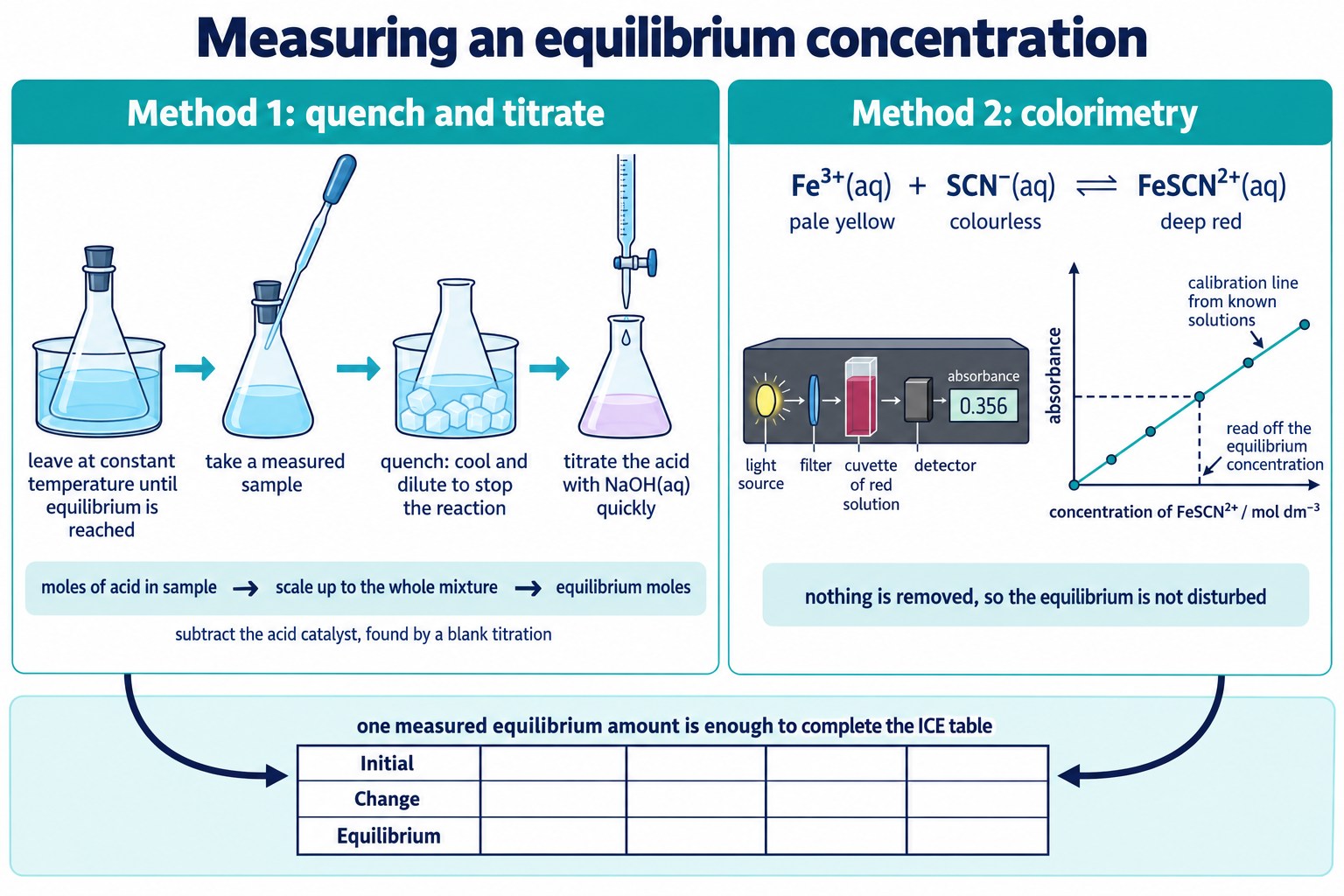
Two ways to measure an equilibrium concentration: quenching a sample and titrating the acid, and using a colorimeter with a calibration line. Either result completes the ICE table.
Remember: Three conditions make the result valid: a closed system, a constant temperature, and enough time for equilibrium to be reached before anything is measured.
Quick Check: From a Titre to Kc
Work out each step on paper, then flip the card to compare. The data are invented for this exercise.
Common Exam Points
Say
- “Change in SO₃ = +0.600 mol, so change in O₂ = −0.300 mol (ratio 2 : 1).”
- “Equilibrium concentration = (equilibrium moles) / (volume in dm³).”
- “V cancels because there are equal numbers of moles on each side.”
- “The sample is quenched in ice-cold water to stop the position of equilibrium shifting during the titration.”
Do not say
- “Kc = (0.800²) / (…)” using initial amounts (only equilibrium values go in).
- “All the changes are the same” (they follow the balancing numbers).
- “The titration gives the acid at equilibrium” without mentioning the catalyst, when one was added.
Watch for
- Data given as a percentage: “40% of the acid reacted” means the change is 0.40 × the initial moles.
- Volumes in cm³: convert to dm³ before finding concentrations.
- A titration on a portion of the mixture: scale up to the whole before using the ICE table.
- Final answers quoted to the same number of significant figures as the data, usually three.
Check: Amounts From Kc and Experimental Data
Find equilibrium amounts from Kc and process titration or colorimeter results for equilibria not used on this page.
FAQs
Use these quick answers to check the Kc calculations.
Why does Kc have different units for different reactions?
The units come from the expression itself. Substitute mol dm⁻³ for every concentration and cancel. Equal powers top and bottom give no units; otherwise a power of mol dm⁻³ is left, such as mol⁻² dm⁶ for ammonia synthesis.
What is an ICE table?
A table with rows for the initial, change and equilibrium moles of each substance. The change row follows the balancing numbers of the equation, so one known equilibrium amount lets you find all the others before converting to concentrations.
When can I ignore the volume in a Kc calculation?
Only when the total powers on the top and bottom of the expression are equal, because the volume then cancels. In every other case divide each equilibrium amount in moles by the volume in dm³ before substituting.
How are equilibrium concentrations measured without disturbing the equilibrium?
Either measure a property such as colour with a colorimeter, which removes nothing, or cool and dilute the mixture quickly to slow the reaction and then titrate one component before the position has time to shift.
Why is my Kc answer wrong when the expression is right?
The usual causes are substituting initial instead of equilibrium amounts, forgetting to divide moles by the volume, ignoring the balancing numbers in the change row, or forgetting to raise a concentration to its power.

Copyright notice: This OLS revision content, including the explanations, layout, diagrams, tables and embedded learning structure, is authored for Online Learning System by Dr. Mohammed Al-Fatah. It may not be copied, reproduced, redistributed or adapted without written permission.
Keep this note — free
Save your progress across every Edexcel topic. A free account remembers which topics you have covered, saves your question scores, and syncs across your phone and laptop.
- Track every topic you have finished
- Keep your practice-question scores
- No payment, no card, free forever
Already registered? Log in