Simple Molecular Structures
A concise revision guide to simple molecular lattices: iodine and ice, the strong covalent bonds inside the molecules and the weak forces between them, and why that gives low melting points, no conductivity and solubility that follows polarity.
- 2.2.2(n)
- 2.2.2(o)-i
- 2.2.2(o)-ii
- 2.2.2(o)-iii
What these spec points say
- 2.2.2(n) explanation of the solid structures of simple molecular lattices, as covalently bonded molecules attracted by intermolecular forces, e.g. I2, ice
- 2.2.2(o)-i explanation of the effect of structure and bonding on the melting and boiling points of covalent compounds with simple molecular lattice structures
- 2.2.2(o)-ii explanation of the effect of structure and bonding on the solubility of covalent compounds with simple molecular lattice structures
- 2.2.2(o)-iii explanation of the effect of structure and bonding on the electrical conductivity of covalent compounds with simple molecular lattice structures
Simple Molecular Lattices: Iodine, Ice and C₆₀
Choose a step to watch a crystal built from whole molecules, then heat each one to see which forces melting has to overcome.
© Dr. Mohammed Al-Fatah – onlinelearningsystem.net
GCSE Recap: Molecules, Bonds and Conducting
Before you start, check the GCSE ideas this page builds on.
What a Simple Molecular Lattice Is
Some solids are made of molecules: small groups of atoms held together by strong covalent bonds.
In the solid the molecules pack into a regular lattice, but the forces between the molecules are weak intermolecular forces, not covalent bonds. This gives every simple molecular solid the same family of properties.
| Feature | Inside each molecule | Between molecules |
|---|---|---|
| Type of force | Covalent bonds | Intermolecular forces (London forces, permanent dipoles, hydrogen bonds) |
| Strength | Strong (hundreds of kJ mol−1) | Weak (a few to about 40 kJ mol−1) |
| Broken on melting or boiling? | No | Yes |
| Consequence | The molecules survive changes of state | Low melting and boiling points, soft solids |
Key idea: When iodine sublimes, purple I2 molecules leave the crystal intact. Nothing covalent breaks.
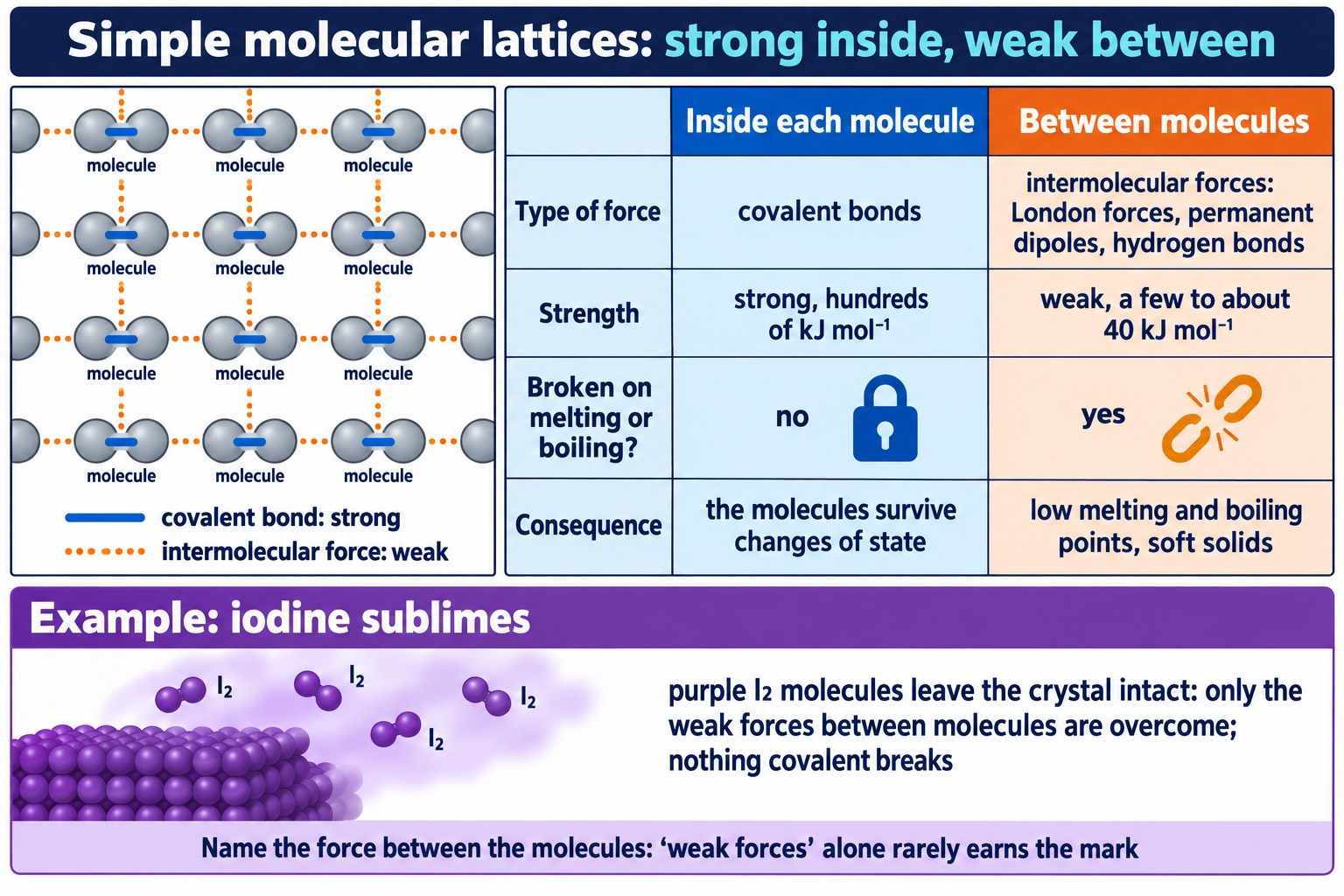
In a simple molecular lattice the covalent bonds inside each molecule stay intact on melting and boiling, and only the weak intermolecular forces between molecules are overcome.
Quick Check: Phosphorus and Chlorine
Drag each term into place to compare two molecular solids the page does not use.
Iodine
Solid iodine is a lattice of I₂ molecules. Each molecule has one strong I-I covalent bond; the molecules are held in the lattice only by London forces (instantaneous dipole-induced dipole forces).
Iodine has 106 electrons per molecule, so its London forces are strong enough for it to be a solid at room temperature.
They are still far weaker than covalent bonds: iodine sublimes on gentle warming to give a purple vapour.
| Property | Observation | Explanation |
|---|---|---|
| Melting point | 114 °C (sublimes readily) | Only weak London forces between I2 molecules are overcome |
| Electrical conductivity | None, solid or molten | No ions and no delocalised electrons; the molecules are neutral |
| Solubility | Almost insoluble in water; dissolves in hexane | A non-polar molecule interacts best with a non-polar solvent |
| Hardness | Soft, flaky crystals | The layers of molecules are easily separated |
Exam sentence: Iodine has a low melting point because only the weak London forces between I2 molecules have to be overcome; the strong covalent bonds within the molecules are not broken.
Quick Check: Which Solid Is Molecular?
Use the melting point and the conductivity of each solid to decide.
Quick Check: Explain the Solubility of Naphthalene
Write a short explanation, then compare it with the mark points and the model answer.
Ice
Ice is a lattice of H₂O molecules held together by hydrogen bonds.
Each water molecule can form up to four hydrogen bonds, two through its hydrogen atoms and two through the lone pairs on oxygen, so in ice every oxygen is surrounded tetrahedrally by four others.
This makes an open, hexagonal lattice with a lot of empty space.
When ice melts some of the hydrogen bonds break and the molecules move closer together, so liquid water is denser than ice and ice floats.
Hydrogen bonds are the strongest intermolecular force, which is why water has a far higher melting and boiling point than a molecule of its size would otherwise have.
But they are still weak next to the O-H covalent bonds, which survive melting and boiling.
| Property | Observation | Explanation |
|---|---|---|
| Melting point | 0 °C | Hydrogen bonds between molecules are overcome; higher than for I2-sized non-polar molecules because hydrogen bonds are stronger than London forces |
| Density | Ice is less dense than water | The hydrogen-bonded open lattice holds the molecules further apart than in the liquid |
| Conductivity | None as a pure solid or liquid | Neutral molecules; no mobile charge carriers |
| Solubility | Miscible with other hydrogen-bonding liquids | Water hydrogen bonds to alcohols and dissolves ionic solids by hydrating the ions |
Exam sentence: In ice each water molecule is hydrogen bonded to four others in an open lattice, so the molecules are further apart than in liquid water and ice is less dense.
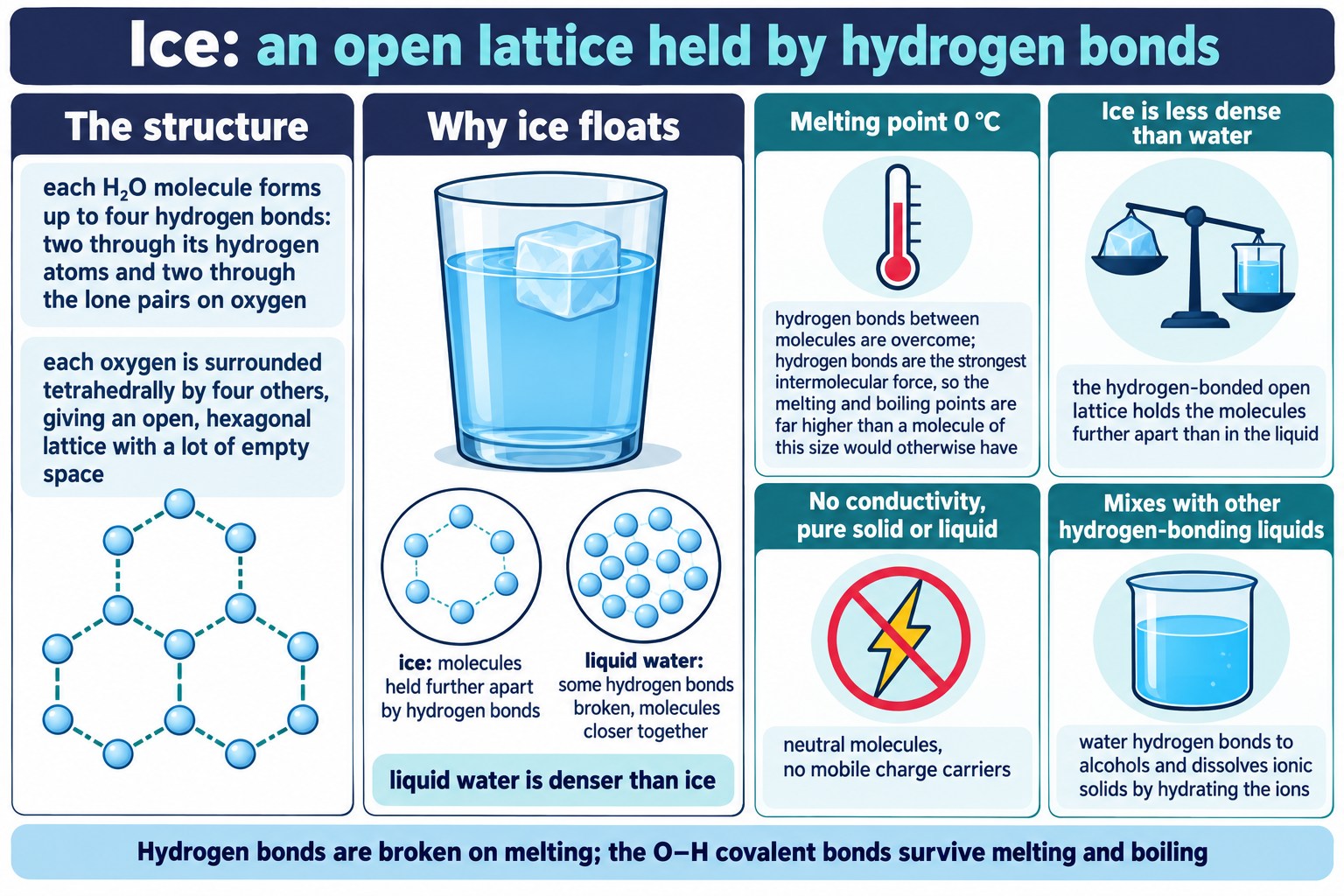
Each water molecule in ice is hydrogen bonded to four others in an open lattice, so ice is less dense than liquid water and floats.
Quick Check: Water Against Hydrogen Sulfide
Two molecules of similar shape, melting almost 82 degrees apart. Choose the reason.
Comparing the Molecular Crystals
| Crystal | Molecule | Intermolecular force | Melting or sublimation | Why |
|---|---|---|---|---|
| Iodine | I2 | London forces | 114 °C | Large, polarisable molecules give fairly strong London forces |
| Ice | H2O | Hydrogen bonds | 0 °C | Hydrogen bonds are the strongest intermolecular force, but there are only four per molecule |
| Buckminsterfullerene | C60 | London forces | above 600 °C | A very large molecule has many electrons and strong London forces |
Buckminsterfullerene, C60, is also a simple molecular solid. Strong covalent bonds hold each ball of sixty carbon atoms together, but only London forces act between the balls, so it sublimes far below the temperature at which graphite melts.
Key idea: The melting point of a molecular crystal is set by the intermolecular force, never by the covalent bonds inside the molecules.
Quick Check: Rank Five Molecular Solids
Drag the five solids into order of melting temperature, lowest at the top.
Quick Check: The Whole Page in Five Rounds
Pick the one accurate statement in each round to pull the molecular crystals together.
Common Exam Mistakes
- Writing that iodine or ice “has weak covalent bonds”. The covalent bonds are strong; the intermolecular forces are weak.
- Saying ice floats because “ice is lighter”. Give the structural reason: the open hydrogen-bonded lattice.
- Claiming a molecular solid conducts when molten. There are no ions; a melt of I2 is still neutral molecules.
- Forgetting to name the intermolecular force. “Weak forces” alone rarely earns the mark.
Exam sentence: Strong inside, weak between: molecular crystals melt at low temperatures because only the weak intermolecular forces are overcome.
Where This Sits in the OCR Specification
OCR 2.2.2(n) asks you to explain the solid structures of simple molecular lattices, using I₂ and ice, as covalently bonded molecules attracted by intermolecular forces.
Point 2.2.2(o) asks you to explain the effect of that structure on melting and boiling points, solubility and electrical conductivity.
The anomalous density of ice is examined under hydrogen bonding, 2.2.2(m).
OCR focus: Two forces, two strengths: strong covalent bonds within molecules, weak intermolecular forces between them. Every property follows from the weak one.
FAQs
These questions target the points students most often get wrong about molecular crystals.
Do covalent bonds break when iodine sublimes?
No. Whole I2 molecules leave the crystal. Only the weak London forces between the molecules are overcome; the strong I-I covalent bond is not broken.
Why does ice float on water?
In ice each molecule is hydrogen bonded to four others in an open lattice with a lot of empty space. On melting some hydrogen bonds break and the molecules move closer, so liquid water is denser than ice.
Why does molten iodine not conduct electricity?
Molten iodine still contains only neutral I2 molecules. There are no ions and no delocalised electrons, so there are no charged particles free to move.
Why does iodine dissolve in hexane but not in water?
Iodine and hexane are both non-polar, so the London forces between them are similar to those they replace. Water molecules hydrogen bond strongly to each other, and iodine cannot replace those hydrogen bonds.
C60 is pure carbon, so is it a giant covalent structure?
No. C60 is a molecule of exactly sixty carbon atoms. Strong covalent bonds hold each ball together, but only London forces act between the balls, so it is simple molecular and sublimes far below the melting point of graphite.

Copyright notice: This OLS revision content, including the explanations, layout, diagrams, tables and embedded learning structure, is authored for Online Learning System by Dr. Mohammed Al-Fatah. It may not be copied, reproduced, redistributed or adapted without written permission.
Keep this note — free
Save your progress across every OCR topic. A free account remembers which topics you have covered, saves your question scores, and syncs across your phone and laptop.
- Track every topic you have finished
- Keep your practice-question scores
- No payment, no card, free forever
Already registered? Log in