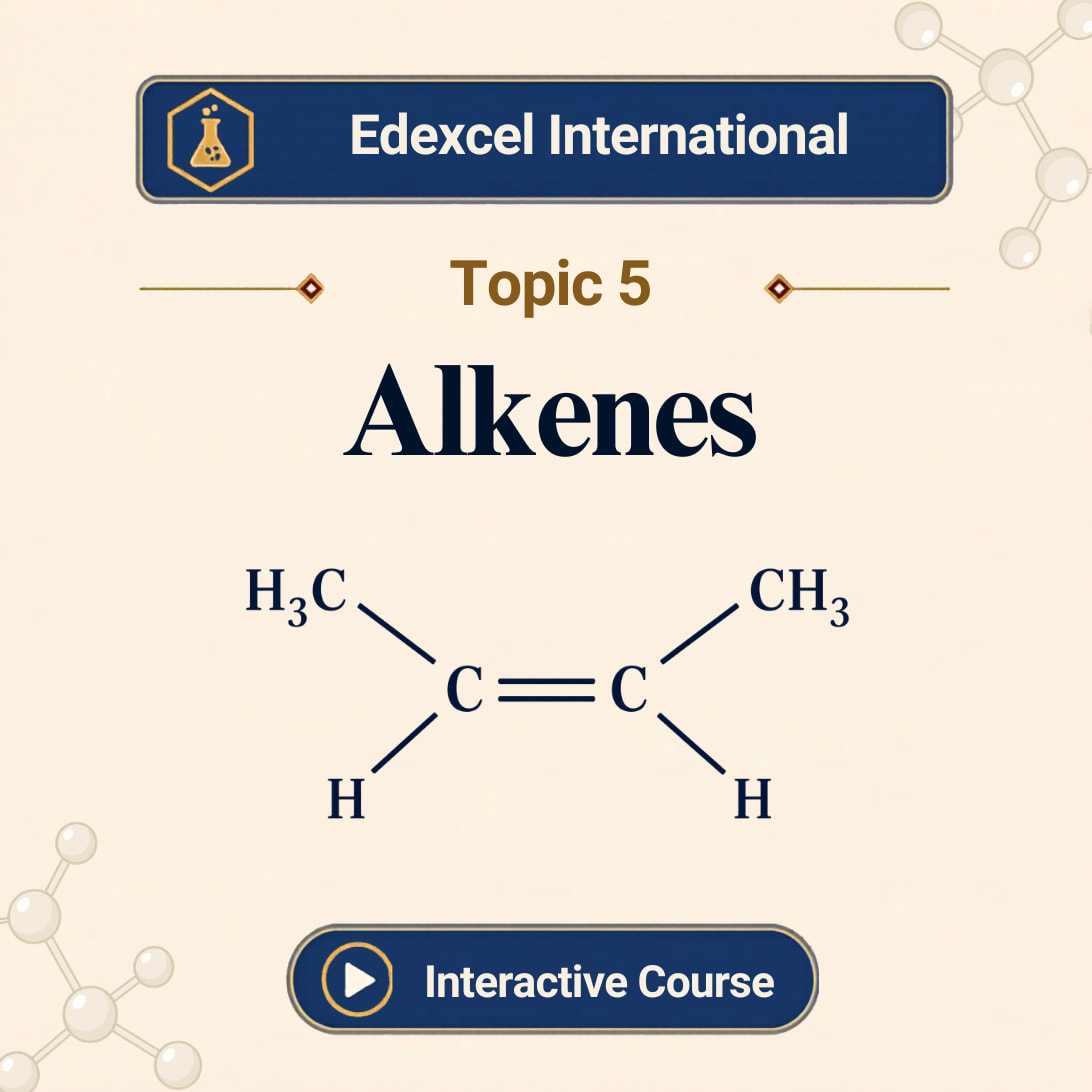
Alkenes – Topic 5

(6 customer reviews)

£34.99

Out of stock

Alkenes – Topic 5

The Alkenes Topic 5 Edexcel International A Level Chemistry course provides approximately 12 hours of guided learning. Students work through guided video teaching, auto-marked MCQ practice, teacher-marked short-answer questions, and a specification assignment with a personalised progress report.

Guided Learning
12 Hours
Video Lessons
145 mins
MCQ Assessments
90 Marks
SAQ Assessments
90 Marks

Guided video teaching

Virtual Lesson

The recorded lesson teaches the key chemistry and the exam technique needed to apply it accurately. Students pause during exam-practice sections, attempt questions independently, then review the worked explanations and the mark-scheme approach.

At a glance

What you get in this course

145 minutes of guided video

A full Topic 5 walkthrough covering every spec point, with worked exam questions and mark-scheme strategy built into the lesson.

90 marks of MCQ practice

Auto-marked MCQ quizzes with instant diagnostic feedback for every option. Repeat as many times as you like.

90 marks of written practice

Written-answer quizzes marked by a chemistry specialist, with per-mark feedback returned by the following Monday.

Spec-point tagged throughout

Every question maps to the Edexcel IAL specification, so your scores roll up into your personal KASP Analytics dashboard.

Exam-technique baked in

The lesson teaches the chemistry and the exam wording. You learn what Edexcel actually rewards, not just the content.

Personalised progress report

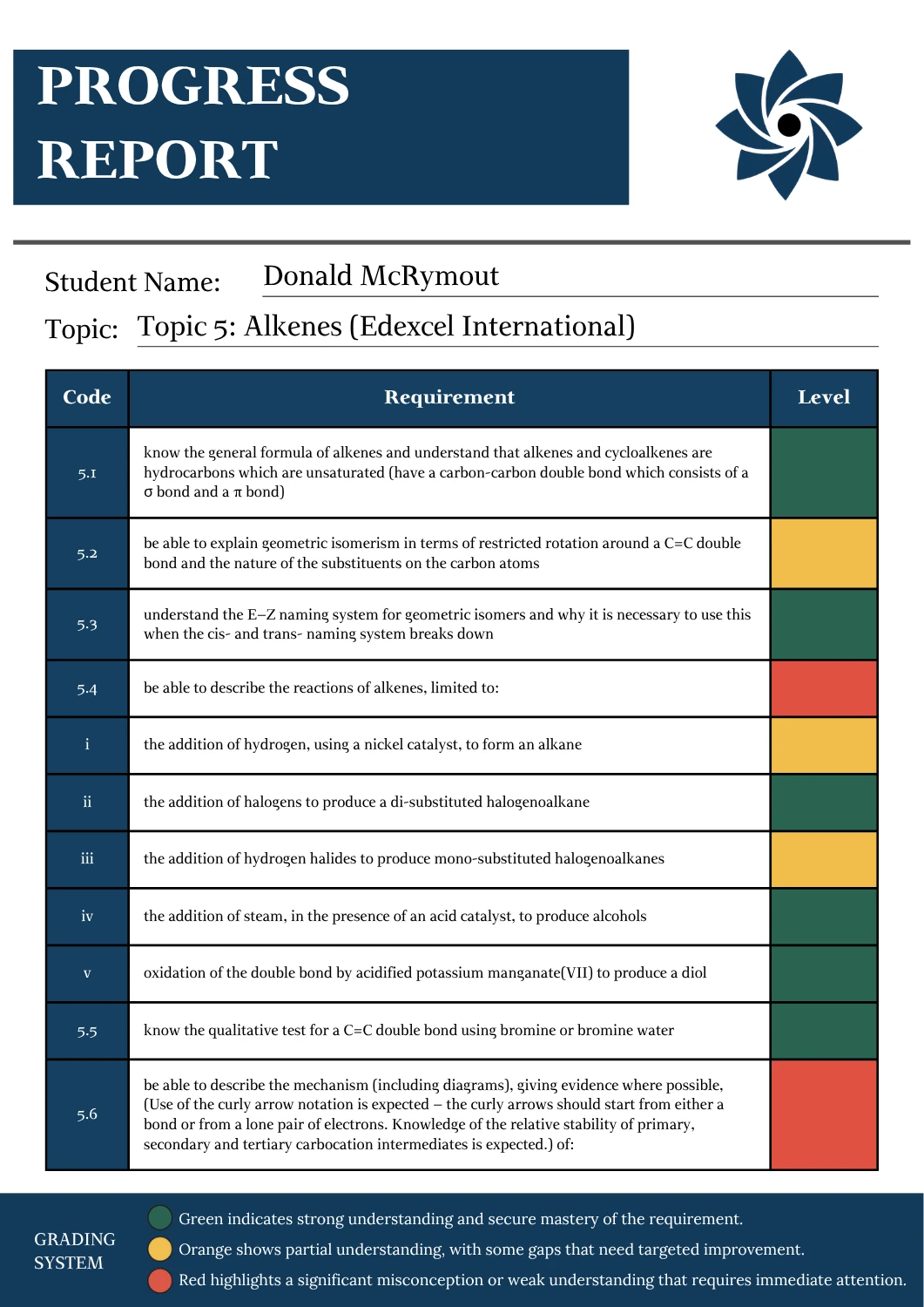
A one-click PDF report at the end of the course shows your level on every spec point in colour-coded form.

What is KASP Analytics?

KASP (Knowledge Analytics & Spec-point Platform) tracks your progress at the level of individual specification points, not just whole quizzes. Every question you attempt on this course is mapped to the Edexcel IAL spec point it assesses, so you always know exactly which parts of the specification you have mastered and which need another look.

Your topic dashboard

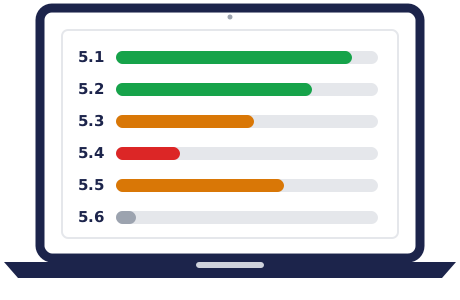
Every topic you have worked through is summarised here. At a glance you see how many questions you have attempted, what is still waiting to be marked, your total marks scored, and an overall score percentage on a colour-coded bar.

Hello, Sara

Here is how you are doing across the topics you have attempted.

Edexcel IAL Chemistry
Topic Questions Attempted Pending Marks (Scored / Available) Score
Topic 5: Alkenes 18 / 20 2 42.00 / 56.00
75.0%
Topic 6: Energetics 22 / 28 4 31.50 / 64.00
49.2%

Spec point breakdown for a topic

Click into any topic and you see the full spec-point breakdown. Each row is a single Edexcel IAL spec point with its official wording, your score on it, and how many questions you have answered against it. The colour tells you immediately where to focus.

Spec points: Topic 5: Alkenes

Edexcel IAL
Spec tag Description Questions Marks Score
5.1 Know the general formula of alkenes and understand that alkenes and cycloalkenes are hydrocarbons with a C=C double bond. 4 / 4 8.00 / 8.00
100.0%
5.2 Be able to explain geometric isomerism in terms of restricted rotation around a C=C double bond. 3 / 3 5.00 / 6.00
83.3%
5.4i Be able to describe the addition reaction of alkenes with hydrogen, using a nickel catalyst. 2 / 2 3.00 / 4.00
75.0%
5.4iii Be able to describe the addition of hydrogen halides to produce a halogenoalkane. 2 / 2 2.50 / 5.00
50.0%
5.6i Be able to describe the mechanism of the electrophilic addition of hydrogen halides to alkenes. 2 / 3 2.00 / 6.00
33.3%
5.7 Be able to describe the addition polymerisation of alkenes and draw the repeat unit given the monomer. 0 / 2 0.00 / 0.00 Not yet attempted
Green 70 to 100%: secure mastery Orange 40 to 69%: some gaps Red 0 to 39%: needs attention Grey: not yet assessed

Printable progress report

One click and you can download a clean, branded Progress Report PDF for any topic. Useful for your own revision folder, for parents to see at a glance, or for tutors to plan focused sessions.

One report card per topic

A focused, one-glance view of how you are doing on every spec point in a single topic. Designed to mirror the on-screen dashboard, so the colours you see in your daily revision carry through to the printed record.

The branded navy header carries your name and the topic. Every spec point in the topic appears with its code and full requirement text, and the Level column on the right is colour-coded green through red so you can spot strengths and gaps at a glance. A built-in legend at the foot of the report keeps the meaning of each colour clear for anyone reading it: a parent, a tutor, or future you.

At a glance

What you get with this course

Spec-point level tracking

Every question is tagged to the exact Edexcel IAL spec point it assesses, so your scores roll up cleanly to the specification.

Updates automatically

Submit a quiz and your dashboard updates right away. Short-answer questions appear as pending until they have been marked.

Built for Edexcel IAL

Wording, codes, and topic structure follow the Edexcel IAL Chemistry specification exactly, so your scores line up with the document you will be examined on.

Printable report

One-click PDF Progress Report per topic, in the same colour system, ready for your folder or for a tutor session.

Strongest and weakest areas

Your strongest spec points and the ones most worth revisiting are surfaced for every topic you work through.

Progress over time

A simple line chart shows how your overall score has trended across the days you have been studying.

PROGRESS
REPORT
Student Name: Sara Mitchell
Topic: Topic 5: Alkenes
70-100% mastery 40-69% gaps 0-39% urgent not assessed
CODE
REQUIREMENT
LEVEL
5.1
General formula of alkenes; C=C double bond
5.2
Geometric isomerism, restricted rotation at C=C
5.3
E-Z naming system for geometric isomers
5.4i
Addition of hydrogen, nickel catalyst
5.4ii
Addition of halogens, di-substituted halogenoalkane
5.4iii
Addition of hydrogen halides to alkenes
5.4iv
Addition of steam, acid catalyst, hydration
5.4v
Oxidation by acidified potassium manganate(VII)
5.5
Test for C=C: bromine / bromine water
5.6i
Electrophilic addition mechanism, HX to alkene
5.6ii
Electrophilic addition mechanism, halogens
5.7
Addition polymerisation, repeat unit from monomer
5.8i
Biodegradable polymers and disposal issues
5.8ii
Removing toxic waste gases from polymer disposal
GRADING SYSTEM
Green indicates strong understanding and secure mastery of the requirement.
Orange shows partial understanding, with some gaps that need targeted improvement.
Red highlights a significant misconception or weak understanding that needs immediate attention.
Grey means not yet assessed: no questions have been attempted for this requirement.

What is the MCQ Bank?

The MCQ Bank for Topic 5: Alkenes is an auto-marked, instant-feedback practice engine built from past Edexcel IAL paper questions. Every question is tagged to a specific Edexcel IAL spec point, every option carries diagnostic feedback explaining the chemistry, and every quiz attempt feeds directly into your KASP Analytics dashboard. New questions are added to the bank every quarter – the figures below reflect the Q2 2026 snapshot.

Try a real Topic 5 MCQ

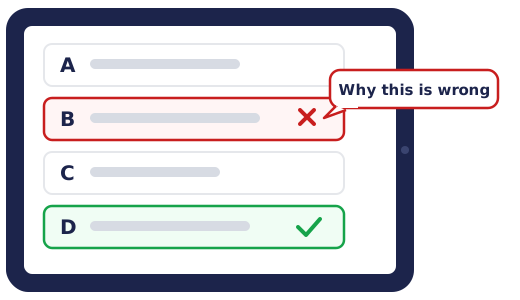
This is a genuine question from the Topic 5 Alkenes MCQ Bank. Click any option to reveal the diagnostic feedback for that choice, then expand the correct-answer panel at the bottom to see the full mechanism walkthrough.

Electrophilic addition of HBr to propene

5.4iii (Edexcel IAL) 5.6i (Edexcel IAL)

Propene reacts with hydrogen bromide gas at room temperature to form a halogenoalkane. Which row correctly identifies the major product and the reason it is preferred?

Click an option to see feedback

A 1-bromopropane, because the H atom of HBr bonds preferentially to the more substituted carbon of the C=C.
Incorrect

The product is 2-bromopropane, but your reasoning is the wrong way round. In Markovnikov addition the hydrogen of HBr adds to the carbon already bearing more hydrogens (the less substituted carbon), not the more substituted one. The selectivity is driven by carbocation stability, not by where H prefers to bond.

B 2-bromopropane, because the secondary carbocation intermediate is more stable than the primary carbocation.
Correct

In the electrophilic addition mechanism, H+ adds across the C=C to give a carbocation. Attack onto C1 of propene gives a secondary carbocation on C2, which is stabilised by the inductive effect of two alkyl groups. Attack onto C2 would give a less stable primary carbocation. The bromide ion then attacks the more stable carbocation, giving 2-bromopropane as the major product. This is Markovnikov's rule.

C 1-bromopropane, because primary C−Br bonds are stronger than secondary C−Br bonds.
Incorrect

This is incorrect on two counts. The major product is 2-bromopropane, not 1-bromopropane, and the selectivity is not determined by C−Br bond strength. The decisive factor is the relative stability of the carbocation intermediate formed in the rate-determining step, not the strength of bonds in the final product.

D 2-bromopropane, because the bromide ion attacks the less sterically hindered carbon atom.
Incorrect

The product is right but the reason is wrong. Steric hindrance is not the controlling factor here. The bromide ion attacks the more stable carbocation, which happens to be at C2. The correct explanation is rooted in carbocation stability, not steric accessibility.

Show correct answer & full explanation →
General feedback

Electrophilic addition of HBr to an unsymmetrical alkene follows Markovnikov's rule. To predict the major product you must compare the two possible carbocation intermediates.

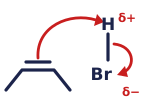
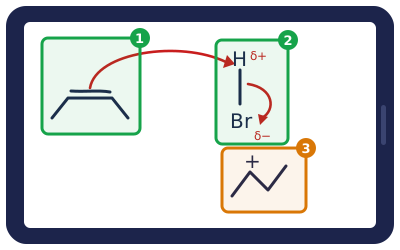
  • Step 1: The π electrons of the C=C attack the δ+ hydrogen of HBr.
  • Step 2: A C−H bond forms, leaving a carbocation on the other carbon. With propene this is either a 1° carbocation (CH3CH2CH2+) or a 2° carbocation (CH3CH+CH3).
  • Step 3: Br attacks the more stable carbocation. The 2° carbocation is more stable due to inductive donation from two alkyl groups, so 2-bromopropane is the major product.
  • Bond strengths and steric hindrance are not the controlling factors. Carbocation stability is.

The correct answer is B.

Five quizzes, 90 marks of MCQ practice

The Topic 5 MCQ Bank is divided into five quizzes (A–E), each a single auto-marked attempt. Because every spec point is tested across multiple quizzes, your KASP scores reveal real improvement as you move from quiz A through E. New questions are added every quarter.

Topic 5: Alkenes – MCQ quizzes

Q2 2026 snapshot 90 marks total
MCQ A
20
marks
MCQ B
20
marks
MCQ C
20
marks
MCQ D
20
marks
MCQ E
10
marks
86 total marks One attempt per quiz Auto-marked on submit Updated quarterly

Your quiz review

Once you submit a quiz, Moodle shows a clean review screen. You see your overall score, a per-question breakdown, the spec point that was being tested, and a one-click route back into any question you want to study further.

Quiz review – Topic 5 MCQ A

Attempt completed 14 March, 19:42

Score
18 / 22
82%
Question Spec point Mark Result
Identifying the C=C functional group test 5.5 1 / 1 Correct
E/Z naming of 2-methylpent-2-ene 5.3 1 / 1 Correct
Electrophilic addition of HBr to propene 5.6i 0 / 1 Incorrect
Repeat unit of poly(propene) 5.7 1 / 1 Correct
Oxidation by acidified KMnO4 5.4v 1 / 1 Correct
… and 17 more questions
Tip: Click any incorrect row to reopen that question, re-read the diagnostic feedback, and revisit the linked spec point on your KASP dashboard.

At a glance

What you get with the MCQ Bank

90 marks, five quizzes

MCQs A–D carry 20 marks each; MCQ E carries 6 marks. Together they provide balanced coverage of every Topic 5 spec point. New questions are added every quarter.

Instant auto-marking

Submit and the result is back in your hands inside a second. No waiting, no manual checking.

Diagnostic feedback per option

Every wrong option carries a tailored explanation of the misconception, not just a generic “incorrect”.

Spec-point tagged

Each question is mapped to the Edexcel IAL spec point it assesses, so your score flows straight into KASP Analytics.

Track improvement across quizzes

One attempt per quiz, but the same spec points appear across MCQs A through E. Your scores from quiz to quiz show genuine progress, not repeat-attempt inflation.

Built from past papers

Every MCQ is sourced from genuine Edexcel IAL past papers, with the wording polished for clarity and the chemistry verified.

What is the SAQ Bank?

The SAQ Bank for Topic 5: Alkenes is a written-answer practice engine marked by a real chemistry specialist. You attempt one quiz per week, submit your full written response, and your teacher returns mark-by-mark feedback the following Monday. Every comment is targeted at the exam wording you need to use. New questions are added to the bank every quarter – the figures below reflect the Q2 2026 snapshot.

A submitted SAQ and the feedback it gets

This is a genuine question from the Topic 5 Alkenes SAQ Bank with a real student answer already submitted. Click below to view the marked-up feedback returned by the chemistry specialist.

Geometric isomerism in but-2-ene and but-1-ene

5.2 (Edexcel IAL) [4 marks]

Explain, in terms of bonding, why but-2-ene exhibits geometric (E−Z) isomerism whereas but-1-ene does not. [4]

Student's submitted answer

But-2-ene has a C=C double bond which cannot rotate. It is fixed in place because of the double bond. Each of the two carbons in the double bond has a methyl group and a hydrogen atom attached, so the methyl groups can be arranged on the same side (Z) or on opposite sides (E), giving two different isomers. In but-1-ene, the end carbon of the double bond has two hydrogen atoms attached, so swapping them does not create a different molecule, and so but-1-ene does not show geometric isomerism.
View returned feedback →
Returned by your chemistry specialist
Mr Hassan – returned Mon 17 March
Score
3 / 4
75%

Your answer (annotated)

But-2-ene has a C=C double bond which cannot rotate. It is fixed in place because of the double bond. Each of the two carbons in the double bond has a methyl group and a hydrogen atom attached, so the methyl groups can be arranged on the same side (Z) or on opposite sides (E), giving two different isomers. In but-1-ene, the end carbon of the double bond has two hydrogen atoms attached, so swapping them does not create a different molecule, and so but-1-ene does not show geometric isomerism.

Mark scheme

Restricted rotation around the C=C double bond. Awarded – you explicitly said the C=C cannot rotate.
Rotation is restricted because of the π bond (sideways overlap of p-orbitals). Not awarded. You said the C=C “cannot rotate” but didn't explain why. To earn this mark, state that the π bond is formed by sideways overlap of p-orbitals, and that rotating around the C=C would break this π bond, which requires too much energy at room temperature.
Each carbon of the C=C in but-2-ene has two different groups (CH3 and H). Awarded – cleanly identified.
One carbon of the C=C in but-1-ene has two identical groups (two H atoms), so no E/Z isomerism. Awarded – nicely contrasted against but-2-ene.

Teacher comment

Strong structural answer, Sara. You've nailed the geometric reasoning for why but-2-ene can show E/Z and why but-1-ene can't. The one mark you've left on the table is the bonding explanation behind restricted rotation. Examiners want to see the words “π bond” and “sideways overlap of p-orbitals” explicitly, not just “cannot rotate”. Bank that phrase for your next E/Z question.

A predictable weekly rhythm

One quiz per week. Submit anywhere from Monday to Friday, marking happens over the weekend, and you receive your feedback by the following Monday. The rhythm is the same every week so you always know when to expect a return.

Mon
Submit
Tue
Submit
Wed
Submit
Thu
Submit
Fri
Submit
Sat
Marking
Sun
Marking
Returned
Next Monday morning
Your marked SAQ lands back in your dashboard with per-mark feedback, model wording, and a teacher comment.
One attempt per quiz, one quiz submitted per week. Because the same spec points reappear across SAQs A through F, your scores from quiz to quiz show genuine improvement – not repeat-attempt inflation. The weekly cap also keeps the marking load manageable so your feedback stays genuinely thorough.

Six quizzes, 90 marks of written practice

The Topic 5 SAQ Bank is split into six quizzes (A–F). Quizzes A–E each contain 20 questions; quiz F contains the remaining questions. Each quiz draws from past Edexcel IAL written-paper questions and covers a spread of Topic 5 spec points. New questions are added every quarter.

Topic 5: Alkenes – SAQ quizzes

Q2 2026 snapshot 90 marks total
SAQ A
20
questions
SAQ B
20
questions
SAQ C
20
questions
SAQ D
20
questions
SAQ E
10
questions
SAQ F
Remaining
questions
90 total marks 1 quiz per week Returned the following Monday Updated quarterly

At a glance

What you get with the SAQ Bank

90 marks, six quizzes

SAQs A–E each contain 20 questions; SAQ F contains the remaining questions. Mark values vary by question; total across all quizzes is 115 marks. New questions are added every quarter.

Marked by a chemistry specialist

Not auto-graded, not AI-scored. A subject specialist reads your answer end-to-end and writes the comments by hand.

Per-mark feedback

Every mark in the scheme is checked off explicitly. You see exactly which marks you earned and what wording the missed ones needed.

Predictable weekly turnaround

Submit by Friday, marked over the weekend, feedback returned by Monday. One quiz per week; one attempt per quiz.

Exam-board wording focus

Feedback teaches the precise language the Edexcel mark scheme rewards, so the next time the topic appears you write to score.

Feeds your KASP dashboard

Every SAQ is spec-point tagged. Once marked, your scores flow into KASP Analytics alongside your MCQ results.

6 reviews for Alkenes – Topic 5

  1. Fatima (verified owner)

    I failed my first attempt of unit 1 edexcel international chemistry, mainly because i did not understand alkenes topic because our teacher was terrible at organic chemistry. I was a few marks away from passing! im so happy I came across this website, because it allows me to just purchase the topic i need help in! the study notes was amazing, you are tested with questions, and then the video with the chemistry specialist is absolutely shockingly amazing, he goes through the topic in detail and goes through exam questions step by step, with thought processes on how to approach specific exam questions and what the examiner wants! Then there is a quiz (exam questions) that he marks and returns with a report specifying which parts of the specification related to alkenes i need to work on. Then there is a bunch of exam multiple choice questions with instant feedback which was very helpful with short answer written exam questiosn that he also marks with feedback! The amount you get for this price is shocking! it may seem expensive at first, but i was paying approximately half the amount of this course for 1 hour of tuition, and i had 3 hours tuition a week! Highly recommend this course!!!

  2. Khan (verified owner)

    The course taught by the Chemistry Specialist helped improve my confidence in Chemistry and made the subject much clearer to understand. The lessons were very structured, and the recorded videos explain the topics clearly while answering the kinds of questions students often have when learning the material. What I found especially useful was being able to practise using the MCQs, SAQs, and assignments, which helped reinforce the concepts rather than just looking at a mark scheme. The explanations focus on understanding the chemistry behind the questions, which makes it easier to apply the knowledge in exam-style problems. The course also helped increase my overall confidence because everything is organised clearly and the practice questions allow you to test your understanding as you progress. Overall, every lesson felt beneficial and helped build a stronger understanding of the topic.

  3. Jumana (verified owner)

    The course taught by the Chemistry Specialist has really improved my confidence in Chemistry, and I now feel much more confident with the subject than before. What I found most helpful was the way the content explains how and why things work rather than just asking us to memorise facts. The recorded lesson videos break down complex ideas clearly, and the diagrams and visual explanations make the theory much easier to understand. The MCQs, SAQs, and assignments also helped a lot because they allowed me to practise applying the concepts and check my understanding as I worked through the course. Everything feels well structured and clearly prepared, which makes it easier to see the bigger picture of the topic. Using the course resources also helped me become more consistent with revising previous topics and practising exam-style questions. Overall, the course made Chemistry feel much more approachable and less intimidating because difficult concepts are explained step by step and supported with practice questions that help reinforce what you learn.

  4. Latifa (verified owner)

    The Topic 5 Alkenes course helped increase my confidence in Chemistry a lot. The lesson materials and resources were very organised, which made it easy to follow the topic without worrying about where to find things. The recorded explanations and practice questions helped me understand the concepts more clearly, and the course overall helped improve my understanding of the topic significantly.

  5. Linda (verified owner)

    The Topic 5 Alkenes course really helped improve my confidence in Chemistry. The videos explain the topics step by step and make the harder ideas much easier to understand. I also found the diagrams and examples really helpful because they show how the theory actually works instead of just memorising it. Overall it made the topic feel much clearer and easier to revise.

  6. Sara (verified owner)

    I studied the T5 Alkenes course from Abu Dhabi and it really helped improve my confidence with the topic. The Chemistry Specialist explains complex ideas in a very clear and simple way, which made the reactions and mechanisms much easier to understand. The lessons are very well organised and the recorded videos meant I could go back and review anything I didn’t fully understand. The notes and online quizzes were also really helpful for reinforcing the material and preparing for exam-style questions. Overall, the course made the topic much easier to grasp and helped me focus on actually understanding the chemistry rather than just memorising it.

Only logged in customers who have purchased this product may leave a review.

Exam Board Alignment

Alkenes Topic 5 Edexcel International A Level Chemistry

This course covers the following Edexcel IAL Chemistry specification points:

5.1
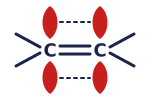
know the general formula of alkenes and understand that alkenes and cycloalkenes are hydrocarbons which are unsaturated, having a C=C double bond consisting of a σ bond and a π bond
5.2
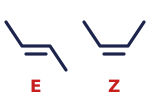
be able to explain geometric isomerism in terms of restricted rotation around a C=C double bond and the nature of the substituents on the carbon atoms
5.3
understand the E–Z naming system for geometric isomers and why it is necessary to use this when the cis- and trans- naming system breaks down
5.4
be able to describe the reactions of alkenes, limited to the addition of:
ihydrogen, using a nickel catalyst, to form an alkane
iihalogens to produce a di-substituted halogenoalkane
iiihydrogen halides to produce mono-substituted halogenoalkanes
ivsteam, in the presence of an acid catalyst, to produce alcohols
voxidation of the double bond by acidified potassium manganate(VII) to produce a diol
5.5
know the qualitative test for a C=C double bond using bromine or bromine water
5.6
be able to describe the mechanism (including diagrams) of:
ithe electrophilic addition of bromine and hydrogen bromide to ethene
iithe electrophilic addition of hydrogen bromide to propene
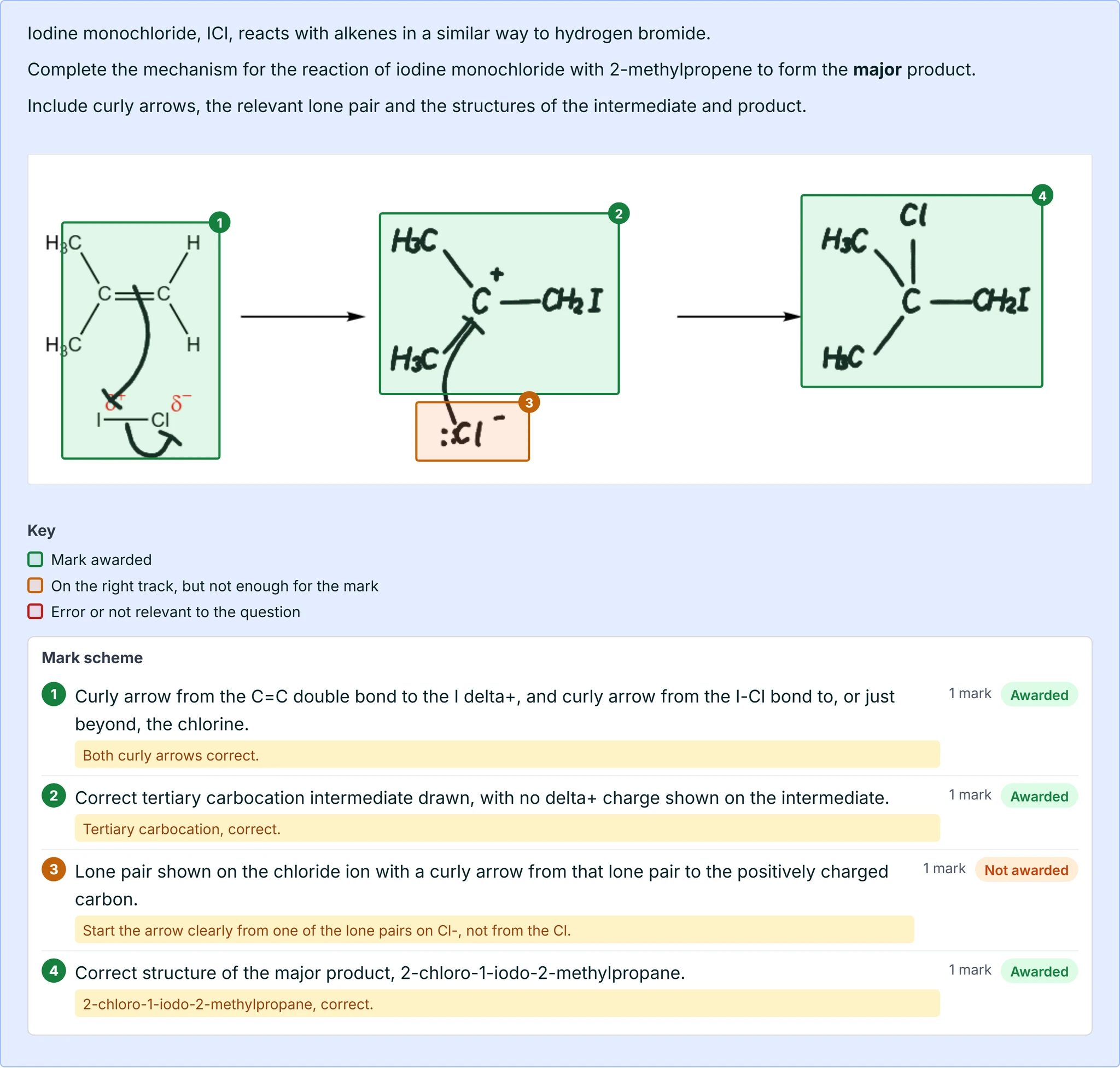
Use of the curly arrow notation is expected. Curly arrows should start from either a bond or from a lone pair of electrons. Knowledge of the relative stability of primary, secondary and tertiary carbocation intermediates is expected.
5.7
be able to describe the addition polymerisation of alkenes and draw the repeat unit given the monomer, and vice versa
5.8
understand how chemists limit the problems caused by polymer disposal by:
ideveloping biodegradable polymers
iiremoving toxic waste gases produced by the incineration of polymers

Complete Topic Package

Learn the content, practise exam questions, and identify exactly where marks are being lost.

This course combines guided video teaching, diagnostic MCQs, teacher-marked written assessment, and detailed specification reporting for Edexcel IAL Chemistry.