Reactions of Period 3 Elements with Oxygen and Water
A concise revision guide to the reactions of the Period 3 elements sodium to sulfur: how sodium and magnesium react with water, how each element burns in oxygen to form its oxide, with the equations, observations and the trends examiners ask you to explain.
Recap: The Period 3 Elements
Five quick questions on what you already know: the elements sodium to argon, their electron configurations ([Ne]3s¹ for sodium to [Ne]3s²3p⁴ for sulfur), which are metals and which non-metals, and the trends in atomic radius and melting point from 3.2.1 Periodicity.
Sodium and Magnesium with Water
Only the two metals at the start of the period are studied with water. Sodium reacts with cold water at once; magnesium hardly reacts with cold water but reacts quickly with steam.
Sodium with cold water
Equation: 2Na(s) + 2H₂O(l) → 2NaOH(aq) + H₂(g)
Observations: the sodium floats, melts into a silvery ball, fizzes as hydrogen is given off and darts about the surface. The solution turns universal indicator purple: pH 13 to 14, a strong alkali.
Magnesium with cold water
Equation: Mg(s) + 2H₂O(l) → Mg(OH)₂(aq) + H₂(g)
Observations: very slow: a few bubbles of hydrogen collect on clean magnesium ribbon after several days. Magnesium hydroxide is only sparingly soluble, so the solution is weakly alkaline, pH 9 to 10.
Magnesium with steam
Equation: Mg(s) + H₂O(g) → MgO(s) + H₂(g)
Observations: fast: heated magnesium burns in steam with a bright white light and leaves a white solid, magnesium oxide. The hydrogen can be lit at the end of the tube.
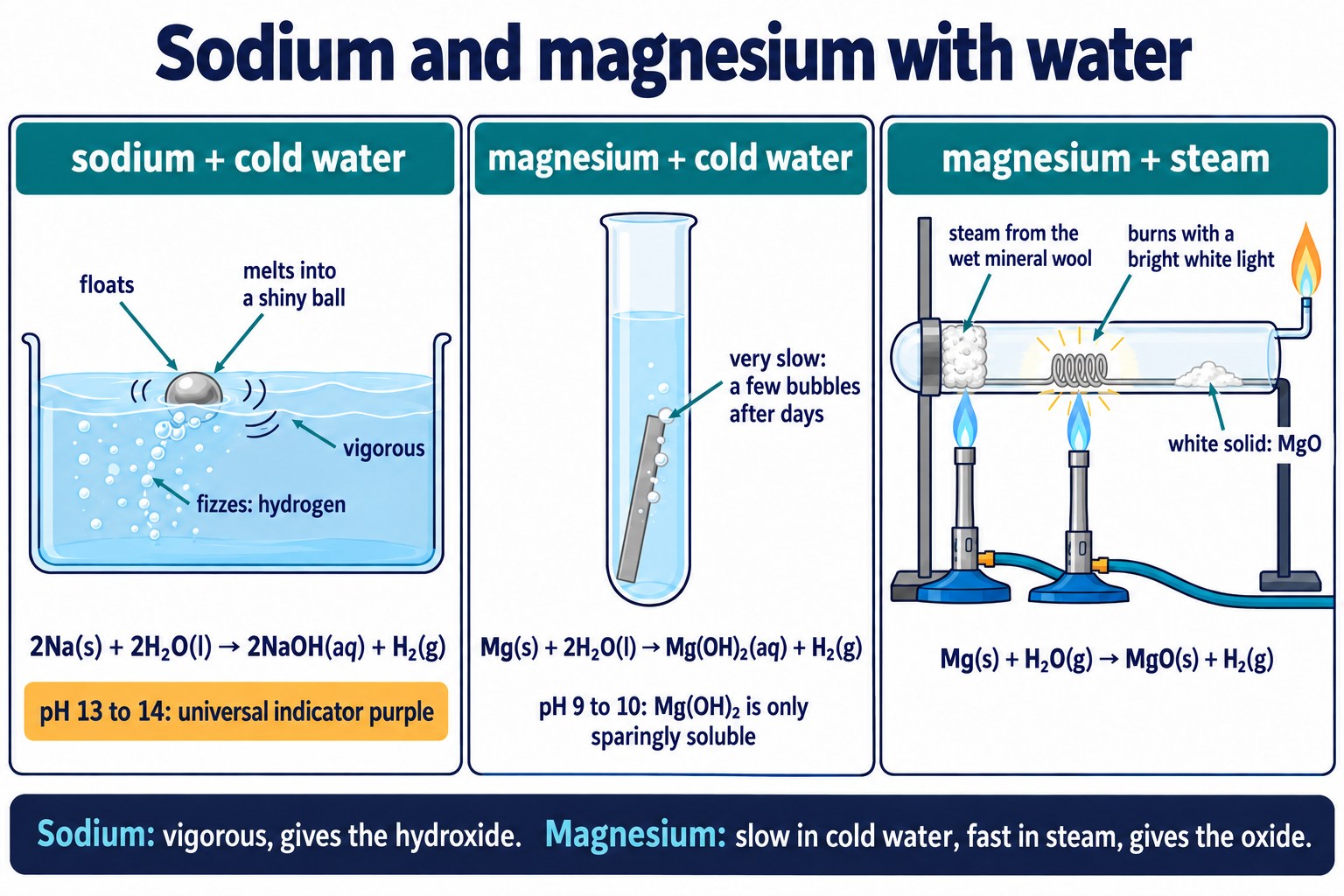
Sodium and magnesium with cold water and magnesium with steam: what is seen, the products and the pH of each solution.
- Magnesium is less reactive than sodium: its two outer electrons are held more strongly (higher ionisation energies), and the hydroxide formed coats the metal.
- With steam the product is the oxide, not the hydroxide: at high temperature magnesium hydroxide would decompose to MgO and water.
Exam focus: The state symbol on water decides the product: H₂O(l) gives the hydroxide, H₂O(g) gives the oxide. Writing Mg(OH)₂ for the steam reaction loses the mark.
The Elements with Oxygen
Every element from sodium to sulfur burns in oxygen to form its oxide. Learn the formula of each oxide first; the equation then balances itself.
| Element | Equation | Observation |
|---|---|---|
| sodium | 4Na(s) + O₂(g) → 2Na₂O(s) | burns with a yellow flame; white solid |
| magnesium | 2Mg(s) + O₂(g) → 2MgO(s) | burns with a brilliant white flame; white powder |
| aluminium | 4Al(s) + 3O₂(g) → 2Al₂O₃(s) | the powder burns brightly with a white flame; the solid metal is protected by its oxide layer |
| silicon | Si(s) + O₂(g) → SiO₂(s) | reacts slowly even on strong heating; white solid |
| phosphorus | P₄(s) + 5O₂(g) → P₄O₁₀(s) | burns with a white flame; dense white fumes of the solid oxide |
| sulfur | S(s) + O₂(g) → SO₂(g) | burns with a blue flame; colourless, choking gas |
Sulfur trioxide: burning sulfur gives mainly SO₂. The trioxide forms from 2SO₂(g) + O₂(g) ⇌ 2SO₃(g) over a vanadium(V) oxide catalyst at about 450 °C, the step used to make sulfuric acid.
Storage: sodium is kept under oil and white phosphorus under water so that neither meets the air.
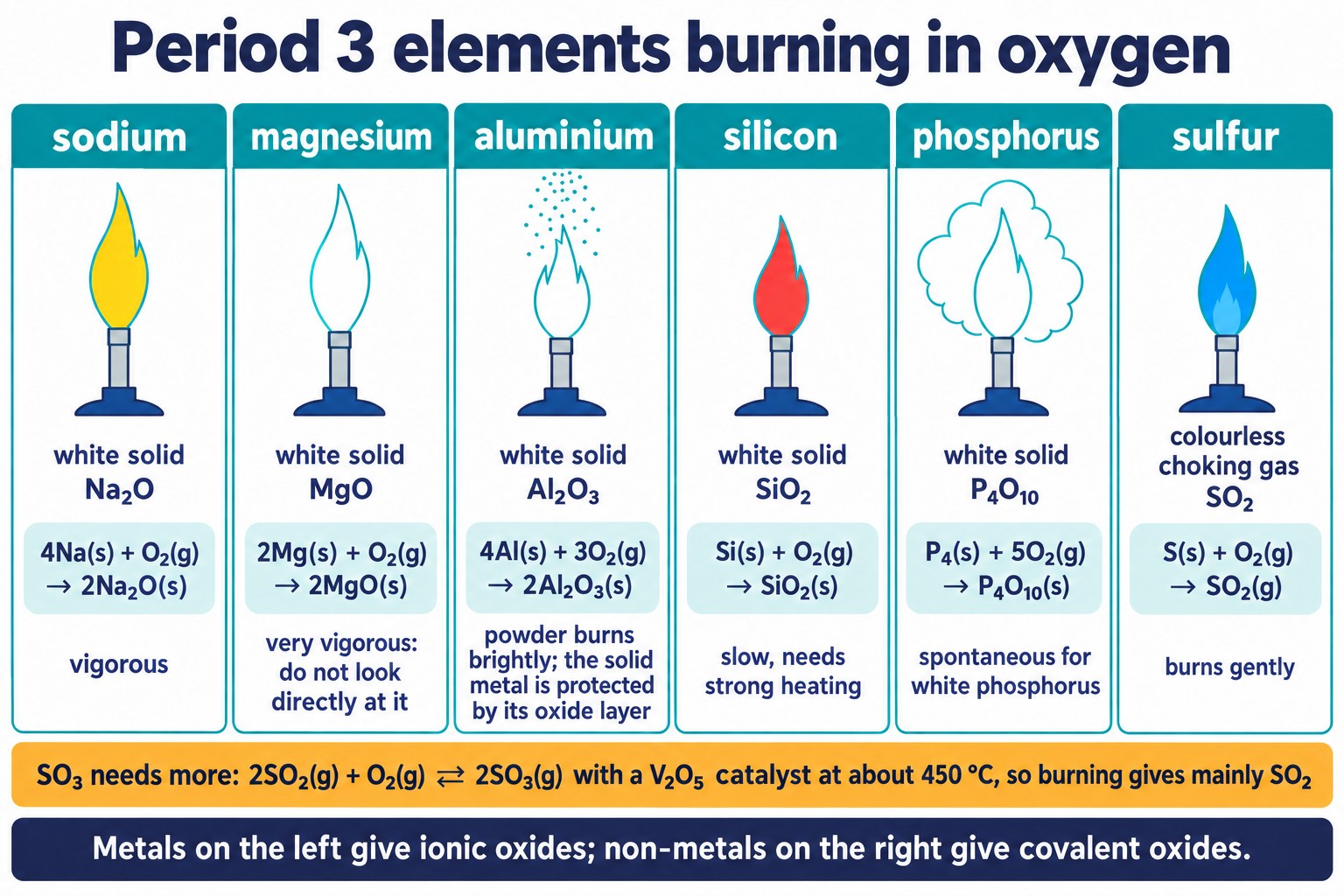
Six element tiles: flame colour, product and equation for each reaction with oxygen.
Common mistake: Writing SO₃ or PO₂ as the product of burning. Sulfur burns to SO₂ and phosphorus to P₄O₁₀; start every equation from the correct oxide formula and balance the oxygen last.
Check: Water and Oxygen Reactions
Balance the equations for the elements with water and oxygen, match each element to its flame colour and product, and give the pH of the solutions formed.
Quick Check: Which Gram Needs Most Oxygen?
Use the formula of each oxide to compare the oxygen needed by equal masses of the elements.
Trends Across the Period
Across Period 3 the elements change from reactive metals to non-metals, and their reactions change with them.
- With water: sodium reacts vigorously, magnesium very slowly; aluminium onwards shows no reaction of this kind (aluminium is sealed by its oxide layer).
- In oxygen: every element burns, the flame yellow for sodium, white for magnesium, aluminium and phosphorus, blue for sulfur; silicon needs strong heating.
- The oxides: Na₂O, MgO and Al₂O₃ are ionic solids, SiO₂ is giant covalent, P₄O₁₀, SO₂ and SO₃ are simple molecules: Period 3 Oxides: Structure, Bonding and Melting Points.
- Why: electronegativity rises across the period, so the bonding to oxygen changes from ionic to covalent: Period 3 Oxides with Water, Acids and Bases.
Remember: Metal plus oxygen gives an ionic oxide that is basic; non-metal plus oxygen gives a covalent oxide that is acidic. The change happens at silicon, the metalloid in the middle of the period.
Check: Trends in the Element Reactions
Decide which element gives each observation, pick the metal that reacts fastest with water, and explain the change from ionic to covalent oxides in terms of electrons and electronegativity.
Common Exam Points
- Sodium with cold water: 2Na(s) + 2H₂O(l) → 2NaOH(aq) + H₂(g); floats, melts, fizzes; pH 13 to 14.
- Magnesium: very slow with cold water to Mg(OH)₂ (pH 9 to 10); fast with steam to MgO and hydrogen with a bright white light.
- Formulae of the oxides: Na₂O, MgO, Al₂O₃, SiO₂, P₄O₁₀, SO₂ and SO₃. Flames: sodium yellow, sulfur blue, the rest white.
- SO₃ is not made by burning sulfur: 2SO₂(g) + O₂(g) ⇌ 2SO₃(g) needs a V₂O₅ catalyst at about 450 °C.
- State symbols are marked: (s) for every oxide except SO₂(g) and SO₃(g); H₂O(l) for cold water and H₂O(g) for steam.
- Explain trends with electronegativity: it rises across the period, so the oxides go from ionic to covalent and from basic to acidic.
FAQs
Use these quick answers to check the reactions of sodium, magnesium, aluminium, silicon, phosphorus and sulfur with water and oxygen, the observations examiners expect and the trend behind them.
Why does sodium react so much more vigorously with cold water than magnesium?
Sodium loses its single outer electron very easily, so 2Na(s) + 2H₂O(l) → 2NaOH(aq) + H₂(g) is fast: the metal floats, melts into a ball and fizzes, giving pH 13 to 14. Magnesium holds its two electrons more tightly and barely bubbles.
What is different when magnesium reacts with steam instead of cold water?
With steam the reaction is fast and the metal burns with a bright white light, forming the oxide rather than the hydroxide: Mg(s) + H₂O(g) → MgO(s) + H₂(g).
Cold water slowly gives sparingly soluble Mg(OH)₂(aq), so the solution only reaches pH 9 to 10.
Why does a piece of aluminium not seem to burn in oxygen when aluminium is a reactive metal?
A thin, unreactive layer of Al₂O₃ coats the solid metal and stops oxygen reaching it.
Powdered aluminium has a huge surface area with fresh metal exposed, so it burns brightly: 4Al(s) + 3O₂(g) → 2Al₂O₃(s). The oxide layer is why aluminium resists corrosion.
Why does burning sulfur give sulfur dioxide and not sulfur trioxide?
Sulfur burns with a blue flame to form SO₂: S(s) + O₂(g) → SO₂(g).
Further oxidation, 2SO₂(g) + O₂(g) ⇌ 2SO₃(g), is slow and reversible, needing a vanadium(V) oxide catalyst at about 450 °C as in the Contact process. Burning alone gives almost entirely SO₂.
How do I describe the trend in the reactions of the Period 3 elements with oxygen?
Every element from sodium to sulfur combines with oxygen, but the vigour varies: sodium burns with a yellow flame, magnesium with a brilliant white flame, silicon reacts only slowly on strong heating and phosphorus burns with a white flame to give fumes of P₄O₁₀.

Copyright notice: This OLS revision content, including the explanations, layout, diagrams, tables and embedded learning structure, is authored for Online Learning System by Dr. Mohammed Al-Fatah. It may not be copied, reproduced, redistributed or adapted without written permission.
Keep this note — free
Save your progress across every AQA topic. A free account remembers which topics you have covered, saves your question scores, and syncs across your phone and laptop.
- Track every topic you have finished
- Keep your practice-question scores
- No payment, no card, free forever
Already registered? Log in