Period 3 Oxides: Structure, Bonding and Melting Points
A concise revision guide to the structures of the Period 3 oxides from Na₂O to SO₃: which are giant ionic, which giant covalent and which simple molecular, why their melting points fall across the period, and how to explain the trend in terms of bonding and structure.
Period 3 Oxides: Three Structure Types
Choose a step to watch which particles and forces must be overcome when a giant ionic, a giant covalent and a simple molecular oxide melt.
© Dr. Mohammed Al-Fatah – onlinelearningsystem.net
Before You Start
This page explains one graph: how the melting points of the Period 3 oxides change from Na₂O to SO₃. Three ideas from earlier work carry the whole explanation.
- Structure types: giant ionic, giant covalent and simple molecular, and which force breaks when each melts: Structure Types and Giant Covalent Structures.
- Ionic bonding: smaller, more highly charged ions attract more strongly: Ionic Bonding.
- The oxides themselves: how each element forms its oxide, from Reactions of Period 3 Elements with Oxygen and Water.
- Melting means separating the particles of a solid: the melting point measures the strength of the forces between those particles, not of the bonds inside a molecule.
Remember: Always name the particles and the force between them. “Strong bonds” on its own never explains a melting point.
GCSE Recap: Structure and Melting Points
Three quick questions on the GCSE ideas this page builds on.
The Seven Oxides
The main oxides of the elements are listed with their structure, bonding and melting point. Learn the three structure types and where the boundaries fall.
| Oxide | Structure | Bonding | Melting point |
|---|---|---|---|
| Na₂O | giant ionic lattice | ionic: Na⁺ and O²⁻ | 1275 °C |
| MgO | giant ionic lattice | ionic: Mg²⁺ and O²⁻ | 2852 °C |
| Al₂O₃ | giant ionic lattice | ionic with some covalent character | 2072 °C |
| SiO₂ | giant covalent (macromolecular) | covalent: every Si bonded to four O | 1610 °C |
| P₄O₁₀ | simple molecular | covalent molecules; London forces between them | sublimes at about 360 °C |
| SO₂ | simple molecular | covalent bent molecules; dipole-dipole and London forces | −75 °C |
| SO₃ | simple molecular | covalent trigonal planar molecules; London forces | 17 °C |
The pattern: high for the three ionic oxides, peaking at MgO; still high for giant covalent SiO₂; then a sharp fall to the molecular oxides of phosphorus and sulfur.
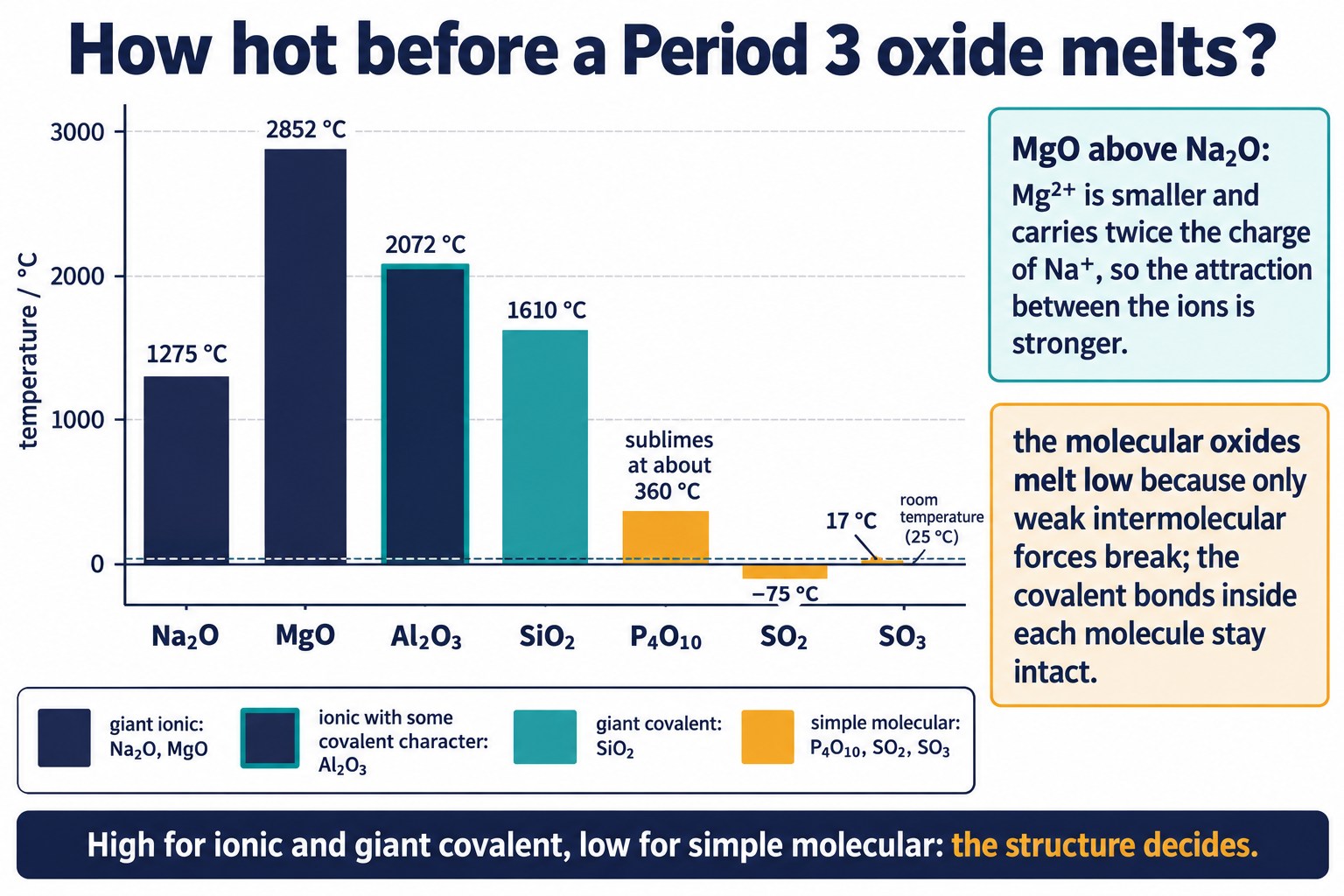
Bar chart of the seven melting points with every value written and each bar coloured by structure type.
Exam focus: The question says “explain the trend in melting points in terms of structure and bonding”. Give the structure, the particles and the force that is overcome, for each of the three types.
Ionic Oxides: Strong Attraction in Every Direction
Na₂O, MgO and Al₂O₃ are giant ionic lattices. Melting means overcoming the strong electrostatic attraction between oppositely charged ions that acts throughout the lattice, so their melting points are high.
MgO above Na₂O: Mg²⁺ carries twice the charge of Na⁺ and is smaller, so its attraction to the O²⁻ ions is much stronger. MgO melts at 2852 °C, Na₂O at 1275 °C.
Al₂O₃: Al³⁺ is small and highly charged, so it polarises the O²⁻ ion and the bonding gains some covalent character. The melting point, 2072 °C, is high but below that of MgO.
Evidence for ions: the molten oxides conduct electricity because their ions are free to move; the solids do not, because the ions are fixed in the lattice.
Uses: MgO and Al₂O₃ are ceramics: furnace linings and refractory bricks rely on these high melting points. Aluminium metal is protected by its thin, insoluble oxide layer.
Exam focus: Name the particles and the force: “strong electrostatic attraction between Mg²⁺ and O²⁻ ions acting in all directions”. The phrase “strong ionic bonds” alone earns less.
Silicon Dioxide: A Giant Covalent Lattice
SiO₂ has a giant covalent (macromolecular) structure. Every silicon atom is bonded to four oxygen atoms arranged tetrahedrally, and every oxygen bridges two silicon atoms, in a network that runs through the whole crystal.
Melting: means breaking many strong Si–O covalent bonds, so the melting point is high: 1610 °C.
Conduction: none, solid or molten: there are no ions and no delocalised electrons. This is how SiO₂ is told apart from the ionic oxides experimentally.
Why covalent: silicon is a metalloid; the electronegativity difference between silicon and oxygen is too small for electron transfer, so the atoms share electrons instead.
Contrast with CO₂: carbon dioxide, the Period 2 analogue, is a simple molecular gas: carbon forms double bonds to oxygen in a small molecule, silicon does not.
Common mistake: Calling SiO₂ “a molecule” or writing about intermolecular forces. There are no separate molecules in silicon dioxide, only one continuous lattice of covalent bonds.
Check: Ionic and Giant Covalent Oxides
Explain why MgO melts higher than Na₂O, why SiO₂ melts high with no ions present, and which oxides conduct electricity when molten.
Molecular Oxides: P₄O₁₀, SO₂ and SO₃
The oxides of phosphorus and sulfur are simple molecular. Strong covalent bonds hold the atoms inside each molecule, but only weak intermolecular forces act between molecules, and only those are overcome on melting. Hence the low melting points.
P₄O₁₀: a cage of four phosphorus and ten oxygen atoms. The molecule is large with many electrons, so its London forces are the strongest of the three and it sublimes at about 360 °C.
SO₂: a bent molecule with a permanent dipole; dipole-dipole and London forces hold the molecules together. Melting point −75 °C: a gas at room temperature.
SO₃: a trigonal planar molecule with no overall dipole; London forces only. It melts at 17 °C, so it is a solid on a cold day and a liquid on a warm one.
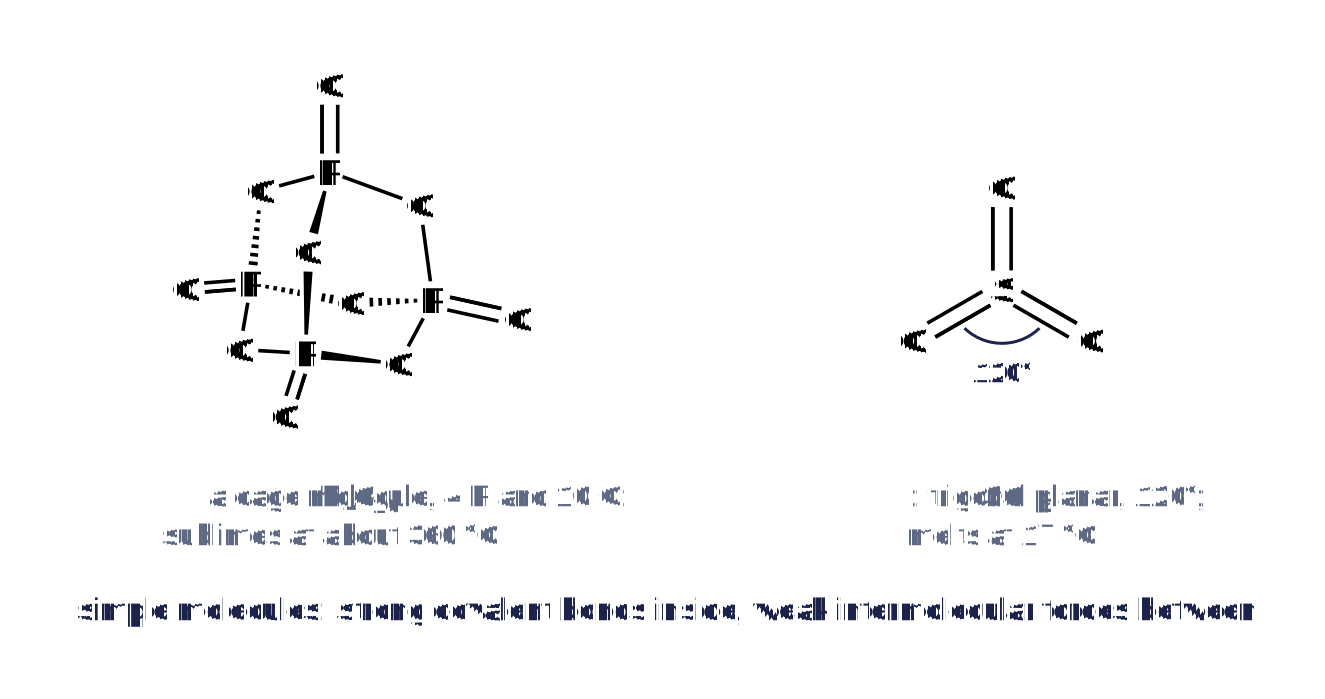
Ball-and-stick models of the P₄O₁₀ cage and the trigonal planar SO₃ molecule.
Common mistake: Saying that covalent bonds break when SO₂ melts. The S=O bonds stay intact; only the weak forces between molecules are overcome, which is why the melting point is so low.
Quick Check: Oxides That Are New to You
Use the data to decide the structure of each oxide and what is overcome on melting.
The Trend Across the Period
Put the three structure types together and the graph explains itself: ionic (high), giant covalent (high) and simple molecular (low). The change follows the bonding, and the bonding follows electronegativity.
- Na, Mg, Al: metals with low electronegativity transfer electrons to oxygen; ionic lattices form, melted only by overcoming strong electrostatic attraction between ions.
- Si: a metalloid shares electrons with oxygen in a giant covalent lattice; many strong covalent bonds must break.
- P, S: non-metals with electronegativities close to oxygen share electrons in small molecules; only weak intermolecular forces break on melting.
- Within each type the detail matters: MgO above Na₂O (charge and size of the cation), P₄O₁₀ above SO₂ (larger molecule, more electrons, stronger London forces).
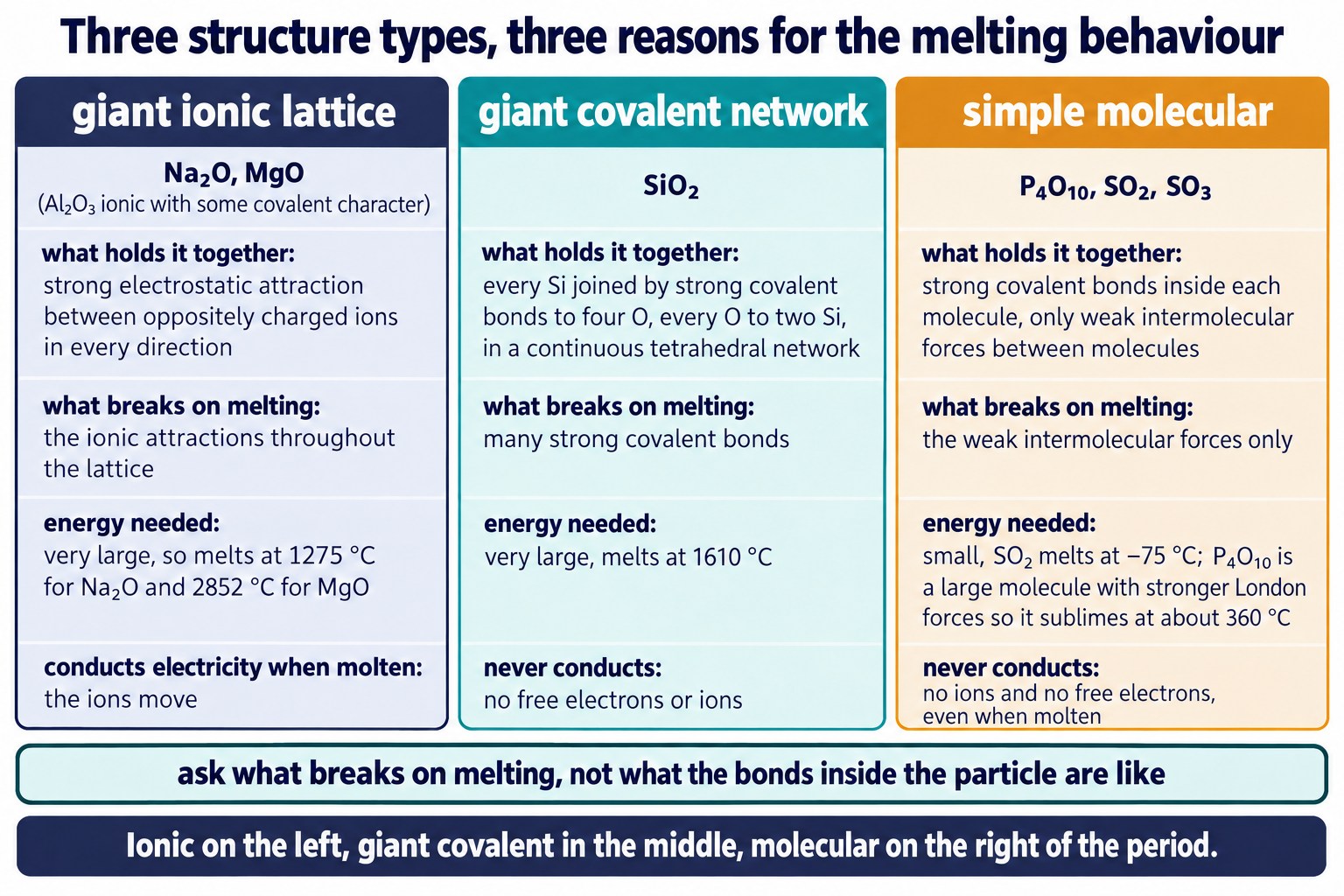
Three-panel poster: giant ionic, giant covalent and simple molecular, with the particles, the force overcome on melting and an example oxide in each panel.
Remember: Two reasons for a high melting point (ions or a covalent network) and one for a low melting point (separate molecules). Decide the structure type first, then write the explanation that belongs to it.
Check: Molecular Oxides and the Trend
Classify an unfamiliar oxide from its melting point and conductivity, explain why P₄O₁₀ melts above SO₂, and write the three-part explanation of the trend across the period.
Common Exam Points
- Three structure types: Na₂O, MgO, Al₂O₃ giant ionic; SiO₂ giant covalent; P₄O₁₀, SO₂, SO₃ simple molecular. Quote melting points to support the classification.
- Ionic oxides melt high because of strong electrostatic attraction between oppositely charged ions acting in all directions; MgO above Na₂O because Mg²⁺ is smaller and doubly charged.
- SiO₂ melts high because many strong Si–O covalent bonds must be broken; no ions, no conduction, no molecules.
- Molecular oxides melt low because only weak intermolecular forces (London forces, plus dipole-dipole for SO₂) are overcome; the covalent bonds inside the molecules stay intact.
- P₄O₁₀ melts above SO₂ and SO₃ because the molecule is larger with more electrons, giving stronger London forces.
- Al₂O₃ is ionic with some covalent character: the small, highly charged Al³⁺ polarises the O²⁻ ion.
- Molten ionic oxides conduct electricity (mobile ions); SiO₂ and the molecular oxides never do.
- The underlying cause of every trend: electronegativity rises across the period, so bonding to oxygen changes from ionic to covalent.
FAQs
Use these quick answers to check which Period 3 oxides are giant ionic, giant covalent or simple molecular, why their melting points fall across the period and how to explain the trend in an exam answer.
Why does magnesium oxide have a higher melting point than sodium oxide?
Both are giant ionic lattices, but Mg²⁺ is smaller than Na⁺ and carries twice the charge, so the electrostatic attraction between Mg²⁺ and O²⁻ ions is much stronger. More energy is needed to separate the ions: MgO melts at 2852 °C, Na₂O at 1275 °C.
Why is the melting point of silicon dioxide so high when silicon is a non-metal?
SiO₂ is a giant covalent (macromolecular) structure: every silicon atom is bonded to four oxygen atoms in a tetrahedral network extending through the whole crystal. Melting means breaking many strong covalent bonds, which needs a great deal of energy, so SiO₂ melts at 1610 °C.
Why does P₄O₁₀ have a much lower melting point than SiO₂ when both are covalent compounds?
The difference is the structure, not the bonds. P₄O₁₀ exists as separate molecules held together only by weak intermolecular forces (London forces), which are overcome at about 360 °C when it sublimes. In SiO₂ the strong covalent bonds themselves must break on melting.
Why does sulfur trioxide have a higher melting point than sulfur dioxide?
Both are simple molecular oxides held together by weak intermolecular forces. SO₃ is the larger molecule with more electrons, so its London forces are stronger and it melts at 17 °C, while the smaller SO₂ melts at −75 °C. No covalent bonds break.
Why does aluminium oxide have a lower melting point than magnesium oxide although Al³⁺ has a higher charge?
Al₂O₃ is still a giant ionic lattice melting at 2072 °C, but the small, highly charged Al³⁺ ion distorts the electron cloud of O²⁻, giving the bonding some covalent character. This weakens the purely ionic attraction compared with MgO, whose melting point is 2852 °C.

Copyright notice: This OLS revision content, including the explanations, layout, diagrams, tables and embedded learning structure, is authored for Online Learning System by Dr. Mohammed Al-Fatah. It may not be copied, reproduced, redistributed or adapted without written permission.
Keep this note — free
Save your progress across every AQA topic. A free account remembers which topics you have covered, saves your question scores, and syncs across your phone and laptop.
- Track every topic you have finished
- Keep your practice-question scores
- No payment, no card, free forever
Already registered? Log in