Period 3 Oxides with Water, Acids and Bases
A concise revision guide to the acid–base character of the Period 3 oxides: sodium and magnesium oxides giving alkaline solutions, aluminium oxide amphoteric, silicon dioxide insoluble and acidic, phosphorus and sulfur oxides forming acids, with the pH of each solution, equations for the reactions with acids and bases, the structures of the acids and anions formed and the bonding that explains the trend.
Before You Start
The structures from the previous page decide how each oxide behaves in water: ionic oxides are bases, covalent oxides are acids, and aluminium oxide sits between them.
- Structure and bonding of the oxides: Period 3 Oxides: Structure, Bonding and Melting Points.
- Acids and bases: a Brønsted–Lowry base accepts a proton, an acid donates one; pH 0 to 1 strongly acidic, 13 to 14 alkaline: Brønsted–Lowry Acids and Bases.
- Salt formation: acid + base → salt + water; to write the salt, know the charges on the ions (Na⁺, Mg²⁺, Al³⁺, SO₄²⁻, PO₄³⁻, SO₃²⁻).
- Metal oxides and hydroxides met in Group 2: 3.2.2 Group 2.
Remember: Every equation on this page needs state symbols: the oxides are (s) except SO₂(g) and SO₃(g); the solutions formed are (aq).
GCSE Recap: Metal and Non-Metal Oxides
Three quick questions on the GCSE ideas this page builds on.
The Oxides with Water
Add each oxide to water and test the solution with universal indicator. The pH runs from strongly alkaline at sodium to strongly acidic at sulfur, with two insoluble oxides in the middle.
| Oxide | Reaction with water | pH |
|---|---|---|
| Na₂O | Na₂O(s) + H₂O(l) → 2NaOH(aq); vigorous and exothermic | 13 to 14 |
| MgO | MgO(s) + H₂O(l) → Mg(OH)₂(aq); slight: the hydroxide is sparingly soluble | 9 to 10 |
| Al₂O₃ | no reaction: insoluble | 7 |
| SiO₂ | no reaction: insoluble | 7 |
| P₄O₁₀ | P₄O₁₀(s) + 6H₂O(l) → 4H₃PO₄(aq); vigorous | 0 to 1 |
| SO₂ | SO₂(g) + H₂O(l) → H₂SO₃(aq); dissolves readily to a weak acid | 2 to 3 |
| SO₃ | SO₃(g) + H₂O(l) → H₂SO₄(aq); violent, a strong acid | 0 to 1 |
The oxide ion: O²⁻(s) + H₂O(l) → 2OH⁻(aq): the oxide ion is a strong Brønsted–Lowry base, taking a proton from water. This is why Na₂O gives such a high pH.
Magnesium: MgO reacts in the same way, but Mg(OH)₂ is sparingly soluble, so far fewer OH⁻ ions are in solution and the pH is only 9 to 10.
In solution: H₂SO₄(aq) → 2H⁺(aq) + SO₄²⁻(aq) (a strong acid), H₂SO₃(aq) ⇌ H⁺(aq) + HSO₃⁻(aq) and H₃PO₄(aq) ⇌ H⁺(aq) + H₂PO₄⁻(aq) (partial): hence the pH values.
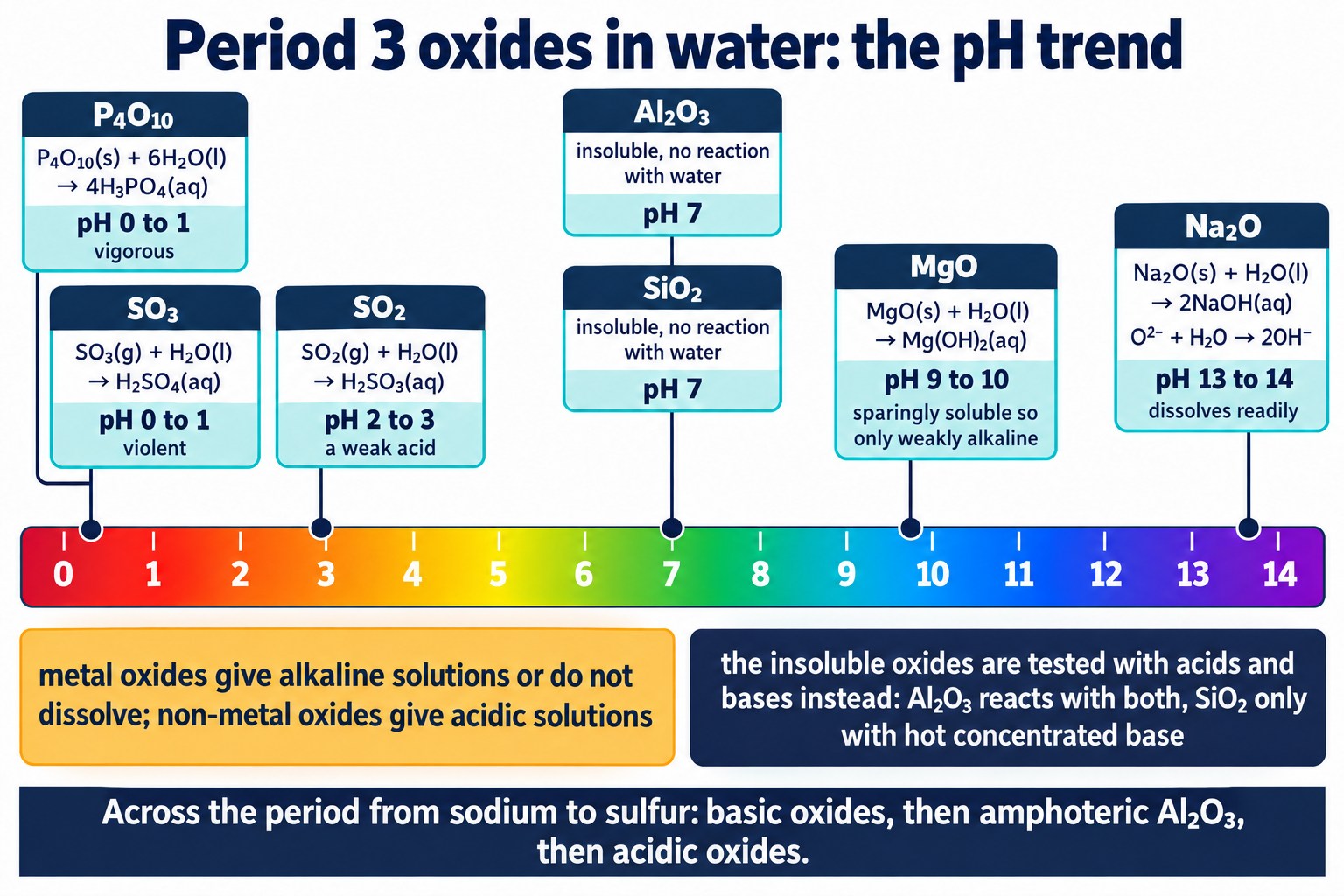
A pH strip from 0 to 14 with each oxide solution placed on it, the equation beside each.
Common mistake: Saying Al₂O₃ and SiO₂ “are neutral oxides”. They are insoluble, so the water stays at pH 7; chemically Al₂O₃ is amphoteric and SiO₂ is acidic, as their reactions with alkali show.
The pH Trend and the Bonding Behind It
The trend from alkaline to acidic is a trend in bonding. Ionic oxides contain the oxide ion; covalent oxides do not.
Ionic oxides (Na₂O, MgO): contain O²⁻, a strong base. In water it accepts a proton to give hydroxide ions, so the solution is alkaline.
Covalent oxides (P₄O₁₀, SO₂, SO₃): have a non-metal in a high oxidation state bonded covalently to oxygen. With water they form O–H bonds that release H⁺: oxoacids such as H₃PO₄ and H₂SO₄.
Insoluble oxides: Al₂O₃ (a strong ionic lattice with covalent character) and SiO₂ (a giant covalent network) are not broken up by water, so they show their acid-base character only with acids or concentrated alkali.
Why the change: electronegativity rises across the period. The difference between the element and oxygen falls, so the bonding changes from ionic to covalent and the oxide from basic to acidic.
Exam focus: Three sentences score the trend: ionic oxides contain O²⁻ which accepts protons (alkaline); covalent oxides form acids by releasing H⁺; the bonding changes because electronegativity increases across the period.
Check: Oxides with Water
Match each oxide to the pH of its solution, write the equations for the oxides that react, and explain why two oxides leave the water at pH 7.
Basic Oxides with Acids
Na₂O and MgO are basic oxides: they neutralise acids to give a salt and water. Learn the pattern rather than every equation.
Sodium oxide: Na₂O(s) + 2HCl(aq) → 2NaCl(aq) + H₂O(l); Na₂O(s) + H₂SO₄(aq) → Na₂SO₄(aq) + H₂O(l).
Magnesium oxide: MgO(s) + 2HCl(aq) → MgCl₂(aq) + H₂O(l); MgO(s) + H₂SO₄(aq) → MgSO₄(aq) + H₂O(l).
Ionic equation: Na₂O(s) + 2H⁺(aq) → 2Na⁺(aq) + H₂O(l); MgO(s) + 2H⁺(aq) → Mg²⁺(aq) + H₂O(l). The oxide ion accepts two protons.
Use: magnesium oxide treats excess acid in indigestion remedies and in acidified rivers: it is only sparingly soluble and weakly alkaline, so an excess does no harm.
Remember: Salt formula first, then balance: Mg²⁺ with SO₄²⁻ is MgSO₄, Na⁺ with SO₄²⁻ is Na₂SO₄, Al³⁺ with SO₄²⁻ is Al₂(SO₄)₃.
Amphoteric Aluminium Oxide
Al₂O₃ reacts with both acids and bases: it is amphoteric. The small, highly charged Al³⁺ ion gives the bonding a character between ionic and covalent, and the chemistry sits between basic and acidic.
As a base, with acids: Al₂O₃(s) + 6HCl(aq) → 2AlCl₃(aq) + 3H₂O(l); Al₂O₃(s) + 3H₂SO₄(aq) → Al₂(SO₄)₃(aq) + 3H₂O(l).
As an acid, with alkali: Al₂O₃(s) + 2NaOH(aq) + 3H₂O(l) → 2NaAl(OH)₄(aq): sodium aluminate, also written Na[Al(OH)₄]. Hot, concentrated sodium hydroxide is used.
Ionic forms: Al₂O₃(s) + 6H⁺(aq) → 2Al³⁺(aq) + 3H₂O(l); Al₂O₃(s) + 2OH⁻(aq) + 3H₂O(l) → 2Al(OH)₄⁻(aq).
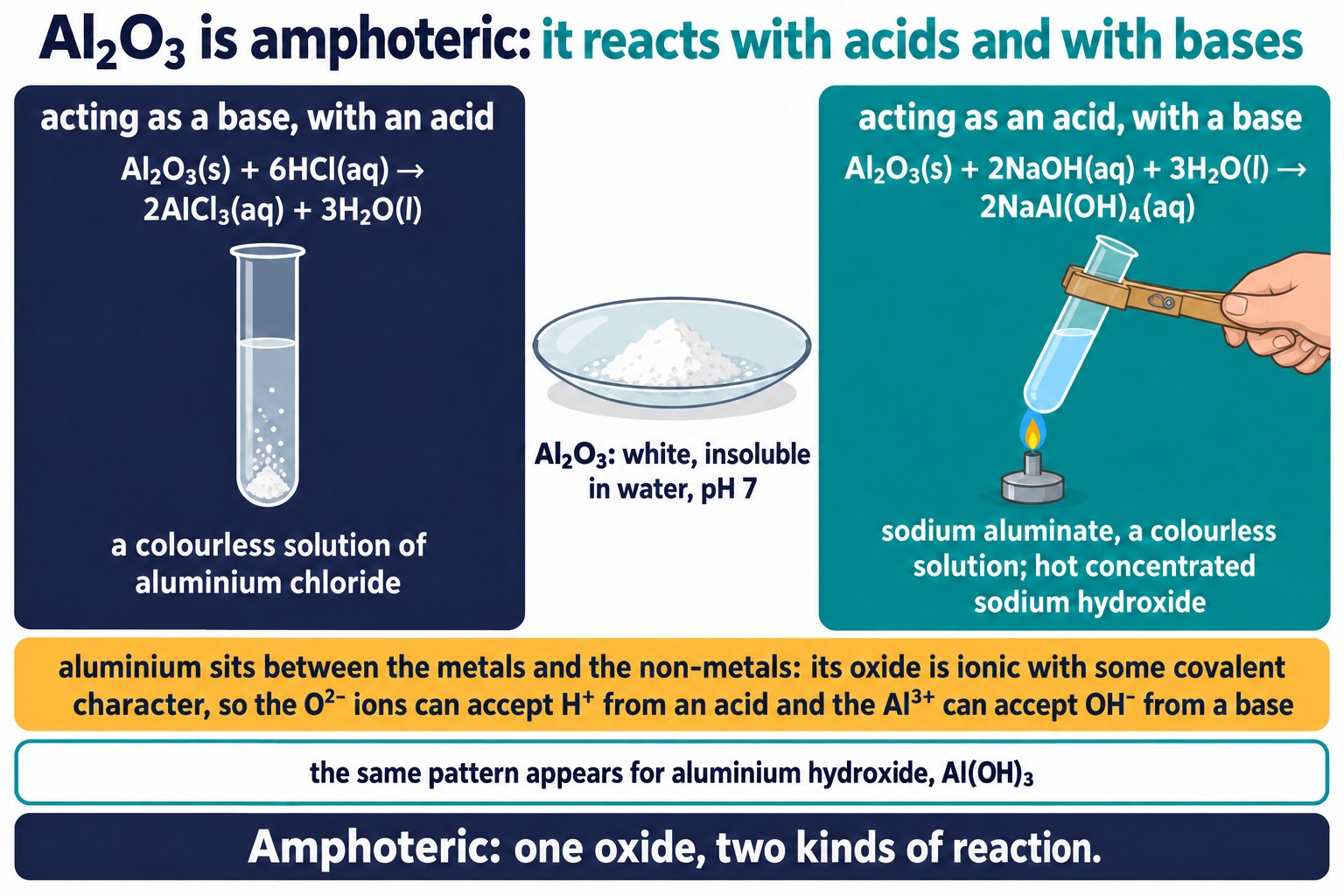
Two tiles: aluminium oxide with hydrochloric acid and with sodium hydroxide, products and the word amphoteric between them.
Exam focus: The aluminate equation is the one students forget: count the oxygens. Two Al(OH)₄⁻ need eight O, so Al₂O₃ (three O) and 2NaOH (two O) need three more from 3H₂O.
Acidic Oxides with Bases
SiO₂, P₄O₁₀, SO₂ and SO₃ are acidic oxides: they react with bases to form salts. The anion of the salt is the anion of the corresponding acid.
Silicon dioxide: SiO₂(s) + 2NaOH(aq) → Na₂SiO₃(aq) + H₂O(l), with hot, concentrated alkali only: the giant lattice resists dilute solutions.
Phosphorus(V) oxide: P₄O₁₀(s) + 12NaOH(aq) → 4Na₃PO₄(aq) + 6H₂O(l): sodium phosphate contains the PO₄³⁻ ion.
Sulfur dioxide: SO₂(g) + 2NaOH(aq) → Na₂SO₃(aq) + H₂O(l): sodium sulfite, the SO₃²⁻ ion.
Sulfur trioxide: SO₃(g) + 2NaOH(aq) → Na₂SO₄(aq) + H₂O(l): sodium sulfate, the SO₄²⁻ ion.
Ionic forms: SO₂(g) + 2OH⁻(aq) → SO₃²⁻(aq) + H₂O(l); P₄O₁₀(s) + 12OH⁻(aq) → 4PO₄³⁻(aq) + 6H₂O(l).
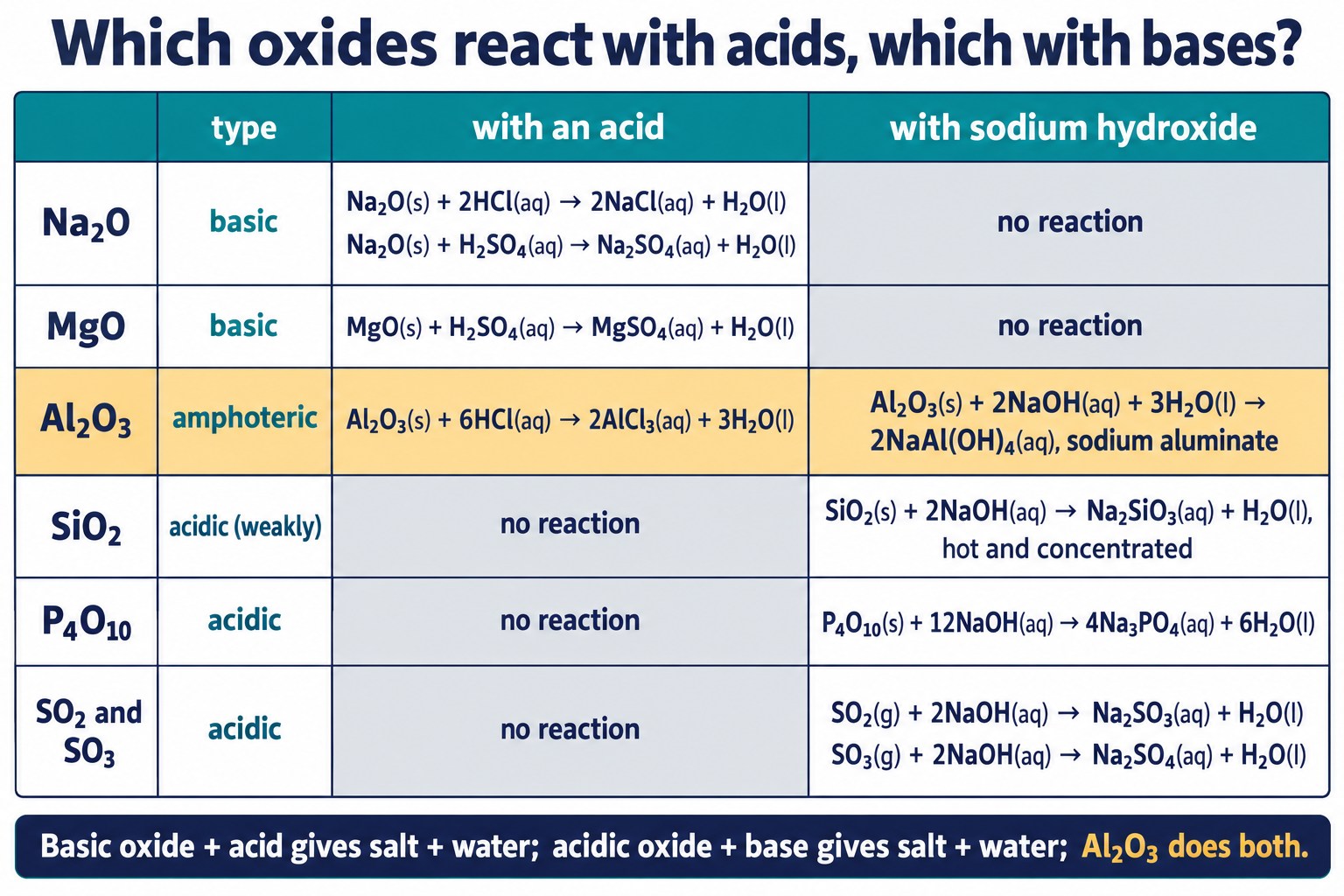
Grid of the seven oxides against hydrochloric acid, sulfuric acid and sodium hydroxide, with the product in every cell or “no reaction”.
Common mistake: Writing Na₂SO₄ from SO₂. Sulfur dioxide gives the sulfite ion SO₃²⁻ (sulfur +4); only sulfur trioxide gives the sulfate ion SO₄²⁻ (sulfur +6).
Check: Oxides with Acids and Bases
Write balanced equations for oxides with acids and alkalis, name the salt formed, and decide which oxide is basic, acidic or amphoteric from its reactions.
The Acids and Their Anions: Structures and Shapes
The acids formed by P₄O₁₀, SO₂ and SO₃ in water, and the anions they release, have shapes that follow from electron-pair repulsion. Draw each with every bond and lone pair.
| Acid | Structure | Anion | Shape of the anion |
|---|---|---|---|
| H₃PO₄, phosphoric(V) acid | one P=O and three P–OH around a tetrahedral phosphorus | PO₄³⁻, phosphate | tetrahedral, 109.5°; the charge is shared over the four oxygens |
| H₂SO₃, sulfurous acid | one S=O, two S–OH and one lone pair on sulfur | SO₃²⁻, sulfite | trigonal pyramidal; the lone pair on sulfur stays |
| H₂SO₄, sulfuric acid | two S=O and two S–OH around a tetrahedral sulfur | SO₄²⁻, sulfate | tetrahedral, 109.5°; all four S–O bonds equivalent |
Losing protons: H₃PO₄(aq) → 3H⁺(aq) + PO₄³⁻(aq); H₂SO₃(aq) → 2H⁺(aq) + SO₃²⁻(aq); H₂SO₄(aq) → 2H⁺(aq) + SO₄²⁻(aq). Each O–H hydrogen leaves as H⁺ and the oxygen keeps the electrons.
Shapes: phosphorus and sulfur in the tetrahedral species have four bonding regions and no lone pairs; sulfur in SO₃²⁻ has three bonding regions and one lone pair, so the shape is trigonal pyramidal.
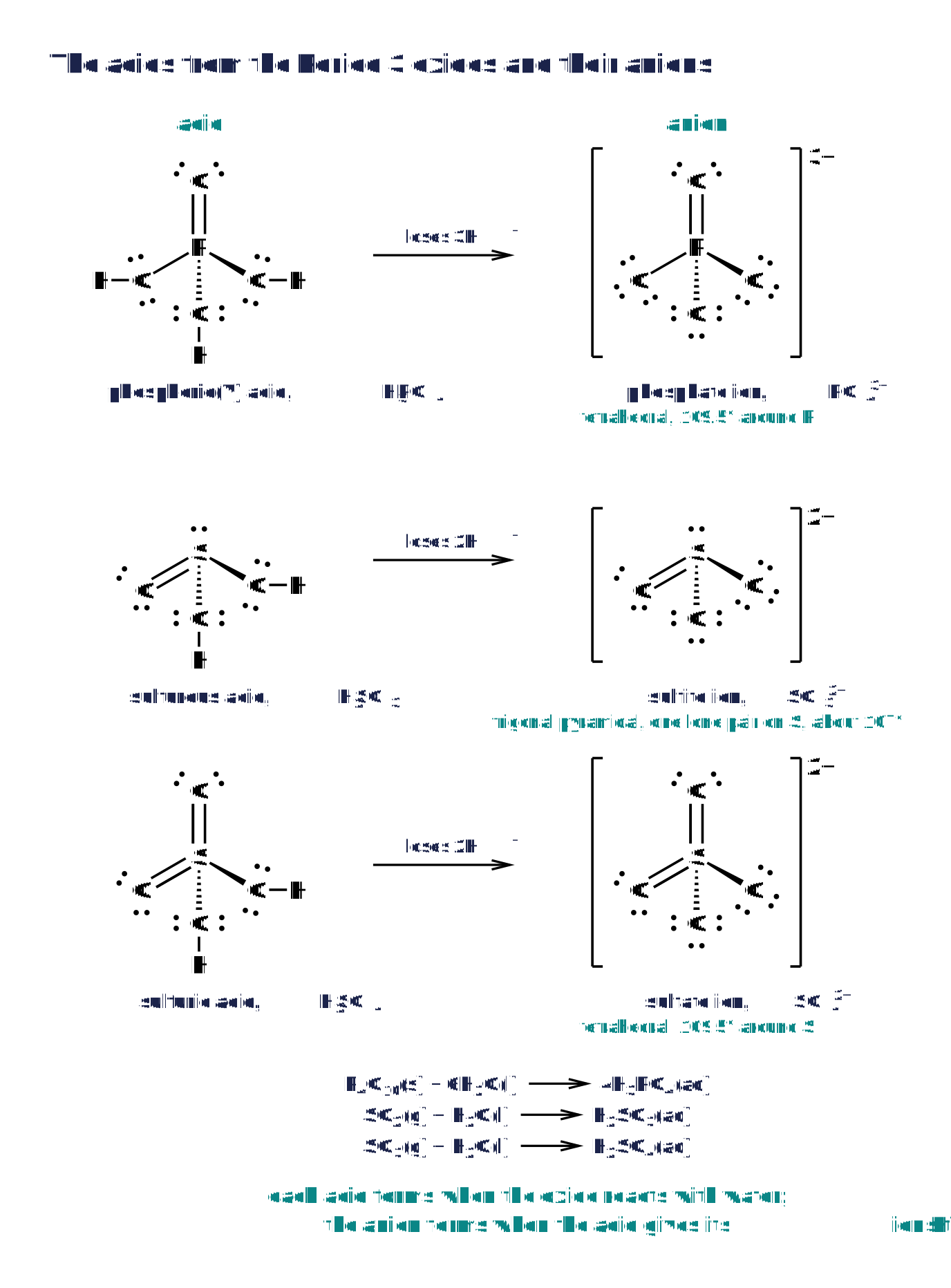
H₃PO₄, H₂SO₃ and H₂SO₄ with their anions PO₄³⁻, SO₃²⁻ and SO₄²⁻: every bond, lone pair and charge, with the shape named under each ion.
Exam focus: A displayed structure needs every lone pair on oxygen (two on each =O, two on each –OH), and the negative charges placed on single-bonded oxygens. Then name the shape and quote the bond angle.
Why the Trend: Bonding and Electronegativity
One idea explains the whole page. The oxides go from basic to acidic because the bonding goes from ionic to covalent, and that follows the rise in electronegativity across the period.
- Basic: Na₂O and MgO are ionic and contain O²⁻, a proton acceptor. They react with acids only.
- Amphoteric: Al₂O₃ is ionic with covalent character; it reacts with acids and with concentrated alkali.
- Acidic: SiO₂, P₄O₁₀, SO₂ and SO₃ are covalent; they react with bases, and the three molecular oxides form acids with water.
- Electronegativity: Na 0.9, Mg 1.3, Al 1.6, Si 1.9, P 2.2, S 2.6 against O 3.4. The difference shrinks from 2.5 to 0.8 across the period.
Exam focus: Write “ionic oxide, contains O²⁻, basic” or “covalent oxide, non-metal, acidic” as the first line of any explanation. Then give the equation that proves it.
Check: Acidic, Basic and Amphoteric
Classify oxides from their reactions, explain the trend in terms of bonding and electronegativity, and name the shapes of the anions formed.
Common Exam Points
- pH of the oxide solutions: Na₂O 13 to 14, MgO 9 to 10, Al₂O₃ and SiO₂ 7 (insoluble), P₄O₁₀ 0 to 1, SO₂ 2 to 3, SO₃ 0 to 1.
- Equations with water: Na₂O + H₂O → 2NaOH; MgO + H₂O → Mg(OH)₂; P₄O₁₀ + 6H₂O → 4H₃PO₄; SO₂ + H₂O → H₂SO₃; SO₃ + H₂O → H₂SO₄.
- Basic oxides with acids: Na₂O + 2HCl → 2NaCl + H₂O; MgO + H₂SO₄ → MgSO₄ + H₂O. Know the ion charges to write the salt.
- Amphoteric Al₂O₃: Al₂O₃ + 6HCl → 2AlCl₃ + 3H₂O and Al₂O₃ + 2NaOH + 3H₂O → 2NaAl(OH)₄.
- Acidic oxides with alkali: SiO₂ + 2NaOH → Na₂SiO₃ + H₂O (hot, concentrated); P₄O₁₀ + 12NaOH → 4Na₃PO₄ + 6H₂O; SO₂ gives Na₂SO₃, SO₃ gives Na₂SO₄.
- Shapes: PO₄³⁻ and SO₄²⁻ tetrahedral (109.5°); SO₃²⁻ trigonal pyramidal because sulfur keeps one lone pair.
- The trend: ionic oxides contain O²⁻ and are basic; covalent oxides are acidic; the change follows the rise in electronegativity across the period.
- Al₂O₃ and SiO₂ do not dissolve because their giant lattices are too strong for water to break up; they still react with concentrated alkali.
FAQs
Quick answers on the pH of each Period 3 oxide in water, how basic, amphoteric and acidic oxides react with acids and bases, the shapes of the acids and anions and why the oxides turn from basic to acidic across the period.
Why does sodium oxide give pH 13 to 14 in water but magnesium oxide only pH 9 to 10?
Both contain the oxide ion, which takes a proton from water: O²⁻ + H₂O → 2OH⁻. Na₂O(s) + H₂O(l) → 2NaOH(aq) goes completely and NaOH is fully soluble.
MgO reacts slowly and Mg(OH)₂ is only sparingly soluble, so far fewer hydroxide ions enter the solution.
Why do aluminium oxide and silicon dioxide leave water at pH 7?
Neither dissolves nor reacts with water, so no acid or base enters the solution. Al₂O₃ is a strongly bonded ionic lattice with some covalent character and SiO₂ is a giant covalent network, both too strongly held together for water molecules to break them apart.
What does amphoteric mean, and how do I show it for aluminium oxide?
An amphoteric oxide reacts with both acids and bases. With acid: Al₂O₃(s) + 6HCl(aq) → 2AlCl₃(aq) + 3H₂O(l).
With alkali: Al₂O₃(s) + 2NaOH(aq) + 3H₂O(l) → 2NaAl(OH)₄(aq), sodium aluminate. Write both equations with state symbols to earn the marks.
What shapes do the phosphate, sulfite and sulfate ions have?
PO₄³⁻ and SO₄²⁻ are tetrahedral, with four bonding pairs and no lone pairs around the central atom.
SO₃²⁻ is trigonal pyramidal because sulfur keeps one lone pair, which pushes the three oxygen atoms closer together. The acids H₃PO₄, H₂SO₄ and H₂SO₃ have the same arrangements.
Why do the oxides change from basic to acidic across Period 3?
The metal oxides are ionic and contain the oxide ion, a strong base that accepts protons. Across the period the electronegativity difference falls, so the non-metal oxides are covalent: the non-metal atom bonds to several oxygen atoms and the oxide releases H⁺ in water.

Copyright notice: This OLS revision content, including the explanations, layout, diagrams, tables and embedded learning structure, is authored for Online Learning System by Dr. Mohammed Al-Fatah. It may not be copied, reproduced, redistributed or adapted without written permission.
Keep this note — free
Save your progress across every AQA topic. A free account remembers which topics you have covered, saves your question scores, and syncs across your phone and laptop.
- Track every topic you have finished
- Keep your practice-question scores
- No payment, no card, free forever
Already registered? Log in