Amines as Nucleophiles
A concise revision guide to amines as nucleophiles: their reactions with halogenoalkanes to give secondary and tertiary amines and quaternary ammonium salts and with acyl chlorides to give N-substituted amides (and with acid anhydrides), with the mechanisms.
Before You Start
The lone pair that makes an amine a base also makes it a nucleophile. Check these ideas first.
- A nucleophile is an electron-pair donor that attacks an electron-deficient (δ+) carbon atom.
- The carbon bonded to the halogen in a halogenoalkane is δ+, and ammonia substitutes the halogen: Nucleophilic Substitution Reactions.
- The carbonyl carbon of an acyl chloride is strongly δ+ (O and Cl both withdraw electrons) and reacts rapidly with water, alcohols, ammonia and amines: Acyl Chlorides.
- Amines as bases, and the salts they form with HCl: Amines as Bases.
With Halogenoalkanes: Secondary and Tertiary Amines
A primary amine attacks a halogenoalkane exactly as ammonia does. The product has two carbon groups on nitrogen: a secondary amine.
| Reaction | Equation | Product class |
|---|---|---|
| butylamine + bromoethane | CH₃CH₂CH₂CH₂NH₂ + CH₃CH₂Br → CH₃CH₂CH₂CH₂NHCH₂CH₃ + HBr | secondary amine: N-ethylbutylamine, CH₃CH₂CH₂CH₂NHCH₂CH₃ |
| secondary amine + bromoethane | CH₃CH₂CH₂CH₂NHCH₂CH₃ + CH₃CH₂Br → CH₃CH₂CH₂CH₂N(CH₂CH₃)₂ + HBr | tertiary amine: N,N-diethylbutylamine, CH₃CH₂CH₂CH₂N(CH₂CH₃)₂ |
| tertiary amine + bromoethane | [CH₃CH₂CH₂CH₂N(CH₂CH₃)₃]⁺Br⁻ forms | quaternary ammonium salt |
- Conditions are the same as for ammonia: in ethanol, heated under pressure.
- The HBr formed is taken up by excess amine as its salt, so the equation is often written with two moles of amine.
- Each product still has a lone pair on nitrogen, so the halogenoalkane is attacked again: a mixture of secondary and tertiary amines and a quaternary ammonium salt forms.
- The fourth substitution gives a quaternary ammonium salt with no lone pair left: the ladder ends there (next cards).
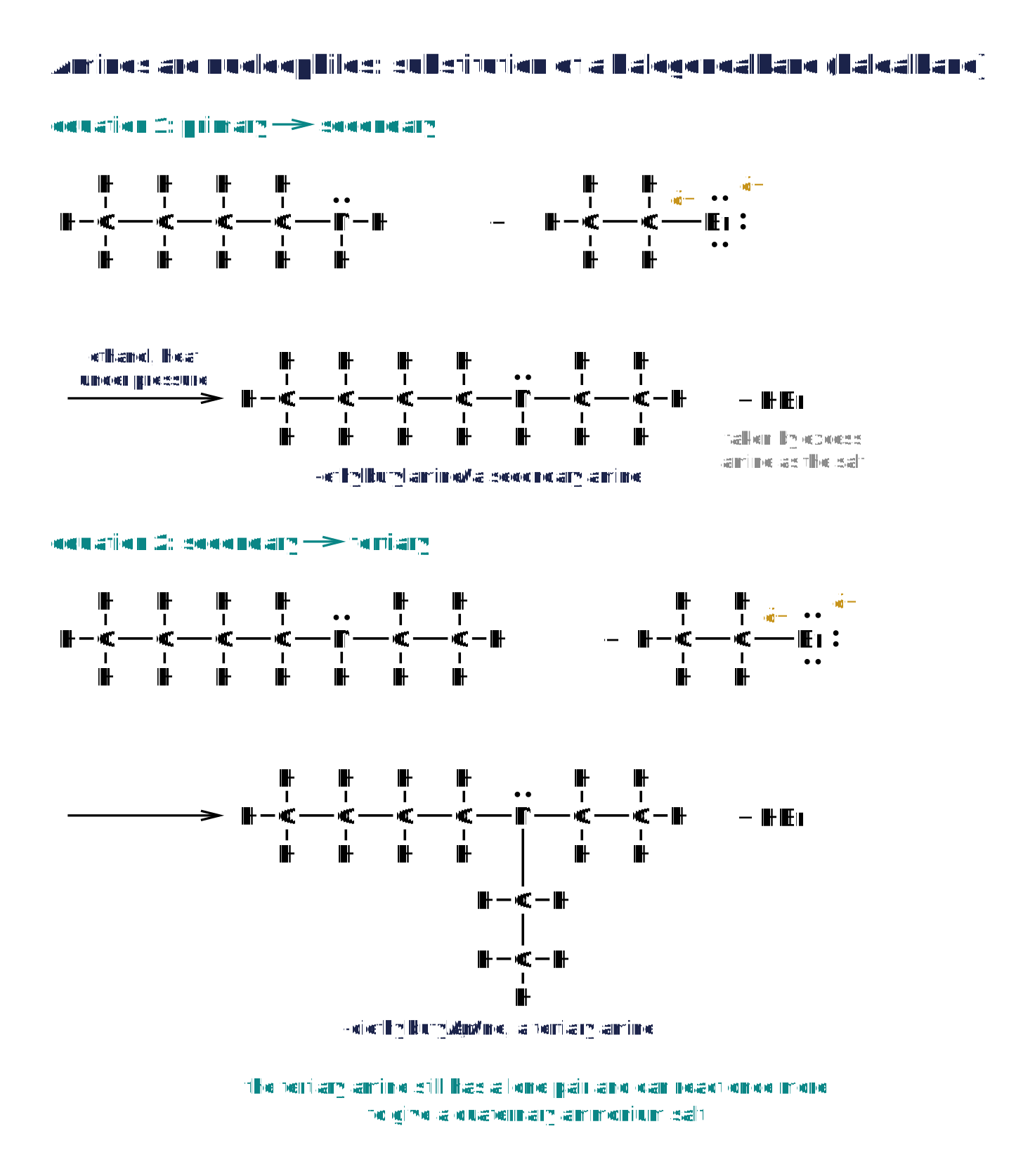
Butylamine with bromoethane to the secondary amine, then on to the tertiary amine. The curly arrows follow in the next figure.
Exam focus: Name the product carefully: the group from the halogenoalkane goes on the nitrogen and takes the prefix N-. butylamine with bromoethane gives N-ethylbutylamine.
Quick Check: Following Repeated Substitution
Work out what each amine goes on to form when the alkylating reagent is in large excess.
The Mechanism: Nucleophilic Substitution by an Amine
The mechanism is the two-step nucleophilic substitution already met with ammonia. The amine nitrogen is the nucleophile and a second amine molecule is the base.
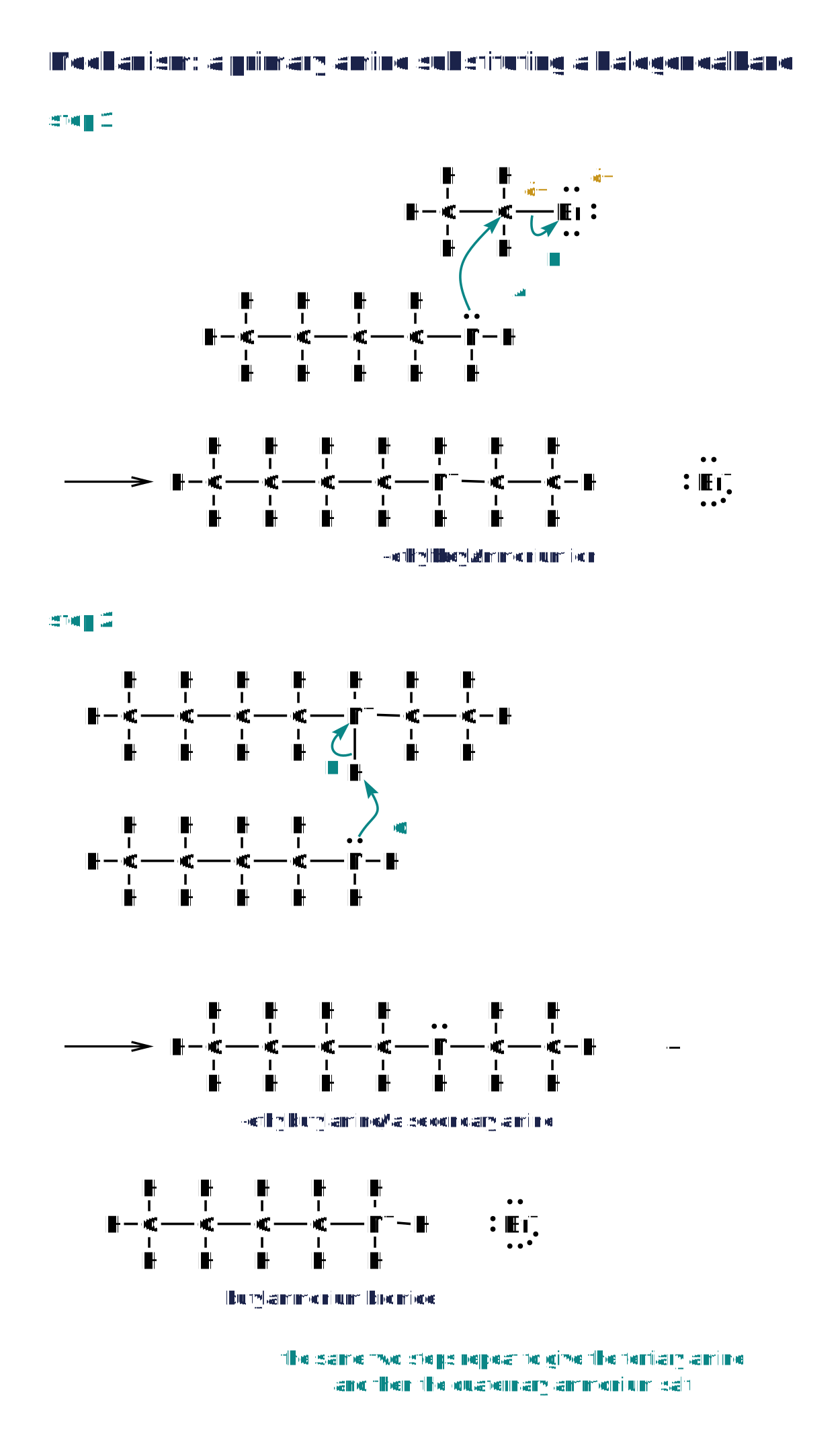
Both steps with every curly arrow, lone pair and charge: attack by the lone pair, loss of bromide, then loss of a proton to a second amine.
Common mistake: In the intermediate the nitrogen carries the positive charge and still has both its hydrogens. The proton is removed by a base in a separate step; it does not fall off.
Quaternary Ammonium Salts as Cationic Surfactants
Complete substitution gives a quaternary ammonium salt, R₄N⁺X⁻: four carbon groups on a positive nitrogen with no lone pair. With one long hydrocarbon chain these ions are cationic surfactants.
| Part of the ion | Property | Role |
|---|---|---|
| long hydrocarbon chain (C₁₂ to C₁₈) | non-polar, hydrophobic | dissolves in grease and oil |
| N⁺ head with three short alkyl groups | ionic, hydrophilic | stays in the water; attracted to negatively charged surfaces |
- Fibres and wet hair carry a slight negative charge, so the positive heads bind to them and the chains coat the surface: fabric softeners and hair conditioners.
- As detergents the tails lift grease into the water while the heads keep the droplets dispersed. Some quaternary salts are also disinfectants.
- Cationic means the surface-active ion is the positive one; soaps and most washing-up liquids are anionic surfactants.
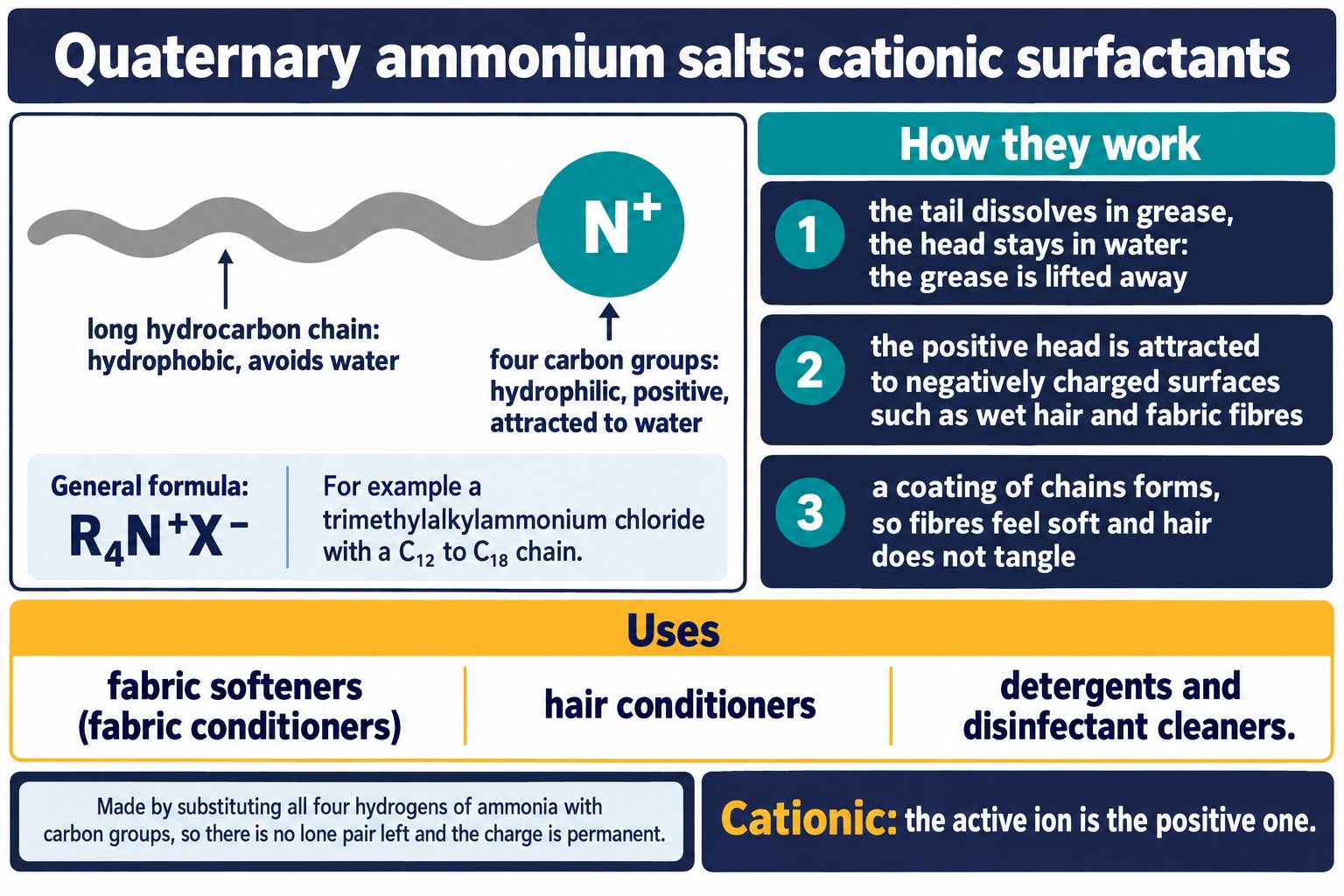
Tail and head: how a quaternary ammonium ion softens fabric, conditions hair and lifts grease.
Check: Amines with Halogenoalkanes
Predict and name the amine formed when a named amine attacks a halogenoalkane, state the conditions and explain why a mixture of products forms.
With Acyl Chlorides: N-substituted amides
The amine lone pair attacks the strongly δ+ carbonyl carbon of an acyl chloride. The reaction is a nucleophilic addition-elimination: the amine adds, then chloride is eliminated, and an amide forms.
| Reaction | Equation | Product |
|---|---|---|
| butylamine + ethanoyl chloride | CH₃COCl + CH₃CH₂CH₂CH₂NH₂ → CH₃CONHCH₂CH₂CH₂CH₃ + HCl | N-butylethanamide, CH₃CONHCH₂CH₂CH₂CH₃ (N-substituted amide) |
| with excess amine | CH₃COCl + 2CH₃CH₂CH₂CH₂NH₂ → CH₃CONHCH₂CH₂CH₂CH₃ + CH₃CH₂CH₂CH₂NH₃⁺Cl⁻ | the HCl is taken by the second amine as a salt |
| phenylamine + ethanoyl chloride | CH₃COCl + C₆H₅NH₂ → CH₃CONHC₆H₅ + HCl | N-phenylethanamide, a white solid |
| ammonia + ethanoyl chloride | CH₃COCl + NH₃ → CH₃CONH₂ + HCl | ethanamide, a primary amide |
- Conditions: room temperature, no catalyst. The reaction is rapid and vigorous at room temperature. The HCl formed reacts with more amine to give a white solid, the alkylammonium chloride, so two moles of amine are used; if the amine is not in excess, misty (steamy) fumes of HCl are given off.
- The product is an N-substituted amide: the group from the amine sits on the nitrogen and takes the prefix N-.
- The amide link –CONH– formed here is the link in polyamides (Condensation Polymers: Polyamides and Polyesters) and the peptide link in proteins (Peptides and Proteins).
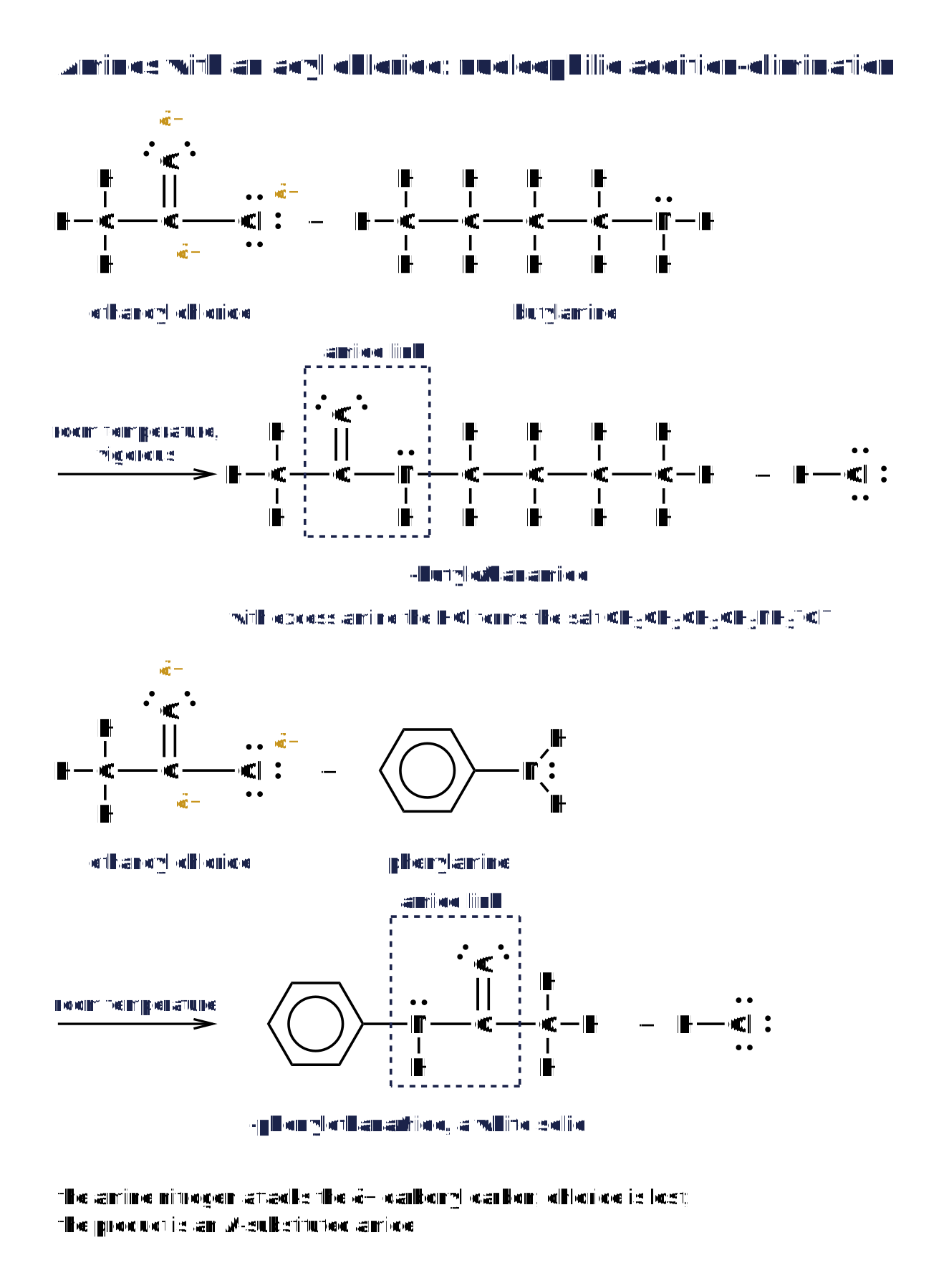
Ethanoyl chloride with butylamine and with phenylamine: the amide link is boxed in each product. The mechanism is in the next card.
Exam focus: Write the amide with the N bonded to the carbonyl carbon: CH₃CO–NH–R. butylamine + ethanoyl chloride gives N-butylethanamide; phenylamine gives N-phenylethanamide.
Quick Check: Reasoning About Amide Formation
Pick the one accurate statement in each set.
Acid Anhydrides: the Milder Alternative
An acid anhydride such as ethanoic anhydride, (CH₃CO)₂O, reacts with ammonia and amines by the same addition-elimination. The leaving group is ethanoate, so ethanoic acid forms instead of HCl.
| Reaction | Equation |
|---|---|
| ethanoic anhydride + butylamine | (CH₃CO)₂O + CH₃CH₂CH₂CH₂NH₂ → CH₃CONHCH₂CH₂CH₂CH₃ + CH₃COOH |
| ethanoic anhydride + ammonia | (CH₃CO)₂O + NH₃ → CH₃CONH₂ + CH₃COOH |
- Anhydrides react more slowly than acyl chlorides and release no corrosive HCl, so they are safer and cheaper on an industrial scale.
- The amide product is the same as from the acyl chloride; only the small molecule lost changes.
Remember: Acyl chloride: loses HCl, vigorous at room temperature. Acid anhydride: loses a carboxylic acid, slower and gentler; it also works at room temperature, and warming speeds it up.
Quick Check: A Different Anhydride
Apply the reaction to an anhydride and an amine that are new to you.
The Mechanism: Nucleophilic Addition-Elimination
Three steps make up the addition-elimination mechanism with an amine. Methylamine and ethanoyl chloride are shown, but any primary amine or ammonia follows the same path.
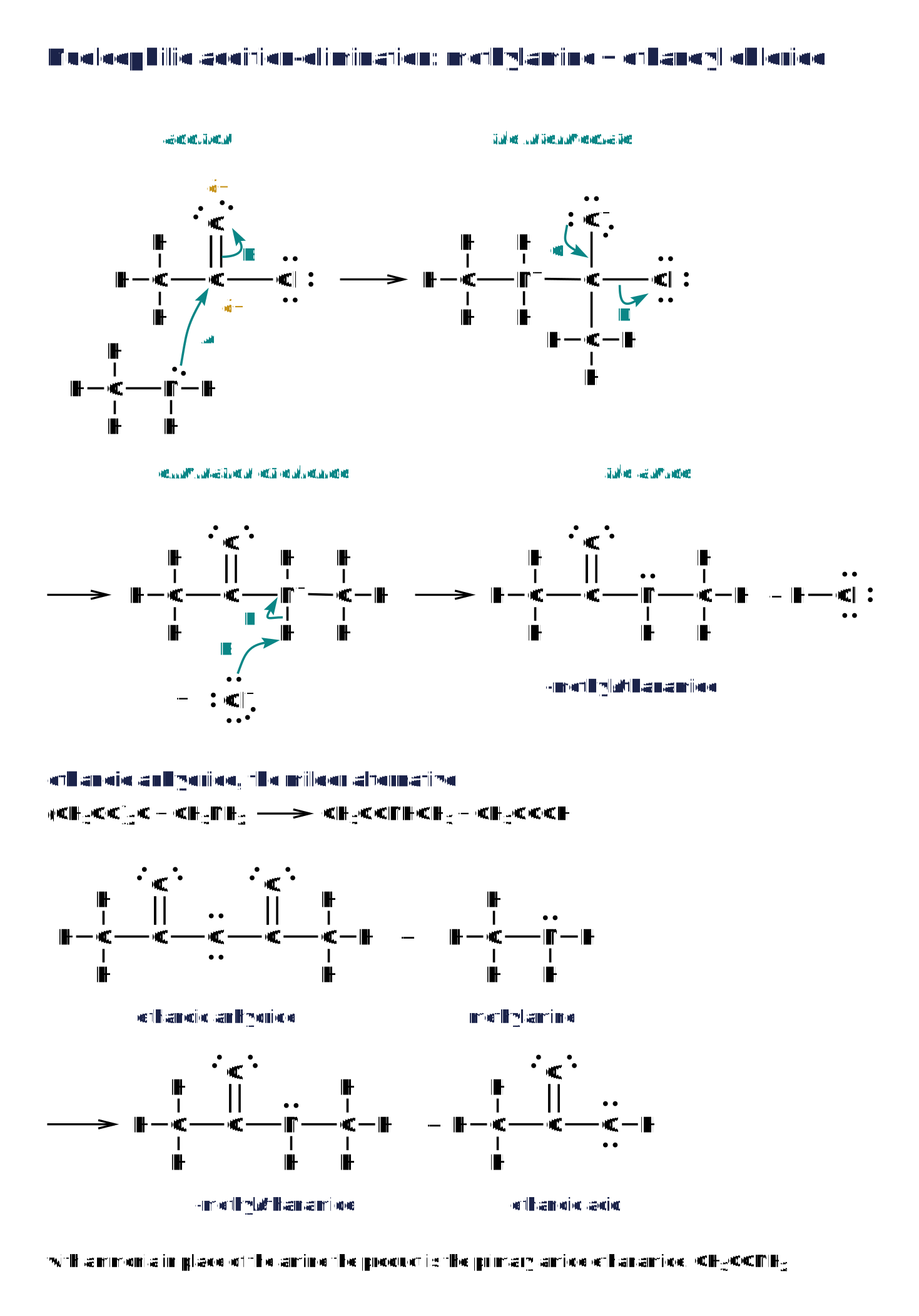
All four frames with every curly arrow, lone pair and charge, and the ethanoic anhydride equation beneath.
Common mistake: The nitrogen keeps both hydrogens and a positive charge until the last step. Chloride leaves before the proton is lost, not at the same time.
Worked Example: Naming the Amide Product
Name the amide formed when propanoyl chloride reacts with methylamine.
Step 2. The amine supplies the group on the nitrogen: methyl, written with the prefix N-.
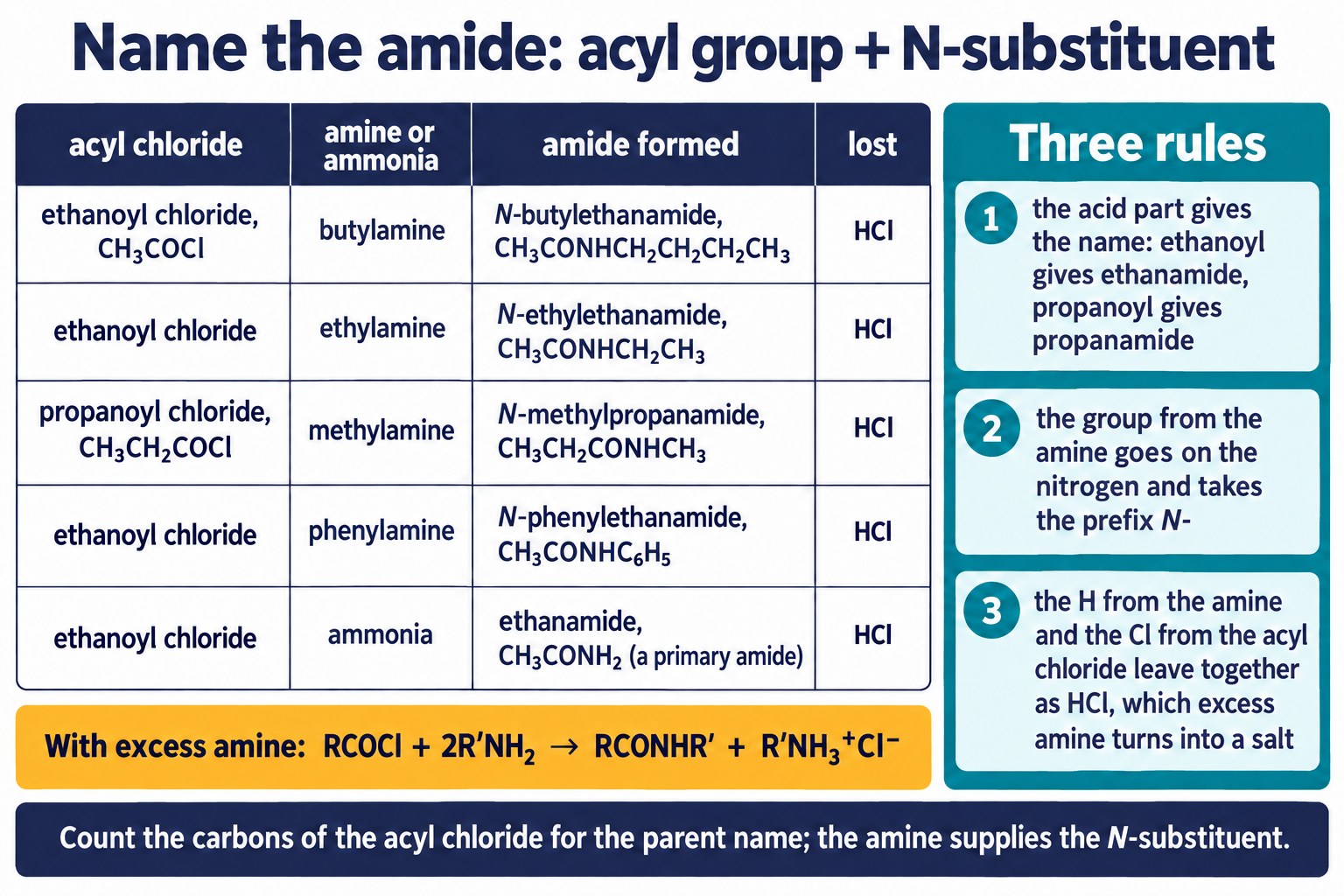
Five reactant pairs and their amide products, with the three naming rules.
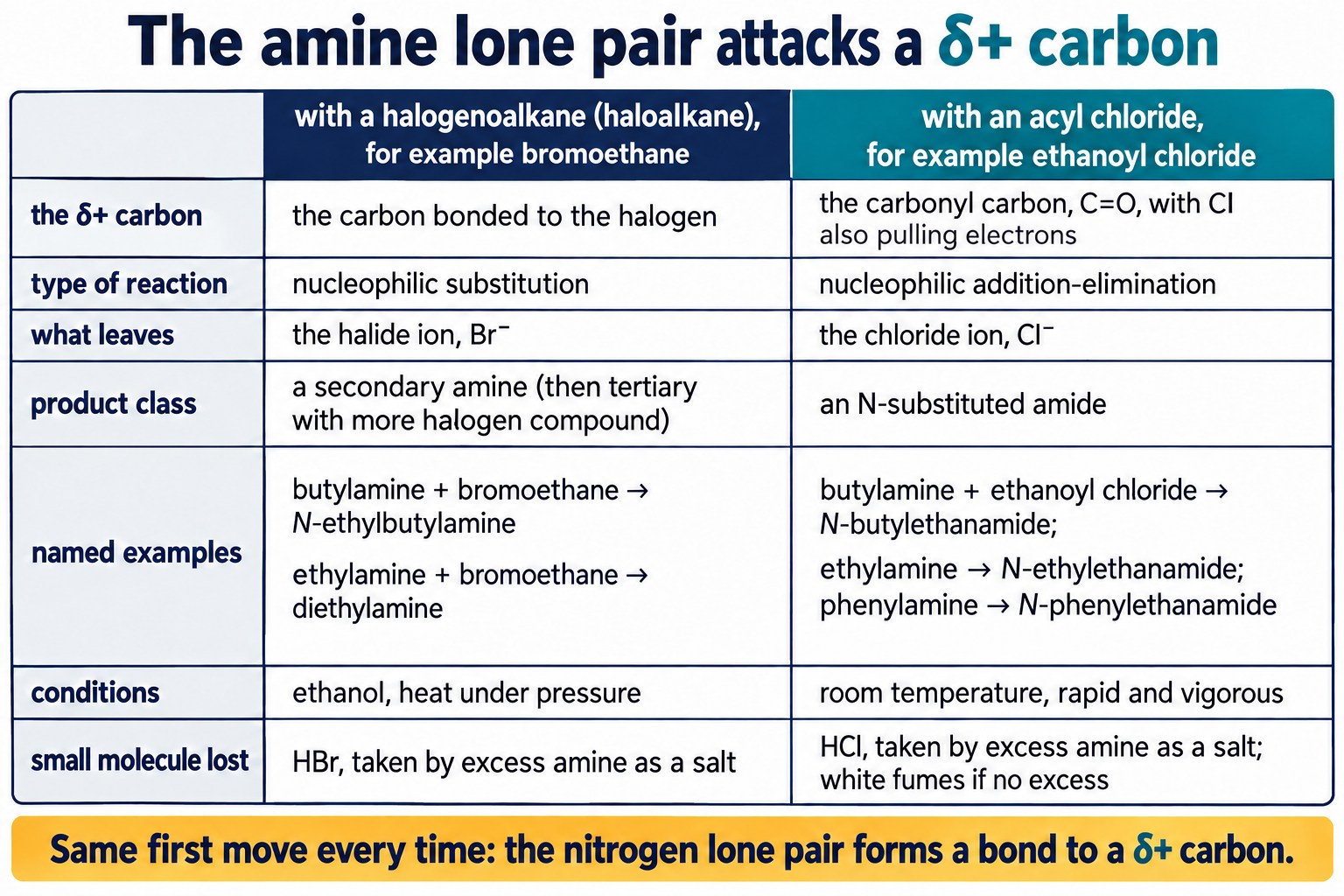
What the lone pair attacks in a halogenoalkane and in an acyl chloride: the δ+ carbon, the leaving group, the product class and the conditions.
Check: Amines with Acyl Chlorides
Write the equation for an amine or ammonia with an acyl chloride, name the amide formed and state what happens to the HCl.
Common Exam Points
- The nitrogen lone pair attacks a δ+ carbon: amines are nucleophiles as well as bases.
- Butylamine + bromoethane → N-ethylbutylamine + HBr in ethanol under pressure: a secondary amine, then a tertiary amine with more bromoethane.
- Successive substitution ends at a quaternary ammonium salt, R₄N⁺X⁻; with one long chain these are cationic surfactants (fabric softeners, hair conditioners).
- Butylamine + ethanoyl chloride → N-butylethanamide + HCl at room temperature: nucleophilic addition-elimination.
- Phenylamine + ethanoyl chloride → N-phenylethanamide + HCl, a white solid; ammonia gives ethanamide.
- With excess amine the HCl is taken as the alkylammonium chloride: CH₃COCl + 2RNH₂ → CH₃CONHR + RNH₃⁺Cl⁻.
- Ethanoic anhydride gives the same amide but releases ethanoic acid instead of HCl: milder and safer.
- Mechanisms: lone pair to δ+ carbon first; the positive nitrogen loses its proton to a base in a separate final step.
- Name the product from the acyl group and the N-substituent: an N-substituted amide such as N-methylpropanamide.
FAQs
Use these quick answers to check how the lone pair of butylamine attacks a halogenoalkane and an acyl chloride, the amines and amides formed, quaternary ammonium salts and the mechanisms.
Why can an amine act as both a base and a nucleophile?
Both roles use the same lone pair on nitrogen. As a base it accepts a proton, H⁺. As a nucleophile it attacks an electron-deficient carbon, the δ+ carbon of a halogenoalkane or the carbonyl carbon of an acyl chloride, forming a new C–N bond.
What forms when butylamine reacts with bromoethane?
A secondary amine, N-ethylbutylamine, CH₃CH₂CH₂CH₂NHCH₂CH₃, and HBr, which excess amine takes up as a salt.
The new amine still has a lone pair, so it can attack more bromoethane to give a tertiary amine and finally a quaternary ammonium salt, so a mixture forms.
What is the product when an amine reacts with an acyl chloride?
An N-substituted (secondary) amide. Ethanoyl chloride and butylamine give N-butylethanamide, CH₃CONHCH₂CH₂CH₂CH₃, plus HCl, in a vigorous reaction at room temperature. Phenylamine gives N-phenylethanamide, a white solid. Ethanoic anhydride gives the same amide more safely, with ethanoic acid as the by-product.
How do I draw the addition-elimination mechanism with an amine?
Draw a curly arrow from the nitrogen lone pair to the δ+ carbonyl carbon as the C=O π bond breaks onto oxygen. The C=O re-forms while the C–Cl bond breaks, expelling Cl⁻. Finally a second amine removes H⁺ from the N⁺, leaving the amide.
What is a cationic surfactant?
A quaternary ammonium salt, [R₄N]⁺X⁻, in which one R group is a long hydrocarbon chain.
The chain is hydrophobic and the positively charged nitrogen head is hydrophilic, so the ion sits at surfaces and coats fabrics and hair: fabric softeners, hair conditioners and detergents.

Copyright notice: This OLS revision content, including the explanations, layout, diagrams, tables and embedded learning structure, is authored for Online Learning System by Dr. Mohammed Al-Fatah. It may not be copied, reproduced, redistributed or adapted without written permission.
Keep this note — free
Save your progress across every AQA topic. A free account remembers which topics you have covered, saves your question scores, and syncs across your phone and laptop.
- Track every topic you have finished
- Keep your practice-question scores
- No payment, no card, free forever
Already registered? Log in