Carbon-13 NMR Spectroscopy
A concise revision guide to carbon-13 NMR: what a carbon environment is, counting environments using symmetry, the chemical shift scale and TMS, and using a spectrum with shift data to work out a structure.
- 3.3.15i-a
- 3.3.15ii
- 3.3.15iii-a
- 3.3.15iii-b
- 3.3.15vi
- 3.3.15vii-b
What these spec points say
- 3.3.15i-a know that NMR gives information about the position of 13C atoms in a molecule
- 3.3.15ii know that 13C NMR gives simpler spectra than 1H NMR
- 3.3.15iii-a know the use of the delta scale for recording chemical shift
- 3.3.15iii-b know that chemical shift depends on the molecular environment
- 3.3.15vi know the use of tetramethylsilane (TMS) as a standard and explain why it is suitable
- 3.3.15vii-b use 13C NMR spectra and chemical shift data to suggest possible structures or part structures for molecules
Before You Start
NMR is used with the mass spectrometry and infrared spectroscopy in 3.3.6 Organic analysis. Mass spectra give Mr and infrared spectra give the bonds present. NMR shows how the atoms are arranged.
What NMR Measures
Nuclear magnetic resonance (NMR) spectroscopy gives information about the positions of ¹³C or ¹H atoms in a molecule.
- The sample is dissolved and placed in a strong magnetic field.
- Nuclei such as ¹³C and ¹H absorb radio-frequency radiation in the field.
- The exact frequency absorbed depends on the electrons around the nucleus: its chemical environment.
- Only about 1.1% of carbon atoms are ¹³C, but that is enough to give a spectrum. ¹²C gives no signal.
Chemical shift and TMS
The position of each peak is its chemical shift, δ, measured in parts per million (ppm). It is measured relative to a standard, tetramethylsilane (TMS), Si(CH₃)₄.
- TMS is given δ = 0, at the right-hand end of the spectrum.
- The δ scale increases from right to left. A ¹³C spectrum runs from about 220 down to 0.
- All four carbon atoms in TMS are equivalent, so it gives one sharp peak.
Key idea: A carbon-13 NMR spectrum gives two things: the number of peaks shows the number of carbon environments, and each chemical shift shows what type of carbon it is.
Carbon Environments and the Number of Peaks
Two carbon atoms are in the same environment only if they are bonded to exactly the same atoms and groups, all the way along the molecule. Equivalent carbons give one peak between them.
How to count
- Draw the displayed or skeletal formula.
- Look for a plane of symmetry: carbons that are mirror images of each other are equivalent.
- Give each different environment a number.
- The number of environments is the number of peaks.
| Compound | Structure | Carbon environments | Peaks |
|---|---|---|---|
| Propan-1-ol | CH₃CH₂CH₂OH | CH₃, middle CH₂, CH₂OH | 3 |
| Propan-2-ol | CH₃CH(OH)CH₃ | two equivalent CH₃, CH(OH) | 2 |
| Propanone | CH₃COCH₃ | two equivalent CH₃, C=O | 2 |
| Propanal | CH₃CH₂CHO | CH₃, CH₂, CHO | 3 |
| Ethyl ethanoate | CH₃COOCH₂CH₃ | CH₃C=O, C=O, OCH₂, CH₃ | 4 |
| Butane | CH₃CH₂CH₂CH₃ | two CH₃, two CH₂ | 2 |
| Cyclohexane | C₆H₁₂ ring | six equivalent CH₂ | 1 |
| 1,4-Dimethylbenzene | CH₃C₆H₄CH₃ | two CH₃, two ring C–CH₃, four ring CH | 3 |
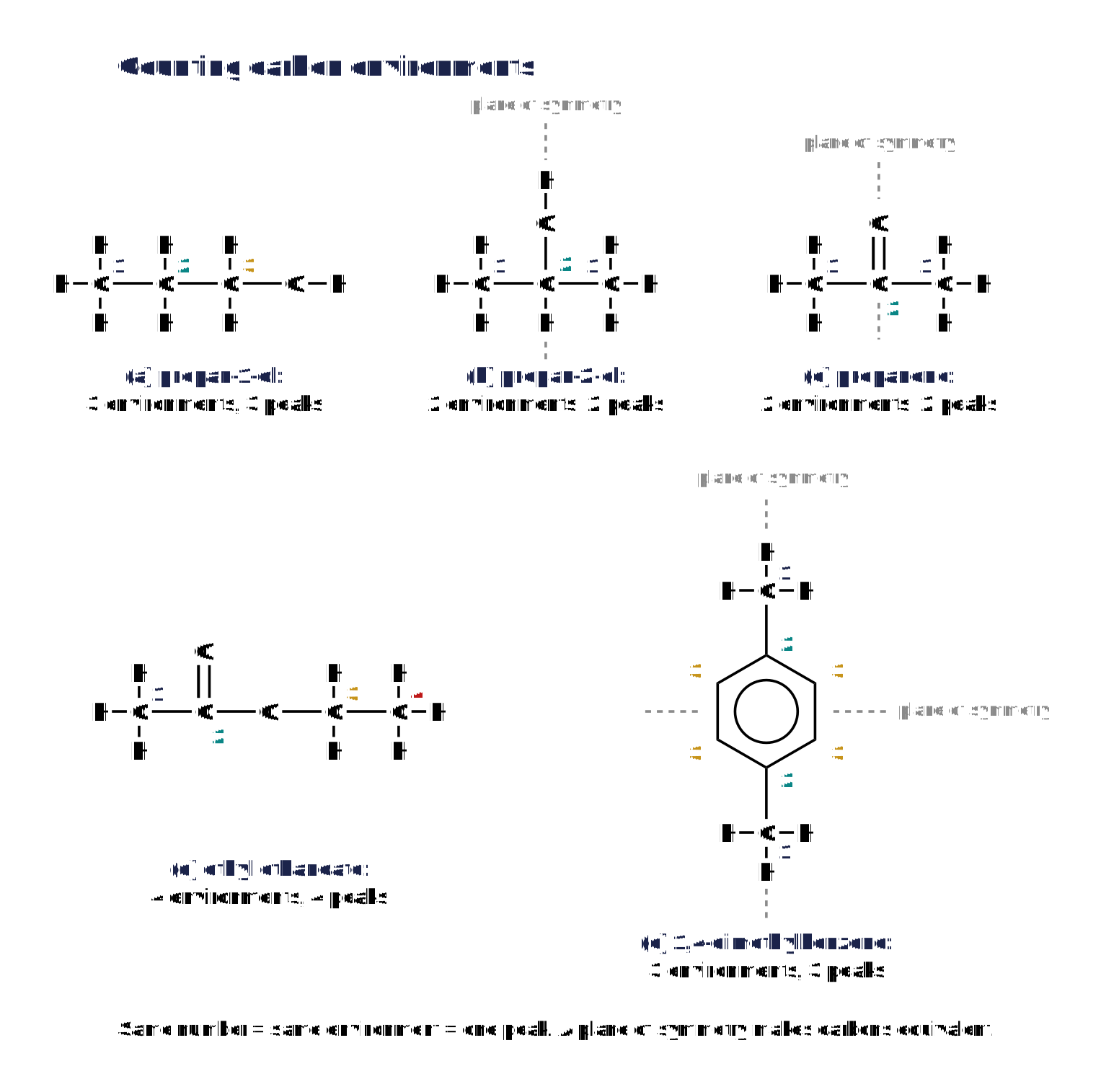
Carbon environments numbered on propan-1-ol, propan-2-ol, propanone, ethyl ethanoate and 1,4-dimethylbenzene. Carbons with the same number are equivalent and share one peak.
Worked example 1
How many peaks are in the ¹³C NMR spectrum of 1,4-dimethylbenzene?
Step 1. The molecule has two planes of symmetry: one through both CH₃ groups and one across the middle of the ring.
Answer. Three environments, so 3 peaks, even though the molecule has eight carbon atoms.
Exam focus: The number of peaks is never more than the number of carbon atoms. Fewer peaks than carbons means the molecule has symmetry.
Check: Counting Carbon Environments
Count the carbon environments and predict the number of peaks in a carbon-13 NMR spectrum, for molecules not used on this page.
Chemical Shift: What Type of Carbon?
Electronegative atoms and double bonds pull electron density away from a carbon atom. This moves its peak to a larger δ value, further to the left.
| Type of carbon | Found in | Typical δ / ppm |
|---|---|---|
| C–C | alkyl chains | 0 to 50 |
| C–Cl, C–Br or C–N | halogenoalkanes, amines | 10 to 70 |
| C–O | alcohols, ethers, esters | 50 to 90 |
| C=C | alkenes and arenes | 90 to 160 |
| C=O | carboxylic acids and esters | 160 to 185 |
| C=O | aldehydes and ketones | 190 to 220 |
Shift ranges are typical values and they overlap. Always use the data provided in the exam.
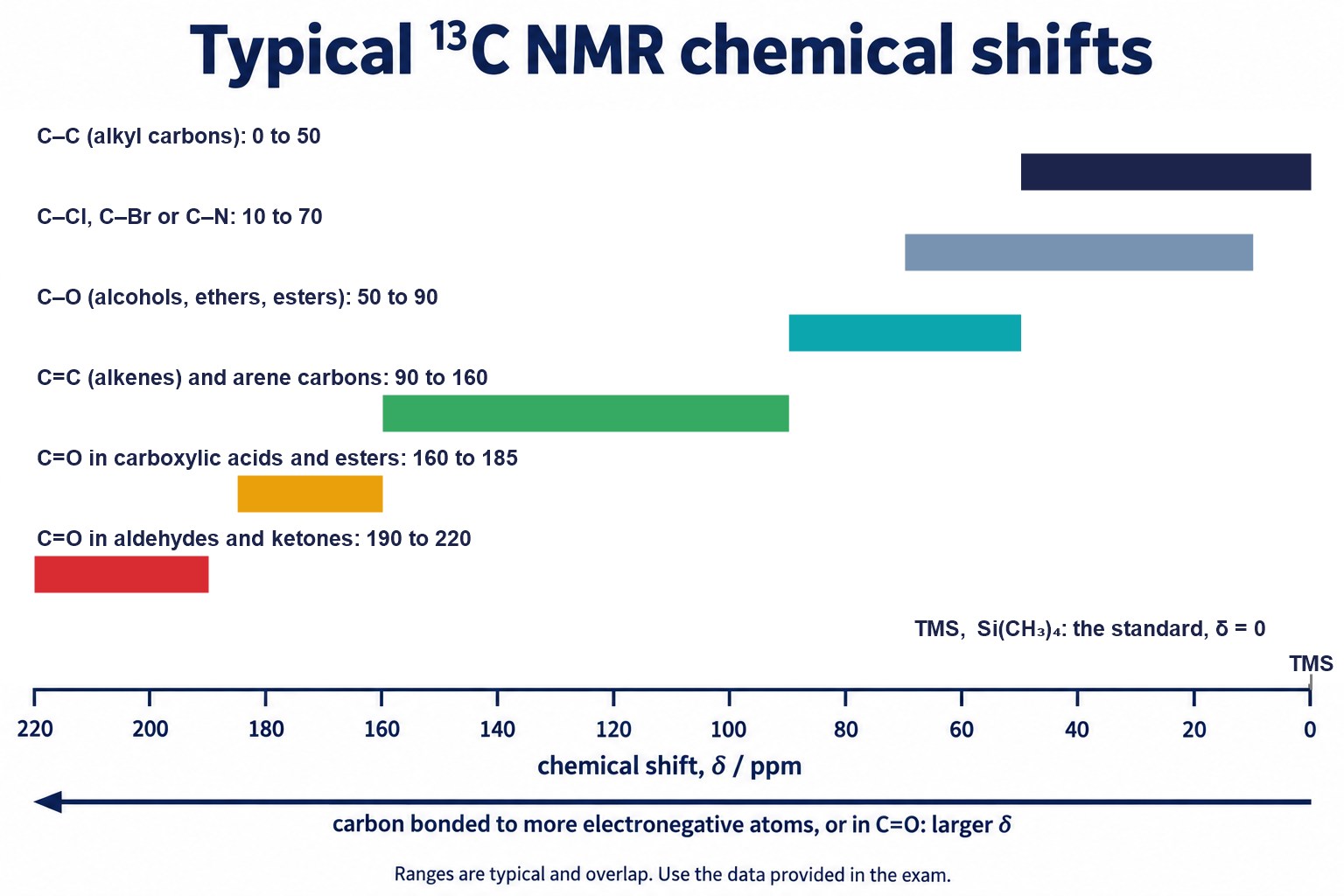
Typical carbon-13 chemical shift ranges on the δ scale, from alkyl carbons near TMS on the right to carbonyl carbons at the far left.
Features of a ¹³C spectrum
- Each environment gives a single line. There is no splitting to interpret.
- The spectrum is usually simpler than a ¹H NMR spectrum of the same compound.
- Peak heights are not proportional to the number of carbon atoms, so do not use them to count carbons.
- A carbon bonded to oxygen appears further left than an ordinary alkyl carbon.
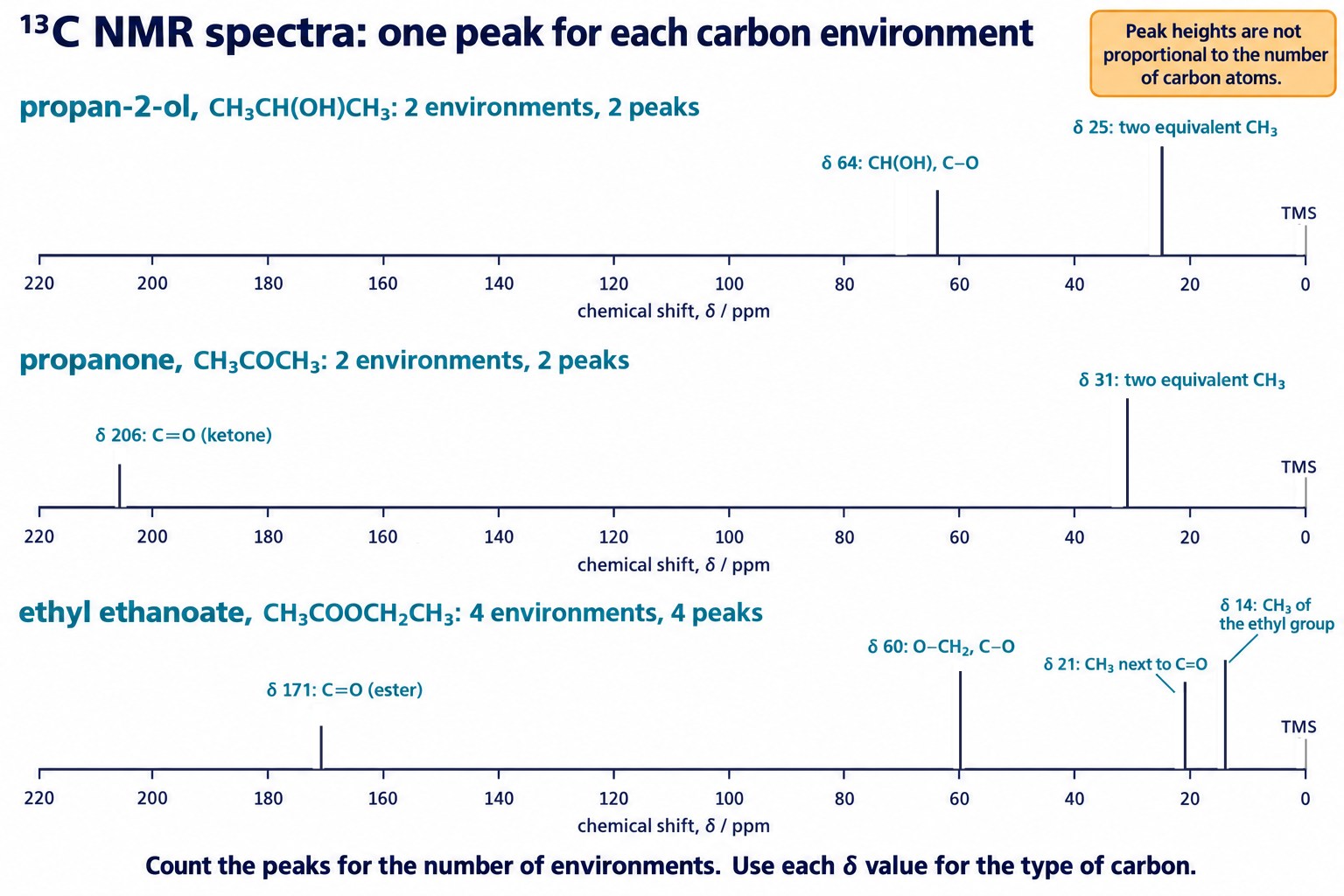
Sketch carbon-13 spectra of propan-2-ol (δ 64, 25), propanone (δ 206, 31) and ethyl ethanoate (δ 171, 60, 21, 14), each peak labelled with its carbon environment.
Assigning ethyl ethanoate, CH₃COOCH₂CH₃
| δ / ppm | Range it falls in | Carbon |
|---|---|---|
| 171 | 160 to 185 | C=O of the ester |
| 60 | 50 to 90 | O–CH₂ |
| 21 | 0 to 50 | CH₃ next to C=O |
| 14 | 0 to 50 | CH₃ of the ethyl group |
Remember: A peak above δ 190 means an aldehyde or ketone. A peak between δ 160 and 185 means an acid or ester. No peak above δ 160 means no C=O group.
Check: Using Chemical Shifts
Use typical chemical shift ranges to decide what type of carbon atom gives each peak, for spectra not used on this page.
Deducing a Structure
Use the molecular formula with the number of peaks first. Then use the chemical shifts to confirm the types of carbon.
Telling isomers apart
| Isomer of C₄H₁₀O | Structure | Peaks |
|---|---|---|
| Butan-1-ol | CH₃CH₂CH₂CH₂OH | 4 |
| Butan-2-ol | CH₃CH(OH)CH₂CH₃ | 4 |
| 2-Methylpropan-1-ol | (CH₃)₂CHCH₂OH | 3 |
| 2-Methylpropan-2-ol | (CH₃)₃COH | 2 |
- Propan-1-ol gives three peaks, but propan-2-ol gives only two.
- Propanal gives three peaks, but propanone gives only two.
- Butanone, CH₃COCH₂CH₃, has no symmetry and gives four peaks.
Worked example 2
A ketone, C₅H₁₀O, has three peaks in its ¹³C NMR spectrum, at δ 212, 36 and 8. Identify it.
Step 1. The ketones are pentan-2-one, CH₃COCH₂CH₂CH₃, pentan-3-one, CH₃CH₂COCH₂CH₃, and 3-methylbutan-2-one, CH₃COCH(CH₃)₂.
Answer. The compound is pentan-3-one.
Exam wording: “There are three peaks, so there are three carbon environments. Pentan-3-one is symmetrical: its two CH₃ carbons are equivalent and its two CH₂ carbons are equivalent.”
Quick Check: Combining a Spectrum with a Test
Work out each step on paper, then flip the card to check.
Common Exam Points
Say
- “The number of peaks equals the number of different carbon environments.”
- “The two CH₃ carbons are equivalent because of the plane of symmetry, so they give one peak.”
- “The peak at δ 171 is in the range for C=O in an ester or acid.”
Do not say
- “There are four carbon atoms, so four peaks” (count environments, not atoms).
- “The tallest peak has the most carbon atoms” (heights are not proportional in ¹³C NMR).
- “The peak is a triplet” (a ¹³C spectrum shows single lines only).
Watch for
- Benzene rings: use symmetry to find equivalent ring carbons.
- Overlapping ranges: C–O and C–Cl carbons can appear at similar δ, so use the formula as well.
- Questions that say “use the Data Booklet”: quote the range that each δ value falls in.
Check: Structures From Carbon-13 Spectra
Choose between isomers using the number of peaks and their chemical shifts, for compounds not used on this page.
FAQs
Use these quick answers to check carbon-13 NMR spectra.
What does the number of peaks in a ¹³C NMR spectrum tell me?
It is the number of different carbon environments. Carbon atoms related by symmetry are equivalent and share one peak. Propan-1-ol has three peaks, but propan-2-ol has only two because its two CH₃ groups are equivalent.
What is chemical shift?
Chemical shift, δ, is the position of a peak in parts per million, measured from the TMS peak at δ = 0. It depends on the environment of the carbon: carbon atoms bonded to electronegative atoms such as oxygen appear at higher δ.
How do I recognise a C=O carbon in a ¹³C spectrum?
Carbonyl carbon atoms appear furthest from TMS. Esters and carboxylic acids come at about 160 to 185 ppm and aldehydes and ketones at about 190 to 220 ppm. Always check against the values in the AQA data booklet.
Do the peak heights show how many carbon atoms there are?
No. In ¹³C NMR the peak heights are not proportional to the number of carbon atoms, so only the number of peaks and their chemical shifts are used. Each peak is a single line, with no splitting to interpret.
How many peaks does 1,4-dimethylbenzene give?
Three. The molecule is highly symmetrical: the two CH₃ carbon atoms are equivalent, the two ring carbon atoms bonded to CH₃ are equivalent, and the four ring CH carbon atoms are equivalent. Eight carbon atoms give only three environments.

Copyright notice: This OLS revision content, including the explanations, layout, diagrams, tables and embedded learning structure, is authored for Online Learning System by Dr. Mohammed Al-Fatah. It may not be copied, reproduced, redistributed or adapted without written permission.
Keep this note — free
Save your progress across every AQA topic. A free account remembers which topics you have covered, saves your question scores, and syncs across your phone and laptop.
- Track every topic you have finished
- Keep your practice-question scores
- No payment, no card, free forever
Already registered? Log in