Temperature, Activation Energy and the Rate Constant
A concise revision guide to how temperature changes the rate of a reaction and its rate constant, k: the Boltzmann distribution at two temperatures, the fraction of particles with energy of at least Eₐ, and how heating differs from adding a catalyst.
- 26.1.6
What these spec points say
- 26.1.6 describe qualitatively the effect of temperature change on the rate constant and hence the rate of a reaction
Temperature and the Rate Constant
Concentration changes affect the rate through the rate equation, but they leave k alone. Temperature is different: the rate constant itself increases with temperature, and for many reactions a rise of about 10 °C roughly doubles it.
That is why k is always quoted at a stated temperature.
Collision theory explains why. Warmer particles collide only slightly more often, but the fraction of collisions with energy of at least the activation energy, Eₐ, rises steeply.
This is because the high-energy tail of the Boltzmann distribution grows much faster than the average. The rate constant is the measure of how likely a collision is to succeed, so it grows with that fraction.
The same idea explains a catalyst in terms of k: by providing a route with a lower Eₐ, the catalyst increases the fraction of collisions that can react at a given temperature, so k for the catalysed reaction is larger.
Key idea: Concentration changes the rate; temperature (and a catalyst) changes the rate constant. A higher temperature means a larger k because a larger fraction of collisions have E ≥ Eₐ.
Check: Temperature and k
Qualitative questions on why k rises with temperature and what happens to k, and to the rate, when the conditions change.
The Boltzmann Distribution
The particles in a gas or a solution do not all have the same energy. The Boltzmann distribution shows how many particles have each energy at one temperature.
The curve starts at the origin, because no particles have zero energy. It rises to a peak at the most likely energy, then falls away but never meets the energy axis, because there is no maximum energy.
The activation energy, Eₐ, is the minimum energy required for a collision to be effective. Only particles in the area to the right of the Eₐ line can react when they collide.
At a higher temperature
The peak moves to a higher energy and becomes lower, and the curve spreads to the right. The total area stays the same, because the number of particles has not changed.
The area to the right of Eₐ becomes much larger: a greater fraction of particles have energy greater than or equal to Eₐ, so a greater fraction of collisions are effective.
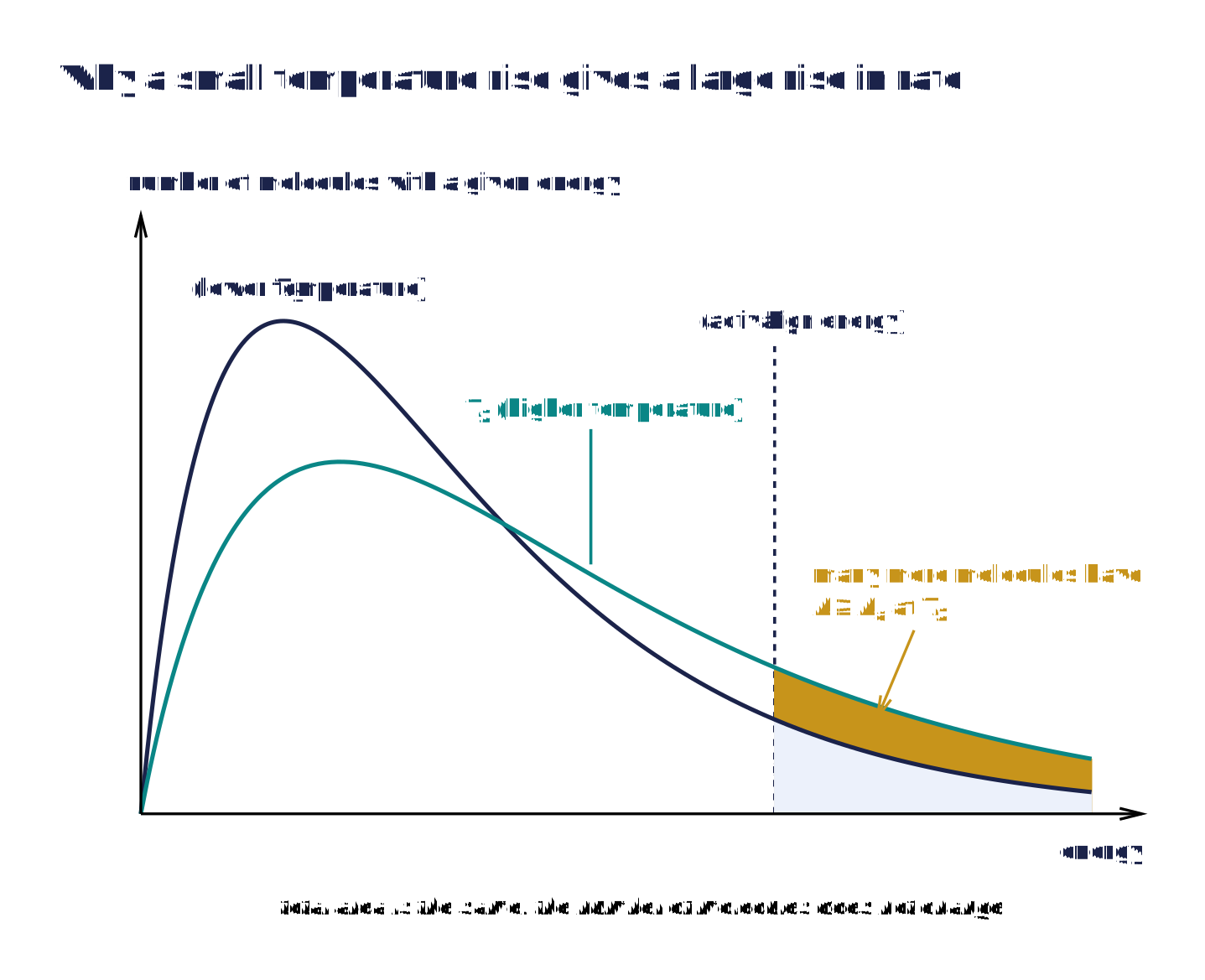
The Boltzmann distribution at two temperatures: at T₂ the curve is lower and further to the right, the area beyond Eₐ is much larger, and the total area is unchanged.
Exam wording: “At a higher temperature a greater proportion of particles have energy greater than or equal to Eₐ, so the frequency of effective collisions increases.”
Check: Reading the Boltzmann Distribution
Read the area, the peak and the Eₐ line on a Boltzmann distribution, and say what heating does to the curve.
Temperature or Catalyst?
A catalyst also increases the rate constant, but in a different way. It provides an alternative route with a lower activation energy; the temperature, and so the curve, stays the same.
On the Boltzmann distribution, heating changes the curve, while a catalyst moves the Eₐ line to lower energy. Either way, a greater fraction of particles have enough energy to react, so k and the rate increase.
| Change | Boltzmann curve | Eₐ | Fraction with E ≥ Eₐ | k | Rate |
|---|---|---|---|---|---|
| Raise the temperature | lower peak, moved to higher energy | unchanged | larger | larger | faster |
| Add a catalyst | unchanged | lower (new route) | larger | larger | faster |
| Increase a concentration | unchanged shape | unchanged | unchanged | unchanged | faster if the reactant is in the rate equation |
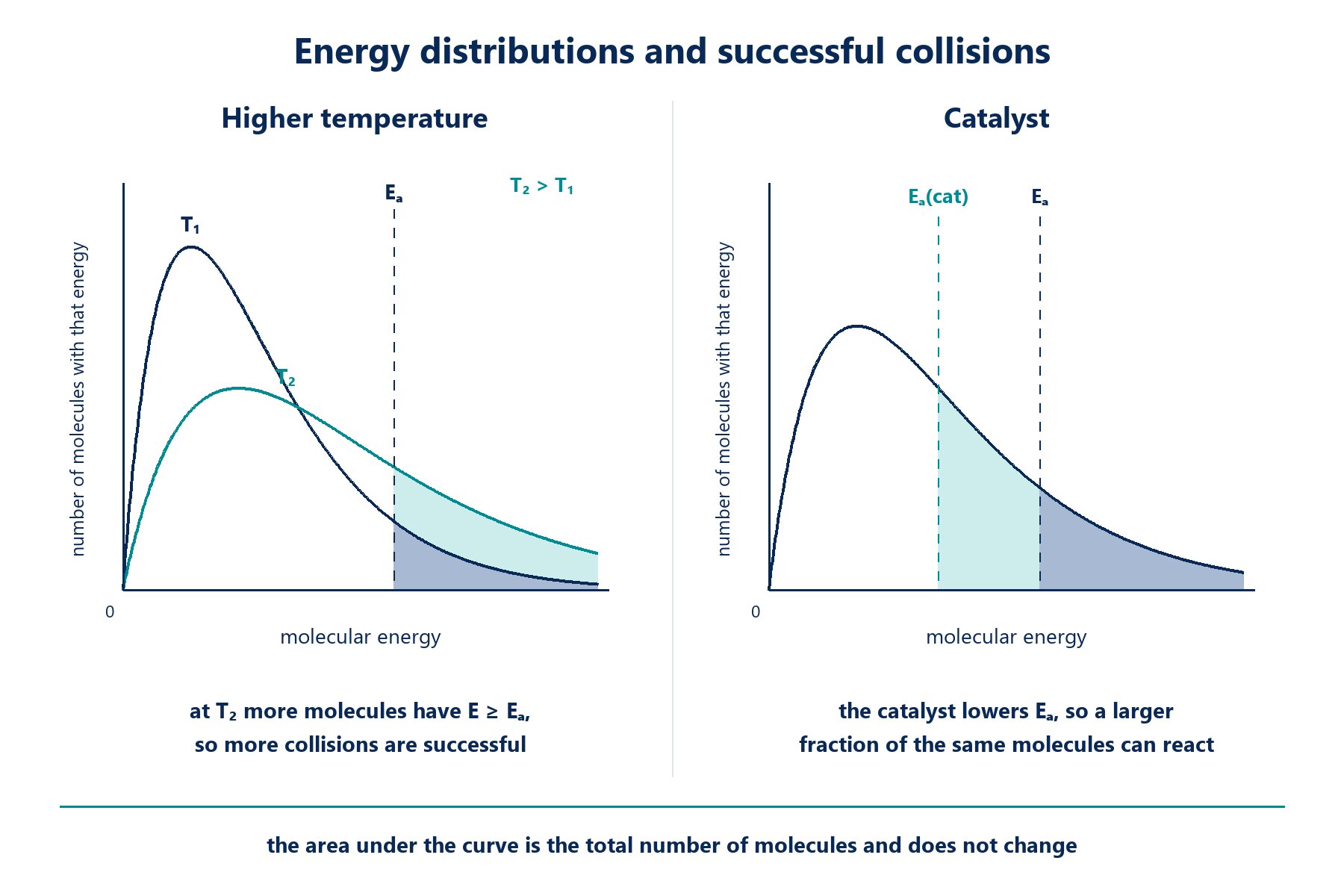
Left: heating moves the curve, so more molecules have E ≥ Eₐ. Right: a catalyst moves Eₐ to lower energy, so a larger fraction of the same molecules can react.
Exam focus: For a temperature rise, draw two curves and one Eₐ line, with equal areas under the curves. For a catalyst, draw one curve and two Eₐ lines.
Beyond the Syllabus: the Arrhenius Equation
Extension: beyond the Cambridge syllabus
The 9701 syllabus asks for the qualitative effect of temperature on the rate constant only. The equation below is not in the syllabus; it shows where that effect comes from.
The rate constant depends on temperature through the Arrhenius equation:
k = Ae−Ea/RT
A is the pre-exponential factor (with the units of k), Eₐ the activation energy in J mol⁻¹, R the gas constant, 8.31 J K⁻¹ mol⁻¹, and T the temperature in kelvin.
The term e−Ea/RT is the fraction of collisions with energy of at least Eₐ. Because T sits in an exponent, a small rise in T makes a large change in that fraction.
Taking natural logarithms gives ln k = (−Eₐ) / (R) × (1) / (T) + ln A, so a graph of ln k against (1) / (T) is a straight line of gradient (−Eₐ) / (R).
The graph below has a gradient of −8300 K, so Eₐ = 8300 × 8.31 = 69 000 J mol⁻¹ = 69 kJ mol⁻¹.
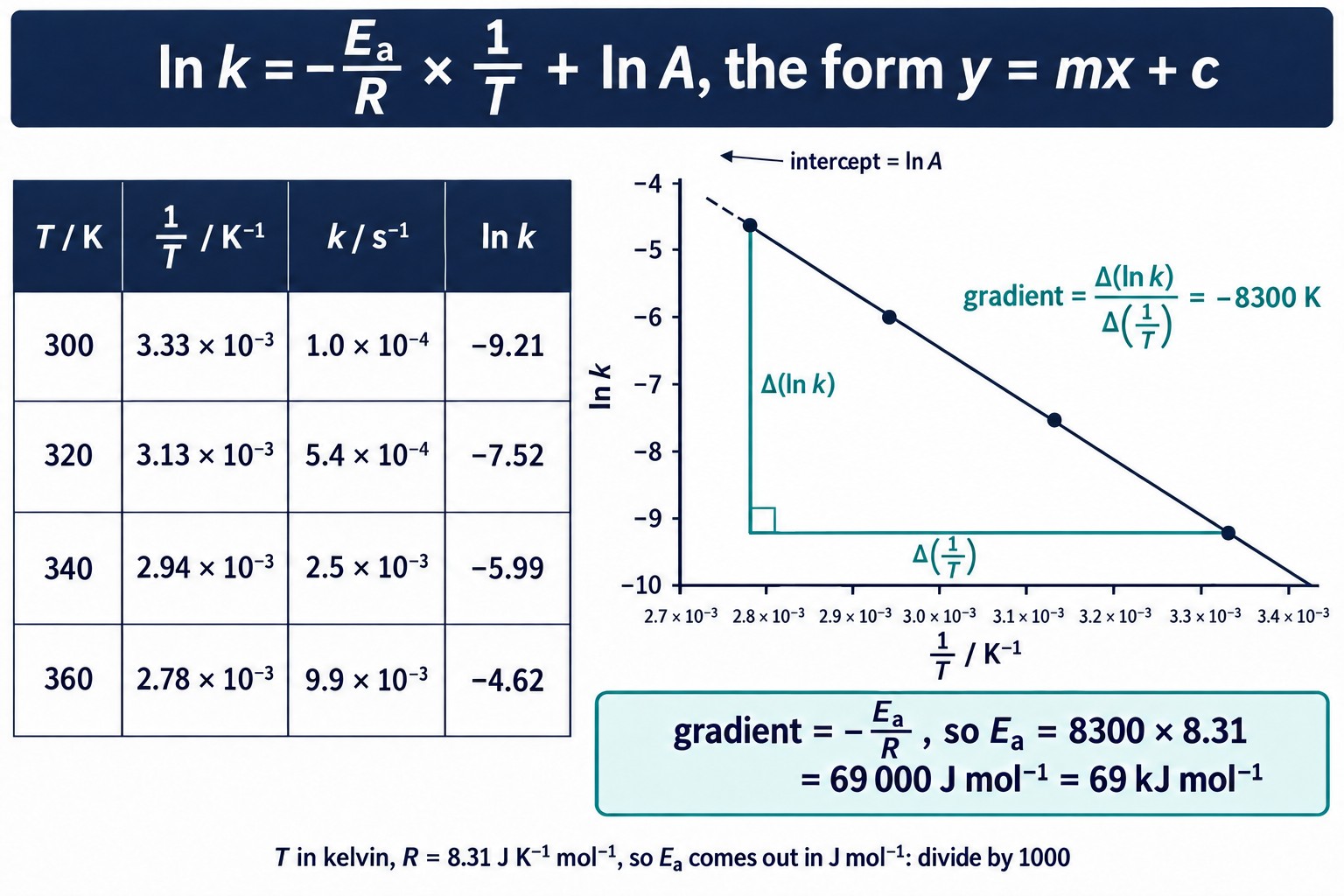
The Arrhenius plot: ln k against (1) / (T) is a straight line of gradient (−Eₐ) / (R), with the data and the working for Eₐ.
Common Exam Points
Say
“A higher temperature gives a greater proportion of particles with energy ≥ Eₐ, so the frequency of effective collisions increases.” “The rate constant increases with temperature, so the rate increases.” “A catalyst provides an alternative route with a lower Eₐ.”
Do not say
“The activation energy decreases when the temperature rises” (Eₐ is fixed; the fraction of particles that reach it rises). “The rate rises only because the particles collide more often” (that is the smaller effect). “Concentration changes k.”
Watch for
Boltzmann sketches: start at the origin, never touch the energy axis, keep the two areas equal at a higher temperature, and label the axes “number of particles” and “energy”.
FAQs
Use these quick answers to check the ideas on this page.
Why does a small rise in temperature make such a big difference to the rate?
Only the particles in the tail of the Boltzmann distribution, beyond Eₐ, can react. Heating moves the curve so that this small area grows much faster than the average energy, so the number of effective collisions rises steeply.
Does the activation energy change when the temperature rises?
No. Eₐ is set by the reaction pathway. Heating gives more particles enough energy to reach it; only a catalyst, which provides a different route, gives a lower Eₐ.
Why does temperature change k but concentration does not?
A higher concentration gives more collisions each second, but the same fraction of them succeed, so the rate rises while k stays the same. Heating changes that fraction, so k itself rises.
How do I show a catalyst and a temperature rise on a Boltzmann distribution?
For a temperature rise, draw two curves of equal area with one Eₐ line: the hotter curve is lower and further to the right. For a catalyst, draw one curve with two Eₐ lines, the catalysed one at lower energy.
Do I need the Arrhenius equation for Cambridge 9701?
No. The syllabus asks you to describe qualitatively how temperature changes the rate constant and the rate. The equation and its graph are in the extension box on this page.

Copyright notice: This OLS revision content, including the explanations, layout, diagrams, tables and embedded learning structure, is authored for Online Learning System by Dr. Mohammed Al-Fatah. It may not be copied, reproduced, redistributed or adapted without written permission.
Keep this note — free
Save your progress across every Cambridge topic. A free account remembers which topics you have covered, saves your question scores, and syncs across your phone and laptop.
- Track every topic you have finished
- Keep your practice-question scores
- No payment, no card, free forever
Already registered? Log in