Solubility of Group 2 Hydroxides and Sulfates
A concise revision guide to the solubility of the Group 2 hydroxides and sulfates: hydroxides becoming more soluble and sulfates less soluble down the group, explained qualitatively by the relative sizes of the lattice energy and the enthalpy change of hydration and by the trend in the enthalpy change of solution.
Before You Start
This page explains two trends met at AS. Both come down to a tug of war between two energy terms you have defined in energetics.
- Lattice energy, ΔHlatt: the enthalpy change when one mole of an ionic solid forms from its gaseous ions. Always exothermic: Lattice Energy and Born–Haber Cycles.
- Enthalpy change of hydration, ΔHhyd, and enthalpy change of solution, ΔHsol: Enthalpy of Solution and Hydration.
- The AS trends themselves, with the sulfate test: Solubility Trends and the Sulfate Test.
- Why a small, highly charged cation gives a larger lattice energy: Lattice Energy Trends and Covalent Character.
- The same cation idea explains Thermal Stability of Group 2 Nitrates and Carbonates.
GCSE Recap: Ions and Precipitates
Three quick questions on the GCSE ideas this page builds on.
Two Opposite Trends
Down Group 2 the hydroxides become more soluble while the sulfates become less soluble. The approximate values at 25 °C are worth knowing as orders of magnitude.
| Hydroxide | Solubility / mol dm⁻³ | Sulfate | Solubility / mol dm⁻³ |
|---|---|---|---|
| Mg(OH)₂ | 1.2 × 10⁻⁴ | MgSO₄ | 1.8 |
| Ca(OH)₂ | 1.5 × 10⁻² | CaSO₄ | 4.7 × 10⁻³ |
| Sr(OH)₂ | 3.4 × 10⁻² | SrSO₄ | 7.1 × 10⁻⁴ |
| Ba(OH)₂ | 1.5 × 10⁻¹ | BaSO₄ | 9.4 × 10⁻⁶ |
- Magnesium hydroxide is almost insoluble; barium hydroxide dissolves enough to make a strongly alkaline solution of pH about 13.
- Magnesium sulfate dissolves freely (Epsom salts); barium sulfate is one of the least soluble salts known.
- Both trends are about a thousand-fold or more from top to bottom of the group, so the explanation has to be about something that changes a great deal.
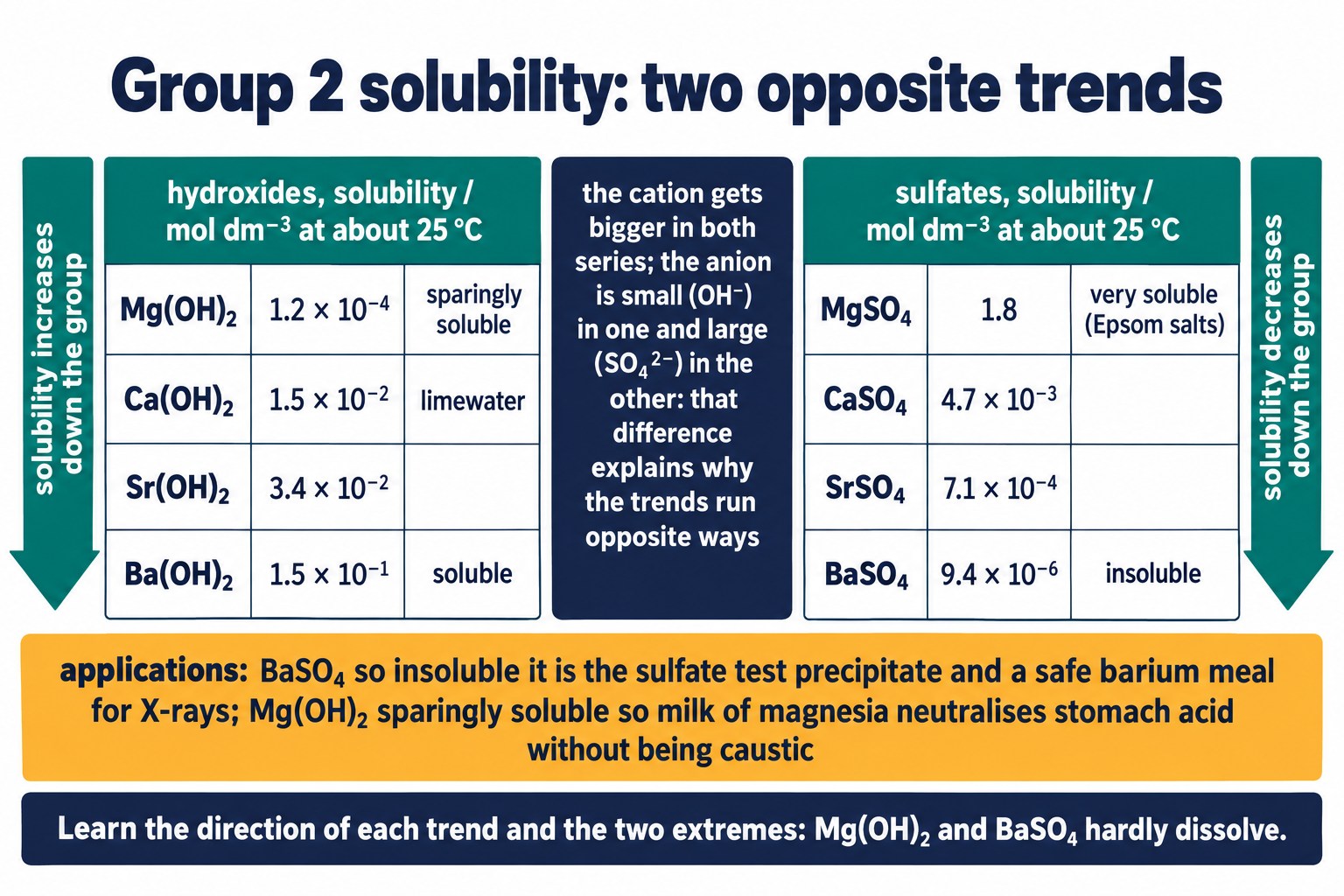
The two columns of values side by side, with an arrow up the hydroxides and an arrow down the sulfates and the factor of change written on each.
The Energy Cycle for Dissolving
Dissolving an ionic solid can be imagined in two stages: the lattice is pulled apart into gaseous ions, then each ion is surrounded by water molecules.
Stage 1. Break the lattice. This is the reverse of lattice formation, so it costs −ΔHlatt, a positive quantity: for MgSO₄ about +2833 kJ mol⁻¹.
Stage 2. Hydrate the ions. ΔHhyd of each ion is exothermic: the attraction between the ion and the polar water molecules releases energy.
Cycle. ΔHsol = ΔHhyd(cation) + ΔHhyd(anion) − ΔHlatt. Each term carries its own sign; ΔHlatt is negative, so subtracting it adds a positive number.
Example. For MgSO₄: ΔHhyd(Mg²⁺) −1926, ΔHhyd(SO₄²⁻) −1004, ΔHlatt −2833 kJ mol⁻¹. ΔHsol = −1926 − 1004 + 2833 = −97 kJ mol⁻¹: exothermic.
- A more exothermic (or less endothermic) ΔHsol goes with higher solubility; a more endothermic ΔHsol goes with lower solubility.
- The question is always which of the two terms, |ΔHlatt| or |ΔHhyd|, falls faster down the group.
- Hydration enthalpies of the cations: Mg²⁺ −1926, Ca²⁺ −1579, Sr²⁺ −1446, Ba²⁺ −1309 kJ mol⁻¹. Larger ions attract water less.
- The anion is the same in each series, so ΔHhyd(anion) is a constant that drops out of the comparison.
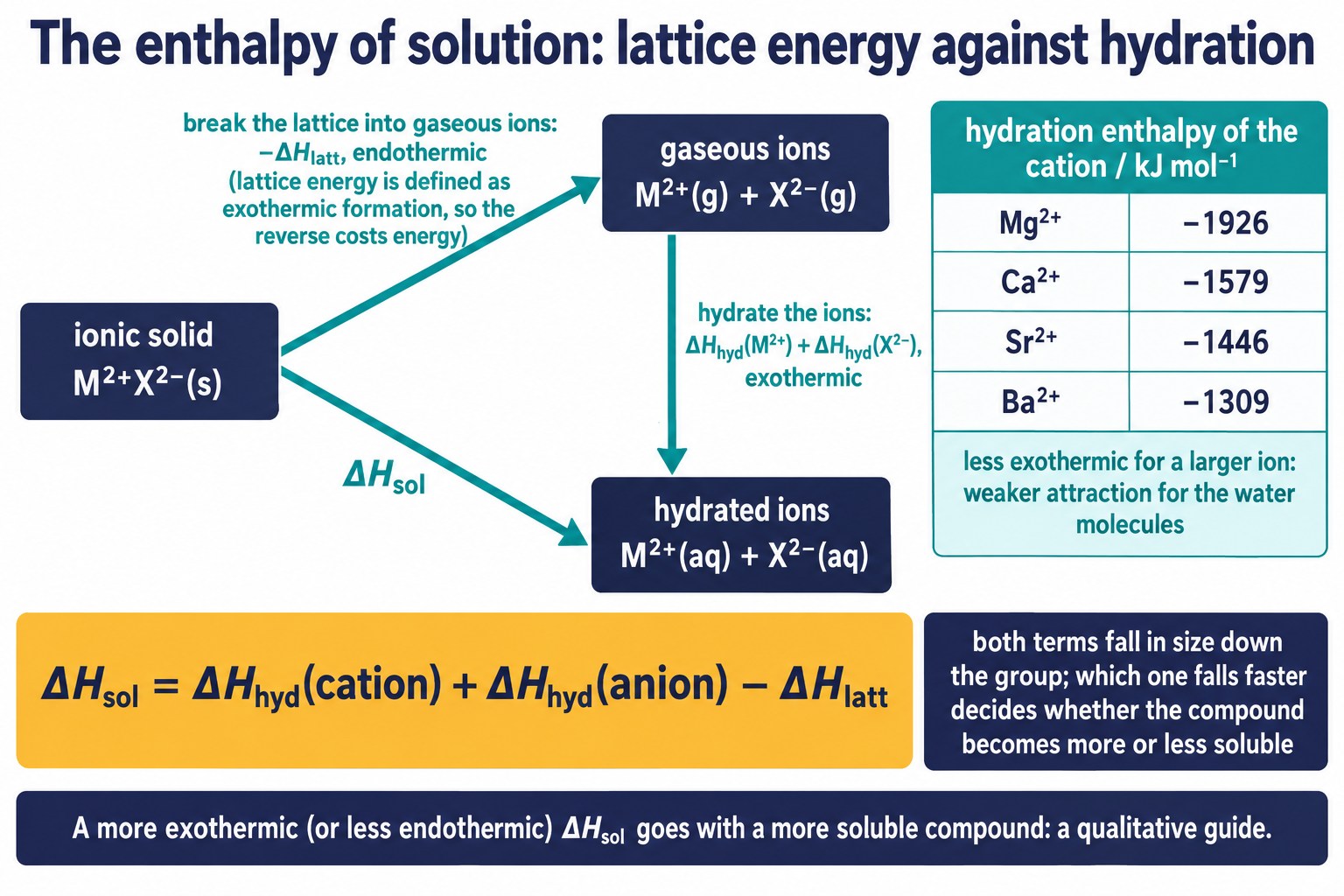
The three-term cycle as boxes: solid, gaseous ions, aqueous ions, with the sign of each arrow and the MgSO₄ numbers written in.
Remember: Solubility also depends on entropy, so the enthalpy argument is qualitative. The syllabus asks for it in terms of the relative magnitudes of ΔHhyd and ΔHlatt only.
Check: The Trends and the Cycle
State the direction of each solubility trend, write the enthalpy of solution cycle, and work out ΔHsol from lattice and hydration data for an unfamiliar salt.
Why the Hydroxides Become More Soluble
The hydroxide ion is small. In a hydroxide lattice the distance between ion centres is set largely by the cation, so the lattice energy is very sensitive to the cation radius.
Step 2. |ΔHhyd| of the cation also falls, from 1926 to 1309 kJ mol⁻¹, but more gently than the lattice energy.
Exam focus: The sentence that earns the mark: “the lattice energy decreases more than the hydration enthalpy down the group, so ΔHsol becomes more exothermic and solubility increases”.
Quick Check: Which Term Falls Faster?
Use the size of each change to predict the trend. The lattice figure is invented for this exercise.
Why the Sulfates Become Less Soluble
The sulfate ion is large. The ion separation in a sulfate lattice is dominated by the big anion, so changing the cation from Mg²⁺ to Ba²⁺ alters the lattice energy comparatively little.
Step 1. |ΔHlatt| falls only slightly down the group: the sulfate ion keeps the ions far apart whatever the cation.
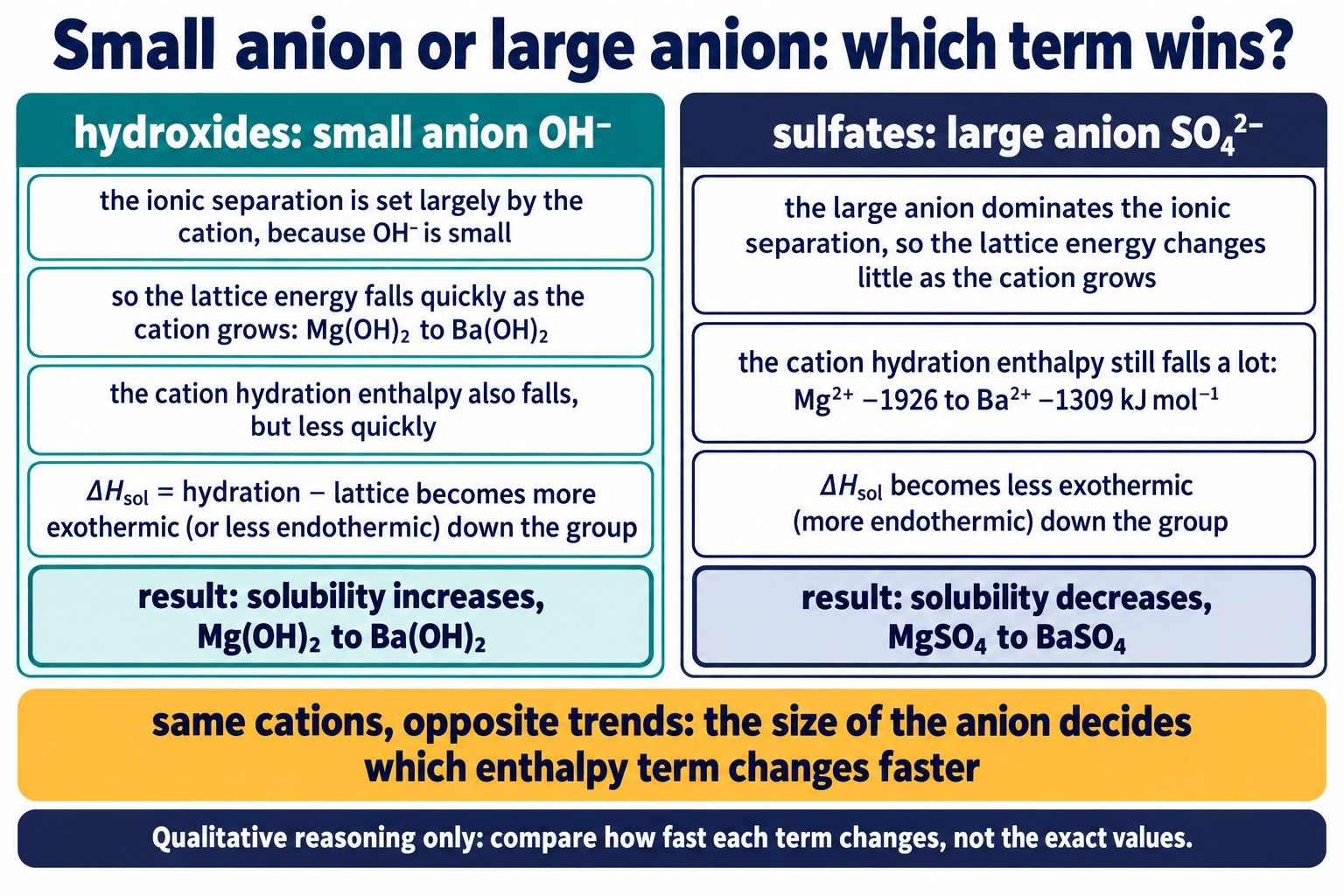
Small anion against large anion: two rows of ion pairs showing why the cation size controls the hydroxide lattice but barely moves the sulfate lattice.
- The two trends are the same argument with the size of the anion deciding which term wins.
- Small anion (OH⁻, F⁻): lattice energy falls fastest, solubility rises down the group.
- Large anion (SO₄²⁻, CO₃²⁻): hydration enthalpy falls fastest, solubility falls down the group.
Common mistake: Saying the hydration enthalpy “increases” down the group. Both terms become smaller in magnitude; the comparison is about which one shrinks faster.
Quick Check: Less Soluble Than the Calcium Salt
Apply both trends at once, including to a large anion that is new to this page.
Applications
Both trends are used in the laboratory and in medicine. Each application rests on one salt being nearly insoluble or one hydroxide being just soluble enough.
- The sulfate test: add acidified barium chloride (or nitrate) to the solution; white barium sulfate, Ba²⁺(aq) + SO₄²⁻(aq) → BaSO₄(s), proves sulfate ions: Tests for Ions.
- The acid removes carbonate ions first, because barium carbonate is also a white insoluble solid and would give a misleading precipitate.
- Barium meal: a suspension of BaSO₄ is swallowed before an X-ray. Barium ions are toxic, but BaSO₄ is so insoluble that almost none dissolves.
- Milk of magnesia: Mg(OH)₂ is sparingly soluble, so it neutralises stomach acid gently, Mg(OH)₂(s) + 2HCl(aq) → MgCl₂(aq) + 2H₂O(l), without a dangerous rise in pH.
- Limewater is a saturated solution of Ca(OH)₂: soluble enough to test for CO₂, dilute enough to be safe to handle.
- Barium hydroxide solution is a strong alkali used in titrations of weak acids, because it dissolves enough to give a known concentration.
Remember: For an application question, name the compound, state whether it is soluble or insoluble, and say which trend places it there.
Check: Explaining Solubility
Explain the hydroxide and sulfate trends through the relative changes in lattice energy and hydration enthalpy, and link each application to the right compound.
Common Exam Points
- Hydroxides become more soluble and sulfates less soluble down Group 2: Mg(OH)₂ about 10⁻⁴ mol dm⁻³, Ba(OH)₂ about 10⁻¹; MgSO₄ about 2, BaSO₄ about 10⁻⁵.
- ΔHsol = ΔHhyd(cation) + ΔHhyd(anion) − ΔHlatt; a more exothermic ΔHsol means a more soluble compound.
- Both |ΔHlatt| and |ΔHhyd(M²⁺)| decrease down the group because the cation gets bigger. The anion decides which falls faster.
- Small OH⁻: the lattice energy falls faster than the hydration enthalpy, so ΔHsol becomes more exothermic and solubility increases.
- Large SO₄²⁻: the lattice energy changes little while the hydration enthalpy falls, so ΔHsol becomes more endothermic and solubility decreases.
- The argument is qualitative: quote relative magnitudes, not individual numbers, unless the question gives data.
- Sulfate test: acidified Ba²⁺(aq) gives white BaSO₄(s); the acid first removes carbonate ions.
- Milk of magnesia and the barium meal work because Mg(OH)₂ and BaSO₄ are so sparingly soluble.
FAQs
Use these quick answers to check why Group 2 hydroxides become more soluble down the group while the sulfates become less soluble, how lattice energy and hydration enthalpy combine in the enthalpy change of solution, and the applications.
What are the two solubility trends in Group 2?
The hydroxides become more soluble down the group: Mg(OH)₂ is almost insoluble while Ba(OH)₂ dissolves readily.
The sulfates go the other way: MgSO₄ is very soluble but BaSO₄ is so insoluble, about 10⁻⁵ mol dm⁻³, that it is the white precipitate in the sulfate test.
How do lattice energy and hydration enthalpy decide whether a salt dissolves?
Dissolving means breaking the lattice, which costs the lattice energy, and then hydrating the separated ions, which releases the hydration enthalpies: ΔHsol = ΔHhyd(cation) + ΔHhyd(anion) − ΔHlatt. A more exothermic, or less endothermic, enthalpy change of solution generally means a more soluble compound.
Why do the hydroxides become more soluble down the group?
The hydroxide ion is small, so the cation size controls the distance between ions and the lattice energy falls steeply as the cation grows. The hydration enthalpy of the cation falls more slowly, so the enthalpy change of solution becomes more exothermic and solubility rises.
Why do the sulfates become less soluble down the group?
The sulfate ion is large, so it dominates the distance between the ions and the lattice energy changes very little down the group. Meanwhile the cation hydration enthalpy falls, from −1926 kJ mol⁻¹ for Mg²⁺ to −1309 for Ba²⁺, so dissolving becomes more endothermic.
Where do these trends matter in practice?
The insolubility of barium sulfate makes acidified barium chloride the test for sulfate ions, giving a white precipitate. The low solubility of magnesium hydroxide lets it be swallowed safely as milk of magnesia, neutralising excess stomach acid without the solution becoming dangerously alkaline.

Copyright notice: This OLS revision content, including the explanations, layout, diagrams, tables and embedded learning structure, is authored for Online Learning System by Dr. Mohammed Al-Fatah. It may not be copied, reproduced, redistributed or adapted without written permission.
Keep this note — free
Save your progress across every Cambridge topic. A free account remembers which topics you have covered, saves your question scores, and syncs across your phone and laptop.
- Track every topic you have finished
- Keep your practice-question scores
- No payment, no card, free forever
Already registered? Log in