Thermal Stability of Group 2 Nitrates and Carbonates
A concise revision guide to the thermal decomposition of the Group 2 nitrates and carbonates: the equations and observations, the increase in stability down the group, and the explanation in terms of the charge density of the cation and its polarisation of the large anion, with the comparison to Group 1 that examiners like.
Polarisation and the Thermal Stability of Group 2 Carbonates
Small, highly charged cations distort the carbonate ion more, so it breaks up at a lower temperature. Down Group 2 the carbonates and nitrates get more stable.
© Dr. Mohammed Al-Fatah – onlinelearningsystem.net
Recap: Group 2 Trends from AS
Five quick questions on what you already know: the Group 2 elements with water and oxygen, their oxides and hydroxides (Oxides, Hydroxides and Carbonates), and the decomposition of carbonates to oxides first met in Thermal Stability and Flame Colours.
Decomposing the Carbonates
Thermal decomposition is the breaking down of one compound into two or more by heat alone. Every Group 2 carbonate decomposes to the metal oxide and carbon dioxide.
General. MCO₃(s) → MO(s) + CO₂(g), where M is Mg, Ca, Sr or Ba.
Magnesium. MgCO₃(s) → MgO(s) + CO₂(g): a white powder gives a white powder, so the gas is the only visible sign.
Calcium. CaCO₃(s) → CaO(s) + CO₂(g): limestone to lime in a kiln above about 840 °C.
- Test the gas: it turns limewater milky, Ca(OH)₂(aq) + CO₂(g) → CaCO₃(s) + H₂O(l).
- The residue is a basic oxide: a drop of water on the cooled solid gives an alkaline reading.
- The same bond is broken in every case: a C–O bond inside the carbonate ion. What changes down the group is how hard that bond is to break.
Remember: Carbonate to oxide plus carbon dioxide, always in a 1 : 1 : 1 ratio. The oxide keeps the metal in oxidation state +2: nothing is oxidised or reduced.
Decomposing the Nitrates
The Group 2 nitrates decompose to the oxide as well, but the nitrate ion breaks into two gases: brown nitrogen dioxide and oxygen.
Magnesium. 2Mg(NO₃)₂(s) → 2MgO(s) + 4NO₂(g) + O₂(g).
Calcium. 2Ca(NO₃)₂(s) → 2CaO(s) + 4NO₂(g) + O₂(g).
- Observations: the white solid melts, bubbles and gives off a brown gas; a glowing splint held at the mouth of the tube relights because of the oxygen.
- Nitrogen in the nitrate ion is +5 and falls to +4 in NO₂; some oxygen rises from −2 to 0. The decomposition is a redox change inside the anion.
- Balance by counting nitrogen first: two nitrate groups per formula unit give four NO₂, then share the remaining oxygen as O₂.
Common mistake: Writing MgO + 2NO₂ + O₂ for one Mg(NO₃)₂. That leaves the oxygen unbalanced: six O on the left, seven on the right. Use two formula units.
The Trend Down the Group
Each compound decomposes at a higher temperature than the one above it. Thermal stability increases down Group 2 for both carbonates and nitrates.
| Carbonate | Approximate decomposition temperature | Cation radius |
|---|---|---|
| MgCO₃ | 350 °C | Mg²⁺ 0.065 nm |
| CaCO₃ | 840 °C | Ca²⁺ 0.099 nm |
| SrCO₃ | 1100 °C | Sr²⁺ 0.113 nm |
| BaCO₃ | 1300 °C | Ba²⁺ 0.135 nm |
- The nitrates follow the same order: magnesium nitrate decomposes most easily, barium nitrate needs the strongest heating.
- Barium carbonate hardly decomposes in a Bunsen flame, which reaches roughly 1000 °C at best.
- A question that says “more stable” means a higher decomposition temperature, or a longer time before the gas appears at the same temperature.
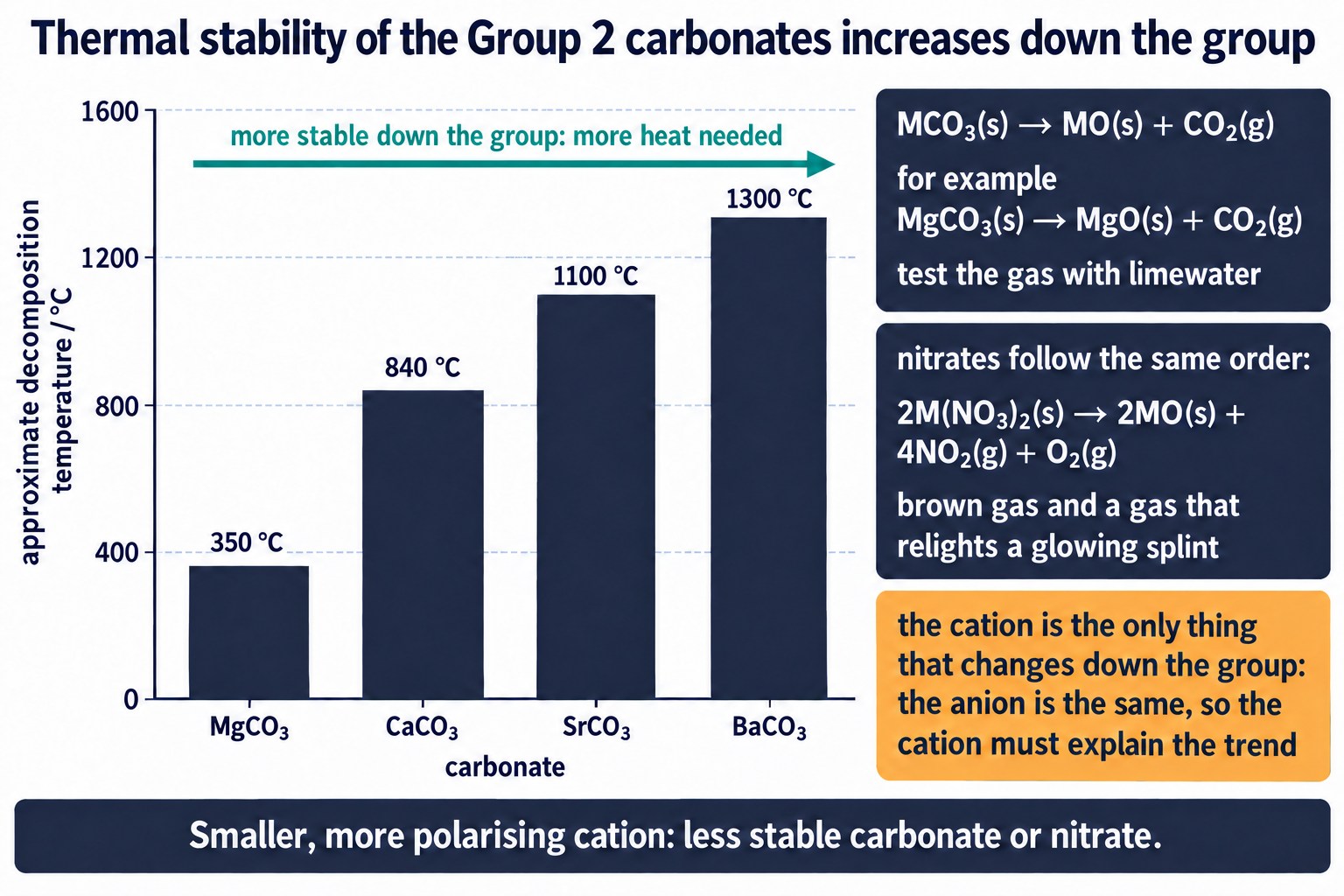
The four carbonate decomposition temperatures as a bar chart, rising from magnesium to barium, with the cation radius beside each bar.
Check: Equations and the Trend
Balance decomposition equations for other Group 2 nitrates and carbonates, name the gases and the observations, and place compounds in order of thermal stability.
Charge Density and Polarisation: the Explanation
The anion is the same all the way down, so the cation must explain the trend. The key idea is the charge density of the cation: its charge divided by its size.
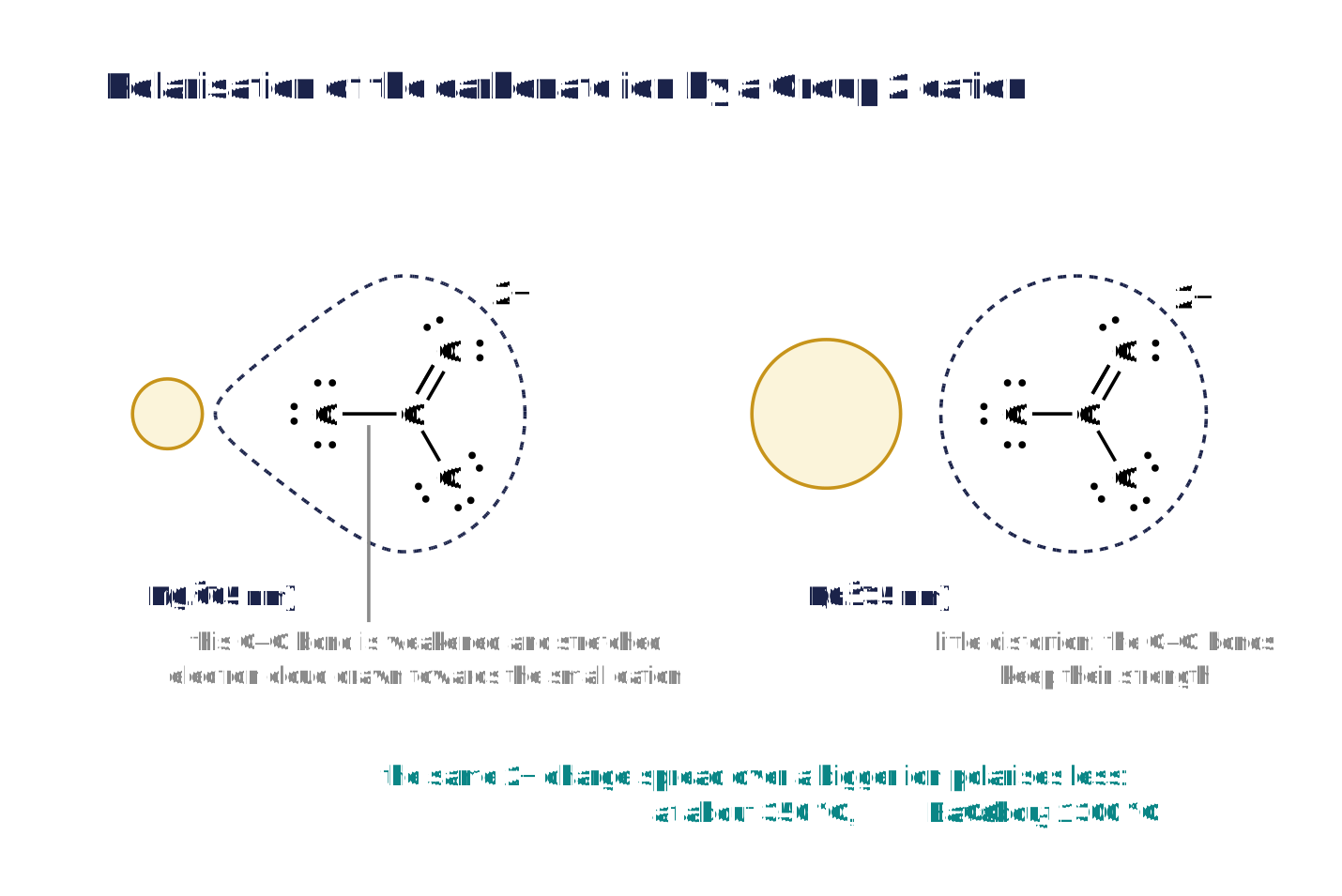
The carbonate ion beside a small Mg²⁺ and beside a large Ba²⁺: the electron cloud is pulled towards magnesium far more, weakening the C–O bonds.
- The oxide ion is small and holds its charge tightly, so the cation can polarise it no further: the oxide is the stable product.
- Say “polarises the anion”, never “polarises the bond”. It is the whole large anion that is distorted.
- The same reasoning runs through Lattice Energy Trends and Covalent Character: a small, highly charged cation gives an ionic lattice covalent character.
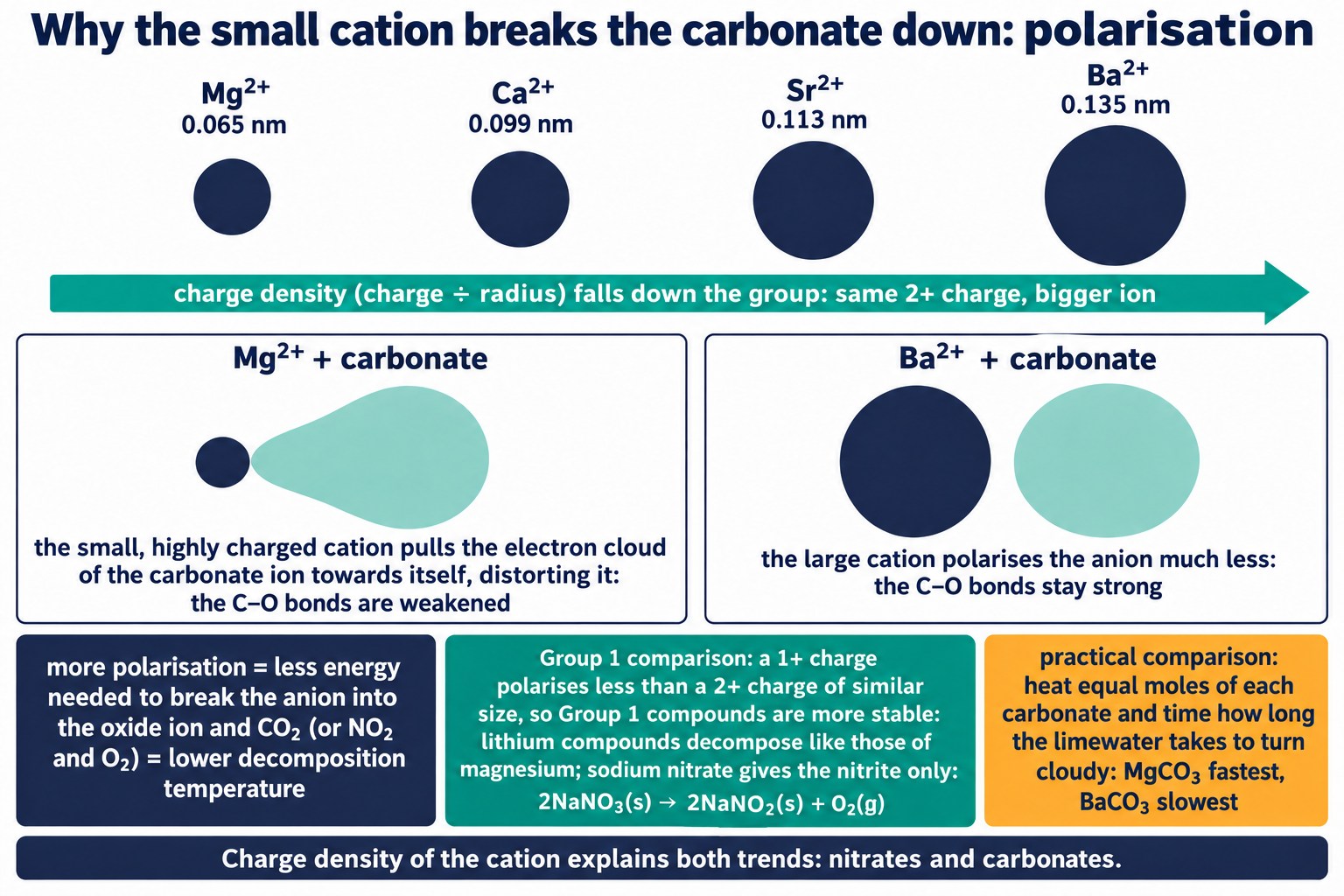
Four cations drawn to scale with their radii, each beside a carbonate ion, and one sentence under each on how strongly the anion is distorted.
Exam focus: Four marks, four ideas: smaller cation, higher charge density, more polarisation of the large anion, weaker C–O or N–O bond so less heat is needed. Write all four.
Group 1 for Comparison
Group 1 cations carry a 1+ charge and are larger than the Group 2 cation in the same period, so their charge density is lower and their compounds are more stable.
- Carbonates: sodium and potassium carbonate do not decompose in a Bunsen flame. Only lithium carbonate does, Li₂CO₃(s) → Li₂O(s) + CO₂(g), because Li⁺ is very small.
- Nitrates: sodium nitrate loses only oxygen, 2NaNO₃(s) → 2NaNO₂(s) + O₂(g), leaving the nitrite (nitrate(III)) rather than the oxide. No brown gas is seen.
- Lithium nitrate behaves like a Group 2 nitrate: 4LiNO₃(s) → 2Li₂O(s) + 4NO₂(g) + O₂(g).
- Compare like with like: Li⁺ and Mg²⁺ are similar in size, but Mg²⁺ carries twice the charge, so MgCO₃ (about 350 °C) decomposes far more easily than Li₂CO₃.
Remember: Two factors set charge density: charge and radius. Group 1 compounds are more stable because the charge is lower; the trend within a group comes from the radius.
Quick Check: Predicting Stability for New Compounds
Pick the one accurate statement in each set, applying the ideas to new comparisons.
Comparing Stability in the Laboratory
The trend can be measured with a side-arm boiling tube, a delivery tube and limewater. The variable is the time for the limewater to turn milky.
- Weigh out the same number of moles of each carbonate (not the same mass: the molar masses differ).
- Heat each sample with the same Bunsen flame, the tube at the same height above the flame.
- Pass the gas through the same volume of fresh limewater and time the first permanent cloudiness.
- A longer time means a more stable carbonate: the order found is MgCO₃, CaCO₃, SrCO₃, BaCO₃.
- For nitrates, time the appearance of the brown gas instead, and work in a fume cupboard: NO₂ is toxic.
- Barium carbonate may give no result at all in the time available, which is itself evidence of its stability.
- Control variables are the marks in a planning question: moles, flame, tube position, limewater volume.
Common mistake: Using equal masses. One gram of MgCO₃ is 0.0119 mol but one gram of BaCO₃ is only 0.00507 mol, so the comparison would be unfair.
Check: Explaining the Trend
Explain thermal stability through charge density and anion polarisation, compare Group 1 with Group 2, and plan a fair comparison with limewater.
Common Exam Points
- Carbonates: MCO₃(s) → MO(s) + CO₂(g). Nitrates: 2M(NO₃)₂(s) → 2MO(s) + 4NO₂(g) + O₂(g). Always two formula units for the nitrate.
- Observations for a nitrate: the solid melts, a brown gas forms and a glowing splint relights. For a carbonate the gas turns limewater milky.
- Thermal stability increases down Group 2: MgCO₃ about 350 °C, BaCO₃ about 1300 °C.
- Explanation: same charge, larger radius, lower charge density, less polarisation of the large anion, C–O or N–O bonds weakened less, more heat needed.
- Group 1 compounds are more stable because the 1+ cation has a lower charge density; lithium is the exception because Li⁺ is so small.
- Sodium nitrate gives the nitrite and oxygen only: 2NaNO₃(s) → 2NaNO₂(s) + O₂(g).
- Fair comparison: equal moles, same flame and tube position, same volume of limewater, time to the first cloudiness.
- Link the idea to Lattice Energy Trends and Covalent Character: polarisation of a large anion by a small cation runs through the whole course.
FAQs
Use these quick answers to check the decomposition of the Group 2 nitrates and carbonates, the increase in stability down the group, the charge-density explanation examiners want, the comparison with Group 1 and the practical that tests it.
What happens when a Group 2 nitrate is heated?
It decomposes to the metal oxide, brown nitrogen dioxide and oxygen: 2Mg(NO₃)₂(s) → 2MgO(s) + 4NO₂(g) + O₂(g).
The brown gas is easy to see, and the oxygen relights a glowing splint. Carbonates give only the oxide and carbon dioxide, MgCO₃(s) → MgO(s) + CO₂(g).
Why does the thermal stability of the carbonates increase down Group 2?
The cation gets larger while its charge stays 2+, so its charge density falls: Mg²⁺ has a radius of 0.065 nm, Ba²⁺ 0.135 nm. A smaller cation pulls electrons from the carbonate ion more strongly, distorting its C–O bonds, so less heat breaks it apart.
What do I mean when I say the cation polarises the anion?
The positive charge of the small cation attracts the electron cloud of the large carbonate or nitrate ion towards it, distorting the anion.
Electron density shifts towards the oxygen nearest the cation, weakening the C–O or N–O bonds, so the anion breaks up more easily.
How do the Group 1 compounds compare with Group 2?
Group 1 cations carry only a 1+ charge, so they polarise anions much less and the compounds are more stable. Sodium carbonate does not decompose in a Bunsen flame, and sodium nitrate only loses oxygen to form the nitrite: 2NaNO₃(s) → 2NaNO₂(s) + O₂(g).
How can I compare the thermal stability of the carbonates in the laboratory?
Heat equal numbers of moles of each carbonate in identical test tubes with the same flame and bubble the gas through limewater. Time how long the limewater takes to turn cloudy: magnesium carbonate is quickest, barium carbonate may give no cloudiness at all.

Copyright notice: This OLS revision content, including the explanations, layout, diagrams, tables and embedded learning structure, is authored for Online Learning System by Dr. Mohammed Al-Fatah. It may not be copied, reproduced, redistributed or adapted without written permission.
Keep this note — free
Save your progress across every Cambridge topic. A free account remembers which topics you have covered, saves your question scores, and syncs across your phone and laptop.
- Track every topic you have finished
- Keep your practice-question scores
- No payment, no card, free forever
Already registered? Log in