Bond Energy and Bond Length
A concise Cambridge International AS Level Chemistry revision guide to 3.4.3: the definitions of bond energy and bond length, how the two are linked through bond order, and how to use bond energy values and bond lengths to compare the reactivity of covalent molecules.
- 3.4.3(a)-i
- 3.4.3(a)-ii
- 3.4.3(b)
What these spec points say
- 3.4.3(a)-i define the term bond energy as the energy required to break one mole of a particular covalent bond in the gaseous state
- 3.4.3(a)-ii define the term bond length as the internuclear distance of two covalently bonded atoms
- 3.4.3(b) use bond energy values and the concept of bond length to compare the reactivity of covalent molecules
GCSE Recap: Breaking and Making Bonds
Before you start, check the GCSE rule about the energy needed to break bonds and the energy given out when bonds form.
Two Definitions to Learn Word for Word
Cambridge sets both of these as definitions, so learn the exact wording.
| Term | Definition | Units |
|---|---|---|
| Bond energy | The energy required to break one mole of a particular covalent bond in the gaseous state | kJ mol−1 |
| Bond length | The internuclear distance between two covalently bonded atoms, i.e. the distance between the centres of the two nuclei | nm or pm |
Bond energy is always endothermic (a positive value) because energy must be supplied to pull the shared pair away from the two nuclei.
For bonds that appear in many different molecules, such as C-H, the data-book value is an average across many compounds; diatomic molecules have an exact value.
Exam sentence: Bond energy is the energy required to break one mole of a particular covalent bond in the gaseous state; bond length is the internuclear distance of two covalently bonded atoms.
Quick Check: Apply the Definition
Pick the one equation that matches every part of the bond energy definition.
Shorter Bonds Are Stronger Bonds
The two quantities move in opposite directions. When more electron density sits between two nuclei, the nuclei are pulled closer together (a shorter bond) and more energy is needed to separate them (a larger bond energy). Two patterns show this clearly.
| Bond | Bond length / nm | Bond energy / kJ mol−1 | Comment |
|---|---|---|---|
| C-C | 0.154 | 350 | One shared pair |
| C=C | 0.134 | 610 | Two shared pairs pull the nuclei closer |
| C≡C | 0.120 | 840 | Three shared pairs: shortest and strongest |
| Cl-Cl | 0.199 | 242 | Small atoms, short bond |
| Br-Br | 0.228 | 193 | Larger atoms, longer and weaker |
| I-I | 0.267 | 151 | Largest atoms, longest and weakest |
- Bond order: between the same two atoms, single bonds are longest and weakest and triple bonds are shortest and strongest.
- Atomic size: down a group the atoms get bigger, the bonding pair is further from each nucleus, and the bond becomes longer and weaker. Fluorine is the exception: F-F (158 kJ mol−1) is weaker than Cl-Cl because the very short bond brings the lone pairs on the two fluorine atoms close enough to repel strongly.
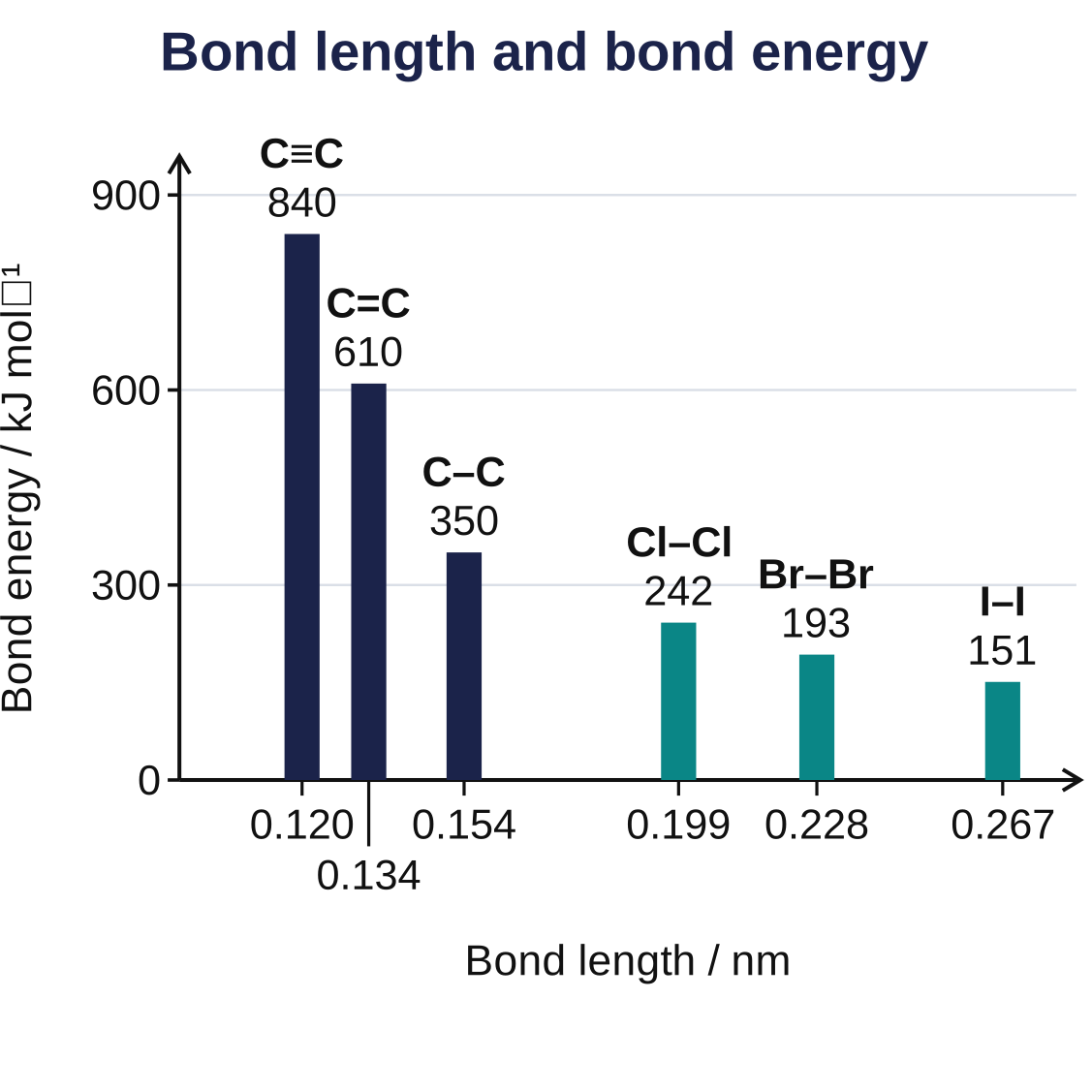
As bond length increases, bond energy decreases: short bonds are strong bonds.
Key idea: More shared electron pairs, or smaller atoms, mean a shorter and stronger bond. Bond length up, bond energy down.
Quick Check: Rank Four Bonds by Length
Use the bond energies given to put the four bonds in order of bond length, shortest at the top.
Using Bond Energies to Compare Reactivity
A reaction usually begins with a bond breaking, so the molecule with the weaker bond tends to react more readily and at a lower temperature. Bond energies let you predict and explain this.
| Comparison | Bond energies / kJ mol−1 | Prediction |
|---|---|---|
| N2 against O2 | N≡N 944, O=O 496 | Oxygen is far more reactive; the very strong triple bond makes nitrogen almost inert at room temperature |
| Chloroalkane against iodoalkane | C-Cl 340, C-I 240 | The iodoalkane is hydrolysed faster because the weaker C-I bond breaks more easily |
| Hydrogen halides | H-Cl 431, H-Br 366, H-I 299 | Thermal stability falls from HCl to HI; HI decomposes on gentle heating |
Bond energy is not the only factor. Bond polarity and the strength of the bonds formed also matter, so use bond energy to explain the trend you are asked about rather than as a universal rule.
Exam focus: When comparing reactivity, name the bond that breaks, quote both bond energies, and say that the bond with the smaller bond energy breaks more easily.
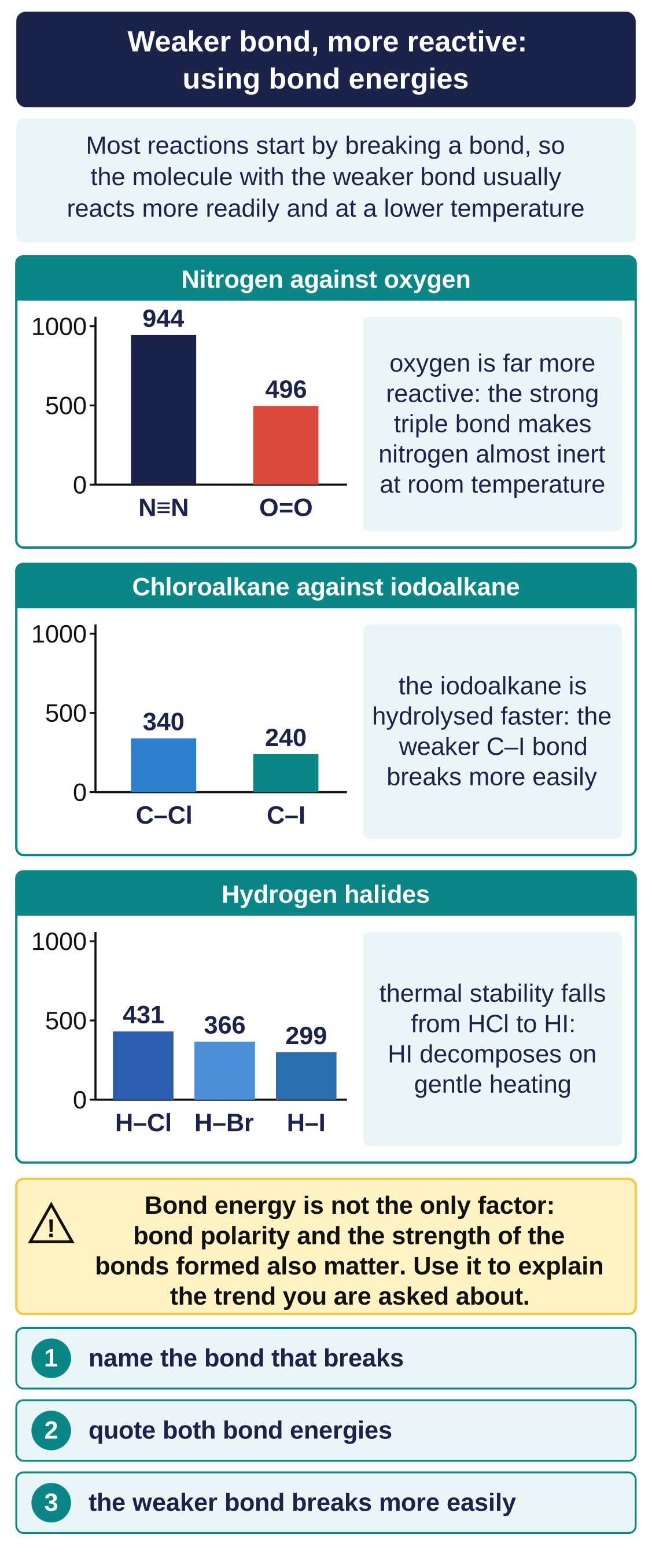
Comparing the energy of the bond that breaks explains why oxygen is more reactive than nitrogen, iodoalkanes hydrolyse faster than chloroalkanes and HI is the least stable hydrogen halide.
Quick Check: The Hydrogen Halides
Drag the words and numbers into place to build the comparison from H-F to H-I.
Quick Check: Explain Which Bond Breaks
Write a short explanation, then compare it with the mark points and the model answer.
Quick Check: The Whole Page in Five Rounds
In each round, choose the one accurate statement about bonds the page has not used.
Common Exam Mistakes
- Leaving “gaseous” out of the bond energy definition, or writing “one bond” instead of “one mole of bonds”.
- Defining bond length as the distance between the atoms’ edges. It is the distance between the two nuclei.
- Assuming that a double bond is exactly twice as strong as a single bond. C=C is 610 kJ mol−1, not 2 × 350 = 700.
- Saying fluorine has the strongest halogen-halogen bond because it is the smallest. The F-F bond is unusually weak because of lone-pair repulsion.
- Explaining reactivity by bond polarity alone when the question gives bond energies. Use the data you are given.
Exam sentence: Short bond, high bond energy, low reactivity: the molecule with the weaker bond breaks first.
FAQs
These questions secure the definitions and comparisons that come up most on bond energy and bond length.
Why is bond energy always positive?
Energy must be supplied to pull the shared pair away from the two nuclei, so bond breaking is endothermic. The same amount of energy is released when that bond forms.
Why is a triple bond shorter than a single bond?
Three shared pairs put more electron density between the nuclei. The nuclei are pulled closer together, so the bond is shorter and more energy is needed to separate them.
Fluorine is the smallest halogen, so why is F-F weaker than Cl-Cl?
The F-F bond is very short, so the lone pairs on the two fluorine atoms are close together and repel. This repulsion weakens the bond to 158 kJ mol−1, below Cl-Cl at 242 kJ mol−1.
C-Cl is more polar than C-I, so why do iodoalkanes hydrolyse faster?
The rate depends on the bond that breaks. C-I has a bond energy of 240 kJ mol−1, far below C-Cl at 340 kJ mol−1, so it breaks more easily. Here bond energy outweighs polarity.
What units should I use for bond length?
Bond length is usually given in nanometres or picometres and is measured between the centres of the two nuclei. 0.154 nm is the same as 154 pm.

Copyright notice: This OLS revision content, including the explanations, layout, diagrams, tables and embedded learning structure, is authored for Online Learning System by Dr. Mohammed Al-Fatah. It may not be copied, reproduced, redistributed or adapted without written permission.
Keep this note — free
Save your progress across every Cambridge topic. A free account remembers which topics you have covered, saves your question scores, and syncs across your phone and laptop.
- Track every topic you have finished
- Keep your practice-question scores
- No payment, no card, free forever
Already registered? Log in