Dative Covalent Bonding
A concise revision guide to dative covalent bonds, lone pair donation, coordinate bonding, hydronium ions and aluminium chloride dimer formation for Cambridge International AS & A Level Chemistry.
- 3.4.1(c)-i
- 3.4.1(c)-iii
- 3.7.1-c
What these spec points say
- 3.4.1(c)-i describe coordinate (dative covalent) bonding
- 3.4.1(c)-iii describe coordinate (dative covalent) bonding in the Al2Cl6 molecule
- 3.7.1-c use dot-and-cross diagrams to illustrate coordinate bonding including the representation of any compounds stated in 3.4 and 3.5
Dative Bonds in NH₄⁺ and Al₂Cl₆
Choose a step to watch a lone pair become a shared pair: first when ammonia meets H⁺, then when two AlCl₃ molecules join to make Al₂Cl₆.
© Dr. Mohammed Al-Fatah – onlinelearningsystem.net
GCSE Recap: Lone Pairs and the Hydrogen Ion
Before you start, check the GCSE ideas about lone pairs and the hydrogen ion that this page builds on.
What Is a Dative Covalent Bond?
A dative covalent bond forms when the shared electron pair in a covalent bond is donated entirely by one atom.
The atom donating the electron pair must have a lone pair. The other atom accepts the pair but does not contribute any electrons to that bond.
This is also called a coordinate bond or co-ordinate bond. Once the bond has formed, it behaves like a normal covalent bond.
Definition: A dative covalent bond is a covalent bond in which both electrons in the shared pair are supplied by the same atom.
Key idea: The bond is still covalent because a pair of electrons is shared. The special feature is where the shared pair originally came from.
Watch: what a dative bond needs
A dative bond needs a lone pair on one atom and an atom that can take a pair. Ammonia has the lone pair. What takes it?
Normal Covalent Bonds Compared With Dative Bonds
In a normal covalent bond, each bonded atom contributes one electron to the shared pair. In a dative covalent bond, one atom contributes both electrons.
After formation, the distinction is only about the origin of the electron pair. The resulting bond is still a covalent bond involving shared electron density between nuclei.
| Feature | Normal covalent bond | Dative covalent bond |
|---|---|---|
| Electron contribution | Each atom contributes one electron. | One atom contributes both electrons. |
| Bond type after formation | A covalent bond with shared electron density. | Also a covalent bond with shared electron density. |
| Typical requirement | Usually requires one unpaired electron from each atom. | Requires a lone pair donor and an electron-pair acceptor. |
Exam focus: Do not describe a dative covalent bond as ionic bonding or electron transfer. It is still a shared-pair covalent bond.
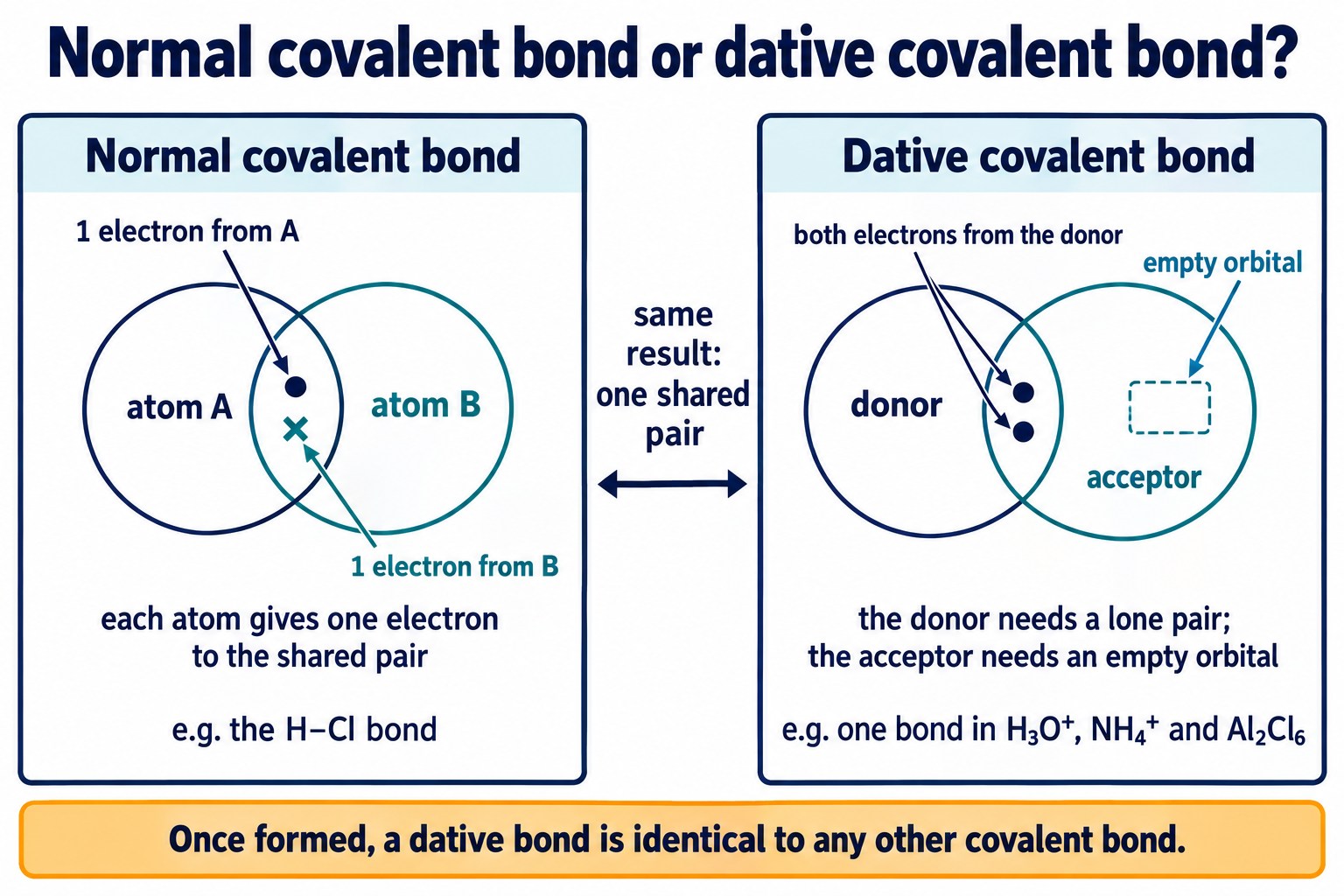
In a normal covalent bond each atom gives one electron; in a dative bond the donor gives both, but the finished bonds are the same.
Quick Check: Normal or Dative?
Choose the change that forms a dative covalent bond.
Hydronium Ion: Lone Pair Donation by Water
Water can form a dative covalent bond because oxygen has lone pairs of electrons. A hydrogen ion, H+, has no electrons and can accept a lone pair.
When water donates one lone pair to H+, the hydronium ion, H3O+, forms. The new O-H bond is drawn as a dative covalent bond because both bonding electrons came from oxygen.
Exam papers and textbooks also call H3O+ the oxonium ion or the hydroxonium ion. All three names describe the same ion, so accept whichever one the question uses.
The charge carries straight over from H⁺. The lone pair is shared, not given away, so no electrons are gained or lost.
A neutral water molecule plus a 1+ ion gives an ion with a charge of 1+. The charge belongs to the whole H₃O⁺ ion, not to any one atom in it.
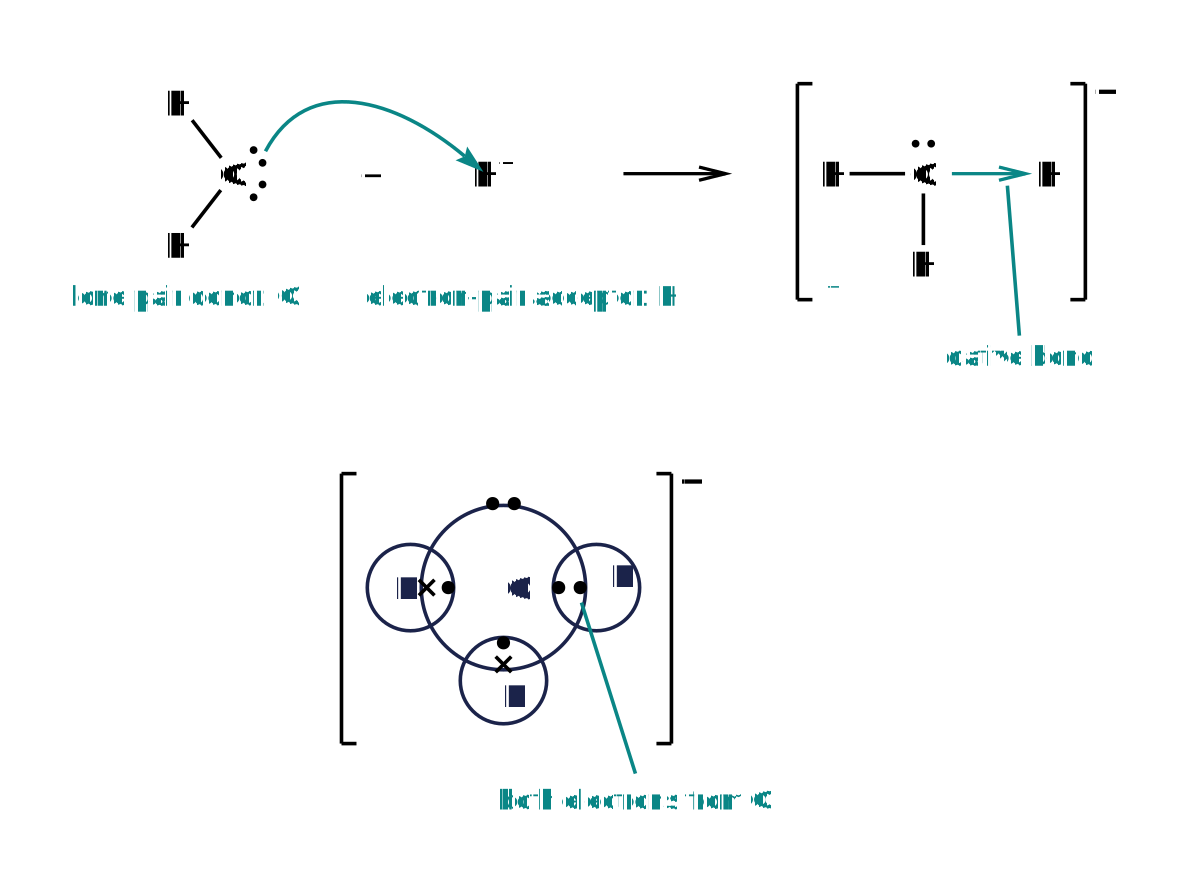
Oxygen donates a lone pair to H+, forming H3O+ with a dative covalent O-H bond.
Remember: H+ accepts an electron pair because it has no electron of its own to contribute to the bond.
Quick Check: The Ammonium Ion
Drag the words into place to describe how the ammonium ion forms.
Aluminium Chloride and Dimer Formation
Aluminium chloride, AlCl3, is a covalent compound that is electron deficient. Aluminium has only three outer electrons, so in AlCl3 it has just six electrons in its outer shell and an empty orbital.
Each chlorine atom carries three lone pairs, so a chlorine atom in another AlCl3 molecule can donate one of them into that empty orbital.
The dimer forms in the vapour. Aluminium chloride sublimes on heating, and just above the sublimation temperature two AlCl₃ molecules combine to form Al₂Cl₆.
The same dimer is present when aluminium chloride is dissolved in a non-polar solvent.
- A lone pair on one chlorine atom of each AlCl3 is donated into the empty orbital of the aluminium in the other molecule, forming a dative covalent bond.
- Two such bonds form, so two chlorine atoms bridge the two aluminium atoms. Each bridging chlorine makes one ordinary covalent bond and one dative bond.
- Each aluminium now has four bonding pairs, a complete octet, and a tetrahedral arrangement of chlorine atoms.
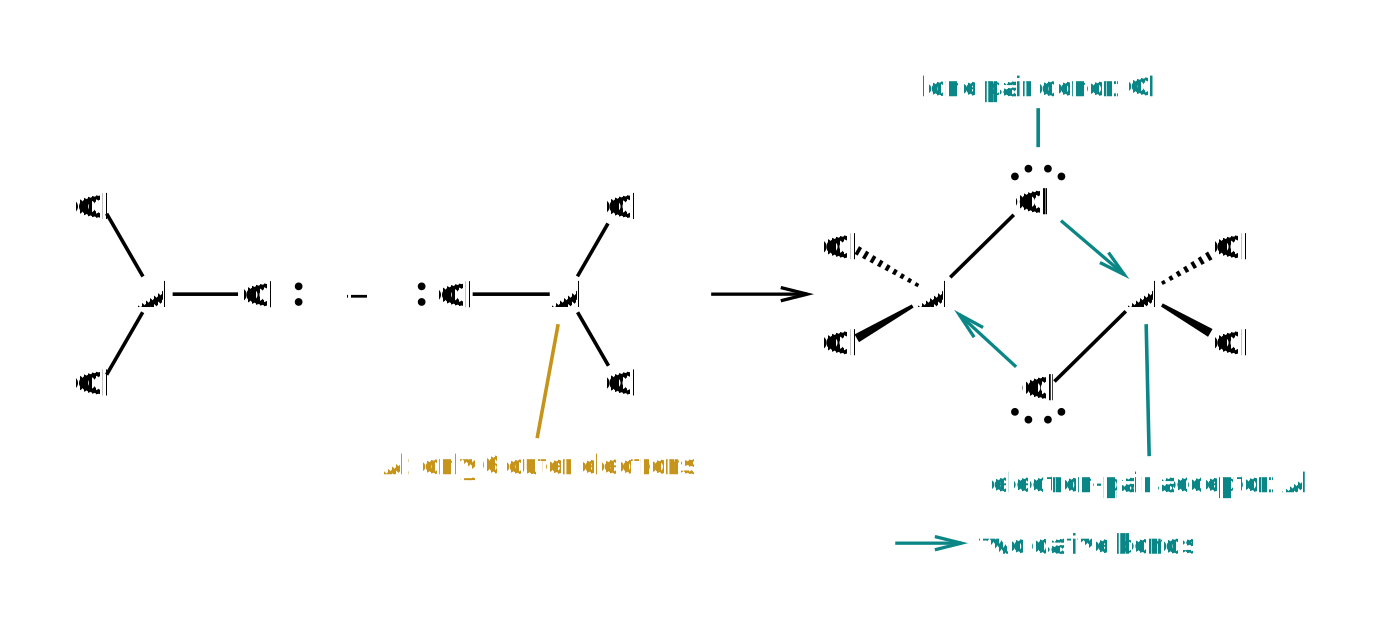
Al₂Cl₆ contains two dative covalent bonds, allowing each aluminium atom to reach a full outer shell.
In Al₂Cl₆ two chlorine atoms donate lone pairs into the empty orbitals of the aluminium atoms, completing both octets.
Exam focus: In Al2Cl6, the chlorine atoms act as lone pair donors and the aluminium atoms act as electron-pair acceptors.
Exam sentence: AlCl3 dimerises to Al2Cl6 because aluminium has an empty orbital and only six outer electrons; a lone pair on a chlorine atom of the other molecule forms a dative covalent bond, giving each aluminium a full octet.
Quick Check: Explain a New Dative Bond
Write a short explanation, then compare it with the mark points and the model answer.
Quick Check: Bridging Chlorine Atoms in BeCl₂
Decide why beryllium chloride molecules can link into chains.
How Dative Bonds Are Represented
Dative covalent bonds are often shown using an arrow. The arrow starts at the atom donating the lone pair and points towards the atom accepting the electron pair.
For example, in H3O+, the arrow would point from oxygen towards H+. In Al2Cl6, the arrows point from chlorine atoms towards aluminium atoms.
Arrow tail
The tail begins at the atom donating the lone pair.
Arrow head
The arrow points towards the atom accepting the electron pair.
After formation
The bond behaves like an ordinary covalent bond even though both electrons originally came from one atom.
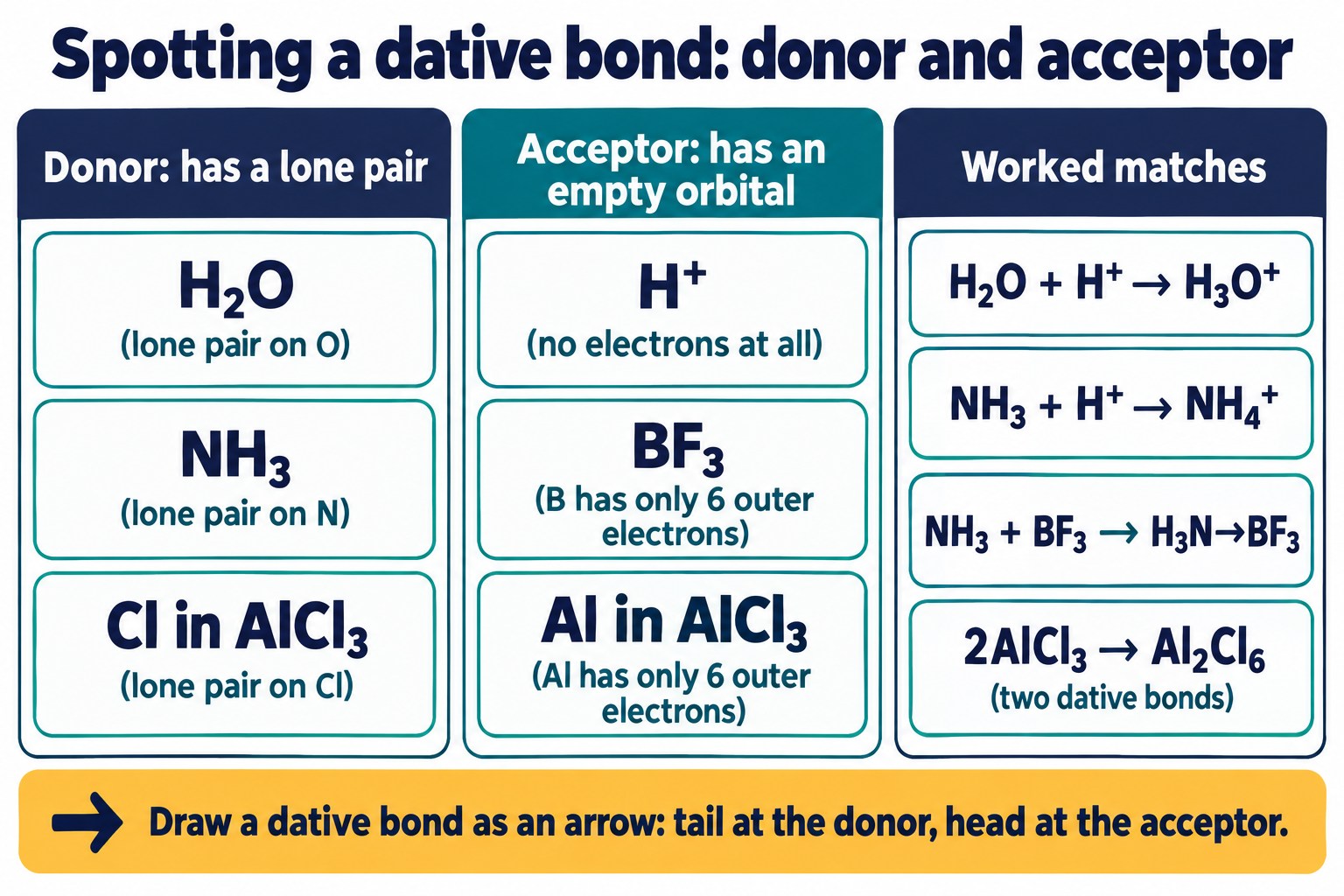
Every dative bond runs from a lone pair on the donor to an empty orbital on the acceptor.
Quick Check: Which Way Does the Arrow Point?
Answer each quick question on the direction of the dative bond arrow.
Quick Check: Spot the Accurate Statement
In each round, choose the one accurate statement to review the whole page.
Common Exam Points
Strong answers identify the electron-pair donor, the electron-pair acceptor and the origin of the shared pair.
Use the phrase lone pair
The donor must provide a lone pair of electrons to form the dative bond.
State that both electrons come from one atom
This is the key difference between a dative covalent bond and a normal covalent bond.
Do not change the bond type after formation
Once formed, the dative bond behaves like a regular covalent bond.
Use correct examples
H3O+ forms when water donates a lone pair to H+. Al2Cl6 forms when chlorine atoms donate lone pairs to electron-deficient aluminium atoms.
FAQs
Common questions students ask about dative covalent bonding.
What is a dative covalent bond?
A dative covalent bond is a covalent bond in which both electrons in the shared pair are donated by the same atom.
Is a dative covalent bond different from a normal covalent bond after it forms?
No. Once a dative covalent bond has formed, it behaves like a normal covalent bond. The difference is that both bonding electrons originally came from one atom.
Why can water form a dative covalent bond with H+?
Water has lone pairs on oxygen, while H+ can accept an electron pair. Oxygen donates a lone pair to H+, forming H3O+.
Why does AlCl3 form Al2Cl6?
In AlCl3, aluminium has only six electrons in its outer shell. Chlorine atoms can donate lone pairs to aluminium atoms in another AlCl3 molecule, forming Al2Cl6.
Which way does the arrow point in a dative covalent bond?
The arrow starts at the lone pair donor and points towards the electron-pair acceptor.

Copyright notice: This OLS revision content, including the explanations, layout, diagrams, tables and embedded learning structure, is authored for Online Learning System by Dr. Mohammed Al-Fatah. It may not be copied, reproduced, redistributed or adapted without written permission.
Keep this note — free
Save your progress across every Cambridge topic. A free account remembers which topics you have covered, saves your question scores, and syncs across your phone and laptop.
- Track every topic you have finished
- Keep your practice-question scores
- No payment, no card, free forever
Already registered? Log in