Sigma and Pi Bonds and Hybridisation
A concise Cambridge International AS Level Chemistry revision guide to how σ and π bonds form by orbital overlap, and how the bonds in nitrogen and hydrogen cyanide are built up.
It also shows how sp, sp2 and sp3 hybridisation explains the number of bonds and the shape around each atom.
- 3.4.2(a)-i
- 3.4.2(a)-ii
- 3.4.2(a)-iii
- 3.4.2(b)-iv
- 3.4.2(b)-v
- 3.4.2(c)-i
- 3.4.2(c)-ii
- 3.4.2(c)-iii
What these spec points say
- 3.4.2(a)-i describe covalent bonds in terms of orbital overlap giving σ and π bonds
- 3.4.2(a)-ii describe that σ bonds are formed by direct overlap of orbitals between the bonding atoms
- 3.4.2(a)-iii describe that π bonds are formed by the sideways overlap of adjacent p orbitals above and below the σ bond
- 3.4.2(b)-iv describe how the σ and π bonds form in HCN
- 3.4.2(b)-v describe how the σ and π bonds form in N2
- 3.4.2(c)-i use the concept of hybridisation to describe sp orbitals
- 3.4.2(c)-ii use the concept of hybridisation to describe sp2 orbitals
- 3.4.2(c)-iii use the concept of hybridisation to describe sp3 orbitals
Bonding in Nitrogen, N₂: sp Hybrids, Sigma and Pi Bonds
Choose a step to watch two nitrogen atoms build a triple bond: one σ bond, then two π bonds at right angles, with a lone pair left on each atom.
© Dr. Mohammed Al-Fatah – onlinelearningsystem.net
Before You Start
This page builds on GCSE covalent bonding and on s and p orbitals from atomic structure.
- A single covalent bond is one shared pair of electrons.
- A double bond is two shared pairs and a triple bond is three.
- Carbon has four outer-shell electrons and forms four bonds.
- Nitrogen gas, N2, is held together by a triple bond.
GCSE Recap: Single, Double and Triple Bonds
Four quick questions on counting shared pairs before you look at how the orbitals overlap.
Sigma and Pi Bonds Are Two Kinds of Overlap
A covalent bond forms when two atomic orbitals overlap and the shared pair occupies the region between the nuclei. Cambridge distinguishes two ways this can happen.
| Bond | How the orbitals overlap | Where the electron density lies | Properties |
|---|---|---|---|
| σ (sigma) | End-on (head-on) overlap of s or p orbitals, or of hybrid orbitals | Directly between the two nuclei, along the bond axis | Strong; the first bond between any two atoms; allows free rotation |
| π (pi) | Sideways overlap of two parallel p orbitals | Above and below the bond axis, in two lobes | Weaker than σ; only forms after a σ bond; prevents rotation |
A single bond is one σ bond. A double bond is one σ bond plus one π bond. A triple bond is one σ bond plus two π bonds, with the two π bonds at right angles to each other around the axis.
Exam sentence: A σ bond forms by end-on overlap of orbitals along the internuclear axis; a π bond forms by sideways overlap of p orbitals, giving electron density above and below the axis.
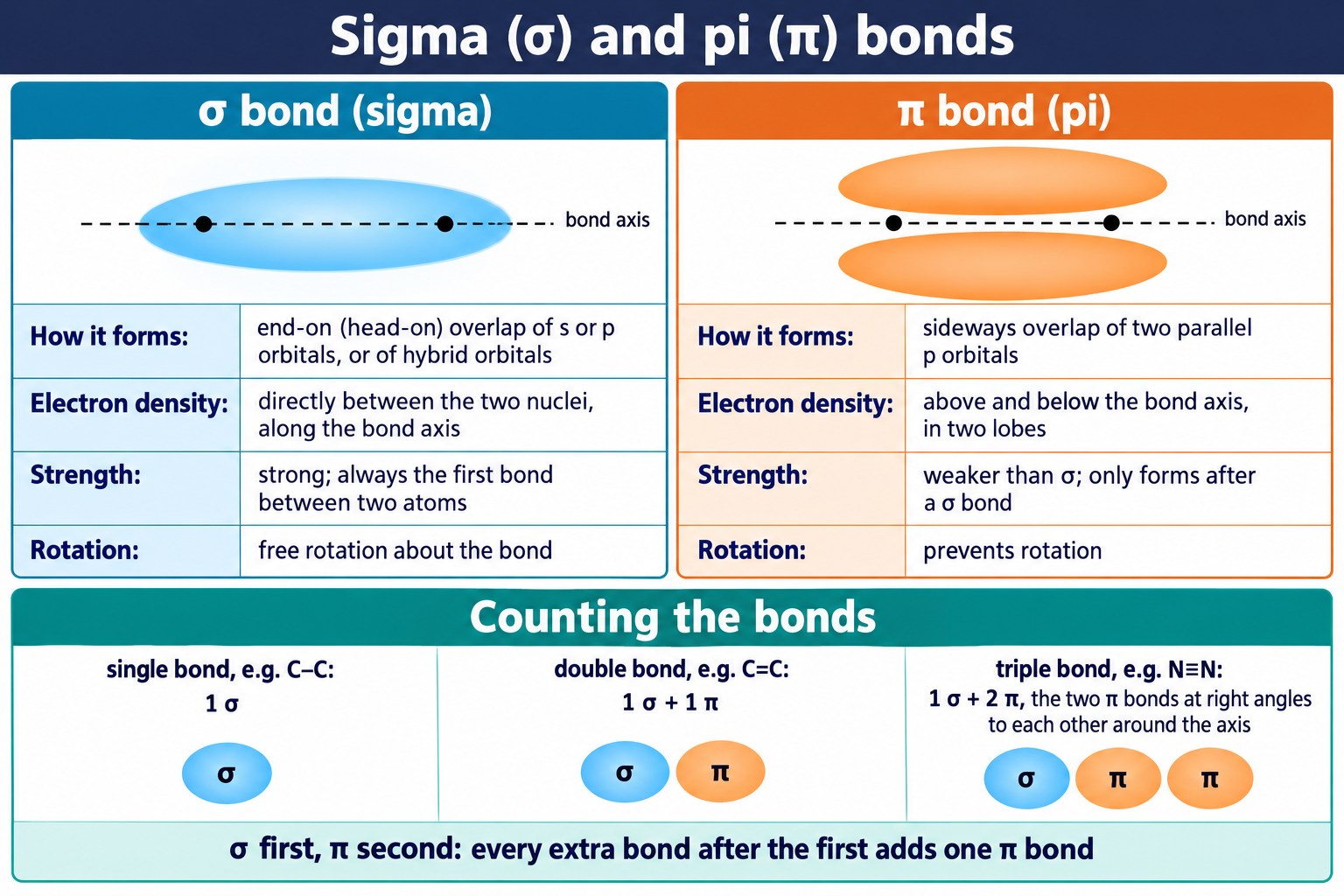
A σ bond puts electron density along the axis between the nuclei, a π bond puts it above and below the axis, and every multiple bond is one σ bond plus one or two π bonds.
Quick Check: Count the Sigma and Pi Bonds
Draw the molecule out, then count the two kinds of bond.
Hybridisation: sp, sp2 and sp3
Carbon is 1s2 2s2 2p2, which suggests only two bonds, yet it always forms four.
The explanation is hybridisation: the 2s orbital mixes with some or all of the 2p orbitals to give a set of identical hybrid orbitals, and any p orbitals left unmixed are used for π bonds.
| Hybridisation | Orbitals mixed | Hybrid orbitals | p orbitals left for π bonds | Shape and angle | Example |
|---|---|---|---|---|---|
| sp3 | 2s + three 2p | Four | None | Tetrahedral, 109.5° | Carbon in methane and every alkane carbon |
| sp2 | 2s + two 2p | Three | One | Trigonal planar, 120° | Each carbon in ethene; carbonyl carbon |
| sp | 2s + one 2p | Two | Two | Linear, 180° | Each carbon in ethyne; the carbon in HCN; each nitrogen in N2 |
The number of hybrid orbitals always equals the number of atomic orbitals mixed, and the hybrid orbitals make the σ bonds and hold lone pairs.
The Topic 13 pages on sp3 carbon in alkanes and sp carbon in alkynes and nitriles apply the same idea to organic molecules.
Hybridisation of Carbon: sp³, sp² and sp Orbitals
Choose a step to watch carbon’s 2s and 2p orbitals mix into sp³, sp² or sp hybrids, see the angle between them and which 2p orbitals are left for π bonds.
© Dr. Mohammed Al-Fatah – onlinelearningsystem.net
© Dr. Mohammed Al-Fatah – onlinelearningsystem.net
Key idea: Count the atoms and lone pairs around the atom: four means sp3, three means sp2, two means sp. The leftover p orbitals tell you how many π bonds the atom makes.
Quick Check: Two Kinds of Carbon in One Molecule
Drag the words and numbers into place to describe the bonding in propyne.
Quick Check: Explain the Two Forms of But-2-ene
Write a short explanation, then compare it with the mark points and the model answer.
The Bonding in Nitrogen, N2
Each nitrogen atom is 1s2 2s2 2p3. In N2 each atom is sp hybridised: the 2s orbital mixes with one 2p orbital to give two sp hybrids pointing in opposite directions, leaving two unhybridised p orbitals at right angles.
- One sp orbital on each nitrogen overlaps end-on with the sp orbital of the other nitrogen: this is the N-N σ bond.
- The other sp orbital on each nitrogen points away from the bond and holds the lone pair.
- The two unhybridised p orbitals on each nitrogen overlap sideways with their partners on the other atom to give two π bonds, one above and below the axis and one in front and behind.
The result is a triple bond, N≡N, made of one σ and two π bonds, with a lone pair on each nitrogen. The three bonds together are very strong, which is why nitrogen gas is so unreactive.
Exam sentence: In N2 each nitrogen is sp hybridised: the sp orbitals form one σ bond and hold the lone pairs, and the two remaining p orbitals on each atom overlap sideways to form two π bonds.
Quick Check: Name the Hybridisation
Count the bonded atoms and the lone pairs together for each atom.
The Bonding in Hydrogen Cyanide, HCN
HCN is linear, H-C≡N, and both the carbon and the nitrogen are sp hybridised. The three atoms are held by two σ bonds and two π bonds.
| Bond | Orbitals that overlap | Type |
|---|---|---|
| H-C | 1s orbital of hydrogen with an sp orbital of carbon (end-on) | σ |
| C-N (first bond) | sp orbital of carbon with an sp orbital of nitrogen (end-on) | σ |
| C-N (second and third bonds) | The two unhybridised p orbitals on carbon with the two on nitrogen (sideways) | Two π |
| Nitrogen lone pair | The second sp orbital of nitrogen, pointing away from carbon | Lone pair |
Carbon therefore makes four bonds (one σ to H, one σ and two π to N) and nitrogen makes three bonds plus a lone pair. Because both central atoms are sp hybridised the H-C-N bond angle is 180°.
Bonding in Hydrogen Cyanide, HCN: sp Hybrids, Sigma and Pi Bonds
Choose a step to watch HCN build up, from the sp hybrids on carbon and nitrogen, through end-on overlap, to its σ and π molecular orbitals and the lone pair.
© Dr. Mohammed Al-Fatah – onlinelearningsystem.net
Exam sentence: In HCN the H-C and C-N σ bonds form by end-on overlap with sp orbitals of carbon, and the two C-N π bonds form by sideways overlap of the unhybridised p orbitals on carbon and nitrogen.
Quick Check: Spot the Accurate Description
In each round, choose the one statement that describes the bonding correctly.
Common Exam Mistakes
- Saying a triple bond is three identical bonds. It is one σ bond and two π bonds, and the π bonds are weaker.
- Describing a π bond as forming “between the atoms”. The π electron density lies above and below the bond axis, not along it.
- Forgetting that hybrid orbitals hold lone pairs as well as forming σ bonds. The lone pair on nitrogen in N2 and HCN is in an sp orbital.
- Choosing the wrong hybridisation for an atom with a lone pair. Count lone pairs as well as bonded atoms: the oxygen in water has four electron pairs and is sp3.
- Claiming free rotation about a double bond. The π bond locks the geometry, which is why alkenes show geometric isomerism.
Exam sentence: σ first, π second: every bond starts with one σ bond, and each extra bond order adds one π bond from a leftover p orbital.
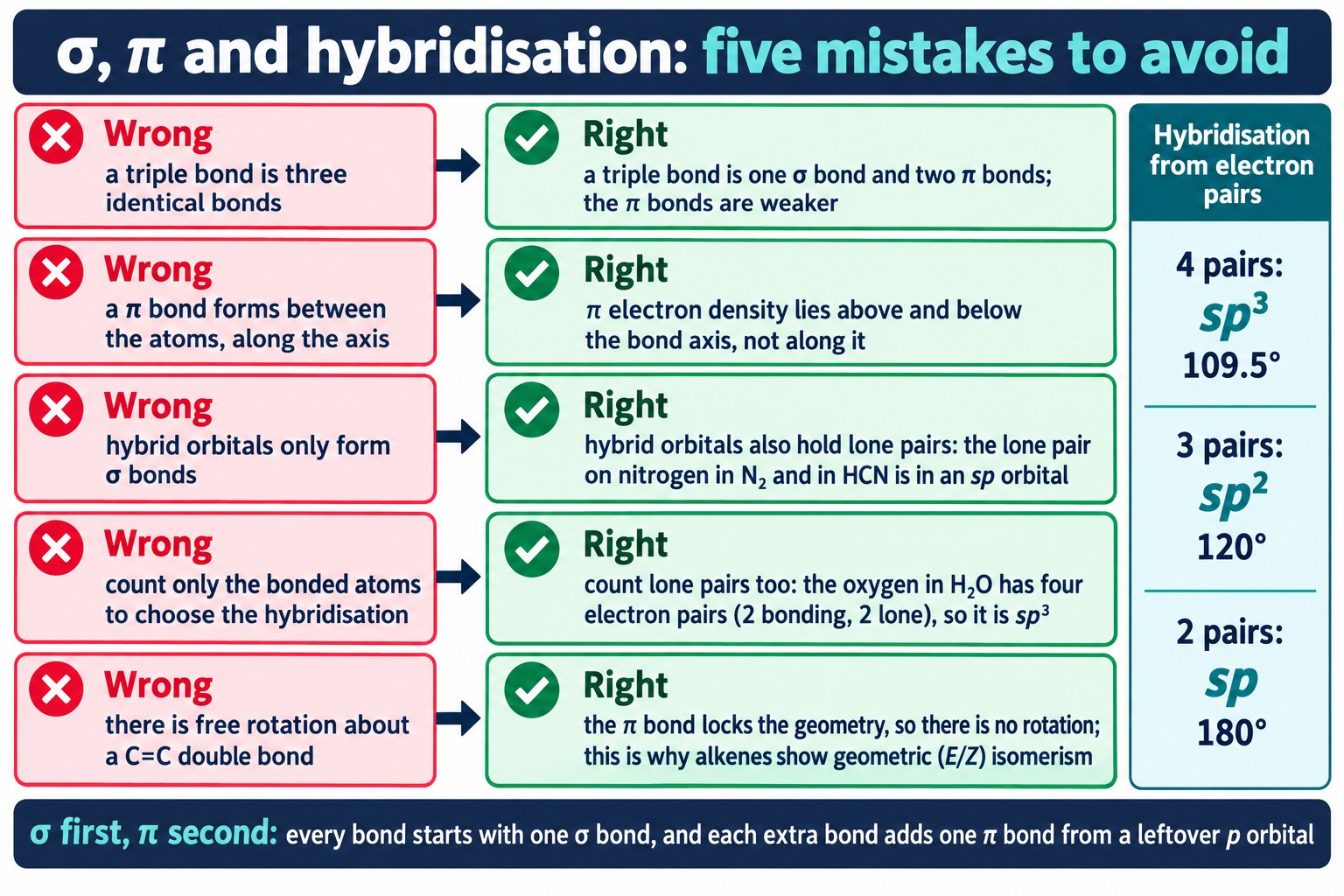
Five common slips about σ and π bonds and hybridisation, each set against the correct statement an examiner expects.
FAQs
These questions cover the counting and reasoning students most often get wrong on σ and π bonds and hybridisation.
Can a π bond form without a σ bond?
No. The σ bond forms first by end-on overlap and holds the two atoms at bonding distance. Only then can parallel p orbitals overlap sideways to give a π bond. Every double or triple bond contains exactly one σ bond.
How do I count the σ and π bonds in a molecule?
Count every single bond as one σ bond, every double bond as one σ and one π, and every triple bond as one σ and two π. HCN, H-C≡N, has two σ bonds and two π bonds.
How do I tell which hybridisation an atom has?
Count the atoms bonded to it and its lone pairs. Four regions means sp3, three means sp2 and two means sp. A double or triple bond counts as one region.
Why does a π bond stop rotation about a double bond?
The π bond needs the two p orbitals to stay parallel. Rotating one end would twist them apart and break the π bond, so rotation is restricted. A σ bond lies along the axis and is not affected by rotation.
Where is the lone pair on each nitrogen in N2?
Each nitrogen is sp hybridised. One sp orbital forms the σ bond; the other points away from the bond, along the axis, and holds the lone pair. The two unhybridised p orbitals form the two π bonds.

Copyright notice: This OLS revision content, including the explanations, layout, diagrams, tables and embedded learning structure, is authored for Online Learning System by Dr. Mohammed Al-Fatah. It may not be copied, reproduced, redistributed or adapted without written permission.
Keep this note — free
Save your progress across every Cambridge topic. A free account remembers which topics you have covered, saves your question scores, and syncs across your phone and laptop.
- Track every topic you have finished
- Keep your practice-question scores
- No payment, no card, free forever
Already registered? Log in